Vietnam Pneumatic Tools Market Size, Share & Growth Rate
The Vietnam Pneumatic Tools Market was estimated at USD 396 Million in 2025 and is projected to reach USD 561 Million by 2032, growing at a CAGR of 5.1% from 2026 to 2032. This growth trajectory is fueled primarily by the rapid expansion of the manufacturing and construction sectors within the country. As Vietnam attracts increased foreign investments and ramps up infrastructure development, the demand for robust and efficient pneumatic tools continues to rise, underscoring their significance in enhancing productivity across various applications.
Vietnam Pneumatic Tools Market Year-wise Growth Rate and Key Drivers
This graph highlights how the Vietnam Pneumatic Tools Market has steadily grown over the years, supported by major growth factors.
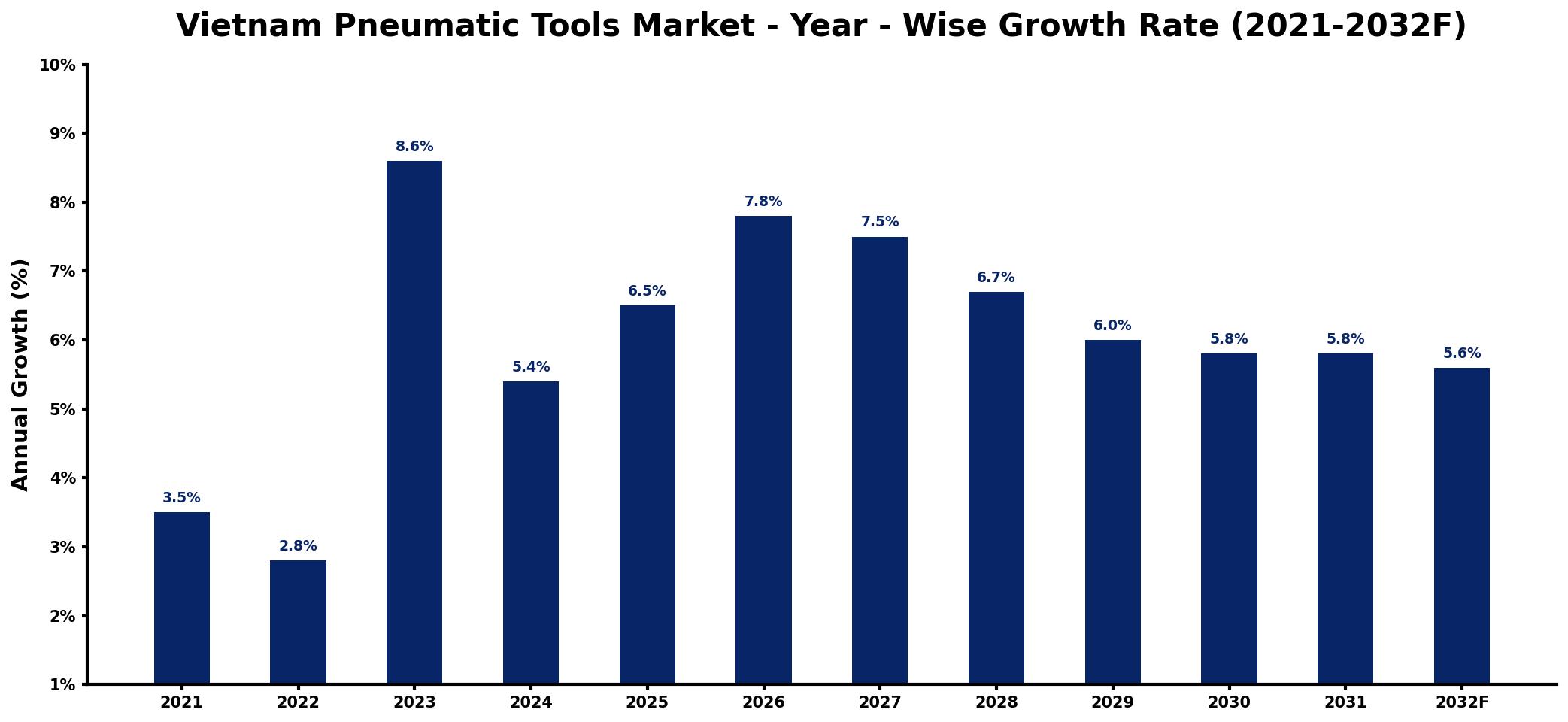
The table below presents the year‑wise growth rates along with the key drivers influencing the market
| Year | Growth Rate | Major Drivers |
| 2021 | 3.5% | Increase in construction activities |
| 2022 | 2.8% | Growth in manufacturing sector demand |
| 2023 | 8.6% | Rising automotive production levels |
| 2024 | 5.4% | Expansion of repair services market |
| 2025 | 6.5% | Investment in infrastructure projects |
| 2026 | 7.8% | Boost in energy sector investments |
| 2027 | 7.5% | Advancement in industrial automation |
| 2028 | 6.7% | growing downstream application demand |
| 2029 | 6.0% | Surge in maintenance service needs |
| 2030 | 5.8% | rising infrastructure development spending |
| 2031 | 5.8% | Rising adoption of safety regulations |
| 2032 | 5.6% | enhanced product quality standards |
Note: Market size estimations and growth projections presented in this report are based on 6Wresearch's proprietary forecasting methodology, utilizing the latest available industry data, government publications, and primary research inputs.
Vietnam Pneumatic Tools Market Synopsis
The Vietnam pneumatic tools market has experienced a surge in demand due to the ongoing industrial boom and government initiatives aimed at enhancing infrastructure. However, as the market matures, it is poised for more strategic growth, focusing on quality and innovation to meet international standards. The increasing complexity of manufacturing processes further solidifies the necessity of high-performance pneumatic tools.
As industries shift toward greater automation and precision, pneumatic tools have emerged as a vital component in achieving operational efficiency. The versatility of these tools makes them suitable for a variety of applications, from automotive assembly lines to intricate woodworking tasks, ensuring that the market remains resilient despite occasional external challenges.
Vietnam Pneumatic Tools Market Key Takeaways
- Strong growth projected at a CAGR of 5.1% from 2026 to 2032, indicating robust market potential.
- Pneumatic tools are increasingly preferred for their efficiency and durability in heavy-duty applications.
- Government support through infrastructure projects is significantly boosting market demand.
- Challenges related to quality control and counterfeit products continue to hinder market growth.
- The demand for skilled technicians to maintain and repair pneumatic tools is on the rise.
Evaluation of Restraints in Vietnam Pneumatic Tools Market
While the Vietnam pneumatic tools market is on a growth trajectory, it faces significant restraints that could hinder its potential. Chief among these are concerns regarding quality control and safety, as adherence to international safety standards is paramount. The prevalence of counterfeit and substandard tools poses a risk not only to user safety but also to the reputation of legitimate manufacturers. Moreover, the distribution networks and after-sales service systems must evolve to adequately support the tools in the field, necessitating investments in technician training and customer support to ensure sustained growth in this competitive market.
Vietnam Pneumatic Tools Market Trends
Key trends in the Vietnam pneumatic tools market include an increasing emphasis on automation and smart technologies. Manufacturers are incorporating advanced features into their tools to enhance efficiency and user experience. Additionally, there is a growing focus on eco-friendly and energy-efficient tools, which aligns with global sustainability initiatives. The push for precision and speed in manufacturing processes is also driving the innovation of pneumatic tools, making them essential for modern industrial applications.
Vietnam Pneumatic Tools Market Opportunities
The Vietnamese market presents numerous growth opportunities for pneumatic tool manufacturers and investors. As the country positions itself as a manufacturing hub in Southeast Asia, the increasing influx of foreign capital creates a fertile environment for pneumatic tool adoption. Furthermore, sectors such as automotive and construction are set to expand significantly, providing a substantial customer base. Investing in advanced training programs and distribution networks can also yield long-term benefits, enhancing the overall market landscape.
Government Initiatives in the Vietnam Pneumatic Tools Market
The Vietnamese government has been proactive in fostering an environment conducive to industrial growth, which directly influences the pneumatic tools market. Initiatives aimed at improving infrastructure and attracting foreign direct investment are pivotal. Public spending on construction and manufacturing projects not only bolsters demand for pneumatic tools but also encourages local manufacturers to meet international quality standards. Such governmental support is crucial for sustaining momentum in the market.
Future Insights of the Vietnam Pneumatic Tools Market
Looking ahead to 2026-2032, the Vietnam pneumatic tools market is expected to experience continued expansion, driven by ongoing industrialization and technological advancements. Manufacturers will need to focus on innovation and quality to differentiate themselves in a crowded market. As industries increasingly embrace automation, the demand for high-performance pneumatic tools will rise. Furthermore, a greater emphasis on safety and training will shape the way businesses approach tool procurement and maintenance, ensuring a more sustainable market dynamic in the future.
Vietnam Pneumatic Tools Market Latest Developments (2025 - 2026)
Recent developments in the Vietnam pneumatic tools market indicate a strategic pivot towards automation and smart technologies. Manufacturers are exploring innovative designs and functionalities to enhance user experience and efficiency. Furthermore, the impact of government policies on infrastructure development continues to drive market demand, highlighting the need for manufacturers to adapt quickly to these evolving trends. Collaborations and partnerships within the industry are becoming more common as companies seek to leverage each other's strengths for competitive advantage.
Vietnam Pneumatic Tools Market - Key Attractiveness of the Report
- 10 Years of Market Numbers
- Historical Data Starting from 2022 to 2025
- Base Year: 2025
- Forecast Data until 2032
- Key Performance Indicators Impacting the Market
- Major Upcoming Developments and Projects
Key Highlights of the Report:
- Vietnam Pneumatic Tools Market Outlook
- Market Size of Vietnam Pneumatic Tools Market, 2025
- Forecast of Vietnam Pneumatic Tools Market, 2032
- Historical Data and Forecast of Vietnam Pneumatic Tools Revenues & Volume for the Period 2022-2032F
- Vietnam Pneumatic Tools Market Trend Evolution
- Vietnam Pneumatic Tools Market Drivers and Challenges
- Vietnam Pneumatic Tools Price Trends
- Vietnam Pneumatic Tools Porter's Five Forces
- Vietnam Pneumatic Tools Industry Life Cycle
- Historical Data and Forecast of Vietnam Pneumatic Tools Market Revenues & Volume By Types for the Period 2022-2032F
- Historical Data and Forecast of Vietnam Pneumatic Tools Market Revenues & Volume By Pneumatic Wrenches for the Period 2022-2032F
- Historical Data and Forecast of Vietnam Pneumatic Tools Market Revenues & Volume By Pneumatic Sanders for the Period 2022-2032F
- Historical Data and Forecast of Vietnam Pneumatic Tools Market Revenues & Volume By Pneumatic Hammers for the Period 2022-2032F
- Historical Data and Forecast of Vietnam Pneumatic Tools Market Revenues & Volume By Pneumatic Drills for the Period 2022-2032F
- Historical Data and Forecast of Vietnam Pneumatic Tools Market Revenues & Volume By Pneumatic Polishers for the Period 2022-2032F
- Historical Data and Forecast of Vietnam Pneumatic Tools Market Revenues & Volume By Pneumatic Grinders for the Period 2022-2032F
- Historical Data and Forecast of Vietnam Pneumatic Tools Market Revenues & Volume By Other Pneumatic Tools for the Period 2022-2032F
- Historical Data and Forecast of Vietnam Pneumatic Tools Market Revenues & Volume By Application for the Period 2022-2032F
- Historical Data and Forecast of Vietnam Pneumatic Tools Market Revenues & Volume By Industrial for the Period 2022-2032F
- Historical Data and Forecast of Vietnam Pneumatic Tools Market Revenues & Volume By Residential or Household for the Period 2022-2032F
- Historical Data and Forecast of Vietnam Pneumatic Tools Market Revenues & Volume By Others for the Period 2022-2032F
- Historical Data and Forecast of Vietnam Pneumatic Tools Market Revenues & Volume By End-use for the Period 2022-2032F
- Historical Data and Forecast of Vietnam Pneumatic Tools Market Revenues & Volume By Automobile for the Period 2022-2032F
- Historical Data and Forecast of Vietnam Pneumatic Tools Market Revenues & Volume By Textile for the Period 2022-2032F
- Historical Data and Forecast of Vietnam Pneumatic Tools Market Revenues & Volume By Defense for the Period 2022-2032F
- Historical Data and Forecast of Vietnam Pneumatic Tools Market Revenues & Volume By Mining for the Period 2022-2032F
- Historical Data and Forecast of Vietnam Pneumatic Tools Market Revenues & Volume By Chemicals for the Period 2022-2032F
- Historical Data and Forecast of Vietnam Pneumatic Tools Market Revenues & Volume By Manufacturing for the Period 2022-2032F
- Historical Data and Forecast of Vietnam Pneumatic Tools Market Revenues & Volume By Mining for the Period 2022-2032F
- Vietnam Pneumatic Tools Import Export Trade Statistics
- Market Opportunity Assessment By Types
- Market Opportunity Assessment By Application
- Market Opportunity Assessment By End-use
- Vietnam Pneumatic Tools Top Companies Market Share
- Vietnam Pneumatic Tools Competitive Benchmarking By Technical and Operational Parameters
- Vietnam Pneumatic Tools Company Profiles
- Vietnam Pneumatic Tools Key Strategic Recommendations






































