Vietnam Polyester Spun Yarn Market Size, Share & Growth Rate
The Vietnam Polyester Spun Yarn Market was estimated at USD 259 Million in 2025 and is projected to reach USD 366 Million by 2032, growing at a CAGR of 5.1% from 2026 to 2032. This growth trajectory is driven by the increasing demand for high-quality, cost-effective synthetic yarns, particularly from the textile and apparel sectors. As manufacturers seek to enhance their product offerings, the versatility of polyester spun yarn continues to play a vital role in meeting evolving consumer preferences.
Vietnam Polyester Spun Yarn Market Year-wise Growth Rate and Key Drivers
This graph highlights how the Vietnam Polyester Spun Yarn Market has steadily grown over the years, supported by major growth factors.
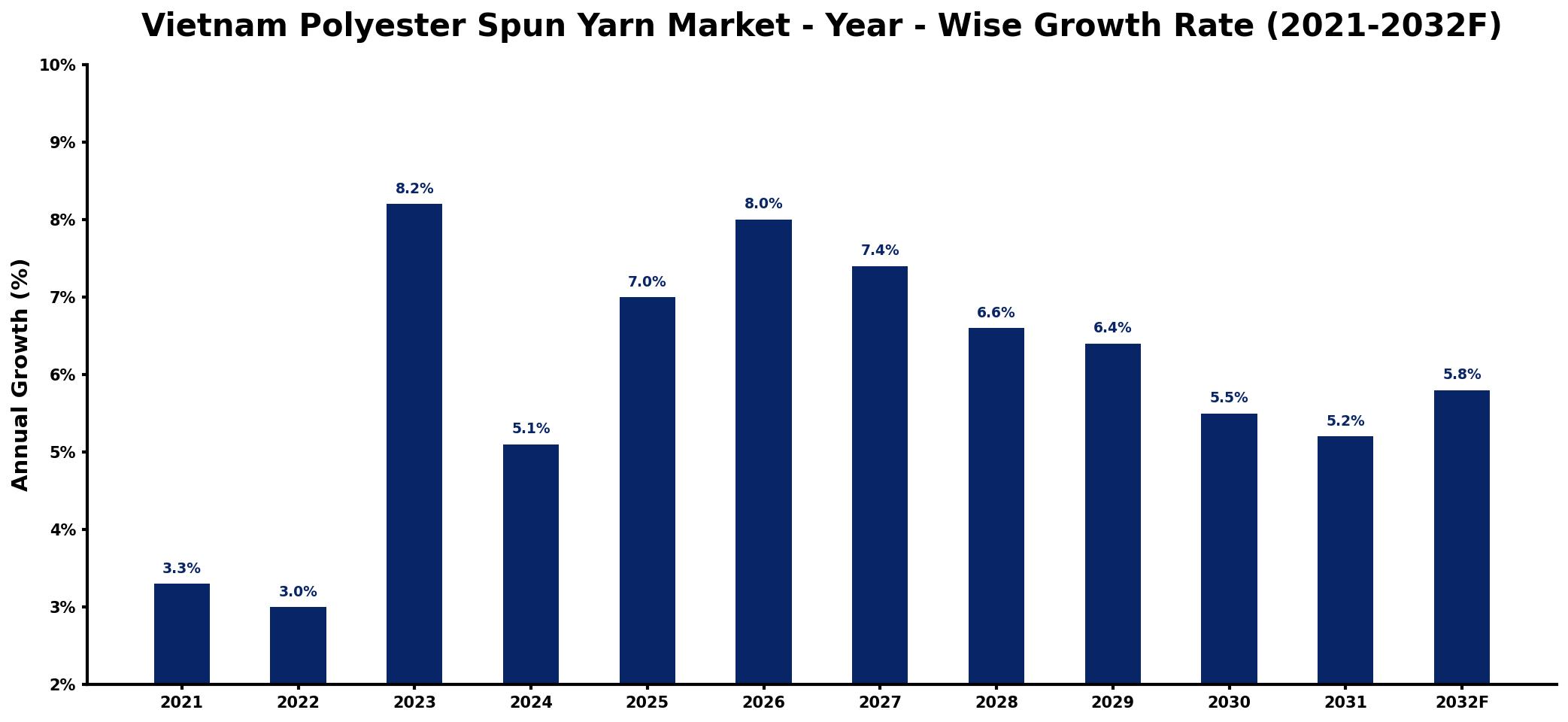
The table below presents the year‑wise growth rates along with the key drivers influencing the market
| Year | Growth Rate | Major Drivers |
| 2021 | 3.3% | Rising textile manufacturing activities |
| 2022 | 3.0% | Increased exports to global markets |
| 2023 | 8.2% | Growing demand for sustainable fabrics |
| 2024 | 5.1% | Expansion of local production facilities |
| 2025 | 7.0% | Surge in fashion industry requirements |
| 2026 | 8.0% | Technological advancements in production |
| 2027 | 7.4% | Growing consumer preference for affordability |
| 2028 | 6.6% | Increase in online retail sales |
| 2029 | 6.4% | Rising investments in textile innovation |
| 2030 | 5.5% | expanding industrial usage applications |
| 2031 | 5.2% | Growth in eco-friendly product lines |
| 2032 | 5.8% | Increasing collaboration with international brands |
Note: Market size estimations and growth projections presented in this report are based on 6Wresearch's proprietary forecasting methodology, utilizing the latest available industry data, government publications, and primary research inputs.
Vietnam Polyester Spun Yarn Market Synopsis
The Vietnam polyester spun yarn market has shown remarkable resilience, particularly as it navigates the post-pandemic recovery phase. With a burgeoning textile industry, the market is set to embrace a future characterized by greater innovation and sustainability in yarn production.
While recent disruptions have posed challenges, the outlook remains optimistic. Manufacturers are increasingly optimizing production processes and exploring new applications to adapt to changing market dynamics, ensuring the continued relevance of polyester spun yarn in diverse fabrications.
Vietnam Polyester Spun Yarn Market Key Takeaways
- The polyester spun yarn market is underpinned by strong demand from the textile and apparel sectors.
- Innovation in synthetic fabrics is driving product development and market growth.
- Competitive pricing and durability of polyester spun yarn are key consumer draws.
- Manufacturers are adjusting to post-pandemic market realities through technological advancements.
- Shifting consumer preferences towards synthetic materials are solidifying the market's relevance.
Evaluation of Restraints in Vietnam Polyester Spun Yarn Market
Several restraints impact the Vietnam polyester spun yarn market, primarily stemming from the rapid pace of technological advancements and the associated capital requirements for upgrading production facilities. Additionally, the competitive landscape is intensifying, as both domestic and international suppliers vie for market share. These dynamics compel manufacturers to invest in R&D and innovations to stay ahead, potentially straining resources, particularly for smaller players. Environmental regulations are also tightening, necessitating greater compliance and responsible practices in production.
Vietnam Polyester Spun Yarn Market Trends
Key trends shaping the Vietnam polyester spun yarn market include a growing emphasis on sustainability and the development of eco-friendly yarns. As consumers increasingly demand environmentally responsible products, manufacturers are exploring biodegradable options and sustainable production practices. Furthermore, technological advancements in yarn manufacturing techniques are leading to enhancements in quality and performance, thereby attracting a wider customer base. Additionally, the rise of e-commerce is reshaping distribution channels, allowing for greater reach and market penetration.
Vietnam Polyester Spun Yarn Market Opportunities
The Vietnam polyester spun yarn market presents significant growth opportunities, particularly through investments in sustainable manufacturing technologies. As global trends pivot towards eco-conscious consumerism, companies that innovate in sustainable yarn production are likely to gain a competitive edge. Moreover, increasing international demand for Vietnamese textiles opens doors for export expansion. Collaborations with tech firms to enhance production efficiency and quality can also unlock additional value within the market.
Government Initiatives in the Vietnam Polyester Spun Yarn Market
The Vietnamese government is increasingly focused on bolstering the textile and garment industries through various initiatives. Policies aimed at promoting sustainable practices and technological innovation are being prioritized, as the government recognizes the importance of these sectors in driving economic growth. Financial incentives and support for research and development projects are being implemented, allowing manufacturers to enhance their capabilities and competitiveness on a global scale.
Future Insights of the Vietnam Polyester Spun Yarn Market
Looking ahead to 2026-2032, the Vietnam polyester spun yarn market is poised for continued expansion. As consumer preferences evolve, the demand for high-quality synthetic materials will persist, pushing manufacturers to innovate and diversify their product lines. The growing emphasis on sustainability and eco-friendly practices will likely shape the strategic direction of the industry. Additionally, as global economic conditions stabilize, enhanced international trade partnerships could further amplify growth opportunities for Vietnamese manufacturers.
Vietnam Polyester Spun Yarn Market Latest Developments (2025 - 2026)
Recent developments in the Vietnam polyester spun yarn market indicate a strong shift towards sustainable production methods, with several manufacturers adopting greener technologies. Innovations in production processes are being explored to enhance quality and reduce waste. Additionally, collaborations with international partners are emerging, facilitating knowledge exchange and technological advancements, which are essential for remaining competitive in the evolving landscape of global textile production.
Vietnam Polyester Spun Yarn Market - Key Attractiveness of the Report
- 10 Years of Market Numbers
- Historical Data Starting from 2022 to 2025
- Base Year: 2025
- Forecast Data until 2032
- Key Performance Indicators Impacting the Market
- Major Upcoming Developments and Projects
Key Highlights of the Report:
- Vietnam Polyester Spun Yarn Market Outlook
- Market Size of Vietnam Polyester Spun Yarn Market, 2025
- Forecast of Vietnam Polyester Spun Yarn Market, 2032
- Historical Data and Forecast of Vietnam Polyester Spun Yarn Revenues & Volume for the Period 2022-2032F
- Vietnam Polyester Spun Yarn Market Trend Evolution
- Vietnam Polyester Spun Yarn Market Drivers and Challenges
- Vietnam Polyester Spun Yarn Price Trends
- Vietnam Polyester Spun Yarn Porter's Five Forces
- Vietnam Polyester Spun Yarn Industry Life Cycle
- Historical Data and Forecast of Vietnam Polyester Spun Yarn Market Revenues & Volume By Types for the Period 2022-2032F
- Historical Data and Forecast of Vietnam Polyester Spun Yarn Market Revenues & Volume By Recycled Spun Yarn for the Period 2022-2032F
- Historical Data and Forecast of Vietnam Polyester Spun Yarn Market Revenues & Volume By Non-recycled Spun Yarn for the Period 2022-2032F
- Historical Data and Forecast of Vietnam Polyester Spun Yarn Market Revenues & Volume By Fields for the Period 2022-2032F
- Historical Data and Forecast of Vietnam Polyester Spun Yarn Market Revenues & Volume By Apparel for the Period 2022-2032F
- Historical Data and Forecast of Vietnam Polyester Spun Yarn Market Revenues & Volume By Household Textiles for the Period 2022-2032F
- Historical Data and Forecast of Vietnam Polyester Spun Yarn Market Revenues & Volume By Others for the Period 2022-2032F
- Vietnam Polyester Spun Yarn Import Export Trade Statistics
- Market Opportunity Assessment By Types
- Market Opportunity Assessment By Fields
- Vietnam Polyester Spun Yarn Top Companies Market Share
- Vietnam Polyester Spun Yarn Competitive Benchmarking By Technical and Operational Parameters
- Vietnam Polyester Spun Yarn Company Profiles
- Vietnam Polyester Spun Yarn Key Strategic Recommendations






































