Vietnam Polyethylene (PE) Pipes and Tubes Market Summary
The vietnam polyethylene (pe) pipes and tubes market was estimated at USD 379 Million in 2025 and is projected to reach USD 537 Million by 2032, growing at a CAGR of 8.0% from 2026 to 2032.
Vietnam Polyethylene (PE) Pipes and Tubes Market Year-wise Growth Rate and Key Drivers
This graph highlights how the Vietnam Polyethylene (PE) Pipes and Tubes Market has steadily grown over the past five years, supported by major growth factors.
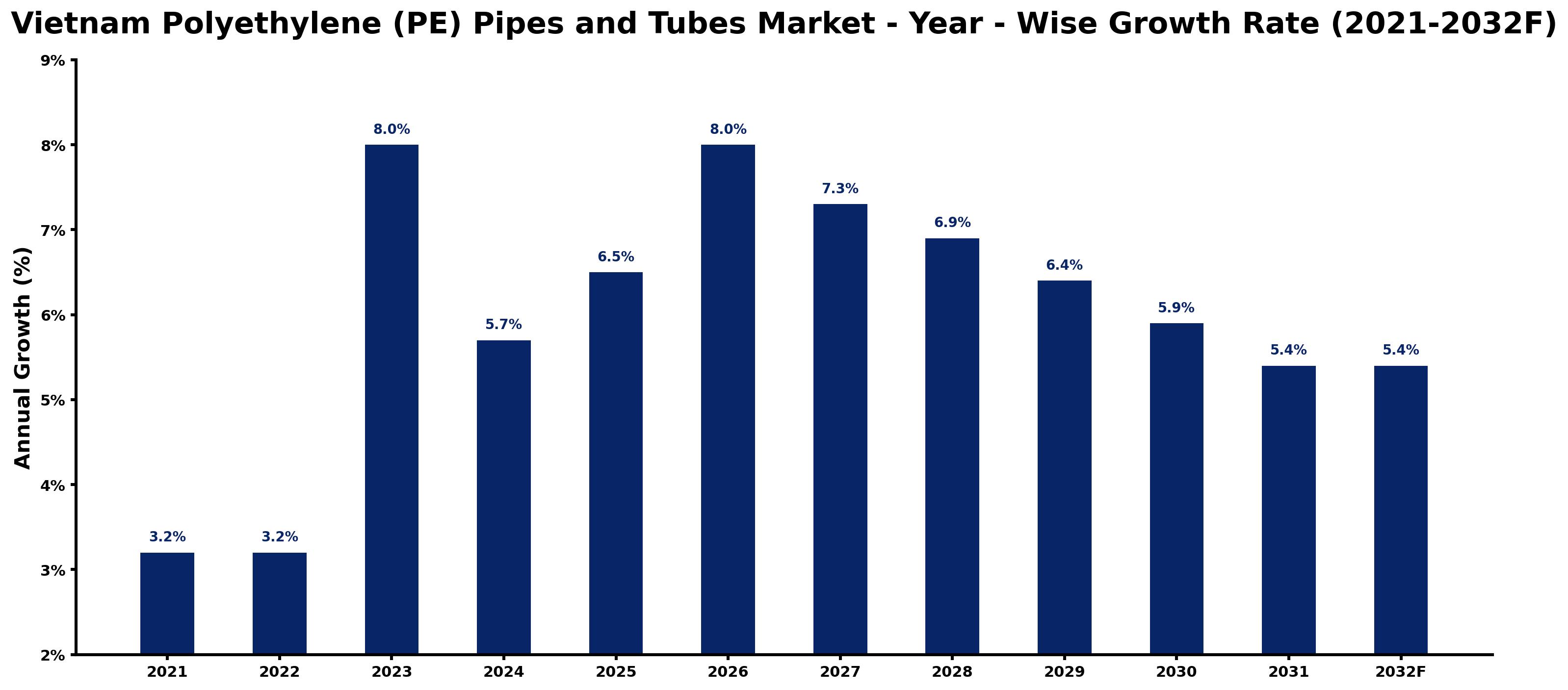
The table below presents the year wise growth rates along with the key drivers influencing the market
| Year | Growth Rate | Major Drivers |
| 2021 | 3.2% | Vietnam's construction sector sees an uptick, increasing demand for durable piping solutions. |
| 2022 | 3.2% | Emerging urban infrastructure projects highlight the need for reliable PE pipe applications. |
| 2023 | 8.0% | Manufacturers invest heavily in local production to reduce dependency on imports. |
| 2024 | 5.7% | Rural development initiatives prioritize water supply improvements using polyethylene piping. |
| 2025 | 6.5% | Public-private partnerships aim to modernize irrigation systems and enhance agricultural productivity. |
| 2026 | 8.0% | Rising environmental awareness fosters interest in recyclable and sustainable piping materials. |
| 2027 | 7.3% | Growing urbanization trends put pressure on existing water distribution networks demanding upgrades. |
| 2028 | 6.9% | Technological innovations in manufacturing streamline production processes for polyethylene pipes. |
| 2029 | 6.4% | Increased foreign investments strengthen the competitive landscape of Vietnam's piping market. |
| 2030 | 5.9% | Local governments seek efficient solutions for wastewater management, boosting PE pipe usage. |
| 2031 | 5.4% | Infrastructure projects align with global sustainability goals, enhancing PE pipes' market viability. |
| 2032 | 5.4% | Economic recovery post-pandemic emphasizes infrastructure resilience, further driving PE pipe demand. |
Note - Market size estimations and growth projections presented in this report are based on 6Wresearch's advanced forecasting approach, validated with industry datasets as of June 2026.
Vietnam Polyethylene (PE) Pipes and Tubes Market Synopsis
The Vietnam Polyethylene (PE) Pipes and Tubes Market is projected to reach 8.0% and witness significant growth during the forecast period (2026-2032). This growth trajectory is primarily driven by the nation's economic expansion, rapid urbanization, and the surge in infrastructure investments. PE pipes and tubes are increasingly favored for applications like water supply, irrigation, and industrial transportation due to their lightweight nature, resistance to corrosion, and economic efficiency. The demand spans across both residential and commercial sectors, contributing to the market's robust development in the upcoming years.
Vietnam Polyethylene (PE) Pipes and Tubes Market Growth Drivers
Several important factors are stimulating the growth of the Vietnam Polyethylene (PE) Pipes and Tubes Market. Firstly, government initiatives aimed at improving national infrastructure are significantly boosting demand for PE products. Large-scale projects in water management, irrigation systems, and wastewater treatment are attracting considerable investment in PE pipes and tubes. Secondly, the accelerating urbanization and population growth in Vietnam are creating a heightened demand for efficient water supply and sewage systems. PE pipes and tubes serve as a reliable and durable solution for these needs, driving market expansion. Furthermore, the cost advantages of polyethylene over traditional materials such as metal and concrete have made them attractive to a wide range of end-users. Lastly, the simplicity in installation and maintenance associated with PE pipes has led to their widespread acceptance in various applications.
Vietnam Polyethylene (PE) Pipes and Tubes Market Challenges and Restraints
Despite the promising growth, the Vietnam Polyethylene (PE) Pipes and Tubes Market faces several challenges. One of the main concerns is the prevalence of counterfeit or substandard products, which can jeopardize the integrity of infrastructure projects and damage the reputations of legitimate manufacturers. Additionally, fluctuations in raw material prices pose a significant hurdle. Given that polyethylene is derived from petroleum, any volatility in crude oil prices can adversely affect production costs. Consequently, manufacturers are compelled to develop strategies to manage these price fluctuations without compromising product quality. Moreover, competition from alternative materials and the need for market education regarding the benefits of PE piping systems also represent ongoing challenges.
Vietnam Polyethylene (PE) Pipes and Tubes Market Government Investment and Initiatives
The Vietnamese government is actively engaging in various initiatives aimed at enhancing the infrastructure landscape, which directly benefits the Polyethylene (PE) Pipes and Tubes Market. Public spending on development plans that prioritize water management, sanitation, and irrigation is critical to the growth of this sector. Investments are being funneled into large-scale infrastructure projects that employ PE piping systems for their durability and efficiency. Additionally, government incentives aimed at promoting sustainable materials and technology adoption in construction further bolster market demand. These initiatives underline the national commitment to improving living standards and environmental management, thereby creating favorable conditions for the PE pipes and tubes market.
Vietnam Polyethylene (PE) Pipes and Tubes Market Latest Developments (May 2025 - June 2026)
From May 2025 to June 2026, the Vietnam Polyethylene (PE) Pipes and Tubes Market witnessed notable developments shaped by both economic conditions and regulatory policies. Throughout this period, there has been a noticeable increase in infrastructure projects, driven by government mandates to modernize water supply and sanitation systems in urban areas. Furthermore, the emphasis on sustainable practices within the construction sector has resulted in heightened interest in PE piping solutions. The COVID-19 pandemic also played a role in accelerating the transition to digital platforms for distribution, thereby enhancing access to PE pipes and tubes across various regions. These developments point to a resilient market adapting to ongoing challenges and opportunities within the industry landscape.
Vietnam Polyethylene (PE) Pipes and Tubes Market - Key Attractiveness of the Report
- 10 Years of Market Numbers
- Historical Data Starting from 2022 to 2025
- Base Year: 2025
- Forecast Data until 2032
- Key Performance Indicators Impacting the Market
- Major Upcoming Developments and Projects
Key Highlights of the Report:
- Vietnam Polyethylene (PE) Pipes and Tubes Market Outlook
- Market Size of Vietnam Polyethylene (PE) Pipes and Tubes Market, 2025
- Forecast of Vietnam Polyethylene (PE) Pipes and Tubes Market, 2032
- Historical Data and Forecast of Vietnam Polyethylene (PE) Pipes and Tubes Revenues & Volume for the Period 2022-2032F
- Vietnam Polyethylene (PE) Pipes and Tubes Market Trend Evolution
- Vietnam Polyethylene (PE) Pipes and Tubes Market Drivers and Challenges
- Vietnam Polyethylene (PE) Pipes and Tubes Price Trends
- Vietnam Polyethylene (PE) Pipes and Tubes Porter's Five Forces
- Vietnam Polyethylene (PE) Pipes and Tubes Industry Life Cycle
- Historical Data and Forecast of Vietnam Polyethylene (PE) Pipes and Tubes Market Revenues & Volume By Type for the Period 2022-2032F
- Historical Data and Forecast of Vietnam Polyethylene (PE) Pipes and Tubes Market Revenues & Volume By High Density Polythene (HDPE) for the Period 2022-2032F
- Historical Data and Forecast of Vietnam Polyethylene (PE) Pipes and Tubes Market Revenues & Volume By Low Density Polythene (LDPE) for the Period 2022-2032F
- Historical Data and Forecast of Vietnam Polyethylene (PE) Pipes and Tubes Market Revenues & Volume By Linear Low Density Polythene (LLDPE) for the Period 2022-2032F
- Historical Data and Forecast of Vietnam Polyethylene (PE) Pipes and Tubes Market Revenues & Volume By Cross Link Polythene (PEX/XLPE) for the Period 2022-2032F
- Historical Data and Forecast of Vietnam Polyethylene (PE) Pipes and Tubes Market Revenues & Volume By Application for the Period 2022-2032F
- Historical Data and Forecast of Vietnam Polyethylene (PE) Pipes and Tubes Market Revenues & Volume By Industrial for the Period 2022-2032F
- Historical Data and Forecast of Vietnam Polyethylene (PE) Pipes and Tubes Market Revenues & Volume By Agriculture for the Period 2022-2032F
- Historical Data and Forecast of Vietnam Polyethylene (PE) Pipes and Tubes Market Revenues & Volume By Underwater And Municipal for the Period 2022-2032F
- Historical Data and Forecast of Vietnam Polyethylene (PE) Pipes and Tubes Market Revenues & Volume By Construction for the Period 2022-2032F
- Historical Data and Forecast of Vietnam Polyethylene (PE) Pipes and Tubes Market Revenues & Volume By Gas Extraction for the Period 2022-2032F
- Historical Data and Forecast of Vietnam Polyethylene (PE) Pipes and Tubes Market Revenues & Volume By Others for the Period 2022-2032F
- Vietnam Polyethylene (PE) Pipes and Tubes Import Export Trade Statistics
- Market Opportunity Assessment By Type
- Market Opportunity Assessment By Application
- Vietnam Polyethylene (PE) Pipes and Tubes Top Companies Market Share
- Vietnam Polyethylene (PE) Pipes and Tubes Competitive Benchmarking By Technical and Operational Parameters
- Vietnam Polyethylene (PE) Pipes and Tubes Company Profiles
- Vietnam Polyethylene (PE) Pipes and Tubes Key Strategic Recommendations






































