Vietnam Potassium chlorate Market Size, Share & Growth Rate
The Vietnam Potassium chlorate Market was estimated at USD 444 Million in 2025 and is projected to reach USD 628 Million by 2032, growing at a CAGR of 5.1% from 2026 to 2032. This growth trajectory is underpinned by robust demand from the fireworks and explosives industries, which leverage potassium chlorate as a fundamental ingredient. Furthermore, the ongoing modernization of Vietnam's agricultural practices, coupled with rising consumption in pyrotechnics, is driving the expansion of the market.
Vietnam Potassium chlorate Market Year-wise Growth Rate and Key Drivers
This graph highlights how the Vietnam Potassium chlorate Market has steadily grown over the years, supported by major growth factors.
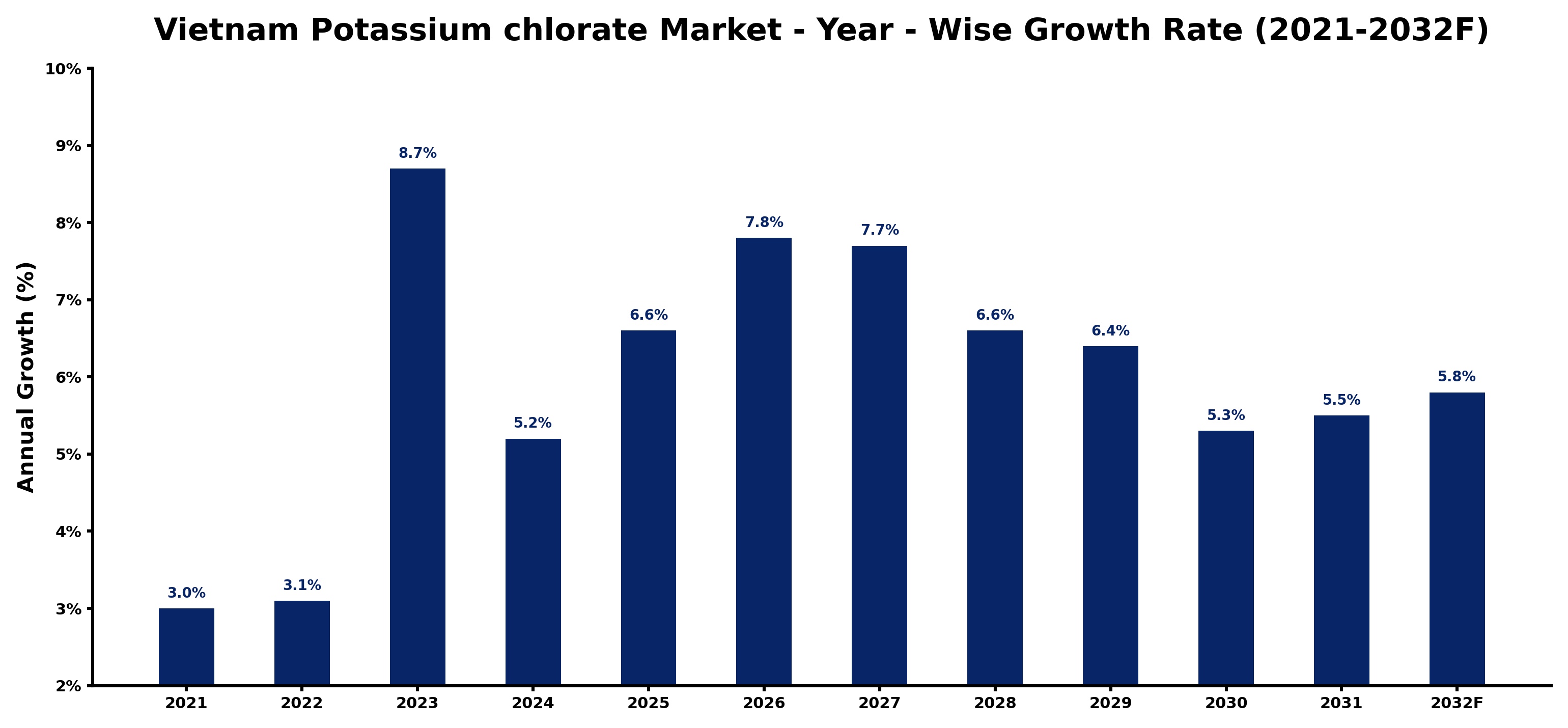
The table below presents the year‑wise growth rates along with the key drivers influencing the market
| Year | Growth Rate | Major Drivers |
| 2021 | 3.0% | Automotive assembly growth boosts potassium chlorate production capacity utilization |
| 2022 | 3.1% | Foreign investments boost potassium chlorate production capacity and export potential |
| 2023 | 8.7% | Foreign investments boosted local production capacity for potassium chlorate |
| 2024 | 5.2% | Foreign direct investments boost potassium chlorate production capacity upgrades |
| 2025 | 6.6% | Technology integration in manufacturing enhanced potassium chlorate production efficiency |
| 2026 | 7.8% | Foreign investments boost domestic capacity for potassium chlorate production |
| 2027 | 7.7% | Export driven automotive assembly expansion boosts potassium chlorate demand |
| 2028 | 6.6% | Optimized manufacturing processes boosted potassium chlorate export competitiveness |
| 2029 | 6.4% | Foreign investments boost domestic production capabilities for potassium chlorate |
| 2030 | 5.3% | New automotive assembly plants drive potassium chlorate production increases |
| 2031 | 5.5% | Foreign direct investments bolster local potassium chlorate production capacity |
| 2032 | 5.8% | Foreign investments in tech upgrades enhance potassium chlorate production capacity |
Note - Market size estimations and growth projections presented in this report are based on 6Wresearch's advanced forecasting approach, validated with industry datasets as of June 2026.
Vietnam Potassium chlorate Market Synopsis
The fireworks and explosives manufacturing industry emerges as the most potent force shaping the Vietnam Potassium chlorate market. The cultural significance of fireworks during celebrations propels consistent demand, providing a stable foundation for market growth. In addition to this, agricultural applications—particularly in weed control and plant desiccation—further enhance the market's relevance within Vietnam's evolving agricultural landscape.
As the market adapts to regulatory changes and safety compliance, innovation in product offerings is becoming increasingly vital. Companies are exploring sustainable practices and alternative production methods to meet the environmental expectations of both regulators and consumers. This shift not only aligns with global sustainability trends but also positions market players advantageously in a competitive environment.
Vietnam Potassium chlorate Market Key Takeaways
- The market is characterized by significant growth driven by the fireworks and agricultural sectors.
- Regulatory compliance and safety measures are crucial to maintaining market stability.
- Innovation and sustainability are becoming key differentiators for industry players.
- Post-pandemic recovery is creating opportunities for market expansion and alignment with safety standards.
- Market demand is sensitive to fluctuations in industrial production and regulatory changes.
Evaluation of Restraints in Vietnam Potassium chlorate Market
Despite the promising growth prospects, the Vietnam Potassium chlorate market faces several restraints. Safety concerns and stringent regulatory frameworks pose significant hurdles for manufacturers. The potential for misuse of potassium chlorate in unregulated applications creates a cautious approach among regulatory bodies, leading to strict oversight. Moreover, fluctuations in demand, driven by changes in industrial production cycles and shifts in consumer preferences, add layers of complexity to long-term business planning for market stakeholders.
Vietnam Potassium chlorate Market Trends
Current trends in the Vietnam Potassium chlorate market indicate a robust push towards sustainable and innovative production methods. Companies are increasingly investing in R&D to develop safer and more eco-friendly formulations that adhere to new environmental regulations. Moreover, the integration of technology in production processes is streamlining operations and enhancing product quality, thereby meeting the growing demand for high-performance chemical products.
Vietnam Potassium chlorate Market Opportunities
Significant growth and investment opportunities lie within the agricultural segment, particularly as Vietnam's farming practices modernize. Enhancements in agricultural productivity create a burgeoning market for potassium chlorate applications in crop management. Additionally, as consumer preferences shift towards more environmentally responsible products, companies that prioritize sustainability stand to gain a competitive edge, paving the way for innovative product offerings and market expansion.
Government Initiatives in the Vietnam Potassium chlorate Market
The Vietnamese government is actively promoting safe chemical manufacturing practices, including the production and use of potassium chlorate. Initiatives focused on enhancing safety regulations and environmental standards are shaping industry compliance. Public spending on agricultural modernization and infrastructural improvements further supports the growth of the potassium chlorate market, facilitating better access to technology and advanced agricultural techniques.
Future Insights of the Vietnam Potassium chlorate Market
Looking ahead to the period between 2026 and 2032, the Vietnam Potassium chlorate market is poised for substantial growth. As the agricultural sector continues its modernization journey, the demand for potassium chlorate applications in crop management is expected to rise significantly. Additionally, ongoing innovations in safety and production methods will enable manufacturers to better navigate regulatory landscapes, ensuring sustainable growth in alignment with global market trends.
Vietnam Potassium chlorate Market Latest Developments (May 2025 - June 2026)
In the recent months, the Vietnam Potassium chlorate market has witnessed several strategic advancements. Companies are increasingly collaborating on research initiatives aimed at enhancing production efficiency while adhering to stricter safety regulations. Furthermore, there is a notable emphasis on developing eco-friendly product lines to cater to evolving consumer preferences and regulatory demands, signifying a shift towards sustainable manufacturing practices.
Vietnam Potassium chlorate Market - Key Attractiveness of the Report
- 10 Years of Market Numbers
- Historical Data Starting from 2022 to 2025
- Base Year: 2025
- Forecast Data until 2032
- Key Performance Indicators Impacting the Market
- Major Upcoming Developments and Projects
Key Highlights of the Report:
- Vietnam Potassium chlorate Market Outlook
- Market Size of Vietnam Potassium chlorate Market, 2025
- Forecast of Vietnam Potassium chlorate Market, 2032
- Historical Data and Forecast of Vietnam Potassium chlorate Revenues & Volume for the Period 2022-2032F
- Vietnam Potassium chlorate Market Trend Evolution
- Vietnam Potassium chlorate Market Drivers and Challenges
- Vietnam Potassium chlorate Price Trends
- Vietnam Potassium chlorate Porter's Five Forces
- Vietnam Potassium chlorate Industry Life Cycle
- Historical Data and Forecast of Vietnam Potassium chlorate Market Revenues & Volume By Product type for the Period 2022-2032F
- Historical Data and Forecast of Vietnam Potassium chlorate Market Revenues & Volume By Pharmaceutical Grade for the Period 2022-2032F
- Historical Data and Forecast of Vietnam Potassium chlorate Market Revenues & Volume By Chemical Grade for the Period 2022-2032F
- Historical Data and Forecast of Vietnam Potassium chlorate Market Revenues & Volume By End-use for the Period 2022-2032F
- Historical Data and Forecast of Vietnam Potassium chlorate Market Revenues & Volume By Explosives for the Period 2022-2032F
- Historical Data and Forecast of Vietnam Potassium chlorate Market Revenues & Volume By Matches for the Period 2022-2032F
- Historical Data and Forecast of Vietnam Potassium chlorate Market Revenues & Volume By Disinfectants for the Period 2022-2032F
- Historical Data and Forecast of Vietnam Potassium chlorate Market Revenues & Volume By Bleaches for the Period 2022-2032F
- Historical Data and Forecast of Vietnam Potassium chlorate Market Revenues & Volume By Medical for the Period 2022-2032F
- Vietnam Potassium chlorate Import Export Trade Statistics
- Market Opportunity Assessment By Product type
- Market Opportunity Assessment By End-use
- Vietnam Potassium chlorate Top Companies Market Share
- Vietnam Potassium chlorate Competitive Benchmarking By Technical and Operational Parameters
- Vietnam Potassium chlorate Company Profiles
- Vietnam Potassium chlorate Key Strategic Recommendations






































