Vietnam Prepaid Cards Market Size, Share & Growth Rate
The Vietnam Prepaid Cards Market was estimated at USD 787 Million in 2025 and is projected to reach USD 1285 Million by 2032, growing at a CAGR of 7.3% from 2026 to 2032. This upward trajectory is fueled by a rapidly increasing adoption of cashless payment solutions and an expanding range of prepaid card offerings tailored to meet diverse consumer needs. Additionally, the growing inclination towards digital financial services underscores the importance of prepaid cards in managing personal and business expenses efficiently.
Vietnam Prepaid Cards Market Year-wise Growth Rate and Key Drivers
This graph highlights how the Vietnam Prepaid Cards Market has steadily grown over the years, supported by major growth factors.
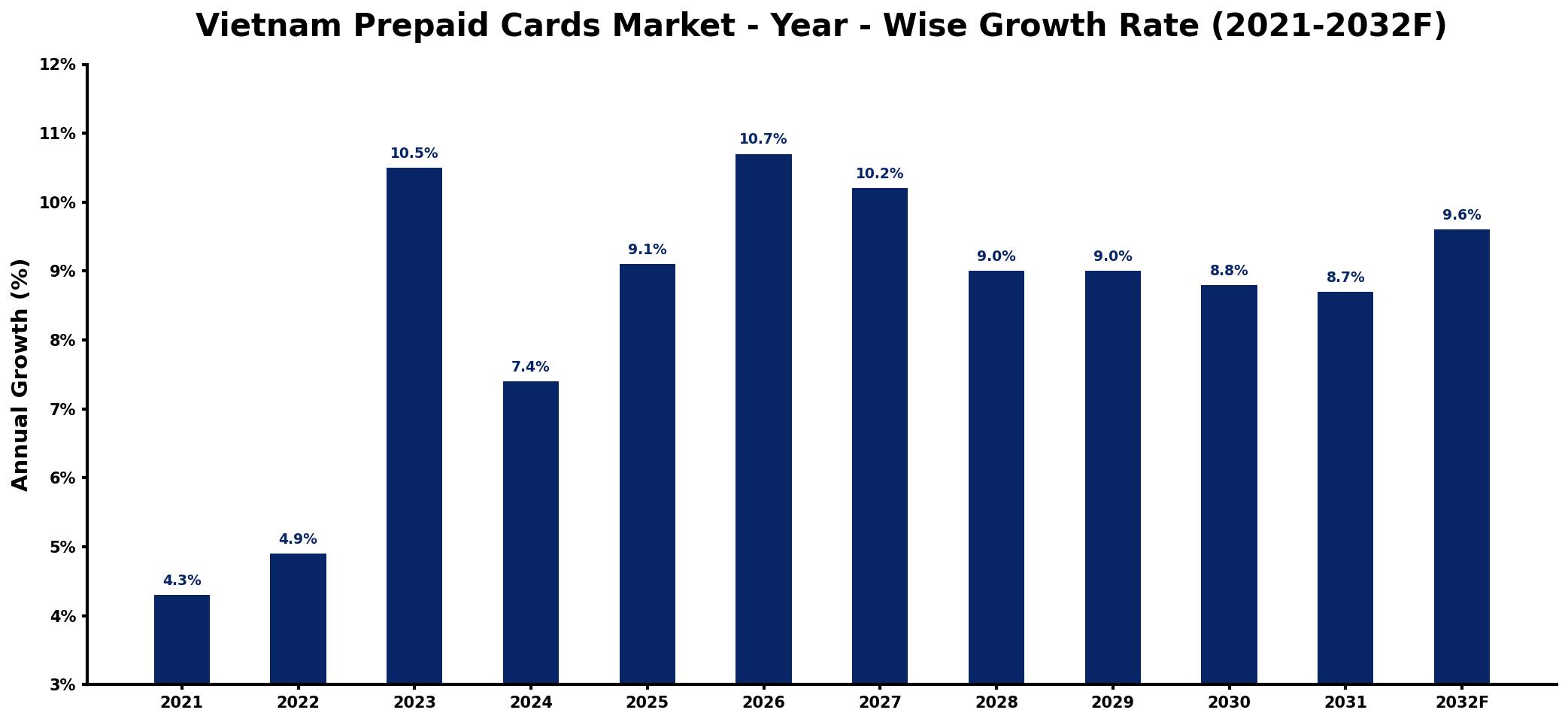
The table below presents the year‑wise growth rates along with the key drivers influencing the market
| Year | Growth Rate | Major Drivers |
| 2021 | 4.3% | Rising digital payment adoption |
| 2022 | 4.9% | Increased mobile wallet usage |
| 2023 | 10.5% | Growing e-commerce transactions volume |
| 2024 | 7.4% | Expansion of retail payment options |
| 2025 | 9.1% | Enhanced consumer spending confidence |
| 2026 | 10.7% | Development of fintech innovations |
| 2027 | 10.2% | Higher cross-border transaction demand |
| 2028 | 9.0% | Boost in travel expenditure recovery |
| 2029 | 9.0% | Surge in online subscription services |
| 2030 | 8.8% | Growing popularity of gift solutions |
| 2031 | 8.7% | Increased focus on loyalty programs |
| 2032 | 9.6% | increased capital investment inflows |
Note: Market size estimations and growth projections presented in this report are based on 6Wresearch's proprietary forecasting methodology, utilizing the latest available industry data, government publications, and primary research inputs.
Vietnam Prepaid Cards Market Synopsis
In recent years, the Vietnam prepaid cards market has gained momentum, transitioning from traditional cash transactions to innovative digital payment solutions. As consumer preferences evolve towards convenience, this market is set to experience significant growth, particularly as digital wallets become more integrated with prepaid card functionalities.
Moving forward, the Vietnam prepaid cards market is poised for substantial expansion, driven by technological advancements and a shift in consumer behavior towards secure payment methods. With ongoing developments in digital infrastructure and increasing financial literacy among consumers, the demand for prepaid cards is likely to see an upward trend, reflecting a broader movement towards a cashless economy.
Vietnam Prepaid Cards Market Key Takeaways
- Increasing demand for prepaid cards as a means of secure and convenient payment solutions.
- Shifts in consumer behavior due to rising digital payment adoption and financial literacy.
- Potential growth from expanding offerings of gift cards, mobile top-ups, and travel cards.
- Need for enhanced security measures to protect against fraud and maintain consumer trust.
- Market competition driving innovation and diverse product offerings among providers.
Evaluation of Restraints in Vietnam Prepaid Cards Market
Despite its robust growth prospects, the Vietnam prepaid cards market faces significant restraints that can impede its progress. Key among these is the challenge of ensuring transaction security. With the rise in digital financial transactions, the potential for fraud increases, making it essential for card issuers to implement robust security protocols to protect consumers. Additionally, competitive pressures within the market can lead to price wars that may affect profitability for providers, requiring them to balance competitive pricing with sustainable business practices.
Vietnam Prepaid Cards Market Trends
The current landscape of the Vietnam prepaid cards market is shaped by several significant trends. Firstly, the growing integration of digital wallets with prepaid cards enhances the user experience, allowing for seamless transactions and management of finances. Moreover, the increasing popularity of online shopping and e-commerce is leading to a higher demand for prepaid cards, particularly for gift and travel purposes. Finally, partnerships between financial institutions and retail businesses are fostering innovative solutions that cater to the evolving payment preferences of consumers.
Vietnam Prepaid Cards Market Opportunities
Opportunities for growth in the Vietnam prepaid cards market are abundant. As the shift towards cashless transactions continues, there is a notable potential for launching new products, such as prepaid travel cards aimed at both domestic and international travelers. Furthermore, targeting the youth demographic, who are tech-savvy and open to adopting digital payment methods, can drive substantial growth. Companies that innovate in providing tailored solutions and enhance customer experiences are likely to capture significant market share.
Government Initiatives in the Vietnam Prepaid Cards Market
The Vietnamese government plays a pivotal role in promoting digital payment solutions through various initiatives aimed at fostering a cashless economy. Policies encouraging financial inclusion and investment in digital infrastructure are critical to expanding the prepaid cards market. Additionally, government regulations supporting consumer protection in financial transactions contribute to enhancing trust and stability within the prepaid cards ecosystem.
Future Insights of the Vietnam Prepaid Cards Market
Looking ahead to 2026-2032, the Vietnam prepaid cards market is expected to witness transformative growth driven by continued technological advancements and increasing acceptance of digital payment solutions. With a younger population inclined towards cashless transactions, coupled with ongoing improvements in digital banking services, the market is positioned to not only expand in size but also diversify in its offerings. The demand for enhanced security measures and innovative product features will further shape the competitive landscape, compelling providers to adapt to ever-changing consumer preferences.
Vietnam Prepaid Cards Market Latest Developments (2025 - 2026)
Recent developments in the Vietnam prepaid cards market highlight a growing trend towards digital offerings, with an increasing number of companies introducing virtual prepaid cards that can be easily accessed and managed through mobile applications. Furthermore, initiatives aimed at enhancing user security and improving customer service capabilities are becoming central to many providers' strategies as they seek to retain consumer trust in an evolving digital landscape.
Vietnam Prepaid Cards Market - Key Attractiveness of the Report
- 10 Years of Market Numbers
- Historical Data Starting from 2022 to 2025
- Base Year: 2025
- Forecast Data until 2032
- Key Performance Indicators Impacting the Market
- Major Upcoming Developments and Projects
Key Highlights of the Report:
- Vietnam Prepaid Cards Market Outlook
- Market Size of Vietnam Prepaid Cards Market, 2025
- Forecast of Vietnam Prepaid Cards Market, 2032
- Historical Data and Forecast of Vietnam Prepaid Cards Revenues & Volume for the Period 2022-2032F
- Vietnam Prepaid Cards Market Trend Evolution
- Vietnam Prepaid Cards Market Drivers and Challenges
- Vietnam Prepaid Cards Price Trends
- Vietnam Prepaid Cards Porter's Five Forces
- Vietnam Prepaid Cards Industry Life Cycle
- Historical Data and Forecast of Vietnam Prepaid Cards Market Revenues & Volume By Offering for the Period 2022-2032F
- Historical Data and Forecast of Vietnam Prepaid Cards Market Revenues & Volume By General Purpose Card for the Period 2022-2032F
- Historical Data and Forecast of Vietnam Prepaid Cards Market Revenues & Volume By Gift Card for the Period 2022-2032F
- Historical Data and Forecast of Vietnam Prepaid Cards Market Revenues & Volume By Government Benefit/Disbursement Card for the Period 2022-2032F
- Historical Data and Forecast of Vietnam Prepaid Cards Market Revenues & Volume By Incentive/Payroll Card for the Period 2022-2032F
- Historical Data and Forecast of Vietnam Prepaid Cards Market Revenues & Volume By Others for the Period 2022-2032F
- Historical Data and Forecast of Vietnam Prepaid Cards Market Revenues & Volume By Card Type for the Period 2022-2032F
- Historical Data and Forecast of Vietnam Prepaid Cards Market Revenues & Volume By Closed Loop Card for the Period 2022-2032F
- Historical Data and Forecast of Vietnam Prepaid Cards Market Revenues & Volume By Open Loop Card for the Period 2022-2032F
- Historical Data and Forecast of Vietnam Prepaid Cards Market Revenues & Volume By End User for the Period 2022-2032F
- Historical Data and Forecast of Vietnam Prepaid Cards Market Revenues & Volume By Retail for the Period 2022-2032F
- Historical Data and Forecast of Vietnam Prepaid Cards Market Revenues & Volume By Corporate for the Period 2022-2032F
- Historical Data and Forecast of Vietnam Prepaid Cards Market Revenues & Volume By Government/Public Sector for the Period 2022-2032F
- Vietnam Prepaid Cards Import Export Trade Statistics
- Market Opportunity Assessment By Offering
- Market Opportunity Assessment By Card Type
- Market Opportunity Assessment By End User
- Vietnam Prepaid Cards Top Companies Market Share
- Vietnam Prepaid Cards Competitive Benchmarking By Technical and Operational Parameters
- Vietnam Prepaid Cards Company Profiles
- Vietnam Prepaid Cards Key Strategic Recommendations






































