Vietnam Prescriptive Analytics Market Size & Growth Rate (2026-2032)
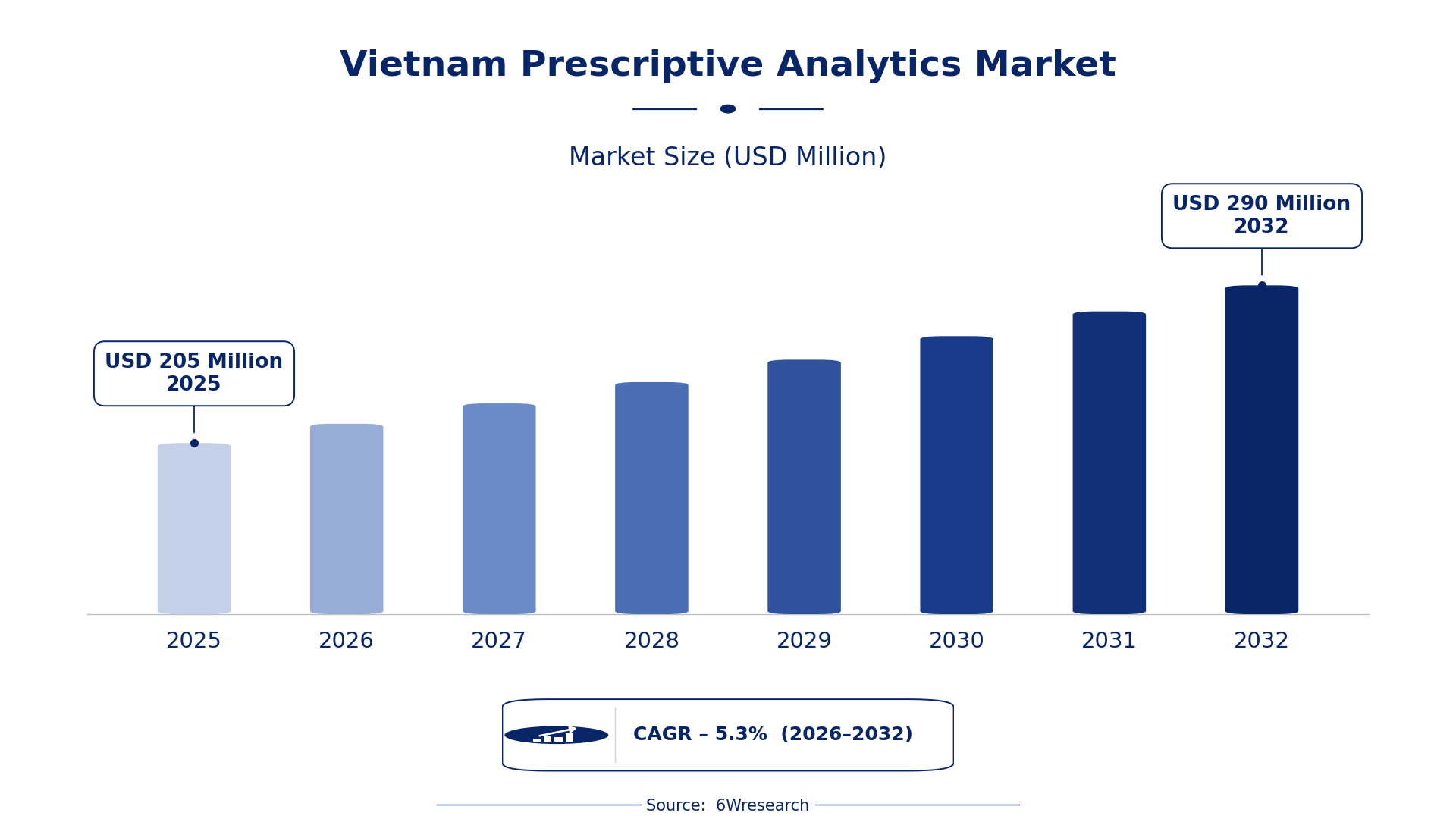
The Vietnam Prescriptive Analytics Market was estimated at USD 205 Million in 2025 and is projected to reach USD 290 Million by 2032, growing at a CAGR of 5.3% from 2026 to 2032.
Vietnam Prescriptive Analytics Market Synopsis
The Vietnam Prescriptive Analytics market is on an upward trajectory, driven by a growing recognition of the need for actionable insights in business decision-making. As organizations become more data-centric, they are shifting from traditional analytics to prescriptive approaches that not only predict outcomes but also recommend optimal actions.
Looking ahead, the market is expected to gain further momentum as technological advancements in machine learning and artificial intelligence enhance the capabilities of prescriptive analytics tools. This transition will empower Vietnamese businesses to harness data more effectively, driving efficiency and strategic agility across various sectors.
Vietnam Prescriptive Analytics Market Year-wise Growth Rate and Key Drivers
This graph illustrates the annual growth rates of the Vietnam Prescriptive Analytics Market from 2021 to 2032, highlighting a steady upward trajectory and projected expansion over the forecast period.
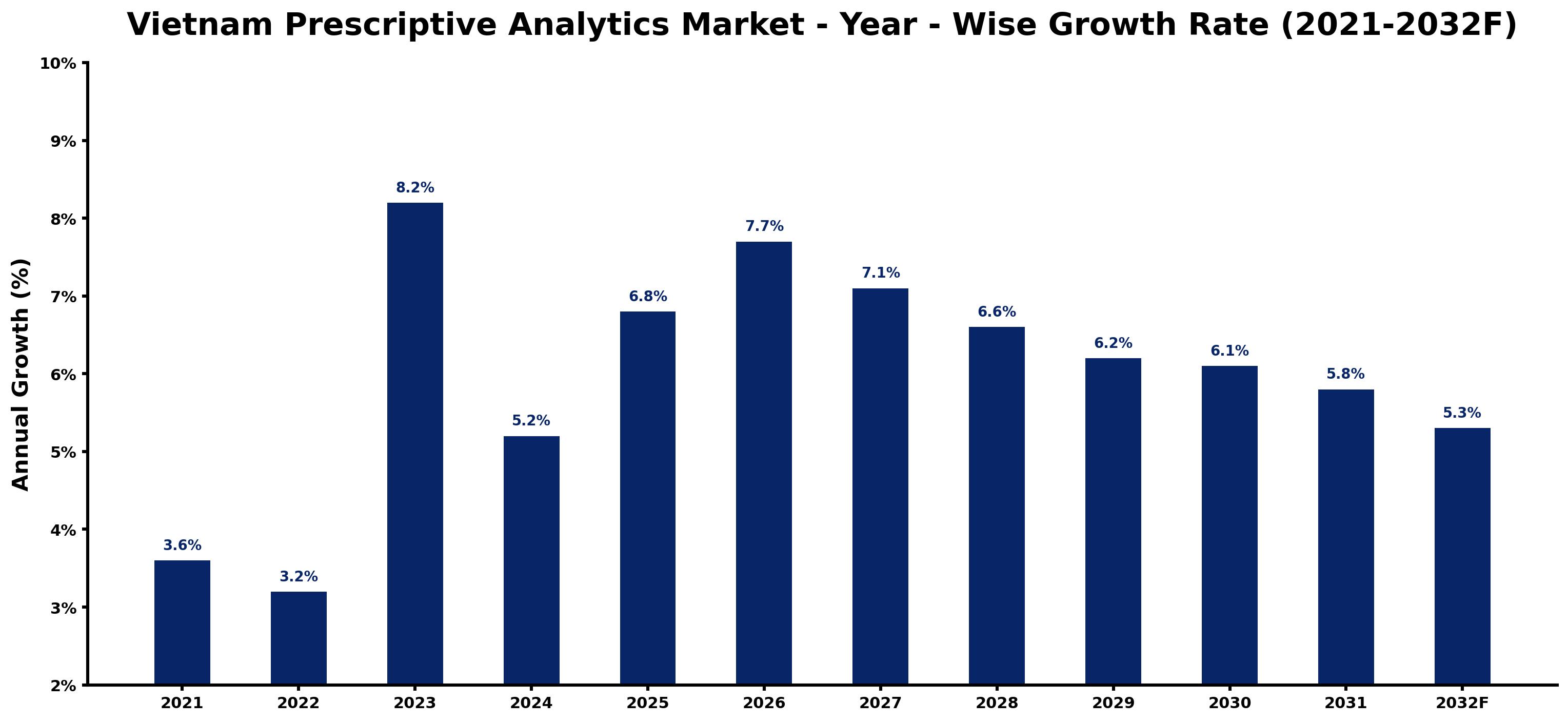
The table below presents the year‑wise growth rates along with the key drivers influencing the market
| Year | Growth Rate | Major Drivers |
| 2021 | 3.6% | Vietnam's Industry 4.0 strategy boosts analytics adoption. |
| 2022 | 3.2% | Boost from local tech startups leveraging data insights. |
| 2023 | 8.2% | Government digitalization push enhances predictive analytics usage. |
| 2024 | 5.2% | Rising consumer behavior analysis drives analytics investments. |
| 2025 | 6.8% | Increased mobile internet penetration improves data collection. |
| 2026 | 7.7% | Manufacturers adopt analytics for supply chain optimization. |
| 2027 | 7.1% | Vietnamese firms prioritize data compliance and analytics platforms. |
| 2028 | 6.6% | Growing urban population demands advanced predictive solutions. |
| 2029 | 6.2% | Investment in fintech drives analytic capabilities expansion. |
| 2030 | 6.1% | Demand for personalized marketing fuels data analytics needs. |
| 2031 | 5.8% | Increasing education initiatives on data literacy enhance demand. |
| 2032 | 5.3% | Evolving regulations support data analytics in healthcare sector. |
Note: Market size estimations and growth projections presented in this report are based on 6Wresearch's proprietary forecasting methodology, utilizing the latest available industry data, government publications, and primary research inputs.
Vietnam Prescriptive Analytics Market Key Takeaways
Below are some of the specific key takeaways from the market, including:
- The growing emphasis on data-driven decision-making across industries is a primary market driver.
- Technological innovations in machine learning are facilitating the rise of prescriptive analytics solutions.
- Data quality and accessibility remain significant barriers to effective implementation.
- COVID-19 has accelerated the adoption of prescriptive analytics as businesses adapt to new challenges.
- Awareness and education about the benefits of prescriptive analytics are crucial for market growth.
Evaluation of Restraints in Vietnam Prescriptive Analytics Market
Despite the clear benefits of prescriptive analytics, many organizations in Vietnam are still hesitant to fully embrace these solutions. A lack of understanding about how prescriptive analytics differs from traditional analytics leaves numerous businesses relying on outdated methods. Compounding this issue, poor data quality hampers effective analysis, while fragmented data sources hinder comprehensive insights. These factors create a challenging environment for the adoption of prescriptive analytics, limiting the market's potential.
Vietnam Prescriptive Analytics Market Trends
Several trends are shaping the Vietnam Prescriptive Analytics market. First, there is a notable shift towards integrating prescriptive analytics with existing business intelligence tools, creating a more unified approach to data analysis. Second, industries such as healthcare and finance are increasingly utilizing prescriptive analytics to optimize operations and improve customer engagement. Finally, the rise of real-time analytics is pushing businesses to seek immediate, actionable insights, further driving demand for prescriptive solutions.
Vietnam Prescriptive Analytics Market Opportunities
Opportunities abound for businesses willing to invest in prescriptive analytics. As awareness grows, companies that adopt these tools early can gain a competitive edge by optimizing resource allocation and enhancing customer experiences. Sectors like retail and logistics stand to benefit significantly from prescriptive solutions, particularly in inventory management and supply chain optimization. The government's push for digital transformation also creates a favorable environment for the adoption of advanced analytics technologies.
Government Initiatives in the Vietnam Prescriptive Analytics Market
The Vietnamese government recognizes the critical role of analytics in driving economic growth and has initiated several programs to promote data-driven decision-making across sectors. These initiatives focus on enhancing data infrastructure and fostering a culture of innovation. By supporting the integration of advanced analytics tools, the government aims to strengthen the country's competitive position in the global market.
- A national digital infrastructure upgrade programme launched in 2024 aims to enhance data accessibility for businesses.
- Currently underway is an initiative to train professionals in analytics skills, funded by public-private partnerships.
- A regulatory framework introduced in 2025 mandates the use of advanced analytics in public sector operations.
- Planned for 2027, a public initiative will focus on developing smart cities, integrating prescriptive analytics for urban planning.
Future Insights of the Vietnam Prescriptive Analytics Market
Looking towards 2026-2032, the Vietnam Prescriptive Analytics market is set to experience robust growth as more businesses recognize the value of actionable insights. The increasing complexity of market dynamics will compel organizations to adopt prescriptive analytics for strategic decision-making. As technology evolves, the sophistication of analytics tools will improve, facilitating deeper insights and more tailored recommendations. This evolution will create a ripple effect, fostering a more data-driven culture across the economy.
Vietnam Prescriptive Analytics Market Latest Developments
In the past year, the Vietnam Prescriptive Analytics market has seen notable advancements, with various organizations investing in analytics capabilities to stay competitive. The momentum built during this period has been marked by significant technological developments and partnerships aimed at enhancing prescriptive analytics solutions.
- A major technology vendor launched an AI-driven prescriptive analytics tool in Q1 2025, aimed at retail applications.
- An initiative that began in mid-2025 focuses on improving data quality standards across industries, enhancing prescriptive analytics effectiveness.
- In early 2025, a leading analytics firm partnered with a local university to develop a certification program in prescriptive analytics.
- A rollout expected to begin in the second half of 2026 will see the deployment of prescriptive analytics tools across public health agencies.
Vietnam Prescriptive Analytics Market - Key Attractiveness of the Report
- 10 Years of Market Numbers
- Historical Data Starting from 2022 to 2025
- Base Year: 2025
- Forecast Data until 2032
- Key Performance Indicators Impacting the Market
- Major Upcoming Developments and Projects
Key Highlights of the Report:
- Vietnam Prescriptive Analytics Market Outlook
- Market Size of Vietnam Prescriptive Analytics Market, 2025
- Forecast of Vietnam Prescriptive Analytics Market, 2032
- Historical Data and Forecast of Vietnam Prescriptive Analytics Revenues & Volume for the Period 2022-2032F
- Vietnam Prescriptive Analytics Market Trend Evolution
- Vietnam Prescriptive Analytics Market Drivers and Challenges
- Vietnam Prescriptive Analytics Price Trends
- Vietnam Prescriptive Analytics Porter's Five Forces
- Vietnam Prescriptive Analytics Industry Life Cycle
- Historical Data and Forecast of Vietnam Prescriptive Analytics Market Revenues & Volume By Application for the Period 2022-2032F
- Historical Data and Forecast of Vietnam Prescriptive Analytics Market Revenues & Volume By Risk Management for the Period 2022-2032F
- Historical Data and Forecast of Vietnam Prescriptive Analytics Market Revenues & Volume By Operation Management for the Period 2022-2032F
- Historical Data and Forecast of Vietnam Prescriptive Analytics Market Revenues & Volume By Revenue Management for the Period 2022-2032F
- Historical Data and Forecast of Vietnam Prescriptive Analytics Market Revenues & Volume By Network Management for the Period 2022-2032F
- Historical Data and Forecast of Vietnam Prescriptive Analytics Market Revenues & Volume By Workforce Management for the Period 2022-2032F
- Historical Data and Forecast of Vietnam Prescriptive Analytics Market Revenues & Volume By Supply Chain Management for the Period 2022-2032F
- Historical Data and Forecast of Vietnam Prescriptive Analytics Market Revenues & Volume By Others for the Period 2022-2032F
- Historical Data and Forecast of Vietnam Prescriptive Analytics Market Revenues & Volume By Data Type for the Period 2022-2032F
- Historical Data and Forecast of Vietnam Prescriptive Analytics Market Revenues & Volume By Unstructured for the Period 2022-2032F
- Historical Data and Forecast of Vietnam Prescriptive Analytics Market Revenues & Volume By Semi-Structured for the Period 2022-2032F
- Historical Data and Forecast of Vietnam Prescriptive Analytics Market Revenues & Volume By Structured for the Period 2022-2032F
- Historical Data and Forecast of Vietnam Prescriptive Analytics Market Revenues & Volume By Component for the Period 2022-2032F
- Historical Data and Forecast of Vietnam Prescriptive Analytics Market Revenues & Volume By Software for the Period 2022-2032F
- Historical Data and Forecast of Vietnam Prescriptive Analytics Market Revenues & Volume By Services for the Period 2022-2032F
- Historical Data and Forecast of Vietnam Prescriptive Analytics Market Revenues & Volume By Deployment Mode for the Period 2022-2032F
- Historical Data and Forecast of Vietnam Prescriptive Analytics Market Revenues & Volume By Cloud for the Period 2022-2032F
- Historical Data and Forecast of Vietnam Prescriptive Analytics Market Revenues & Volume By On-premises for the Period 2022-2032F
- Historical Data and Forecast of Vietnam Prescriptive Analytics Market Revenues & Volume By Organization Size for the Period 2022-2032F
- Historical Data and Forecast of Vietnam Prescriptive Analytics Market Revenues & Volume By Large enterprises for the Period 2022-2032F
- Historical Data and Forecast of Vietnam Prescriptive Analytics Market Revenues & Volume By Small and medium-sized enterprises (SMEs) for the Period 2022-2032F
- Historical Data and Forecast of Vietnam Prescriptive Analytics Market Revenues & Volume By Vertical for the Period 2022-2032F
- Historical Data and Forecast of Vietnam Prescriptive Analytics Market Revenues & Volume By BFSI for the Period 2022-2032F
- Historical Data and Forecast of Vietnam Prescriptive Analytics Market Revenues & Volume By Retail and eCommerce for the Period 2022-2032F
- Historical Data and Forecast of Vietnam Prescriptive Analytics Market Revenues & Volume By Media and Entertainment for the Period 2022-2032F
- Historical Data and Forecast of Vietnam Prescriptive Analytics Market Revenues & Volume By Manufacturing for the Period 2022-2032F
- Historical Data and Forecast of Vietnam Prescriptive Analytics Market Revenues & Volume By Travel and Hospitality for the Period 2022-2032F
- Historical Data and Forecast of Vietnam Prescriptive Analytics Market Revenues & Volume By Energy and Utilities for the Period 2022-2032F
- Historical Data and Forecast of Vietnam Prescriptive Analytics Market Revenues & Volume By Telecom and IT for the Period 2022-2032F
- Vietnam Prescriptive Analytics Import Export Trade Statistics
- Market Opportunity Assessment By Application
- Market Opportunity Assessment By Data Type
- Market Opportunity Assessment By Component
- Market Opportunity Assessment By Deployment Mode
- Market Opportunity Assessment By Organization Size
- Market Opportunity Assessment By Vertical
- Vietnam Prescriptive Analytics Top Companies Market Share
- Vietnam Prescriptive Analytics Competitive Benchmarking By Technical and Operational Parameters
- Vietnam Prescriptive Analytics Company Profiles
- Vietnam Prescriptive Analytics Key Strategic Recommendations






































