Vietnam Printed Circuit Boards Market Summary
The vietnam printed circuit boards market was estimated at USD 206 Million in 2025 and is projected to reach USD 291 Million by 2032, growing at a CAGR of 7.9% from 2026 to 2032.
Vietnam Printed Circuit Boards Market Year-wise Growth Rate and Key Drivers
This graph highlights how the Vietnam Printed Circuit Boards Market has steadily grown over the past five years, supported by major growth factors.
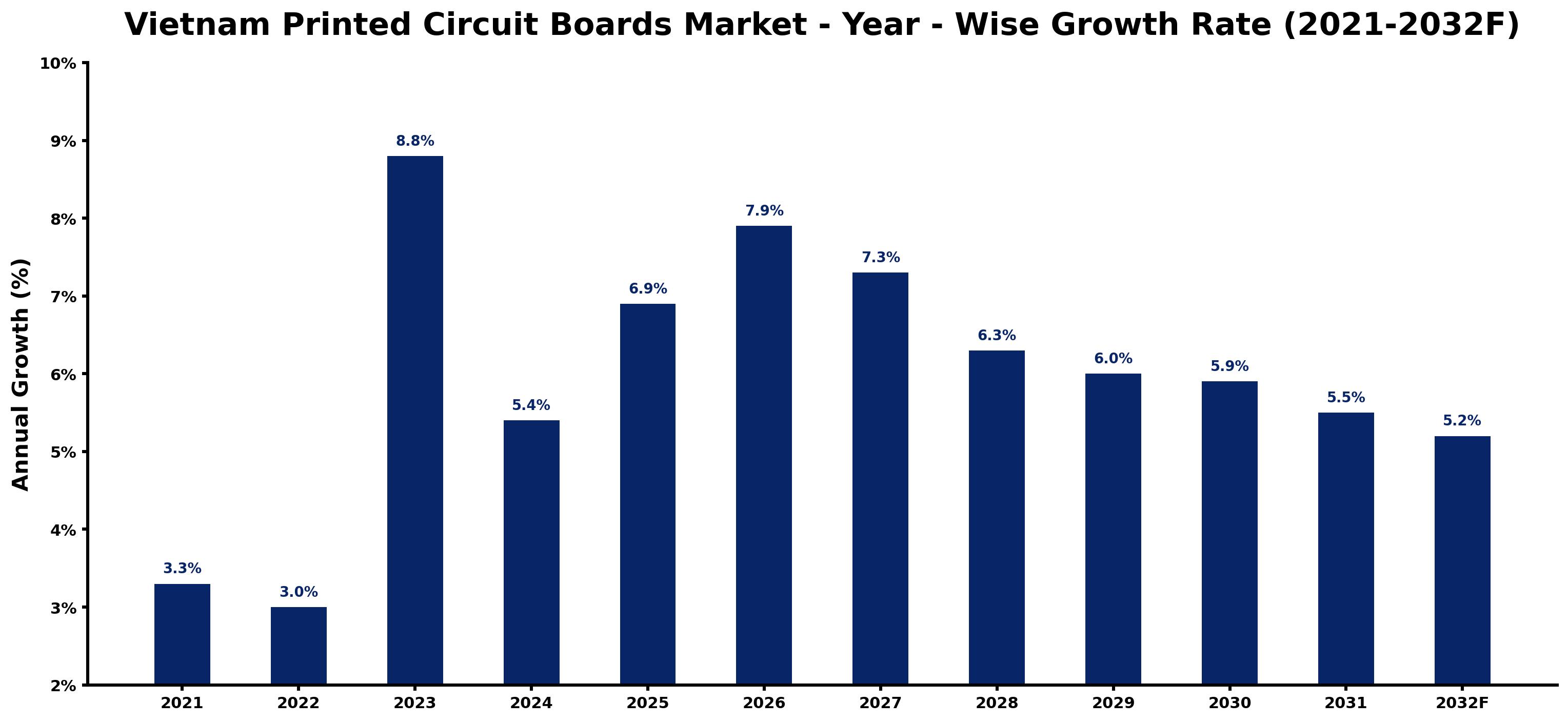
The table below presents the year wise growth rates along with the key drivers influencing the market
| Year | Growth Rate | Major Drivers |
| 2021 | 3.3% | Manufacturers increasingly relocated operations to Vietnam, enhancing PCB production capabilities. |
| 2022 | 3.0% | Global supply chain disruptions prompted local businesses to explore domestic PCB sourcing options. |
| 2023 | 8.8% | Emerging technology sectors in Vietnam require sophisticated PCBs for innovation and development. |
| 2024 | 5.4% | Rising consumer electronics demand fuels expansion of the PCB manufacturing landscape. |
| 2025 | 6.9% | Investment in automation technologies enhances production efficiency across PCB manufacturing facilities. |
| 2026 | 7.9% | Vietnam's strategic location serves as a gateway for ASEAN market access for PCBs. |
| 2027 | 7.3% | Electric vehicle production growth necessitates advanced PCB solutions integrated into automotive systems. |
| 2028 | 6.3% | 5G network deployment creates a surge in demand for high-frequency PCBs. |
| 2029 | 6.0% | Sustainable manufacturing practices drive investments in eco-friendly PCB production technologies. |
| 2030 | 5.9% | Partnerships with international tech firms solidify Vietnam's role in global PCB supply chains. |
| 2031 | 5.5% | Expansion of data centers in Vietnam highlights the need for specialized PCBs in operations. |
| 2032 | 5.2% | Research and development initiatives bolster innovation in PCB technologies across various sectors. |
Note - Market size estimations and growth projections presented in this report are based on 6Wresearch's advanced forecasting approach, validated with industry datasets as of June 2026.
Vietnam Printed Circuit Boards Market Synopsis
The Vietnam Printed Circuit Boards Market is projected to reach 7.9% and witness significant growth during the forecast period (2026-2032). This market encapsulates the manufacturing and distribution of printed circuit boards (PCBs) that are integral to various electronic devices and equipment. PCBs form the essential framework for interconnecting electronic components and facilitating the flow of electrical signals across devices such as smartphones, computers, automotive electronics, consumer electronics, and industrial machinery.
Vietnam Printed Circuit Boards Market Growth Drivers
Several factors contribute to the robust growth of the Vietnam Printed Circuit Boards Market. Firstly, the government's strategic focus on attracting foreign investments into the electronics manufacturing sector has been significant. Major global electronics companies continue to establish production facilities in Vietnam, creating a substantial demand for PCBs. Secondly, the increasing proliferation of smartphones, tablets, and wearable devices has led to a surging need for PCBs within the consumer electronics segment. Moreover, the domestic automotive industry is on an upward trajectory, driven by rising demand and enhanced export capabilities, further establishing PCBs as critical components in modern vehicles with sophisticated electronic systems.
- The Vietnam Printed Circuit Boards Market is benefiting from the expansion of the country's electronics manufacturing sector, drawing foreign investments that bolster local production capacities.
- The rising popularity of smart devices, including smartphones and tablets, continues to escalate the demand for PCBs, positioning Vietnam as a key player in this area.
- As the automotive industry grows, the necessity for advanced electronic systems in vehicles is propelling the demand for PCBs, reflecting their integral role in modern transportation.
- Government incentives aimed at fostering the electronics industry significantly enhance the competitive landscape of PCB manufacturing in Vietnam.
- The increasing trend towards environmentally friendly practices is encouraging manufacturers to innovate while maintaining compliance with regulations, influencing PCB designs and production methodologies.
Vietnam Printed Circuit Boards Market Challenges and Restraints
Despite the optimistic outlook for the Vietnam Printed Circuit Boards Market, several challenges impede its growth. The global PCB market is characterized by intense competition, with numerous players vying for market share. Local manufacturers face significant pressure from established international PCB manufacturers, which can stifle growth potential. Additionally, the manufacturing process of PCBs involves the use of various chemicals and materials that pose environmental risks if not managed properly. Compliance with stringent environmental regulations can be a barrier for some manufacturers, potentially impacting operational efficiency. Furthermore, while Vietnam is improving its electronics manufacturing capabilities, a dependence on imported PCBs for high-end applications persists, which may hinder the domestic market's growth.
- The highly competitive nature of the global PCB market makes it challenging for Vietnamese manufacturers to secure market share against established players.
- Environmental regulation compliance poses a significant challenge, as manufacturers must navigate complex requirements while ensuring sustainable practices.
- Vietnam's reliance on imported PCBs for advanced applications could limit the growth of domestic manufacturers that seek to compete in high-value segments.
- The continuous evolution of technology necessitates ongoing investment in research and development, which may strain resources for smaller manufacturers.
- Supply chain disruptions, exacerbated by global events, can create volatility in the availability of essential components, affecting production timelines and costs.
Vietnam Printed Circuit Boards Market Government Investment and Initiatives
The Vietnamese government plays a pivotal role in fostering the growth of its electronics manufacturing sector, including the printed circuit boards market. Various initiatives and policies have been introduced to enhance investment, stimulate innovation, and improve the overall infrastructure of the electronics industry. These include tax incentives for manufacturers, grants for research and development efforts, and support for vocational training programs aimed at enhancing the skill sets of the workforce. The government's focus on attracting foreign direct investment is underscored by its commitment to improving the business environment, facilitating easier access to funding, and promoting local manufacturing capabilities, all of which contribute to the expansion of the PCB market.
- The introduction of tax incentives fosters a favorable business environment for PCB manufacturers, encouraging investments that boost local production.
- Government grants for research and development significantly aid manufacturers in innovating and enhancing their product offerings.
- Efforts to improve workforce skills through vocational training programs ensure that the industry has access to a high-quality labor pool.
- Promoting local manufacturing capabilities aligns with the government's broader goal of reducing import dependency for high-tech components.
- Strategic partnerships between the government and private sector entities enhance the overall competitiveness of Vietnam's electronics industry.
Vietnam Printed Circuit Boards Market Latest Developments (May 2025 - June 2026)
In the period between May 2025 and June 2026, the Vietnam Printed Circuit Boards Market has undergone significant developments. Manufacturers have increasingly focused on sustainable practices, integrating environmentally friendly materials into their PCB production processes. Innovations such as flexible PCBs and the incorporation of Internet of Things (IoT) technologies have become more prevalent, addressing the growing demand for smart devices. Additionally, market players have been enhancing their production capabilities by investing in advanced machinery, resulting in improved efficiencies and product quality. Collaborative efforts between academia and industry have also gained momentum, aiming to advance research initiatives in PCB technology and manufacturing methods.
- Manufacturers are adopting environmentally sustainable practices, which include using eco-friendly materials in PCB production.
- The rise of flexible PCBs caters to the demand for lightweight and versatile electronic solutions in consumer electronics.
- Integration of IoT technologies into PCBs is becoming increasingly common, reflecting the market's shift towards smarter, connected devices.
- Investment in advanced production machinery enhances manufacturing efficiency and improves the quality of the final products.
- Collaboration between educational institutions and industry stakeholders promotes research and development in PCB technology, spurring innovation.
Vietnam Printed Circuit Boards Market - Key Attractiveness of the Report
- 10 Years of Market Numbers
- Historical Data Starting from 2022 to 2025
- Base Year: 2025
- Forecast Data until 2032
- Key Performance Indicators Impacting the Market
- Major Upcoming Developments and Projects
Key Highlights of the Report:
- Vietnam Printed Circuit Boards Market Outlook
- Market Size of Vietnam Printed Circuit Boards Market, 2025
- Forecast of Vietnam Printed Circuit Boards Market, 2032
- Historical Data and Forecast of Vietnam Printed Circuit Boards Revenues & Volume for the Period 2022-2032F
- Vietnam Printed Circuit Boards Market Trend Evolution
- Vietnam Printed Circuit Boards Market Drivers and Challenges
- Vietnam Printed Circuit Boards Price Trends
- Vietnam Printed Circuit Boards Porter's Five Forces
- Vietnam Printed Circuit Boards Industry Life Cycle
- Historical Data and Forecast of Vietnam Printed Circuit Boards Market Revenues & Volume By Types for the Period 2022-2032F
- Historical Data and Forecast of Vietnam Printed Circuit Boards Market Revenues & Volume By Single Sided for the Period 2022-2032F
- Historical Data and Forecast of Vietnam Printed Circuit Boards Market Revenues & Volume By Double Sided for the Period 2022-2032F
- Historical Data and Forecast of Vietnam Printed Circuit Boards Market Revenues & Volume By Multi-Layer for the Period 2022-2032F
- Historical Data and Forecast of Vietnam Printed Circuit Boards Market Revenues & Volume By HDI for the Period 2022-2032F
- Historical Data and Forecast of Vietnam Printed Circuit Boards Market Revenues & Volume By Substrate for the Period 2022-2032F
- Historical Data and Forecast of Vietnam Printed Circuit Boards Market Revenues & Volume By Rigid for the Period 2022-2032F
- Historical Data and Forecast of Vietnam Printed Circuit Boards Market Revenues & Volume By Flexible for the Period 2022-2032F
- Historical Data and Forecast of Vietnam Printed Circuit Boards Market Revenues & Volume By Rigid-Flex for the Period 2022-2032F
- Historical Data and Forecast of Vietnam Printed Circuit Boards Market Revenues & Volume By End-users for the Period 2022-2032F
- Historical Data and Forecast of Vietnam Printed Circuit Boards Market Revenues & Volume By Industrial Electronics for the Period 2022-2032F
- Historical Data and Forecast of Vietnam Printed Circuit Boards Market Revenues & Volume By Healthcare for the Period 2022-2032F
- Historical Data and Forecast of Vietnam Printed Circuit Boards Market Revenues & Volume By Aerospace & Defense for the Period 2022-2032F
- Historical Data and Forecast of Vietnam Printed Circuit Boards Market Revenues & Volume By Automotive for the Period 2022-2032F
- Historical Data and Forecast of Vietnam Printed Circuit Boards Market Revenues & Volume By IT & Telecom for the Period 2022-2032F
- Historical Data and Forecast of Vietnam Printed Circuit Boards Market Revenues & Volume By Consumer Electronics for the Period 2022-2032F
- Historical Data and Forecast of Vietnam Printed Circuit Boards Market Revenues & Volume By Others for the Period 2022-2032F
- Vietnam Printed Circuit Boards Import Export Trade Statistics
- Market Opportunity Assessment By Types
- Market Opportunity Assessment By Substrate
- Market Opportunity Assessment By End-users
- Vietnam Printed Circuit Boards Top Companies Market Share
- Vietnam Printed Circuit Boards Competitive Benchmarking By Technical and Operational Parameters
- Vietnam Printed Circuit Boards Company Profiles
- Vietnam Printed Circuit Boards Key Strategic Recommendations






































