Vietnam Radio Broadcast Receivers Market Size, Share & Growth Rate
The Vietnam Radio Broadcast Receivers Market was estimated at USD 302 Million in 2025 and is projected to reach USD 427 Million by 2032, growing at a CAGR of 5.1% from 2026 to 2032. This growth trajectory is primarily fueled by the increasing popularity of radio as a reliable source of news and entertainment. As digital audio platforms proliferate, traditional radio receivers are adapting with innovative features that enhance user experience, driving both consumer interest and market expansion.
Vietnam Radio Broadcast Receivers Market Year-wise Growth Rate and Key Drivers
This graph highlights how the Vietnam Radio Broadcast Receivers Market has steadily grown over the years, supported by major growth factors.
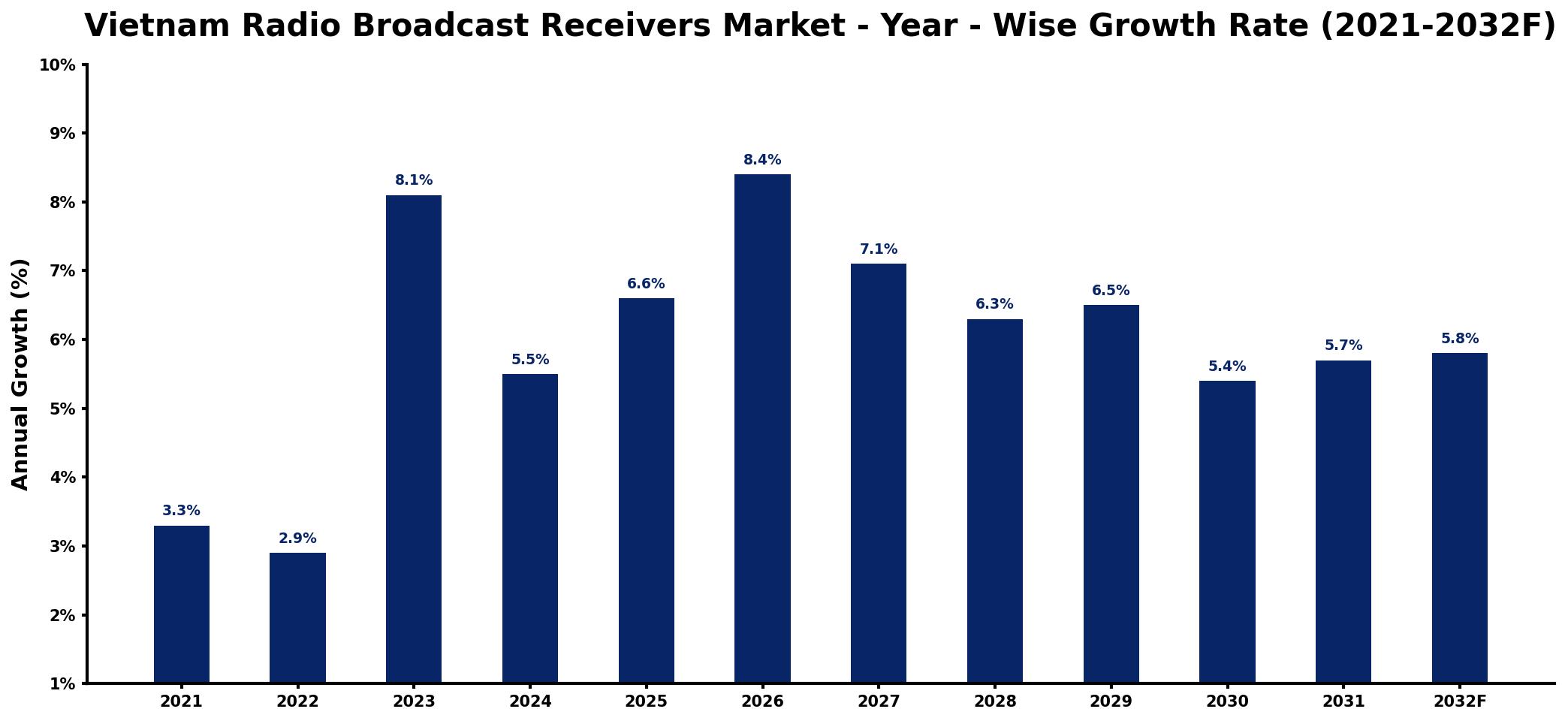
The table below presents the year‑wise growth rates along with the key drivers influencing the market
| Year | Growth Rate | Major Drivers |
| 2021 | 3.3% | Rising consumer electronics demand |
| 2022 | 2.9% | Increased investment in infrastructure |
| 2023 | 8.1% | Growth in digital content consumption |
| 2024 | 5.5% | Expansion of advertising revenues |
| 2025 | 6.6% | Surge in mobile connectivity adoption |
| 2026 | 8.4% | Higher disposable income levels |
| 2027 | 7.1% | Evolving entertainment consumption habits |
| 2028 | 6.3% | Technological advancements in media |
| 2029 | 6.5% | Increase in local content production |
| 2030 | 5.4% | Growing interest in audio experiences |
| 2031 | 5.7% | Strengthened distribution channel networks |
| 2032 | 5.8% | Emergence of smart device integration |
Note: Market size estimations and growth projections presented in this report are based on 6Wresearch's proprietary forecasting methodology, utilizing the latest available industry data, government publications, and primary research inputs.
Vietnam Radio Broadcast Receivers Market Synopsis
The Vietnamese market for radio broadcast receivers is currently experiencing a resurgence as consumers increasingly seek out accessible and portable audio solutions. Amid a backdrop of evolving media consumption habits, the demand for high-quality AM, FM, and digital radio receivers remains robust, catering to various listener preferences.
This market not only supports radio stations and broadcasters but also meets the needs of consumers looking for reliable devices to stay connected with the latest information and entertainment. Enhanced design and sound quality have become pivotal in maintaining competitive advantage in this vibrant sector.
Vietnam Radio Broadcast Receivers Market Key Takeaways
- Growth driven by increasing demand for versatile and portable radio receivers.
- Advancements in design and technology are enhancing audio quality and reception.
- Shift towards digital solutions is reshaping consumer preferences in radio listening.
- COVID-19 led to a significant uptick in radio consumption as people sought reliable information.
- Market players face competition from emerging digital audio platforms.
Evaluation of Restraints in Vietnam Radio Broadcast Receivers Market
Despite positive growth, several key restraints are hindering the Vietnam radio broadcast receivers market. The primary challenge stems from the rapid ascent of digital audio platforms, which offer on-demand content and high-quality audio experiences that traditional radio often struggles to compete with. Furthermore, there is a pressing need for manufacturers to innovate continuously; ensuring product quality while managing costs can be difficult, especially in an environment where consumer expectations for features and performance are evolving rapidly. Compliance with broadcasting standards and technological advancements adds additional layers of complexity that market players must navigate to remain competitive.
Vietnam Radio Broadcast Receivers Market Trends
Current trends in the Vietnam radio broadcast receivers market are shifting towards integration of smart technology. Consumers are increasingly looking for devices with Bluetooth capabilities and internet connectivity, enhancing functionality beyond traditional radio listening. Additionally, portable receivers are gaining traction as lifestyles become more mobile, allowing consumers to access their favorite stations anytime and anywhere. Moreover, the growing recognition of the importance of local content and community radio stations is fostering a renewed interest in radio broadcasts, further enhancing market viability.
Vietnam Radio Broadcast Receivers Market Opportunities
The Vietnam radio broadcast receivers market is ripe with opportunities for investment and growth. As urbanization continues, the demand for sophisticated audio devices is expected to rise, providing openings for manufacturers to launch innovative products that resonate with tech-savvy consumers. Additionally, increased investments in the broadcasting infrastructure could create a favorable environment for expanding radio service coverage, further driving demand. Companies that prioritize sustainability and eco-friendliness in their product offerings are also likely to appeal to an environmentally conscious consumer base.
Government Initiatives in the Vietnam Radio Broadcast Receivers Market
The Vietnamese government has been proactive in supporting the broadcasting sector through various initiatives aimed at modernizing radio infrastructure and enhancing content quality. Policies focusing on expanding the reach of public broadcasting services reflect a commitment to ensuring that citizens have access to reliable information. Investments in technology upgrades and digitalization efforts are also part of the broader strategy to foster a vibrant media landscape, encouraging competition and innovation within the market.
Future Insights of the Vietnam Radio Broadcast Receivers Market
Looking ahead, the Vietnam radio broadcast receivers market is poised for significant transformation from 2026 to 2032. As technological advancements accelerate, we anticipate a surge in the adoption of hybrid radio systems that combine traditional FM/AM broadcasting with digital features. This convergence of technologies is likely to redefine the user experience, making radio more interactive and engaging. Moreover, as consumer preferences continue to evolve, manufacturers that focus on customization and user-centric features will likely gain a competitive edge, positioning themselves favorably in an increasingly dynamic marketplace.
Vietnam Radio Broadcast Receivers Market Latest Developments (2025 - 2026)
In recent months, the Vietnam radio broadcast receivers market has seen notable developments, including the introduction of new portable and digital radio models designed to enhance listening experiences. Market players are increasingly focusing on integrating advanced features such as streaming capabilities and improved user interfaces. Additionally, partnerships between radio manufacturers and tech companies are emerging to leverage shared expertise in creating innovative products that cater to the modern consumer.
Vietnam Radio Broadcast Receivers Market - Key Attractiveness of the Report
- 10 Years of Market Numbers
- Historical Data Starting from 2022 to 2025
- Base Year: 2025
- Forecast Data until 2032
- Key Performance Indicators Impacting the Market
- Major Upcoming Developments and Projects
Key Highlights of the Report:
- Vietnam Radio Broadcast Receivers Market Outlook
- Market Size of Vietnam Radio Broadcast Receivers Market, 2025
- Forecast of Vietnam Radio Broadcast Receivers Market, 2032
- Historical Data and Forecast of Vietnam Radio Broadcast Receivers Revenues & Volume for the Period 2022-2032F
- Vietnam Radio Broadcast Receivers Market Trend Evolution
- Vietnam Radio Broadcast Receivers Market Drivers and Challenges
- Vietnam Radio Broadcast Receivers Price Trends
- Vietnam Radio Broadcast Receivers Porter's Five Forces
- Vietnam Radio Broadcast Receivers Industry Life Cycle
- Historical Data and Forecast of Vietnam Radio Broadcast Receivers Market Revenues & Volume By Equipment for the Period 2022-2032F
- Historical Data and Forecast of Vietnam Radio Broadcast Receivers Market Revenues & Volume By Modulators for the Period 2022-2032F
- Historical Data and Forecast of Vietnam Radio Broadcast Receivers Market Revenues & Volume By Transmitters And Receivers for the Period 2022-2032F
- Historical Data and Forecast of Vietnam Radio Broadcast Receivers Market Revenues & Volume By Encoders for the Period 2022-2032F
- Historical Data and Forecast of Vietnam Radio Broadcast Receivers Market Revenues & Volume By Switches for the Period 2022-2032F
- Historical Data and Forecast of Vietnam Radio Broadcast Receivers Market Revenues & Volume By Filters for the Period 2022-2032F
- Historical Data and Forecast of Vietnam Radio Broadcast Receivers Market Revenues & Volume By Amplifiers for the Period 2022-2032F
- Historical Data and Forecast of Vietnam Radio Broadcast Receivers Market Revenues & Volume By Frequency for the Period 2022-2032F
- Historical Data and Forecast of Vietnam Radio Broadcast Receivers Market Revenues & Volume By Low Frequency for the Period 2022-2032F
- Historical Data and Forecast of Vietnam Radio Broadcast Receivers Market Revenues & Volume By Medium Frequency for the Period 2022-2032F
- Historical Data and Forecast of Vietnam Radio Broadcast Receivers Market Revenues & Volume By High Frequency for the Period 2022-2032F
- Vietnam Radio Broadcast Receivers Import Export Trade Statistics
- Market Opportunity Assessment By Equipment
- Market Opportunity Assessment By Frequency
- Vietnam Radio Broadcast Receivers Top Companies Market Share
- Vietnam Radio Broadcast Receivers Competitive Benchmarking By Technical and Operational Parameters
- Vietnam Radio Broadcast Receivers Company Profiles
- Vietnam Radio Broadcast Receivers Key Strategic Recommendations






































