Vietnam Radio Remote Control Equipment Market Size, Share & Growth Rate
The Vietnam Radio Remote Control Equipment Market was estimated at USD 255 Million in 2025 and is projected to reach USD 358 Million by 2032, growing at a CAGR of 5.0% from 2026 to 2032. This growth trajectory is primarily driven by the surge in industrial automation and the increasing reliance on remote operation technologies across various sectors. As industries in Vietnam continue to prioritize safety and efficiency, the demand for advanced radio remote control solutions is expected to escalate, solidifying the market's upward momentum.
Vietnam Radio Remote Control Equipment Market Year-wise Growth Rate and Key Drivers
This graph highlights how the Vietnam Radio Remote Control Equipment Market has steadily grown over the years, supported by major growth factors.
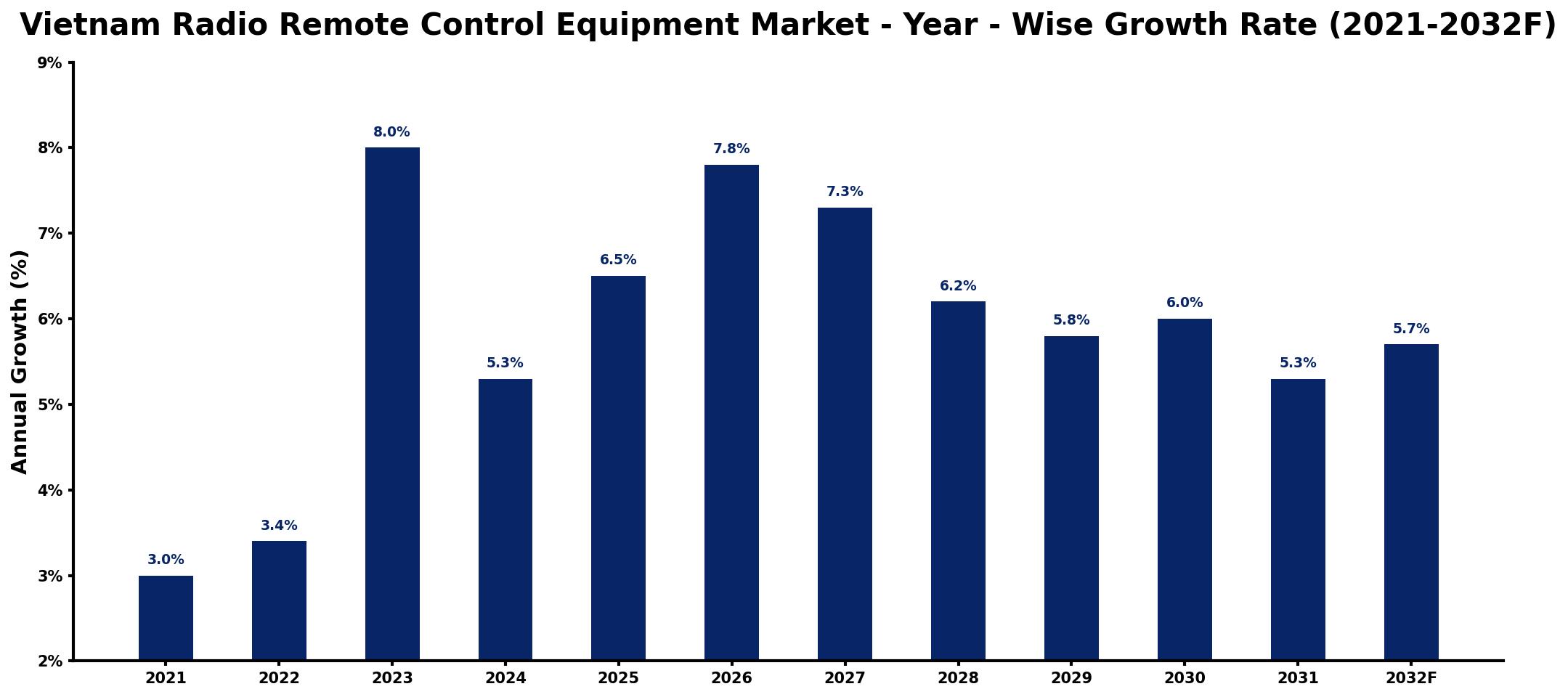
The table below presents the year‑wise growth rates along with the key drivers influencing the market
| Year | Growth Rate | Major Drivers |
| 2021 | 3.0% | Rising demand for automation solutions |
| 2022 | 3.4% | Increased investment in smart technologies |
| 2023 | 8.0% | Expansion of wireless communication infrastructure |
| 2024 | 5.3% | Growth in consumer electronics market |
| 2025 | 6.5% | Surge in IoT applications adoption |
| 2026 | 7.8% | Development of advanced connectivity solutions |
| 2027 | 7.3% | Emergence of smart home trends |
| 2028 | 6.2% | Growing popularity of smart appliances |
| 2029 | 5.8% | Increased focus on energy efficiency |
| 2030 | 6.0% | Rising interest in home automation |
| 2031 | 5.3% | increased domestic production output |
| 2032 | 5.7% | Investments in innovative technology startups |
Note: Market size estimations and growth projections presented in this report are based on 6Wresearch's proprietary forecasting methodology, utilizing the latest available industry data, government publications, and primary research inputs.
Vietnam Radio Remote Control Equipment Market Synopsis
The demand for radio remote control equipment in Vietnam is gaining momentum as businesses seek innovative ways to enhance operational safety and efficiency. With applications spanning industrial automation, construction, and robotics, these devices are essential for remote management of machinery, providing both flexibility and security in operations.
As Vietnams manufacturing and material handling industries expand, the adoption of radio remote control systems becomes increasingly critical. This technology not only minimizes the need for manual intervention but also offers the advantage of operating machinery from a safe distance, reducing potential risks associated with on-site operations.
Vietnam Radio Remote Control Equipment Market Key Takeaways
- The market is expected to grow significantly due to increased demand for automation across various sectors.
- Technological advancements are leading to more reliable and customizable remote control solutions.
- Enhanced safety measures and operational efficiency are driving the uptake of radio remote control systems.
- Competitive pressures from alternative remote control technologies are shaping market dynamics.
- The ongoing trend of digital transformation in industries underscores the need for innovative remote control solutions.
Evaluation of Restraints in Vietnam Radio Remote Control Equipment Market
The Vietnam Radio Remote Control Equipment Market is hindered by several key restraints. Competition from alternative technologies such as wired control systems and smartphone-based solutions poses a challenge for traditional radio remote control devices. Additionally, the need for robust, long-range solutions tailored to specific industrial applications creates pressure on manufacturers to continuously innovate. Managing production costs while ensuring high-quality signal reliability and adherence to automation requirements can be a complex balancing act for market players.
Vietnam Radio Remote Control Equipment Market Trends
Emerging trends in the Vietnam radio remote control equipment market include an increasing focus on customization and smart technology integration. Companies are investing in solutions that offer enhanced connectivity and user-friendly interfaces, facilitating seamless operation across diverse environments. Moreover, the rise of IoT-enabled remote control systems is reshaping the landscape, allowing for better data analytics and operational insights that can drive efficiency.
Vietnam Radio Remote Control Equipment Market Opportunities
There are significant growth opportunities within the Vietnam radio remote control equipment market, particularly in sectors such as construction, manufacturing, and logistics. As industries become more automated, there is a burgeoning demand for innovative solutions that enhance safety and performance. Additionally, government initiatives aimed at boosting industrial growth provide a favorable environment for investments in advanced remote control technologies.
Government Initiatives in the Vietnam Radio Remote Control Equipment Market
Vietnam's government has implemented various initiatives to encourage technological advancements and automation in industries. Public spending on infrastructure development and support for modernization efforts are evident in the growing focus on industrial automation. Additionally, regulatory frameworks are evolving to accommodate new technologies, creating an environment conducive to innovation and adoption of remote control solutions across various sectors.
Future Insights of the Vietnam Radio Remote Control Equipment Market
Looking ahead to 2026-2032, the Vietnam radio remote control equipment market is poised for robust growth, driven by the escalating demand for automation and safety solutions. As industries continue to embrace digital transformation, the role of radio remote control systems will become increasingly central to operational strategies. Innovations in technology, coupled with the expansion of industrial sectors, will further propel market expansion, paving the way for new investment opportunities and advancements.
Vietnam Radio Remote Control Equipment Market Latest Developments (2025 - 2026)
Recent developments in the Vietnam radio remote control equipment market indicate a shift towards more sophisticated solutions that integrate smart technology features. Companies are increasingly focusing on enhancing device interoperability and user experience, reflecting a broader trend towards automation and connectivity. There has also been a noticeable increase in partnerships aimed at developing more robust and reliable remote control systems, emphasizing the sector's commitment to quality and innovation.
Vietnam Radio Remote Control Equipment Market - Key Attractiveness of the Report
- 10 Years of Market Numbers
- Historical Data Starting from 2022 to 2025
- Base Year: 2025
- Forecast Data until 2032
- Key Performance Indicators Impacting the Market
- Major Upcoming Developments and Projects
Key Highlights of the Report:
- Vietnam Radio Remote Control Equipment Market Outlook
- Market Size of Vietnam Radio Remote Control Equipment Market, 2025
- Forecast of Vietnam Radio Remote Control Equipment Market, 2032
- Historical Data and Forecast of Vietnam Radio Remote Control Equipment Revenues & Volume for the Period 2022-2032F
- Vietnam Radio Remote Control Equipment Market Trend Evolution
- Vietnam Radio Remote Control Equipment Market Drivers and Challenges
- Vietnam Radio Remote Control Equipment Price Trends
- Vietnam Radio Remote Control Equipment Porter's Five Forces
- Vietnam Radio Remote Control Equipment Industry Life Cycle
- Historical Data and Forecast of Vietnam Radio Remote Control Equipment Market Revenues & Volume By Type for the Period 2022-2032F
- Historical Data and Forecast of Vietnam Radio Remote Control Equipment Market Revenues & Volume By Pushbutton for the Period 2022-2032F
- Historical Data and Forecast of Vietnam Radio Remote Control Equipment Market Revenues & Volume By Joystick for the Period 2022-2032F
- Historical Data and Forecast of Vietnam Radio Remote Control Equipment Market Revenues & Volume By Application for the Period 2022-2032F
- Historical Data and Forecast of Vietnam Radio Remote Control Equipment Market Revenues & Volume By Industry & Logistics for the Period 2022-2032F
- Historical Data and Forecast of Vietnam Radio Remote Control Equipment Market Revenues & Volume By Construction Crane for the Period 2022-2032F
- Historical Data and Forecast of Vietnam Radio Remote Control Equipment Market Revenues & Volume By Mobile Hydraulics for the Period 2022-2032F
- Historical Data and Forecast of Vietnam Radio Remote Control Equipment Market Revenues & Volume By Forestry for the Period 2022-2032F
- Historical Data and Forecast of Vietnam Radio Remote Control Equipment Market Revenues & Volume By Mining for the Period 2022-2032F
- Historical Data and Forecast of Vietnam Radio Remote Control Equipment Market Revenues & Volume By Others for the Period 2022-2032F
- Vietnam Radio Remote Control Equipment Import Export Trade Statistics
- Market Opportunity Assessment By Type
- Market Opportunity Assessment By Application
- Vietnam Radio Remote Control Equipment Top Companies Market Share
- Vietnam Radio Remote Control Equipment Competitive Benchmarking By Technical and Operational Parameters
- Vietnam Radio Remote Control Equipment Company Profiles
- Vietnam Radio Remote Control Equipment Key Strategic Recommendations






































