Vietnam Radioactive Waste Management Market Size, Share & Growth Rate
The Vietnam Radioactive Waste Management Market was estimated at USD 282 Million in 2025 and is projected to reach USD 398 Million by 2032, growing at a CAGR of 5.0% from 2026 to 2032. This growth trajectory is fueled by an increasing reliance on nuclear energy as a power source, alongside rising awareness regarding the critical need for effective radioactive waste solutions. As Vietnam progresses in its nuclear ambitions, the establishment of robust waste management frameworks is becoming paramount, driving collaboration among governmental bodies and industry stakeholders.
Vietnam Radioactive Waste Management Market Year-wise Growth Rate and Key Drivers
This graph highlights how the Vietnam Radioactive Waste Management Market has steadily grown over the years, supported by major growth factors.
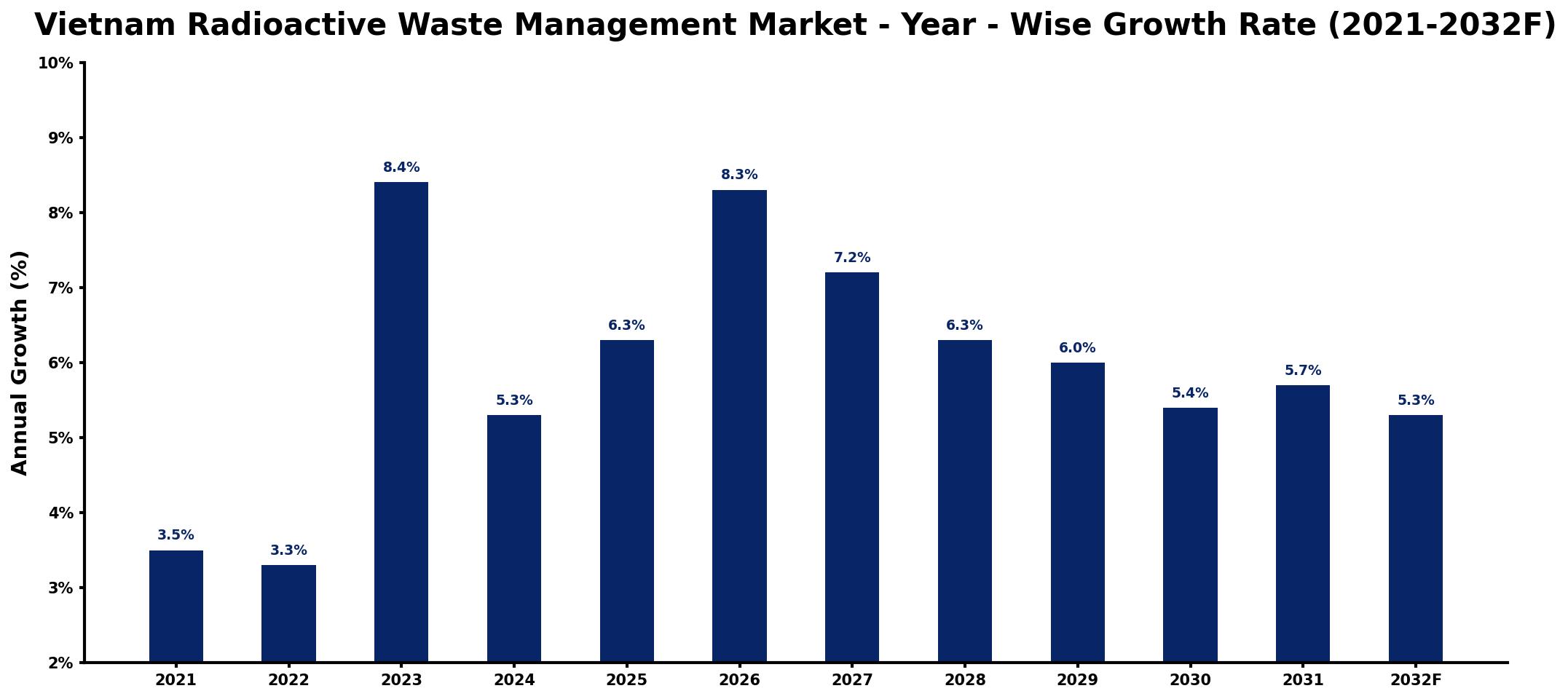
The table below presents the year‑wise growth rates along with the key drivers influencing the market
| Year | Growth Rate | Major Drivers |
| 2021 | 3.5% | Increasing industrial energy requirements |
| 2022 | 3.3% | Growth in nuclear energy sector |
| 2023 | 8.4% | Expansion of regulatory frameworks |
| 2024 | 5.3% | Rising public health awareness |
| 2025 | 6.3% | Investments in clean technologies |
| 2026 | 8.3% | Advancements in disposal techniques |
| 2027 | 7.2% | Growing international cooperation efforts |
| 2028 | 6.3% | Development of new facilities |
| 2029 | 6.0% | Emergence of private sector players |
| 2030 | 5.4% | Government incentives for innovation |
| 2031 | 5.7% | Strengthening environmental protection laws |
| 2032 | 5.3% | Focus on sustainable energy practices |
Note: Market size estimations and growth projections presented in this report are based on 6Wresearch's proprietary forecasting methodology, utilizing the latest available industry data, government publications, and primary research inputs.
Vietnam Radioactive Waste Management Market Synopsis
Vietnam is on the brink of a significant transformation in its energy landscape, with nuclear power emerging as a potential cornerstone of its future energy strategy. The demand for efficient radioactive waste management systems is gaining urgency as the country advances its nuclear initiatives, aiming to ensure public safety and environmental sustainability.
Amidst growing public discourse on environmental issues, Vietnam's commitment to responsible radioactive waste management is vital. Collaboration between governmental entities and private sectors is fostering the development of modern waste handling technologies and facilities, essential for addressing the challenges posed by radioactive materials.
Vietnam Radioactive Waste Management Market Key Takeaways
- The market is projected to grow steadily, driven by an expanding nuclear energy sector and increased public awareness.
- Government initiatives are crucial in establishing safe disposal protocols and investment in necessary infrastructure.
- Public perception remains a critical factor, necessitating community engagement to ensure transparency and trust.
- The impact of COVID-19 has introduced operational challenges, delaying critical projects in the waste management sector.
- Robust regulations and collaborative efforts are essential for overcoming infrastructure development hurdles.
Evaluation of Restraints in Vietnam Radioactive Waste Management Market
The path to effective radioactive waste management in Vietnam is hindered by various restraints. A notable challenge lies in the limited availability of advanced technologies essential for safe waste disposal and long-term storage. Furthermore, the high costs associated with developing and maintaining these technologies can deter investment. Additionally, public apprehension surrounding the safety of nuclear waste facilities poses a significant barrier, often resulting in community opposition and delaying project approvals. Hence, fostering trust through transparent communication and engagement remains critical to addressing these public concerns and facilitating infrastructure development.
Vietnam Radioactive Waste Management Market Trends
Several trends are shaping the landscape of radioactive waste management in Vietnam. The push for sustainable energy solutions is driving innovative waste processing technologies, emphasizing recycling and reuse of materials wherever feasible. Additionally, international partnerships are becoming more prominent, facilitating knowledge transfer and enhancing local capabilities. Furthermore, regulatory bodies are increasingly focused on establishing stringent safety standards, which are expected to evolve as the market matures. These trends highlight the importance of adaptability and forward-thinking in ensuring safe radioactive waste management.
Vietnam Radioactive Waste Management Market Opportunities
The Vietnam Radioactive Waste Management Market presents considerable growth and investment opportunities. There is a pressing need for the establishment of state-of-the-art waste management facilities, which can offer lucrative prospects for companies specializing in waste processing technologies. Moreover, as government policies evolve to support nuclear energy, funding and incentives for infrastructure development are likely to increase. Initiatives aimed at public education on nuclear safety may also foster a more informed community, facilitating smoother project approvals and enhancing overall market confidence.
Government Initiatives in the Vietnam Radioactive Waste Management Market
The Vietnamese government has taken a proactive approach in addressing the challenges of radioactive waste management. Efforts are underway to develop comprehensive regulations that govern the safe disposal of nuclear waste. Public funding is being allocated to build infrastructure, including disposal facilities and research centers, aimed at enhancing local capabilities in waste management. Moreover, educational programs are being implemented to raise awareness about the importance of safe nuclear practices, reflecting the governments commitment to ensuring environmental safety and public health.
Future Insights of the Vietnam Radioactive Waste Management Market
Looking ahead to the period from 2026 to 2032, the Vietnam Radioactive Waste Management Market is poised for significant evolution. With nuclear energy projected to play a larger role in the country's energy strategy, the demand for innovative waste management solutions will only intensify. The ongoing establishment of safety protocols and regulatory frameworks will likely drive investment in technology and infrastructure. As public awareness grows and participation in the discourse surrounding nuclear safety increases, a more cohesive approach to managing radioactive waste may emerge, leading to enhanced public trust and acceptance.
Vietnam Radioactive Waste Management Market Latest Developments (2025 - 2026)
Recent developments in Vietnam's radioactive waste management sector highlight a proactive shift toward enhancing safety and efficiency. Initiatives focusing on technological advancements in waste treatment processes are gaining traction, with a keen emphasis on sustainability. Discussions surrounding international collaborations for knowledge exchange and capacity building are becoming more frequent, indicating a collaborative spirit to address the challenges ahead. Moreover, regulatory bodies are working on updating safety protocols, reflecting the ongoing commitment to public health and environmental integrity.
Vietnam Radioactive Waste Management Market - Key Attractiveness of the Report
- 10 Years of Market Numbers
- Historical Data Starting from 2022 to 2025
- Base Year: 2025
- Forecast Data until 2032
- Key Performance Indicators Impacting the Market
- Major Upcoming Developments and Projects
Key Highlights of the Report:
- Vietnam Radioactive Waste Management Market Outlook
- Market Size of Vietnam Radioactive Waste Management Market, 2025
- Forecast of Vietnam Radioactive Waste Management Market, 2032
- Historical Data and Forecast of Vietnam Radioactive Waste Management Revenues & Volume for the Period 2022-2032F
- Vietnam Radioactive Waste Management Market Trend Evolution
- Vietnam Radioactive Waste Management Market Drivers and Challenges
- Vietnam Radioactive Waste Management Price Trends
- Vietnam Radioactive Waste Management Porter's Five Forces
- Vietnam Radioactive Waste Management Industry Life Cycle
- Historical Data and Forecast of Vietnam Radioactive Waste Management Market Revenues & Volume By Type for the Period 2022-2032F
- Historical Data and Forecast of Vietnam Radioactive Waste Management Market Revenues & Volume By Exempt Waste and Very Low-Level Waste(VLLW) for the Period 2022-2032F
- Historical Data and Forecast of Vietnam Radioactive Waste Management Market Revenues & Volume By Low-Level Waste(LLW) for the Period 2022-2032F
- Historical Data and Forecast of Vietnam Radioactive Waste Management Market Revenues & Volume By Intermediate-Level Waste(ILW) for the Period 2022-2032F
- Historical Data and Forecast of Vietnam Radioactive Waste Management Market Revenues & Volume By High-Level Waste(HLW) for the Period 2022-2032F
- Historical Data and Forecast of Vietnam Radioactive Waste Management Market Revenues & Volume By Application for the Period 2022-2032F
- Historical Data and Forecast of Vietnam Radioactive Waste Management Market Revenues & Volume By Industrial for the Period 2022-2032F
- Historical Data and Forecast of Vietnam Radioactive Waste Management Market Revenues & Volume By Utility for the Period 2022-2032F
- Vietnam Radioactive Waste Management Import Export Trade Statistics
- Market Opportunity Assessment By Type
- Market Opportunity Assessment By Application
- Vietnam Radioactive Waste Management Top Companies Market Share
- Vietnam Radioactive Waste Management Competitive Benchmarking By Technical and Operational Parameters
- Vietnam Radioactive Waste Management Company Profiles
- Vietnam Radioactive Waste Management Key Strategic Recommendations






































