Vietnam Rattan Products Market Size, Share & Growth Rate
The Vietnam Rattan Products Market was estimated at USD 163 Million in 2025 and is projected to reach USD 230 Million by 2032, growing at a CAGR of 5.0% from 2026 to 2032. This growth trajectory is fueled by a rising consumer preference for sustainable and aesthetically pleasing products, which rattan inherently offers. As home improvement projects gain traction and the demand for eco-friendly furnishings continues to increase, the market finds itself on a solid upward path.
Vietnam Rattan Products Market Year-wise Growth Rate and Key Drivers
This graph highlights how the Vietnam Rattan Products Market has steadily grown over the years, supported by major growth factors.
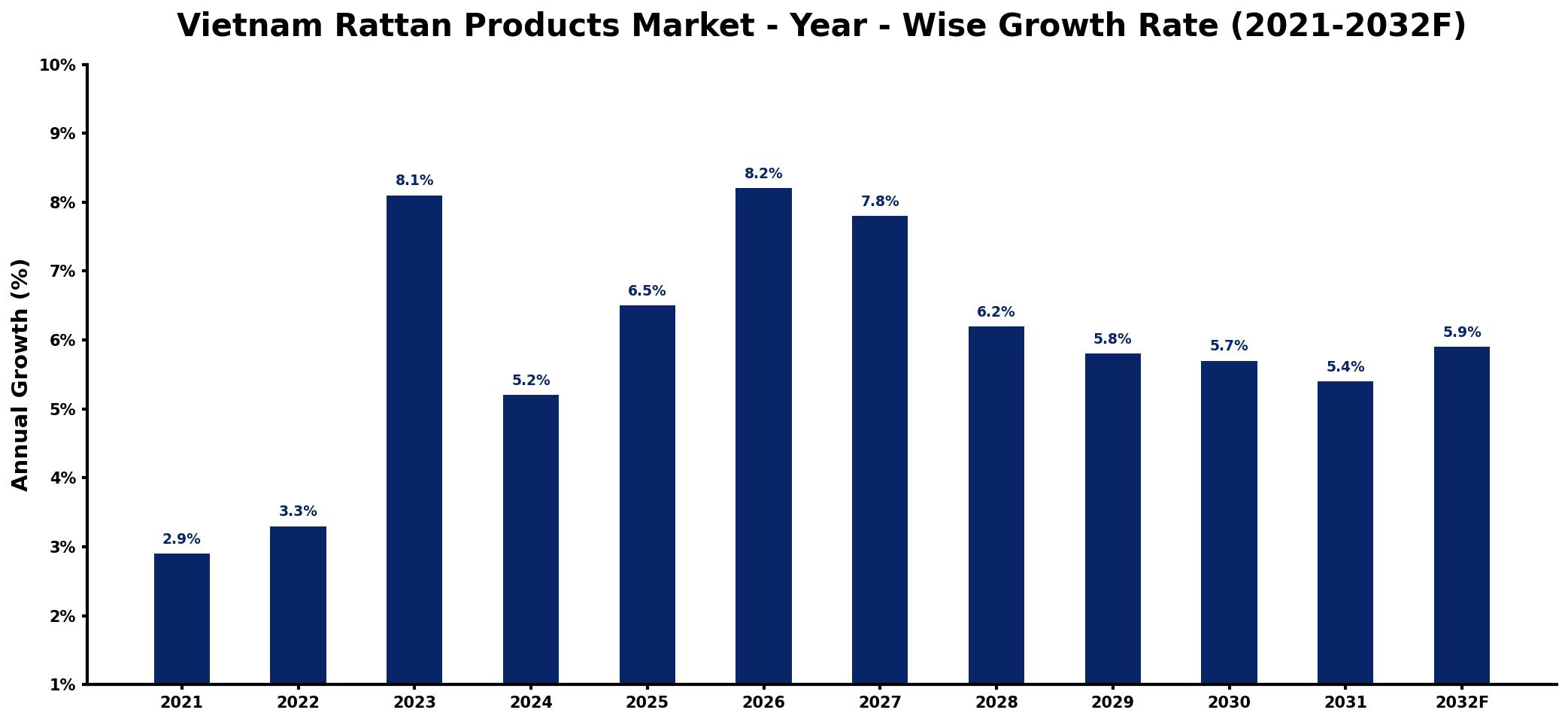
The table below presents the year‑wise growth rates along with the key drivers influencing the market
| Year | Growth Rate | Major Drivers |
| 2021 | 2.9% | Increased consumer interest sustainability |
| 2022 | 3.3% | Growth in eco-friendly home decor |
| 2023 | 8.1% | Rising demand for handmade items |
| 2024 | 5.2% | Expansion of online retail platforms |
| 2025 | 6.5% | Increased investments in craftsmanship |
| 2026 | 8.2% | Growing popularity of outdoor living |
| 2027 | 7.8% | improved raw material availability |
| 2028 | 6.2% | Emergence of new market entrants |
| 2029 | 5.8% | Higher consumer spending on aesthetics |
| 2030 | 5.7% | Increase in export opportunities |
| 2031 | 5.4% | Strengthened focus on artisanal quality |
| 2032 | 5.9% | Growing trend of interior personalization |
Note: Market size estimations and growth projections presented in this report are based on 6Wresearch's proprietary forecasting methodology, utilizing the latest available industry data, government publications, and primary research inputs.
Vietnam Rattan Products Market Synopsis
Craftsmanship is the strongest force shaping the Vietnam rattan products market today. The artisanal nature of rattan weaving and the commitment to sustainability resonate deeply with consumers seeking unique, environmentally friendly decor options. From elegant furniture to intricate handicrafts, rattan products are increasingly seen as both functional and artistic.
The versatility of rattan allows it to be used in various settings, including homes, restaurants, and outdoor spaces. As more individuals and designers gravitate towards natural materials that embody a sense of style and ecological responsibility, the potential for growth in the rattan market becomes even more pronounced.
Vietnam Rattan Products Market Key Takeaways
- The Vietnam rattan products market is driven by rising consumer demand for sustainable and handcrafted items.
- Innovations in design and weaving techniques are enhancing the appeal and functionality of rattan products.
- COVID-19 has influenced consumer preferences, leading to a renewed interest in home decor and improvement projects.
- The eco-friendliness of rattan as a material aligns with global sustainability trends.
- The market landscape is characterized by a diverse range of offerings, from furniture to decorative items.
Evaluation of Restraints in Vietnam Rattan Products Market
Despite its growth prospects, the Vietnam rattan products market faces significant constraints. Competition from synthetic materials and imported furniture poses a threat, as these alternatives often promise lower prices and perceived durability. Additionally, maintaining high standards of product quality while ensuring cost-effectiveness presents ongoing challenges for manufacturers. The industry also grapples with fluctuating raw material costs and the need for sustainable sourcing practices, compelling stakeholders to adapt continuously to market pressures.
Vietnam Rattan Products Market Trends
A notable trend in the Vietnam rattan products market is the growing integration of technology in the design and production processes. This includes the use of digital tools for design innovations and improved weaving techniques that enhance durability without compromising the aesthetic appeal. Furthermore, there's an increasing inclination among consumers toward customized and personalized rattan products, highlighting a demand for individuality in home decor. Additionally, social media platforms are playing a pivotal role in shaping consumer preferences, as rattan products gain visibility and popularity through lifestyle influencers and eco-conscious branding.
Vietnam Rattan Products Market Opportunities
Significant opportunities exist in expanding export markets, as global interest in sustainable and artisanal products rises. Developing partnerships with international retailers and e-commerce platforms can facilitate this growth. Furthermore, tapping into the hospitality sector—such as hotels and restaurants looking to create unique atmospheres with eco-friendly furnishings—presents another promising avenue. Innovating product lines to include multifunctional items can also attract a broader consumer base seeking versatile solutions for modern living.
Government Initiatives in the Vietnam Rattan Products Market
The Vietnamese government has recognized the potential of the rattan industry and is actively promoting sustainable practices through various initiatives. This includes support for research and development aimed at enhancing production techniques and improving product quality. Additionally, programs aimed at increasing the visibility of local artisans and promoting exports are in place. These efforts are bolstered by incentives for eco-friendly practices that align with global sustainability goals, fostering a more robust environment for rattan producers.
Future Insights of the Vietnam Rattan Products Market
Looking ahead to 2026-2032, the Vietnam rattan products market is poised for steady growth driven by a commitment to sustainability and innovation. As the demand for natural materials rises, rattan is likely to become a preferred choice for both consumers and designers. Increasing awareness of environmental issues will further solidify rattan's position as a leading material in furniture and decor. The sector's adaptability to trends and consumer preferences will be crucial in maintaining its growth momentum during this period.
Vietnam Rattan Products Market Latest Developments (2025 - 2026)
In the latest developments, the Vietnam rattan products market is experiencing a surge in collaborative projects between artisans and designers, leading to innovative and unique product offerings. There is also a growing emphasis on sustainable sourcing of rattan, with various initiatives aimed at ensuring ethical harvesting practices. Moreover, increasing participation in international trade fairs has enabled local manufacturers to showcase their craftsmanship and expand their market reach, fostering a more competitive environment.
Vietnam Rattan Products Market - Key Attractiveness of the Report
- 10 Years of Market Numbers
- Historical Data Starting from 2022 to 2025
- Base Year: 2025
- Forecast Data until 2032
- Key Performance Indicators Impacting the Market
- Major Upcoming Developments and Projects
Key Highlights of the Report:
- Vietnam Rattan Products Market Outlook
- Market Size of Vietnam Rattan Products Market, 2025
- Forecast of Vietnam Rattan Products Market, 2032
- Historical Data and Forecast of Vietnam Rattan Products Revenues & Volume for the Period 2022-2032F
- Vietnam Rattan Products Market Trend Evolution
- Vietnam Rattan Products Market Drivers and Challenges
- Vietnam Rattan Products Price Trends
- Vietnam Rattan Products Porter's Five Forces
- Vietnam Rattan Products Industry Life Cycle
- Historical Data and Forecast of Vietnam Rattan Products Market Revenues & Volume By Type for the Period 2022-2032F
- Historical Data and Forecast of Vietnam Rattan Products Market Revenues & Volume By Chair for the Period 2022-2032F
- Historical Data and Forecast of Vietnam Rattan Products Market Revenues & Volume By Table for the Period 2022-2032F
- Historical Data and Forecast of Vietnam Rattan Products Market Revenues & Volume By Storage for the Period 2022-2032F
- Historical Data and Forecast of Vietnam Rattan Products Market Revenues & Volume By Bed for the Period 2022-2032F
- Historical Data and Forecast of Vietnam Rattan Products Market Revenues & Volume By Others for the Period 2022-2032F
- Historical Data and Forecast of Vietnam Rattan Products Market Revenues & Volume By Application for the Period 2022-2032F
- Historical Data and Forecast of Vietnam Rattan Products Market Revenues & Volume By Household for the Period 2022-2032F
- Historical Data and Forecast of Vietnam Rattan Products Market Revenues & Volume By Commerical for the Period 2022-2032F
- Vietnam Rattan Products Import Export Trade Statistics
- Market Opportunity Assessment By Type
- Market Opportunity Assessment By Application
- Vietnam Rattan Products Top Companies Market Share
- Vietnam Rattan Products Competitive Benchmarking By Technical and Operational Parameters
- Vietnam Rattan Products Company Profiles
- Vietnam Rattan Products Key Strategic Recommendations






































