Vietnam Recycled Textiles Market Size, Share & Growth Rate
The Vietnam Recycled Textiles Market was estimated at USD 498 Million in 2025 and is projected to reach USD 704 Million by 2032, growing at a CAGR of 5.1% from 2026 to 2032. This substantial growth trajectory is propelled by a rising consumer consciousness surrounding sustainability and environmental issues. The increasing adoption of eco-friendly practices among manufacturers further fosters this growth, as innovative recycling technologies gain traction within the industry.
Vietnam Recycled Textiles Market Year-wise Growth Rate and Key Drivers
This graph highlights how the Vietnam Recycled Textiles Market has steadily grown over the years, supported by major growth factors.
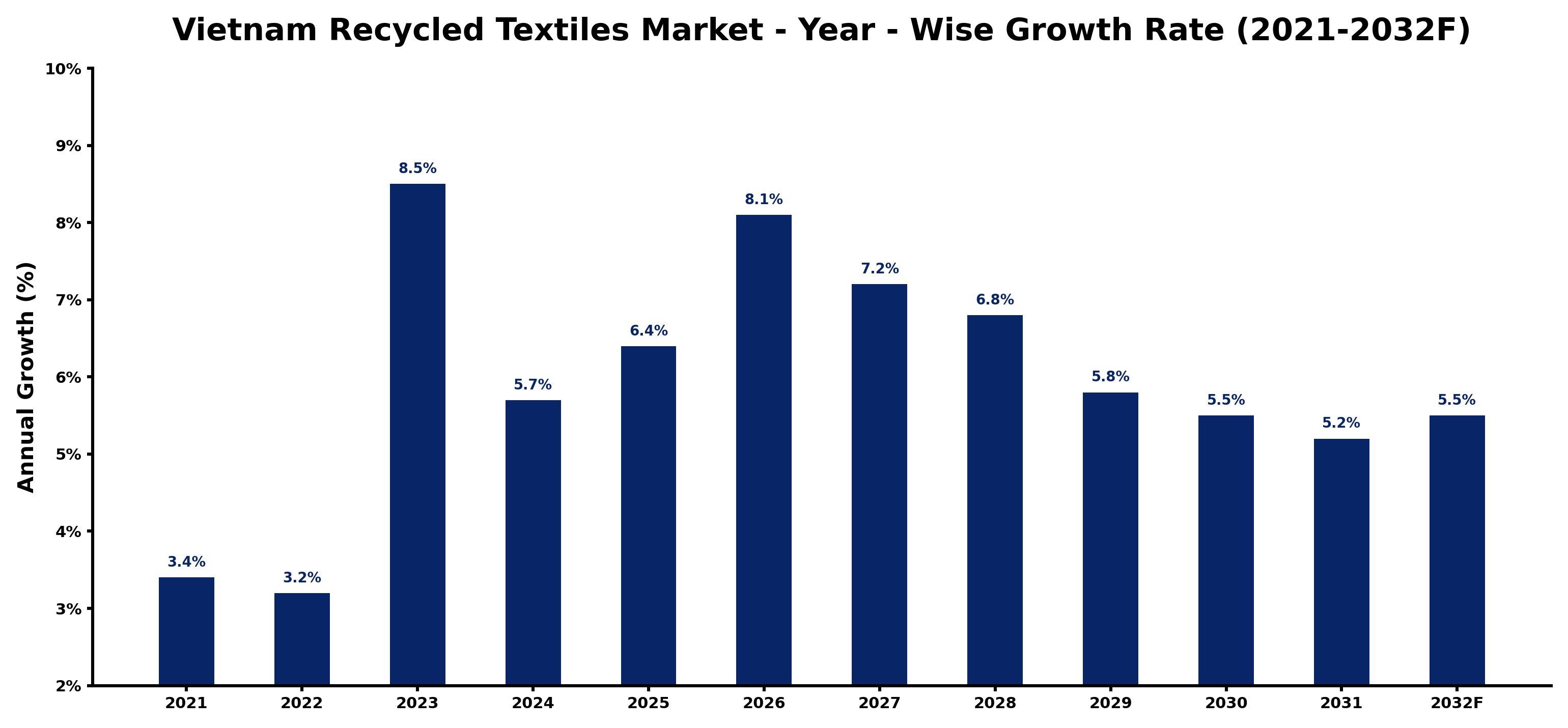
The table below presents the year‑wise growth rates along with the key drivers influencing the market
| Year | Growth Rate | Major Drivers |
| 2021 | 3.4% | Sustainability awareness drove demand |
| 2022 | 3.2% | Government policies encouraged recycling |
| 2023 | 8.5% | Technological advancements improved efficiency |
| 2024 | 5.7% | Consumer preferences shifted towards eco-friendly |
| 2025 | 6.4% | Increased fashion industry collaborations emerged |
| 2026 | 8.1% | Investment in recycling infrastructure expanded |
| 2027 | 7.2% | Circular economy initiatives gained traction |
| 2028 | 6.8% | Global partnerships enhanced market reach |
| 2029 | 5.8% | Innovative product offerings attracted attention |
| 2030 | 5.5% | Brand transparency fostered consumer trust |
| 2031 | 5.2% | Educational campaigns raised awareness |
| 2032 | 5.5% | Export opportunities increased significantly |
Note - Market size estimations and growth projections presented in this report are based on 6Wresearch’s advanced forecasting approach, validated with industry datasets as of June 2026.
Vietnam Recycled Textiles Market Synopsis
The dominant force currently shaping the Vietnam Recycled Textiles Market is a robust consumer demand for sustainable fashion alternatives. As awareness of the environmental impact of textile waste intensifies, consumers are actively seeking clothing options that minimize ecological footprints, catalyzing market expansion.
Additionally, the textile industry is witnessing a shift toward circular economy principles, where materials are reused and repurposed, thereby reducing waste. This transition not only aligns with global sustainability goals but also positions Vietnam as a key player in the regional textile landscape.
Vietnam Recycled Textiles Market Key Takeaways
- The market is driven by increasing consumer awareness of sustainability and environmental impact.
- Innovative recycling technologies are enhancing the efficiency of textile waste processing.
- The development of a circular economy within the textile industry presents unique opportunities.
- Government initiatives are beginning to support sustainable practices in textile production.
- COVID-19 has accelerated the demand for online platforms promoting sustainable fashion.
Evaluation of Restraints in Vietnam Recycled Textiles Market
Despite its growth potential, the Vietnam Recycled Textiles Market faces significant restraints, primarily due to the underdeveloped recycling infrastructure. Limited access to recycled materials hampers manufacturers' ability to meet growing demand. Furthermore, consumer awareness surrounding the benefits of choosing recycled textiles remains low, which can hinder market penetration. Establishing a comprehensive recycling system necessitates substantial investments and strategic shifts in consumer behavior to foster widespread adoption of sustainable products.
Vietnam Recycled Textiles Market Trends
Current trends in the Vietnam Recycled Textiles Market reveal a strong inclination towards transparency in the supply chain, as consumers increasingly demand information on the sourcing and production processes of their garments. The integration of technology, such as blockchain, is emerging to enhance traceability and accountability within the recycling sector. Additionally, partnerships between industry stakeholders are becoming more prevalent, fostering collaboration aimed at improving recycling rates and material recovery.
Vietnam Recycled Textiles Market Opportunities
The genuine growth opportunities within the Vietnam Recycled Textiles Market lie in the development of infrastructure that supports large-scale textile recycling. Investments in advanced recycling technologies and facilities will be crucial for meeting both domestic and international demand. Furthermore, increasing collaborations with fashion brands focused on sustainable practices can pave the way for innovative products and consumer engagement strategies that further elevate the market landscape.
Government Initiatives in the Vietnam Recycled Textiles Market
The Vietnamese government is increasingly recognizing the importance of sustainable practices in the textile industry. Initiatives aimed at encouraging recycling and the use of sustainable materials are becoming more common, with public spending directed towards improving waste management and recycling systems. Programs are being introduced to raise consumer awareness about the benefits of recycled textiles, contributing to a more environmentally responsible market.
Future Insights of the Vietnam Recycled Textiles Market
Looking ahead to the period between 2026 and 2032, the Vietnam Recycled Textiles Market is anticipated to flourish as sustainability continues to take center stage in consumer preferences. Enhanced recycling technologies and infrastructural improvements will drive the availability of recycled materials, thereby creating a more robust supply chain. A heightened focus on circular economy principles will likely transform traditional textile practices, positioning Vietnam as a leading player in sustainable fashion in Southeast Asia.
Vietnam Recycled Textiles Market Latest Developments (May 2025 - June 2026)
Recent developments in the Vietnam Recycled Textiles Market indicate a growing interest among manufacturers to invest in eco-friendly production methods. Collaborative projects focused on technology innovation have emerged, aiming to improve the efficiency of recycling processes. Furthermore, there has been an increase in initiatives promoting sustainable fashion through online platforms, reflecting the changing dynamics of consumer engagement in the post-pandemic market landscape.
Vietnam Recycled Textiles Market - Key Attractiveness of the Report
- 10 Years of Market Numbers
- Historical Data Starting from 2022 to 2025
- Base Year: 2025
- Forecast Data until 2032
- Key Performance Indicators Impacting the Market
- Major Upcoming Developments and Projects
Key Highlights of the Report:
- Vietnam Recycled Textiles Market Outlook
- Market Size of Vietnam Recycled Textiles Market, 2025
- Forecast of Vietnam Recycled Textiles Market, 2032
- Historical Data and Forecast of Vietnam Recycled Textiles Revenues & Volume for the Period 2022-2032F
- Vietnam Recycled Textiles Market Trend Evolution
- Vietnam Recycled Textiles Market Drivers and Challenges
- Vietnam Recycled Textiles Price Trends
- Vietnam Recycled Textiles Porter's Five Forces
- Vietnam Recycled Textiles Industry Life Cycle
- Historical Data and Forecast of Vietnam Recycled Textiles Market Revenues & Volume By Type for the Period 2022-2032F
- Historical Data and Forecast of Vietnam Recycled Textiles Market Revenues & Volume By Recycled Cotton for the Period 2022-2032F
- Historical Data and Forecast of Vietnam Recycled Textiles Market Revenues & Volume By Recycled Wool for the Period 2022-2032F
- Historical Data and Forecast of Vietnam Recycled Textiles Market Revenues & Volume By Recycled Polyester for the Period 2022-2032F
- Historical Data and Forecast of Vietnam Recycled Textiles Market Revenues & Volume By Recycled Nylon for the Period 2022-2032F
- Historical Data and Forecast of Vietnam Recycled Textiles Market Revenues & Volume By Others for the Period 2022-2032F
- Historical Data and Forecast of Vietnam Recycled Textiles Market Revenues & Volume By End-use Industry for the Period 2022-2032F
- Historical Data and Forecast of Vietnam Recycled Textiles Market Revenues & Volume By Automotive for the Period 2022-2032F
- Historical Data and Forecast of Vietnam Recycled Textiles Market Revenues & Volume By Retail for the Period 2022-2032F
- Historical Data and Forecast of Vietnam Recycled Textiles Market Revenues & Volume By Mining for the Period 2022-2032F
- Historical Data and Forecast of Vietnam Recycled Textiles Market Revenues & Volume By Building & Construction for the Period 2022-2032F
- Historical Data and Forecast of Vietnam Recycled Textiles Market Revenues & Volume By Others for the Period 2022-2032F
- Vietnam Recycled Textiles Import Export Trade Statistics
- Market Opportunity Assessment By Type
- Market Opportunity Assessment By End-use Industry
- Vietnam Recycled Textiles Top Companies Market Share
- Vietnam Recycled Textiles Competitive Benchmarking By Technical and Operational Parameters
- Vietnam Recycled Textiles Company Profiles
- Vietnam Recycled Textiles Key Strategic Recommendations






































