Vietnam RegTech Market Size & Growth Rate (2026-2032)
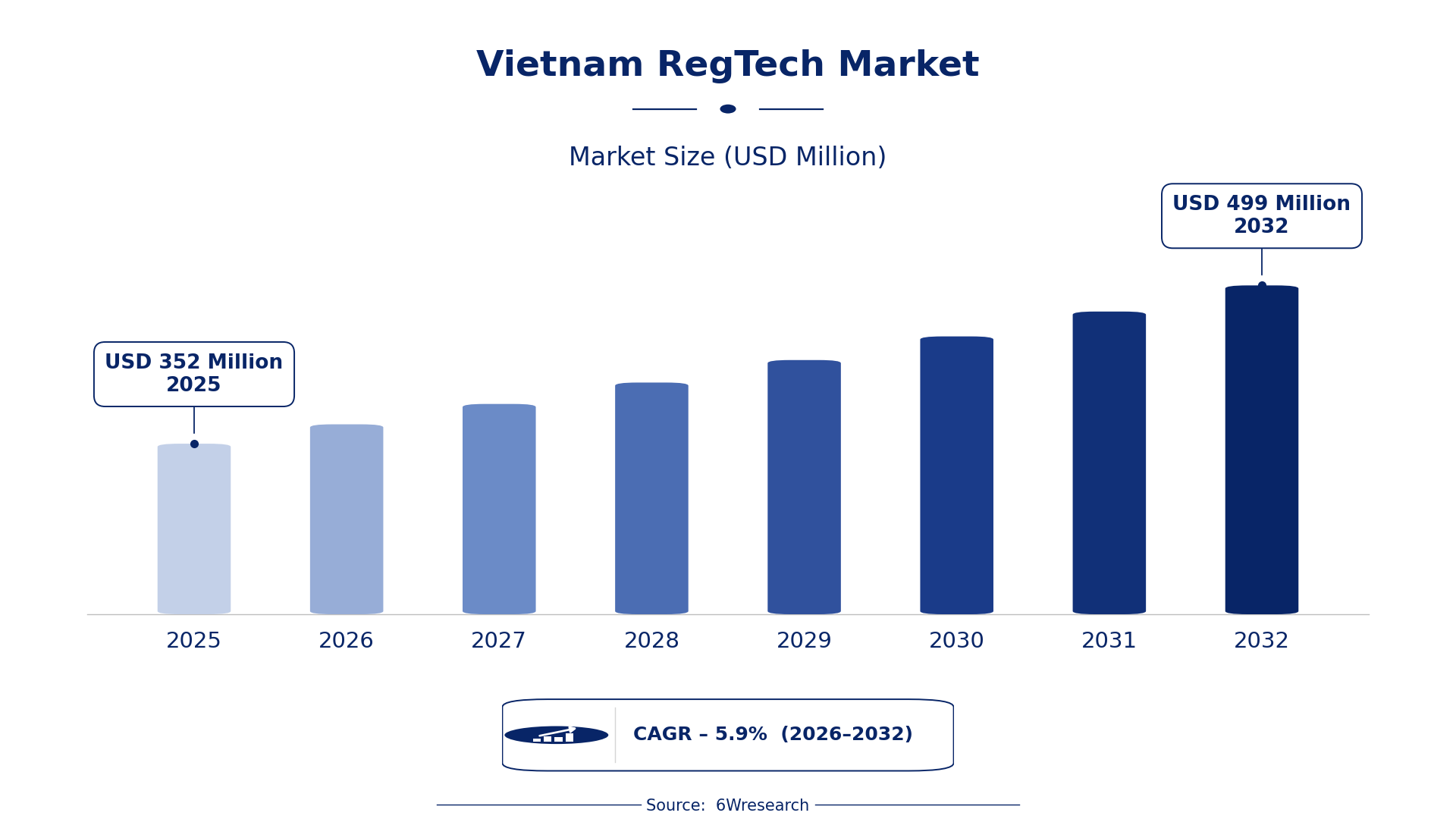
The Vietnam RegTech Market was estimated at USD 352 Million in 2025 and is projected to reach USD 499 Million by 2032, growing at a CAGR of 5.9% from 2026 to 2032.
Vietnam RegTech Market Synopsis
As Vietnam's economy continues to grow, the demand for Regulatory Technology (RegTech) solutions is becoming increasingly pronounced. Industries such as finance and healthcare are under pressure to meet stringent regulatory requirements while minimizing operational costs. This has led to a surge in the adoption of technology that can automate compliance processes, allowing businesses to focus on their core operations.
The trend of digitization is reshaping the regulatory landscape in Vietnam. Companies are seeking advanced tools that utilize artificial intelligence and machine learning to improve compliance efficiency and risk management. This technological shift not only streamlines reporting but also enhances the ability to respond to evolving regulatory standards, creating a more agile business environment.
Vietnam RegTech Market Year-wise Growth Rate and Key Drivers
This graph illustrates the annual growth rates of the Vietnam RegTech Market from 2021 to 2032, highlighting a steady upward trajectory and projected expansion over the forecast period.
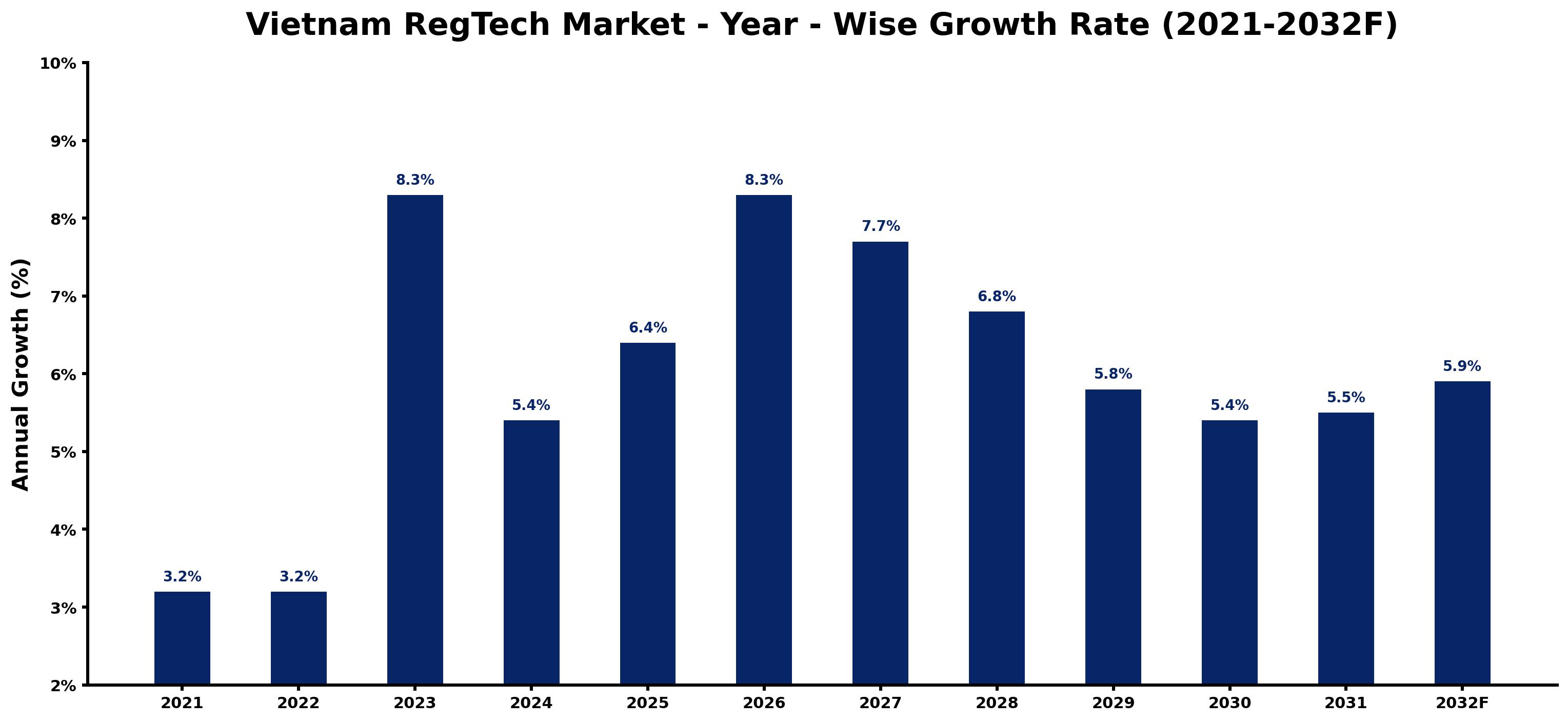
The table below presents the year‑wise growth rates along with the key drivers influencing the market
| Year | Growth Rate | Major Drivers |
| 2021 | 3.2% | New anti-money laundering regulations by SBV introduced. |
| 2022 | 3.2% | Increased digital banking services drive compliance needs. |
| 2023 | 8.3% | Rapid growth in e-commerce amplifies KYC requirements. |
| 2024 | 5.4% | Implementation of national digital transformation strategy supports adoption. |
| 2025 | 6.4% | Emergence of local fintech firms seeking regulatory solutions. |
| 2026 | 8.3% | Government push for digital identity initiatives enhances market. |
| 2027 | 7.7% | Integration of AI technologies in compliance processes grows. |
| 2028 | 6.8% | Rising cybersecurity threats fuel demand for RegTech solutions. |
| 2029 | 5.8% | Investment in data protection laws drives technology adoption. |
| 2030 | 5.4% | Support from the Vietnam National Bank for compliance tech. |
| 2031 | 5.5% | Increased foreign investments necessitate robust regulatory frameworks. |
| 2032 | 5.9% | Development of smart contracts enhances automation in compliance. |
Note: Market size estimations and growth projections presented in this report are based on 6Wresearch's proprietary forecasting methodology, utilizing the latest available industry data, government publications, and primary research inputs.
Vietnam RegTech Market Key Takeaways
Below are some of the specific key takeaways from the market, including:
- The financial services sector is driving the demand for RegTech solutions amid increasing regulatory scrutiny.
- Adoption of AI and machine learning technologies is revolutionizing compliance processes across various industries.
- Data security and privacy concerns are prompting businesses to invest in advanced RegTech tools.
- The COVID-19 pandemic has accelerated the shift toward remote compliance solutions.
- Limited awareness among traditional financial institutions poses challenges for RegTech adoption.
Evaluation of Restraints in Vietnam RegTech Market
The Vietnam RegTech market is confronted by several restraints that can hinder its growth trajectory. The rapidly changing regulatory environment presents a significant challenge for businesses attempting to keep pace with compliance requirements. Financial institutions often grapple with integrating new technology into their existing systems, which can stall progress. Additionally, there is a pronounced need for heightened awareness and education regarding RegTech solutions among these institutions, as reluctance to adopt new technologies can stifle innovation in the sector.
Vietnam RegTech Market Trends
Several trends are emerging that will shape the Vietnam RegTech market in the coming years. The increasing emphasis on data analytics is pushing businesses to adopt tools that provide real-time insights into compliance status. Additionally, partnerships between technology vendors and financial institutions are becoming more common as firms seek tailored solutions to meet specific regulatory challenges. Finally, the growing importance of environmental, social, and governance (ESG) compliance is prompting RegTech solutions to evolve and incorporate ESG-related reporting capabilities.
Vietnam RegTech Market Opportunities
The Vietnam RegTech market is rife with opportunities for growth and investment. As the financial services sector expands, there is a pressing need for solutions that can manage compliance efficiently. Companies that offer innovative, scalable technologies, particularly those that integrate AI and machine learning, are well-positioned to capitalize on this demand. on top of that, there is potential for RegTech solutions to extend into other sectors, such as healthcare and telecommunications, where regulatory requirements are also evolving rapidly.
Government Initiatives in the Vietnam RegTech Market
Government policy plays a crucial role in shaping the Vietnam RegTech market. As the regulatory environment becomes more complex, the government is prioritizing initiatives that promote compliance and enhance data security. These policies are not only aimed at protecting consumers but also at fostering an environment where businesses can thrive amidst stringent regulations.
- A national digital infrastructure upgrade programme launched in 2025 focuses on enhancing compliance capabilities across industries.
- Current efforts are underway to establish a regulatory framework that mandates greater transparency in financial reporting.
- A planned public-private initiative expected to expand access to RegTech solutions is slated for rollout in 2027.
- Recently completed workshops aim to educate financial institutions about the benefits of adopting RegTech solutions.
- The government is currently developing policies to strengthen cybersecurity measures for financial data protection.
Future Insights of the Vietnam RegTech Market
Looking ahead to 2026-2032, the Vietnam RegTech market is expected to continue its upward trajectory, fueled by the growing necessity for compliance and risk management solutions. The integration of advanced technologies such as blockchain and AI will likely transform traditional compliance processes, leading to more efficient operations. As more businesses recognize the value of RegTech, investment in these solutions will become a strategic priority, positioning Vietnam as a key player in the regional RegTech ecosystem.
Vietnam RegTech Market Latest Developments
Recent activity in the Vietnam RegTech market indicates a strong push towards innovation and improved compliance mechanisms. Over the past year, various initiatives and partnerships have emerged, aiming to enhance regulatory compliance and address market needs.
- A major technology vendor launched a new AI-driven compliance monitoring tool in early 2025, aimed at financial institutions.
- In mid-2025, a partnership between leading banks and a RegTech provider was announced, focused on developing solutions for anti-money laundering compliance.
- Upcoming in late 2026, a consortium of financial institutions plans to introduce a shared compliance database to streamline reporting processes.
- A regional operator initiated a pilot programme for a blockchain-based compliance solution in Q3 2025, which is currently ongoing.
- By early 2026, a new educational initiative is expected to launch, aimed at improving awareness of RegTech solutions among traditional financial institutions.
Vietnam RegTech Market - Key Attractiveness of the Report
- 10 Years of Market Numbers
- Historical Data Starting from 2022 to 2025
- Base Year: 2025
- Forecast Data until 2032
- Key Performance Indicators Impacting the Market
- Major Upcoming Developments and Projects
Key Highlights of the Report:
- Vietnam RegTech Market Outlook
- Market Size of Vietnam RegTech Market, 2025
- Forecast of Vietnam RegTech Market, 2032
- Historical Data and Forecast of Vietnam RegTech Revenues & Volume for the Period 2022-2032F
- Vietnam RegTech Market Trend Evolution
- Vietnam RegTech Market Drivers and Challenges
- Vietnam RegTech Price Trends
- Vietnam RegTech Porter's Five Forces
- Vietnam RegTech Industry Life Cycle
- Historical Data and Forecast of Vietnam RegTech Market Revenues & Volume By Component for the Period 2022-2032F
- Historical Data and Forecast of Vietnam RegTech Market Revenues & Volume By Solutions for the Period 2022-2032F
- Historical Data and Forecast of Vietnam RegTech Market Revenues & Volume By Services for the Period 2022-2032F
- Historical Data and Forecast of Vietnam RegTech Market Revenues & Volume By Application for the Period 2022-2032F
- Historical Data and Forecast of Vietnam RegTech Market Revenues & Volume By Risk & Compliance Management for the Period 2022-2032F
- Historical Data and Forecast of Vietnam RegTech Market Revenues & Volume By Identity Management for the Period 2022-2032F
- Historical Data and Forecast of Vietnam RegTech Market Revenues & Volume By Regulatory Reporting for the Period 2022-2032F
- Historical Data and Forecast of Vietnam RegTech Market Revenues & Volume By AML and Fraud Management for the Period 2022-2032F
- Historical Data and Forecast of Vietnam RegTech Market Revenues & Volume By Regulatory Intelligence for the Period 2022-2032F
- Historical Data and Forecast of Vietnam RegTech Market Revenues & Volume By Organization Size for the Period 2022-2032F
- Historical Data and Forecast of Vietnam RegTech Market Revenues & Volume By SMEs for the Period 2022-2032F
- Historical Data and Forecast of Vietnam RegTech Market Revenues & Volume By Large Enterprises for the Period 2022-2032F
- Historical Data and Forecast of Vietnam RegTech Market Revenues & Volume By Deployment Mode for the Period 2022-2032F
- Historical Data and Forecast of Vietnam RegTech Market Revenues & Volume By On-Premises for the Period 2022-2032F
- Historical Data and Forecast of Vietnam RegTech Market Revenues & Volume By Cloud for the Period 2022-2032F
- Historical Data and Forecast of Vietnam RegTech Market Revenues & Volume By Vertical for the Period 2022-2032F
- Historical Data and Forecast of Vietnam RegTech Market Revenues & Volume By Banking for the Period 2022-2032F
- Historical Data and Forecast of Vietnam RegTech Market Revenues & Volume By Insurance for the Period 2022-2032F
- Historical Data and Forecast of Vietnam RegTech Market Revenues & Volume By Non-Financial for the Period 2022-2032F
- Vietnam RegTech Import Export Trade Statistics
- Market Opportunity Assessment By Component
- Market Opportunity Assessment By Application
- Market Opportunity Assessment By Organization Size
- Market Opportunity Assessment By Deployment Mode
- Market Opportunity Assessment By Vertical
- Vietnam RegTech Top Companies Market Share
- Vietnam RegTech Competitive Benchmarking By Technical and Operational Parameters
- Vietnam RegTech Company Profiles
- Vietnam RegTech Key Strategic Recommendations






































