Vietnam Residential Boiler Market Size, Share & Growth Rate
The Vietnam Residential Boiler Market was estimated at USD 542 Million in 2025 and is projected to reach USD 769 Million by 2032, growing at a CAGR of 5.1% from 2026 to 2032. This impressive growth trajectory can be attributed to urbanization trends, the rising middle-class population, and a growing demand for energy-efficient heating solutions across Vietnam. As consumers increasingly prioritize comfort and sustainability, the residential boiler market is set to thrive, fueled by both technological advancements and government initiatives promoting energy efficiency.
Vietnam Residential Boiler Market Year-wise Growth Rate and Key Drivers
This graph highlights how the Vietnam Residential Boiler Market has steadily grown over the years, supported by major growth factors.
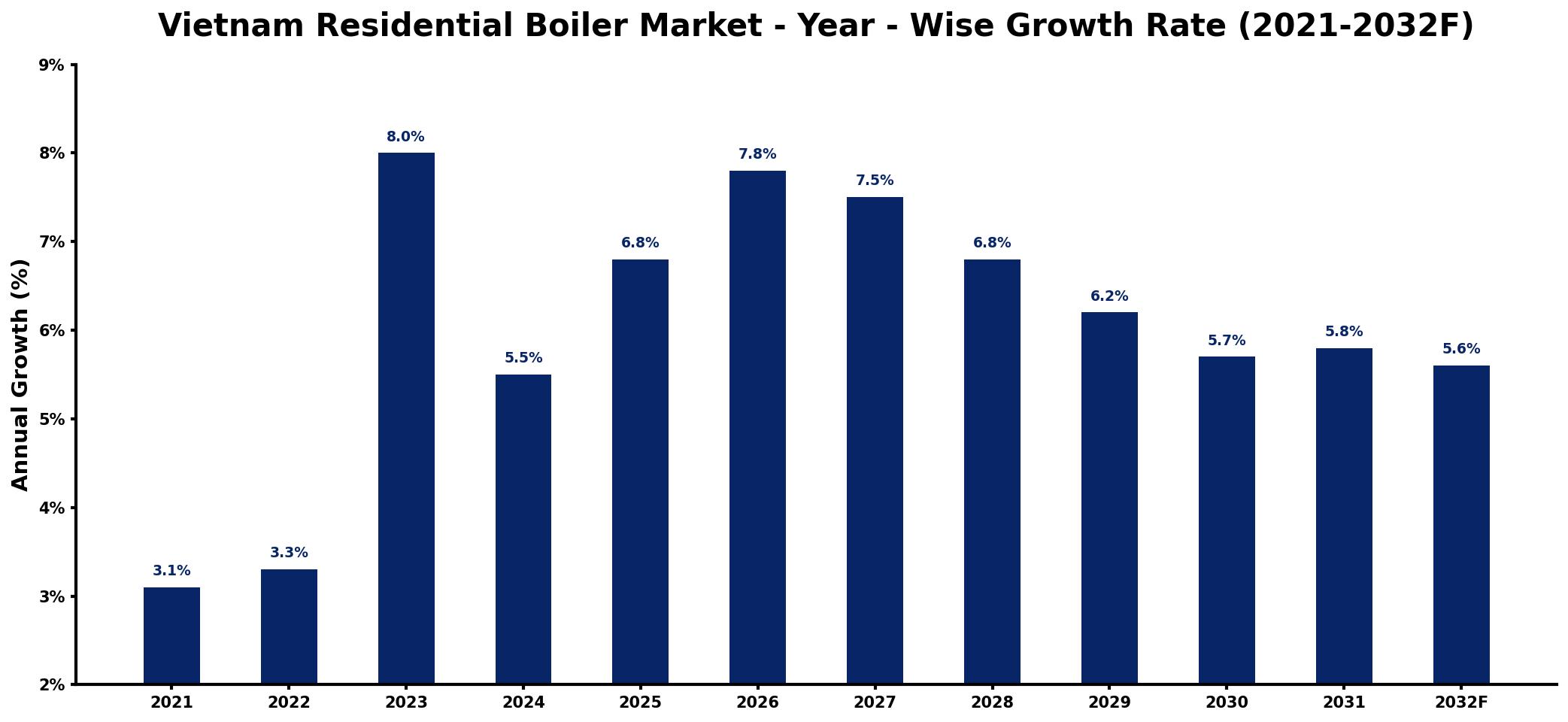
The table below presents the year‑wise growth rates along with the key drivers influencing the market
| Year | Growth Rate | Major Drivers |
| 2021 | 3.1% | Rising energy efficiency standards |
| 2022 | 3.3% | Increased urbanization and construction |
| 2023 | 8.0% | Growing focus on renewable energy |
| 2024 | 5.5% | increased domestic production output |
| 2025 | 6.8% | Surge in energy consumption rates |
| 2026 | 7.8% | Investment in sustainable technologies |
| 2027 | 7.5% | Development of smart home solutions |
| 2028 | 6.8% | Government incentives for modernization |
| 2029 | 6.2% | Higher consumer awareness on efficiency |
| 2030 | 5.7% | Increased disposable income levels |
| 2031 | 5.8% | Technological advancements in heating |
| 2032 | 5.6% | Enhanced environmental regulations compliance |
Note: Market size estimations and growth projections presented in this report are based on 6Wresearch's proprietary forecasting methodology, utilizing the latest available industry data, government publications, and primary research inputs.
Vietnam Residential Boiler Market Synopsis
In recent years, the Vietnam residential boiler market has experienced significant momentum, driven by increased urbanization and evolving consumer expectations regarding heating solutions. This momentum is poised to carry forward, with a clear trajectory pointing towards a robust expansion fueled by both market demand and regulatory support.
Looking ahead, the market is expected to benefit from advancements in energy-efficient technologies, which align with both consumer preferences and governmental objectives for sustainable development. As the residential sector evolves, manufacturers are likely to innovate further, providing eco-friendly solutions that cater to the growing emphasis on environmental consciousness.
Vietnam Residential Boiler Market Key Takeaways
- The market is driven by urbanization and the growing middle class seeking efficient heating solutions.
- Government initiatives aimed at promoting energy efficiency will further accelerate market growth.
- Manufacturers are focusing on developing eco-friendly and energy-efficient boiler solutions.
- Seasonal demand patterns create challenges for production planning and inventory management.
- Competition from alternative heating solutions necessitates innovation within the residential boiler market.
Evaluation of Restraints in Vietnam Residential Boiler Market
The residential boiler market in Vietnam grapples with various restraints that could hinder its growth. One significant concern is the stringent energy efficiency and environmental regulations aimed at reducing carbon emissions and improving air quality. Manufacturers are pressured to develop cleaner-burning technologies, which may increase production costs. Furthermore, the presence of alternative heating solutions, such as heat pumps and solar water heaters, poses a competitive threat, forcing traditional boiler manufacturers to differentiate their offerings. Additionally, ensuring affordability and accessibility for diverse socioeconomic groups remains a critical challenge that needs to be addressed to achieve widespread market adoption.
Vietnam Residential Boiler Market Trends
Several trends are shaping the Vietnam residential boiler market. The increasing shift towards energy-efficient systems is becoming more pronounced as consumers become more environmentally conscious. Additionally, manufacturers are investing in smart technology to enhance user convenience and system efficiency. There is also a growing preference for modular and compact boiler designs that cater to urban homes with limited space. Finally, the integration of renewable energy sources into boiler systems is emerging as a significant trend, reflecting a broader commitment to sustainability within the residential sector.
Vietnam Residential Boiler Market Opportunities
The Vietnam residential boiler market presents genuine growth opportunities, particularly in the realm of energy-efficient and eco-friendly solutions. With the government's focus on sustainability and green technology, there is potential for innovation in boiler design and functionality. Furthermore, expanding urban areas and the ongoing construction of residential buildings will drive demand for modern heating systems. Investments in research and development can also yield new product offerings that meet the evolving needs of consumers, positioning manufacturers to capture larger market shares.
Government Initiatives in the Vietnam Residential Boiler Market
The Vietnamese government is actively supporting the residential boiler market through initiatives that promote energy efficiency and sustainable practices. Policies aimed at reducing the carbon footprint and improving air quality encourage manufacturers to adopt cleaner technologies. Additionally, public spending on infrastructure and housing development is boosting demand for residential boilers. Incentives for the adoption of energy-efficient appliances further underline the government's commitment to enhancing living standards while addressing environmental concerns.
Future Insights of the Vietnam Residential Boiler Market
Looking forward, the Vietnam residential boiler market is on a promising path from 2026 to 2032. As urbanization continues to reshape living conditions, the demand for efficient heating solutions is likely to rise. Innovations in energy-efficient technologies and eco-friendly practices will play a critical role in this evolution. Manufacturers who can adapt to regulatory changes and consumer expectations will not only thrive but also contribute to a more sustainable future in the residential heating sector.
Vietnam Residential Boiler Market Latest Developments (2025 - 2026)
Recently, the residential boiler market in Vietnam has been characterized by a surge in innovation and the introduction of advanced heating solutions. Manufacturers are increasingly focusing on energy-efficient designs and smart technologies, catering to the demands of environmentally conscious consumers. Simultaneously, regulatory frameworks are evolving, pushing companies to align their offerings with sustainability goals. This period is marked by a strong recovery from pandemic-related setbacks, as housing projects gain momentum and consumer confidence improves, driving renewed interest in residential boiler installations.
Vietnam Residential Boiler Market - Key Attractiveness of the Report
- 10 Years of Market Numbers
- Historical Data Starting from 2022 to 2025
- Base Year: 2025
- Forecast Data until 2032
- Key Performance Indicators Impacting the Market
- Major Upcoming Developments and Projects
Key Highlights of the Report:
- Vietnam Residential Boiler Market Outlook
- Market Size of Vietnam Residential Boiler Market, 2025
- Forecast of Vietnam Residential Boiler Market, 2032
- Historical Data and Forecast of Vietnam Residential Boiler Revenues & Volume for the Period 2022-2032F
- Vietnam Residential Boiler Market Trend Evolution
- Vietnam Residential Boiler Market Drivers and Challenges
- Vietnam Residential Boiler Price Trends
- Vietnam Residential Boiler Porter's Five Forces
- Vietnam Residential Boiler Industry Life Cycle
- Historical Data and Forecast of Vietnam Residential Boiler Market Revenues & Volume By Type for the Period 2022-2032F
- Historical Data and Forecast of Vietnam Residential Boiler Market Revenues & Volume By Water Tube Boiler for the Period 2022-2032F
- Historical Data and Forecast of Vietnam Residential Boiler Market Revenues & Volume By Fire Tube Boiler for the Period 2022-2032F
- Historical Data and Forecast of Vietnam Residential Boiler Market Revenues & Volume By Electric Boiler for the Period 2022-2032F
- Historical Data and Forecast of Vietnam Residential Boiler Market Revenues & Volume By Fuel Type for the Period 2022-2032F
- Historical Data and Forecast of Vietnam Residential Boiler Market Revenues & Volume By Coal Fired for the Period 2022-2032F
- Historical Data and Forecast of Vietnam Residential Boiler Market Revenues & Volume By Oil Fired for the Period 2022-2032F
- Historical Data and Forecast of Vietnam Residential Boiler Market Revenues & Volume By Gas Fired for the Period 2022-2032F
- Historical Data and Forecast of Vietnam Residential Boiler Market Revenues & Volume By Others for the Period 2022-2032F
- Historical Data and Forecast of Vietnam Residential Boiler Market Revenues & Volume By Technology for the Period 2022-2032F
- Historical Data and Forecast of Vietnam Residential Boiler Market Revenues & Volume By Condensing for the Period 2022-2032F
- Historical Data and Forecast of Vietnam Residential Boiler Market Revenues & Volume By Non-condensing for the Period 2022-2032F
- Vietnam Residential Boiler Import Export Trade Statistics
- Market Opportunity Assessment By Type
- Market Opportunity Assessment By Fuel Type
- Market Opportunity Assessment By Technology
- Vietnam Residential Boiler Top Companies Market Share
- Vietnam Residential Boiler Competitive Benchmarking By Technical and Operational Parameters
- Vietnam Residential Boiler Company Profiles
- Vietnam Residential Boiler Key Strategic Recommendations






































