Vietnam Retail And Wholesale Market Size, Share & Growth Rate
The Vietnam Retail And Wholesale Market was estimated at USD 607 Million in 2025 and is projected to reach USD 996 Million by 2032, growing at a CAGR of 7.3% from 2026 to 2032. This upward trajectory is largely driven by the burgeoning middle-class demographic, which significantly enhances consumer purchasing power and drives demand for a wide array of products. Moreover, the rapid adoption of e-commerce platforms and improvements in logistics are facilitating more seamless shopping experiences across the nation.
Vietnam Retail And Wholesale Market Year-wise Growth Rate and Key Drivers
This graph highlights how the Vietnam Retail And Wholesale Market has steadily grown over the years, supported by major growth factors.
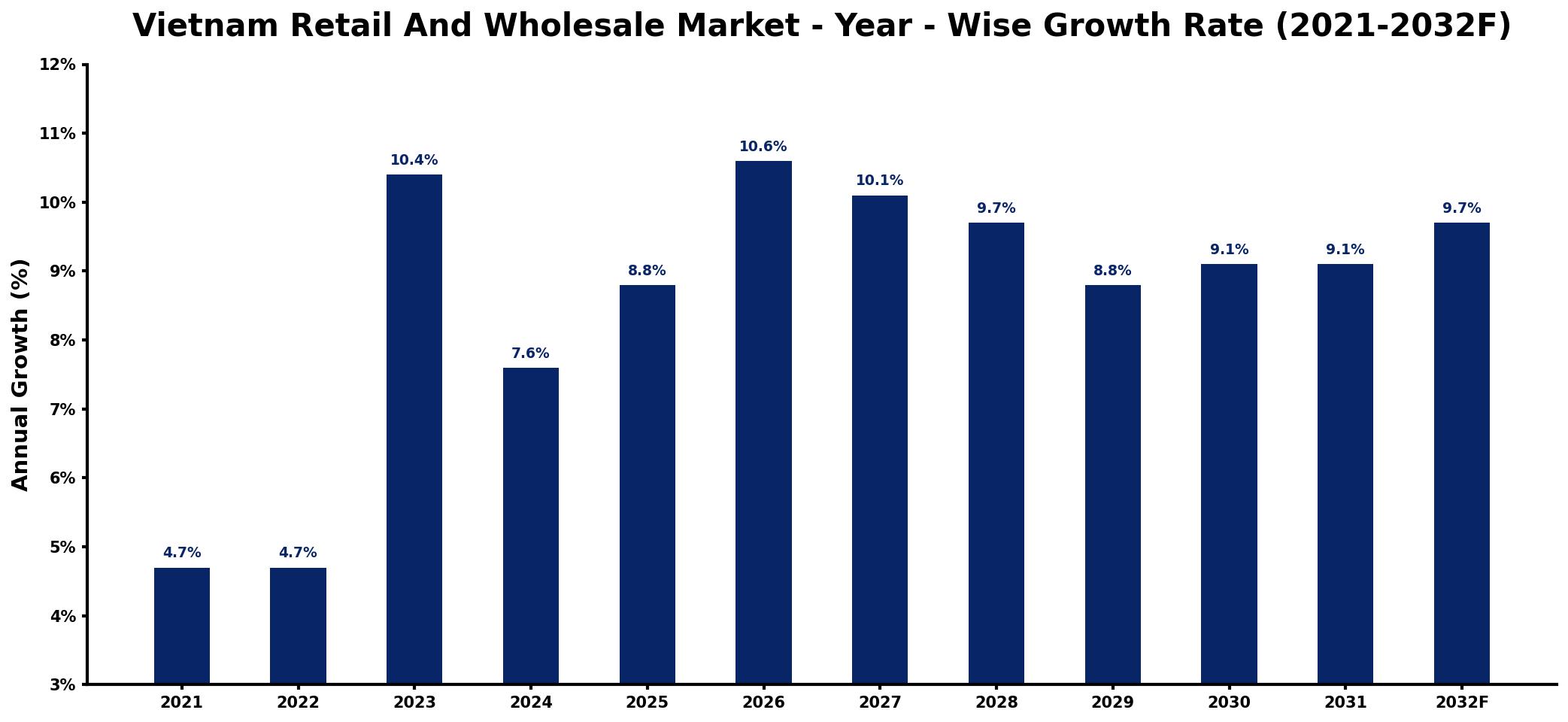
The table below presents the year‑wise growth rates along with the key drivers influencing the market
| Year | Growth Rate | Major Drivers |
| 2021 | 4.7% | Rising consumer spending patterns |
| 2022 | 4.7% | Expansion of e-commerce platforms |
| 2023 | 10.4% | Increased foreign investment influx |
| 2024 | 7.6% | Growth in urbanization trends |
| 2025 | 8.8% | Boost in disposable income levels |
| 2026 | 10.6% | Technological advancements in logistics |
| 2027 | 10.1% | Diversification of product offerings |
| 2028 | 9.7% | Strengthening of distribution networks |
| 2029 | 8.8% | Emergence of health-conscious consumers |
| 2030 | 9.1% | Adoption of sustainable practices |
| 2031 | 9.1% | Enhanced customer experience initiatives |
| 2032 | 9.7% | Growing popularity of local brands |
Note: Market size estimations and growth projections presented in this report are based on 6Wresearch's proprietary forecasting methodology, utilizing the latest available industry data, government publications, and primary research inputs.
Vietnam Retail And Wholesale Market Synopsis
The Vietnam Retail And Wholesale Market is characterized by a dynamic shift towards modern retail formats, with an increasing number of consumers turning to both physical stores and digital channels for their shopping needs. This evolution is underscored by a rising preference for convenience, as consumers seek streamlined access to a broad assortment of goods ranging from electronics to fresh produce.
In addition to the vibrant participation of local players, international retailers are also establishing a significant foothold, intensifying competition within the market. This heightened rivalry stimulates innovation and diversification, ensuring that customers are presented with increasingly attractive options and pricing.
Vietnam Retail And Wholesale Market Key Takeaways
- The market is on a strong growth trajectory, driven by a rising middle-class population.
- E-commerce is transforming traditional retail landscapes, enhancing consumer convenience.
- Infrastructure improvements are facilitating better supply chain efficiencies.
- Domestic and international retailers are actively shaping a competitive environment.
- COVID-19 has accelerated shifts towards digital shopping, creating lasting changes in consumer behavior.
Evaluation of Restraints in Vietnam Retail And Wholesale Market
Despite its rapid growth, the Vietnam Retail And Wholesale Market faces several key restraints. Changing consumer preferences and the swift shift to online shopping represent significant hurdles for traditional retailers. Furthermore, persistent supply chain disruptions can hinder product availability, challenging businesses to maintain consistent customer satisfaction. As retailers adapt, finding a balance between brick-and-mortar operations and a robust online presence becomes increasingly essential for sustainable growth.
Vietnam Retail And Wholesale Market Trends
The landscape of the Vietnam Retail And Wholesale Market is currently shaped by several trends. The rise of omnichannel retailing is evident, as businesses merge online and offline strategies to cater to evolving consumer expectations. Additionally, digital payment solutions are becoming mainstream, further facilitating online transactions. Sustainability is also gaining traction, with consumers increasingly seeking eco-friendly products and practices, prompting retailers to rethink their sourcing and operational strategies.
Vietnam Retail And Wholesale Market Opportunities
Opportunities in the Vietnam Retail And Wholesale Market are abundant, particularly in the realm of e-commerce. Businesses that effectively harness technology to enhance customer experience—through personalized marketing, improved logistics, and seamless payment processes—stand to capture significant market share. Additionally, the rural consumer base presents untapped potential as infrastructure continues to develop, providing avenues for expansion into less saturated regions.
Government Initiatives in the Vietnam Retail And Wholesale Market
The Vietnamese government is implementing various initiatives to support the retail and wholesale sector. Policies focused on enhancing infrastructure, logistics, and digital payment adoption are paramount. Additionally, investments in technology and training programs are aimed at equipping businesses with the necessary tools to adapt to evolving market dynamics. Overall, these government efforts are designed to foster a more competitive and resilient retail landscape.
Future Insights of the Vietnam Retail And Wholesale Market
Looking ahead to 2026-2032, the Vietnam Retail And Wholesale Market is poised for substantial growth. Increasing urbanization and a younger demographic will continue to drive demand, while advancements in technology will further enhance the shopping experience. The continuous integration of digital solutions into traditional retail environments will be crucial. Furthermore, as businesses navigate the complexities of supply chain management, a focus on sustainability and resilience will emerge as core strategies for success.
Vietnam Retail And Wholesale Market Latest Developments (2025 - 2026)
Recent developments within the Vietnam Retail And Wholesale Market indicate a concerted shift towards digitalization, as many retailers ramp up their online platforms to meet changing consumer preferences. The growing emphasis on contactless shopping options has led to significant investments in technology and logistics. Additionally, as physical store operations gradually normalize post-COVID-19, businesses are adopting hybrid models that blend in-store experiences with digital conveniences, reshaping the retail environment for the future.
Vietnam Retail And Wholesale Market - Key Attractiveness of the Report
- 10 Years of Market Numbers
- Historical Data Starting from 2022 to 2025
- Base Year: 2025
- Forecast Data until 2032
- Key Performance Indicators Impacting the Market
- Major Upcoming Developments and Projects
Key Highlights of the Report:
- Vietnam Retail And Wholesale Market Outlook
- Market Size of Vietnam Retail And Wholesale Market, 2025
- Forecast of Vietnam Retail And Wholesale Market, 2032
- Historical Data and Forecast of Vietnam Retail And Wholesale Revenues & Volume for the Period 2022-2032F
- Vietnam Retail And Wholesale Market Trend Evolution
- Vietnam Retail And Wholesale Market Drivers and Challenges
- Vietnam Retail And Wholesale Price Trends
- Vietnam Retail And Wholesale Porter's Five Forces
- Vietnam Retail And Wholesale Industry Life Cycle
- Historical Data and Forecast of Vietnam Retail And Wholesale Market Revenues & Volume By Type for the Period 2022-2032F
- Historical Data and Forecast of Vietnam Retail And Wholesale Market Revenues & Volume By Retail for the Period 2022-2032F
- Historical Data and Forecast of Vietnam Retail And Wholesale Market Revenues & Volume By Wholesale for the Period 2022-2032F
- Historical Data and Forecast of Vietnam Retail And Wholesale Market Revenues & Volume By Ownership for the Period 2022-2032F
- Historical Data and Forecast of Vietnam Retail And Wholesale Market Revenues & Volume By Retail Chain/Wholesale Chain for the Period 2022-2032F
- Historical Data and Forecast of Vietnam Retail And Wholesale Market Revenues & Volume By Independent Retailer/Independent Wholesalers for the Period 2022-2032F
- Historical Data and Forecast of Vietnam Retail And Wholesale Market Revenues & Volume By Price Range for the Period 2022-2032F
- Historical Data and Forecast of Vietnam Retail And Wholesale Market Revenues & Volume By Premium for the Period 2022-2032F
- Historical Data and Forecast of Vietnam Retail And Wholesale Market Revenues & Volume By Mid-Range for the Period 2022-2032F
- Historical Data and Forecast of Vietnam Retail And Wholesale Market Revenues & Volume By Economy for the Period 2022-2032F
- Historical Data and Forecast of Vietnam Retail And Wholesale Market Revenues & Volume By Distribution Channel for the Period 2022-2032F
- Historical Data and Forecast of Vietnam Retail And Wholesale Market Revenues & Volume By Supermarkets/Hypermarkets for the Period 2022-2032F
- Historical Data and Forecast of Vietnam Retail And Wholesale Market Revenues & Volume By Convenience Stores for the Period 2022-2032F
- Historical Data and Forecast of Vietnam Retail And Wholesale Market Revenues & Volume By Department Stores for the Period 2022-2032F
- Historical Data and Forecast of Vietnam Retail And Wholesale Market Revenues & Volume By Specialty Stores for the Period 2022-2032F
- Vietnam Retail And Wholesale Import Export Trade Statistics
- Market Opportunity Assessment By Type
- Market Opportunity Assessment By Ownership
- Market Opportunity Assessment By Price Range
- Market Opportunity Assessment By Distribution Channel
- Vietnam Retail And Wholesale Top Companies Market Share
- Vietnam Retail And Wholesale Competitive Benchmarking By Technical and Operational Parameters
- Vietnam Retail And Wholesale Company Profiles
- Vietnam Retail And Wholesale Key Strategic Recommendations






































