Vietnam Roofing Underlay Market Size, Share & Growth Rate
The Vietnam Roofing Underlay Market was estimated at USD 319 Million in 2025 and is projected to reach USD 449 Million by 2032, growing at a CAGR of 5.0% from 2026 to 2032. This growth trajectory is driven by the ongoing expansion of the construction sector across residential, commercial, and industrial projects, which is fueled by urbanization and infrastructure development initiatives. Additionally, heightened awareness around the need for durable and weather-resistant underlay materials, given Vietnam's diverse climate conditions, is further supporting market growth.
Vietnam Roofing Underlay Market Year-wise Growth Rate and Key Drivers
This graph highlights how the Vietnam Roofing Underlay Market has steadily grown over the years, supported by major growth factors.
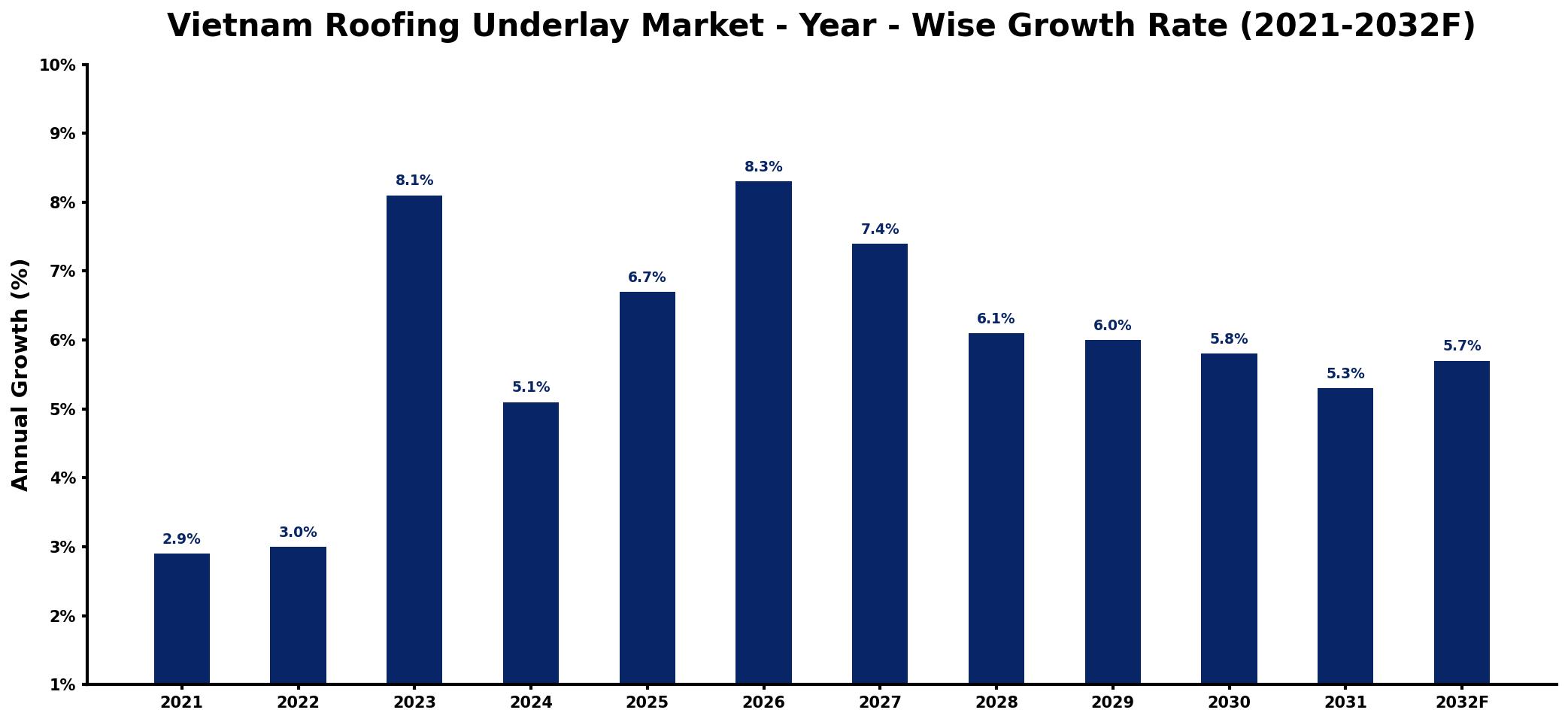
The table below presents the year‑wise growth rates along with the key drivers influencing the market
| Year | Growth Rate | Major Drivers |
| 2021 | 2.9% | Construction sector recovery momentum |
| 2022 | 3.0% | Increased residential building projects |
| 2023 | 8.1% | Surge in infrastructure investments |
| 2024 | 5.1% | Growing urbanization trends observed |
| 2025 | 6.7% | Expansion of commercial real estate |
| 2026 | 8.3% | Rising demand for eco-friendly materials |
| 2027 | 7.4% | Technological advancements in construction |
| 2028 | 6.1% | Government incentives for housing development |
| 2029 | 6.0% | Strengthened supply chain efficiencies |
| 2030 | 5.8% | Increased awareness of building standards |
| 2031 | 5.3% | Enhanced product innovation initiatives |
| 2032 | 5.7% | Sustained growth in renovation projects |
Note: Market size estimations and growth projections presented in this report are based on 6Wresearch's proprietary forecasting methodology, utilizing the latest available industry data, government publications, and primary research inputs.
Vietnam Roofing Underlay Market Synopsis
The strongest force shaping the Vietnam Roofing Underlay Market right now is the booming construction industry. As this sector continues to grow, so does the demand for high-quality roofing underlay materials that provide moisture protection and insulation, crucial for ensuring the longevity of roofing systems. Furthermore, the increasing frequency of extreme weather events has spotlighted the necessity for superior waterproofing solutions, compelling manufacturers to innovate.
The market dynamics are also shifting with a growing emphasis on sustainable construction practices. As builders and consumers alike become more environmentally conscious, there is a distinct shift towards eco-friendly underlay materials. This evolving trend presents an opportunity for manufacturers to develop advanced products that cater to both performance and environmental standards, further contributing to the market's resilience and growth.
Vietnam Roofing Underlay Market Key Takeaways
- The market is poised for significant growth driven by the expansion of the construction sector and infrastructure projects.
- Durable and weather-resistant roofing underlay materials are increasingly in demand due to Vietnam's variable climate.
- Urbanization is a key factor accelerating the need for improved roofing systems across various types of buildings.
- Manufacturers are focusing on sustainable materials in response to evolving consumer preferences.
- The market has shown resilience in its recovery post-COVID-19, highlighting the importance of quality and durability in roofing systems.
Evaluation of Restraints in Vietnam Roofing Underlay Market
The Vietnam Roofing Underlay Market faces several constraints that could impact its growth trajectory. Consumer preferences for specific roofing materials can influence the demand for underlay, sometimes favoring alternatives that may not require the same level of protective features. Moreover, the competition with cost-effective roofing solutions could pose a challenge for premium underlay materials, necessitating a strategic focus on demonstrating the long-term value and performance benefits of quality underlays. Additionally, fluctuations in raw material prices may affect overall pricing strategies, further complicating market dynamics.
Vietnam Roofing Underlay Market Trends
Current trends in the Vietnam Roofing Underlay Market include a growing adoption of eco-friendly materials as part of the broader global movement towards sustainability. Manufacturers are increasingly integrating recycled materials into their products, catering to environmentally conscious consumers and builders. Technological advancements are also shaping product development, with innovations such as breathable underlay membranes that enhance roof performance. Furthermore, the adoption of smart construction practices and digital tools in the construction industry is influencing the way underlay materials are manufactured and integrated into roofing systems.
Vietnam Roofing Underlay Market Opportunities
The future of the Vietnam Roofing Underlay Market holds numerous growth and investment opportunities. With the government's emphasis on infrastructure development and urbanization, there is a sustained need for robust roofing solutions in new construction projects. Additionally, the rise in renovation and retrofitting activities presents a lucrative market for advanced underlay materials that can meet modern building standards. Companies focusing on R&D to innovate durable and sustainable roofing underlay options can capitalize on the growing consumer shift towards high-quality products.
Government Initiatives in the Vietnam Roofing Underlay Market
The Vietnamese government has undertaken several initiatives aimed at boosting the construction sector, which directly influences the roofing underlay market. Policies promoting sustainable building practices, along with public investments in infrastructure and housing developments, are essential for market growth. Additionally, there are various programs encouraging the use of eco-friendly materials in construction, aligning with global sustainability goals. Such initiatives not only stimulate market demand but also pave the way for innovations that support environmental stewardship in building practices.
Future Insights of the Vietnam Roofing Underlay Market
Looking ahead to 2026-2032, the Vietnam Roofing Underlay Market is expected to maintain a positive growth trajectory. The convergence of urbanization, infrastructure investment, and rising consumer demand for quality roofing solutions will drive market expansion. As climate awareness escalates, manufacturers will likely prioritize developing high-performance, sustainable underlay materials that align with evolving regulatory standards and consumer preferences. The market is set to benefit from the integration of innovative technologies, ensuring that roofing underlays not only protect buildings but also contribute to overall energy efficiency.
Vietnam Roofing Underlay Market Latest Developments (2025 - 2026)
Recent developments in the Vietnam Roofing Underlay Market have highlighted a growing focus on innovative solutions and sustainable practices. Companies are exploring partnerships to enhance product offerings and leverage advancements in material science. Additionally, there is a noticeable trend towards integrating digital technologies into production processes, optimizing efficiency and reducing costs. As the industry emerges from the challenges posed by the pandemic, there is a renewed emphasis on quality and durability, with many manufacturers updating their product lines to meet these heightened expectations.
Vietnam Roofing Underlay Market - Key Attractiveness of the Report
- 10 Years of Market Numbers
- Historical Data Starting from 2022 to 2025
- Base Year: 2025
- Forecast Data until 2032
- Key Performance Indicators Impacting the Market
- Major Upcoming Developments and Projects
Key Highlights of the Report:
- Vietnam Roofing Underlay Market Outlook
- Market Size of Vietnam Roofing Underlay Market, 2025
- Forecast of Vietnam Roofing Underlay Market, 2032
- Historical Data and Forecast of Vietnam Roofing Underlay Revenues & Volume for the Period 2022-2032F
- Vietnam Roofing Underlay Market Trend Evolution
- Vietnam Roofing Underlay Market Drivers and Challenges
- Vietnam Roofing Underlay Price Trends
- Vietnam Roofing Underlay Porter's Five Forces
- Vietnam Roofing Underlay Industry Life Cycle
- Historical Data and Forecast of Vietnam Roofing Underlay Market Revenues & Volume By Product for the Period 2022-2032F
- Historical Data and Forecast of Vietnam Roofing Underlay Market Revenues & Volume By Asphalt-saturated felt for the Period 2022-2032F
- Historical Data and Forecast of Vietnam Roofing Underlay Market Revenues & Volume By Rubberized asphalt for the Period 2022-2032F
- Historical Data and Forecast of Vietnam Roofing Underlay Market Revenues & Volume By Non-bitumen synthetic for the Period 2022-2032F
- Historical Data and Forecast of Vietnam Roofing Underlay Market Revenues & Volume By Application for the Period 2022-2032F
- Historical Data and Forecast of Vietnam Roofing Underlay Market Revenues & Volume By Residential construction for the Period 2022-2032F
- Historical Data and Forecast of Vietnam Roofing Underlay Market Revenues & Volume By Non-residential construction for the Period 2022-2032F
- Vietnam Roofing Underlay Import Export Trade Statistics
- Market Opportunity Assessment By Product
- Market Opportunity Assessment By Application
- Vietnam Roofing Underlay Top Companies Market Share
- Vietnam Roofing Underlay Competitive Benchmarking By Technical and Operational Parameters
- Vietnam Roofing Underlay Company Profiles
- Vietnam Roofing Underlay Key Strategic Recommendations






































