Vietnam Sail Canvas Market Size, Share & Growth Rate
The Vietnam Sail Canvas Market was estimated at USD 393 Million in 2025 and is projected to reach USD 642 Million by 2032, growing at a CAGR of 7.3% from 2026 to 2032. This growth trajectory is largely attributed to the burgeoning interests in sailing, windsurfing, and related water sports among both locals and tourists. Additionally, advancements in manufacturing processes have led to more durable and efficient sail canvas options, significantly enhancing their appeal in an increasingly competitive landscape.
Vietnam Sail Canvas Market Year-wise Growth Rate and Key Drivers
This graph highlights how the Vietnam Sail Canvas Market has steadily grown over the years, supported by major growth factors.
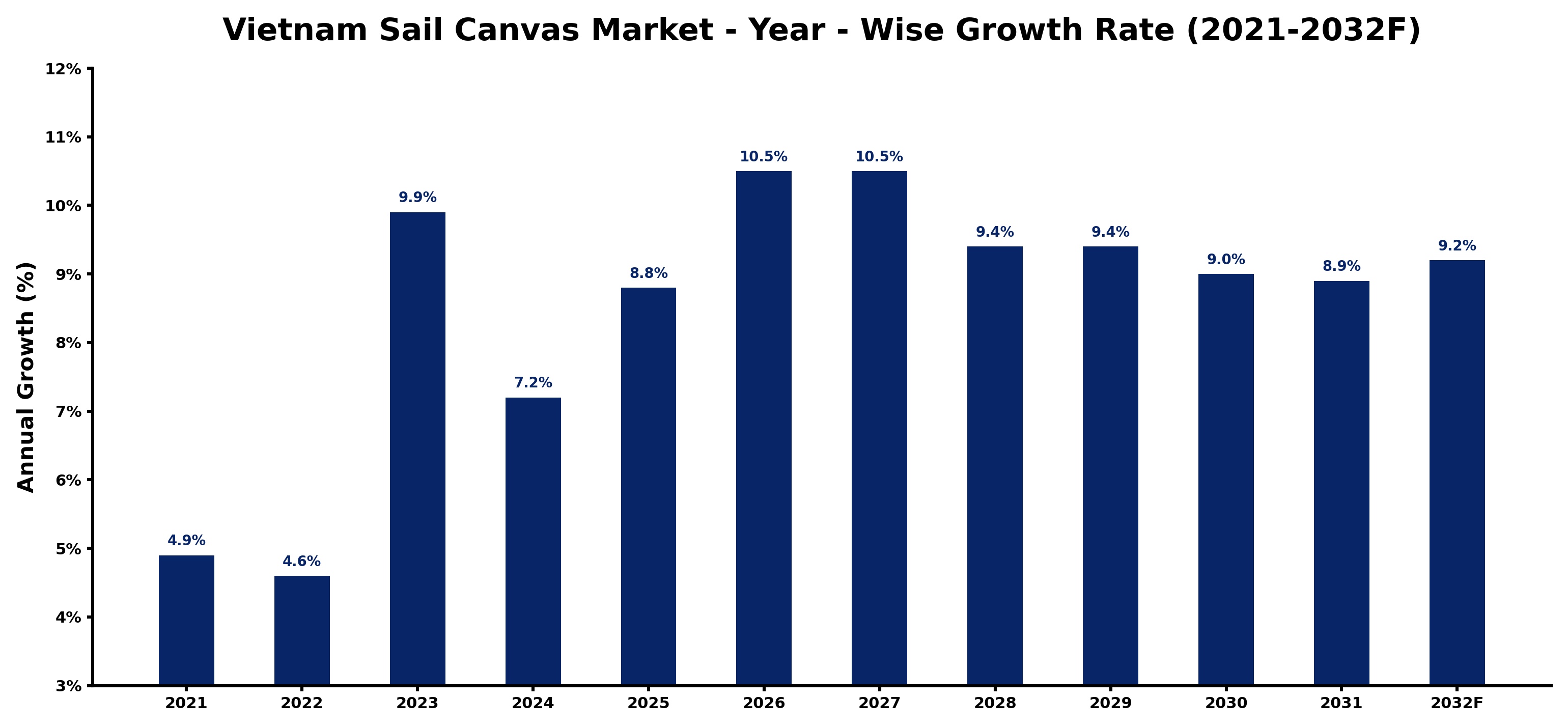
The table below presents the year‑wise growth rates along with the key drivers influencing the market
| Year | Growth Rate | Major Drivers |
| 2021 | 4.9% | Foreign investments boosted local production capacity for sail canvas |
| 2022 | 4.6% | Technology adoption in sail canvas production boosted export capacity |
| 2023 | 9.9% | New foreign investments boost Vietnam's sail canvas production capabilities |
| 2024 | 7.2% | Increased investment in advanced textiles boosts sail canvas production |
| 2025 | 8.8% | Increased automotive assembly demand drives sail canvas production efficiency |
| 2026 | 10.5% | Export demand for Vietnam sail canvas boosted production capacity investments |
| 2027 | 10.5% | Automotive assembly investments boost demand for advanced sail canvas production |
| 2028 | 9.4% | Foreign direct investments boost advanced textile manufacturing capabilities in Vietnam |
| 2029 | 9.4% | Foreign investments boost local sail production capabilities and exports |
| 2030 | 9.0% | Increased demand for marine textiles boosts sail canvas production volumes |
| 2031 | 8.9% | Domestic textile machinery upgrades boosted sail canvas production efficiency |
| 2032 | 9.2% | Foreign direct investments boost production capacity for export sails |
Note - Market size estimations and growth projections presented in this report are based on 6Wresearch's advanced forecasting approach, validated with industry datasets as of June 2026.
Vietnam Sail Canvas Market Synopsis
The demand for sail canvas in Vietnam is notably influenced by the country's rich maritime heritage, which promotes various water-based activities. As Vietnamese coastal tourism flourishes, sailing enthusiasts are driving the market to evolve and adapt to higher performance standards.
Supply dynamics are also changing, as manufacturers increasingly incorporate sustainable practices into production processes. This shift not only appeals to eco-conscious consumers but also aligns with global trends towards sustainability in the textile industry.
Vietnam Sail Canvas Market Key Takeaways
- Market growth is primarily driven by rising participation in water sports and maritime tourism.
- Advancements in material technology enhance the durability and performance of sail canvas.
- Sustainability practices in manufacturing are becoming pivotal for market competitiveness.
- Tourism growth in coastal areas is a significant driver of demand for sail canvas products.
- The industry is adapting to the challenges posed by synthetic materials and fluctuating raw material prices.
Evaluation of Restraints in Vietnam Sail Canvas Market
Despite its growth potential, the Vietnam Sail Canvas market faces significant restraints. One of the primary challenges is the increasing competition from synthetic materials like nylon and polyester, which often offer superior durability and lower maintenance requirements. This trend threatens traditional sail canvas manufacturers that rely on natural fabrics. Furthermore, raw material price volatility, particularly for cotton and linen, poses a continual risk, as fluctuations can significantly impact production costs and profit margins. Lastly, climate change introduces additional unpredictability into the market, affecting crop yields and the longevity of outdoor products.
Vietnam Sail Canvas Market Trends
Several trends are shaping the Vietnam Sail Canvas market today. First, there is a clear shift towards lightweight and high-performance materials that enhance sailing efficiency. Innovations in material science are paving the way for fabrics that not only reduce weight but also improve weather resistance. Furthermore, the rise of eco-conscious consumerism has led to an increased demand for sustainable canvas options, urging manufacturers to invest in greener production processes.
The integration of technology within sailing experiences, such as smart sails equipped with sensors, is also becoming prevalent, further stimulating the need for advanced sail materials that can accommodate such innovations. As the market adapts, we see a convergence of traditional craftsmanship and modern technology enhancing the sailing experience.
Vietnam Sail Canvas Market Opportunities
The market is brimming with opportunities for growth and investment. With Vietnam's coastal regions continuing to attract both domestic and international tourists, there is immense potential to cater to this audience with high-quality sail canvas products. Additionally, the burgeoning interest in sustainable practices opens avenues for manufacturers to differentiate themselves through eco-friendly offerings. Lastly, as the government invests in maritime infrastructure, new business prospects will emerge, particularly in the realm of tourism-oriented marine services.
Government Initiatives in the Vietnam Sail Canvas Market
The Vietnamese government has implemented various initiatives aimed at bolstering the maritime sector, which directly benefits the sail canvas market. These include investments in coastal infrastructure, the promotion of nautical tourism, and programs aimed at enhancing environmental sustainability in the marine industry. Such public spending not only encourages tourism but also fosters a more vibrant market for sailing-related products, thereby supporting local manufacturers.
Future Insights of the Vietnam Sail Canvas Market
Looking ahead to 2026-2032, the Vietnam Sail Canvas Market is set for promising growth. As interest in sailing continues to rise, driven by both leisure and sport, the demand for high-quality canvas is expected to increase correspondingly. The ongoing technological advancements in sail manufacturing will likely enhance product offerings, creating a more robust market environment. Moreover, the convergence of eco-friendly practices with modern textile technologies will continue to open new pathways for innovation, solidifying Vietnam's position in the global sail canvas industry.
Vietnam Sail Canvas Market Latest Developments (May 2025 - June 2026)
Recent developments in the Vietnam Sail Canvas market indicate a focus on integrating sustainable practices into production processes. Several manufacturers are exploring new materials and techniques that enhance the environmental friendliness of sail canvas products. This shift is being driven by both consumer preferences and regulatory changes aimed at promoting sustainability within the textile industry. Additionally, the market is witnessing increased collaboration between local manufacturers and international suppliers, enhancing the overall competitiveness of Vietnam's sail canvas offerings.
Vietnam Sail Canvas Market - Key Attractiveness of the Report
- 10 Years of Market Numbers
- Historical Data Starting from 2022 to 2025
- Base Year: 2025
- Forecast Data until 2032
- Key Performance Indicators Impacting the Market
- Major Upcoming Developments and Projects
Key Highlights of the Report:
- Vietnam Sail Canvas Market Outlook
- Market Size of Vietnam Sail Canvas Market, 2025
- Forecast of Vietnam Sail Canvas Market, 2032
- Historical Data and Forecast of Vietnam Sail Canvas Revenues & Volume for the Period 2022-2032F
- Vietnam Sail Canvas Market Trend Evolution
- Vietnam Sail Canvas Market Drivers and Challenges
- Vietnam Sail Canvas Price Trends
- Vietnam Sail Canvas Porter's Five Forces
- Vietnam Sail Canvas Industry Life Cycle
- Historical Data and Forecast of Vietnam Sail Canvas Market Revenues & Volume By Type for the Period 2022-2032F
- Historical Data and Forecast of Vietnam Sail Canvas Market Revenues & Volume By 8 Ann Canvas for the Period 2022-2032F
- Historical Data and Forecast of Vietnam Sail Canvas Market Revenues & Volume By 12 Ann Canvas for the Period 2022-2032F
- Historical Data and Forecast of Vietnam Sail Canvas Market Revenues & Volume By Polyester Canvas for the Period 2022-2032F
- Historical Data and Forecast of Vietnam Sail Canvas Market Revenues & Volume By Others for the Period 2022-2032F
- Historical Data and Forecast of Vietnam Sail Canvas Market Revenues & Volume By Application for the Period 2022-2032F
- Historical Data and Forecast of Vietnam Sail Canvas Market Revenues & Volume By Sailing for the Period 2022-2032F
- Historical Data and Forecast of Vietnam Sail Canvas Market Revenues & Volume By Yacht for the Period 2022-2032F
- Historical Data and Forecast of Vietnam Sail Canvas Market Revenues & Volume By Others for the Period 2022-2032F
- Vietnam Sail Canvas Import Export Trade Statistics
- Market Opportunity Assessment By Type
- Market Opportunity Assessment By Application
- Vietnam Sail Canvas Top Companies Market Share
- Vietnam Sail Canvas Competitive Benchmarking By Technical and Operational Parameters
- Vietnam Sail Canvas Company Profiles
- Vietnam Sail Canvas Key Strategic Recommendations






































