Vietnam Self-Driving Truck Market Size, Share & Growth Rate
The Vietnam Self-Driving Truck Market was estimated at USD 410 Million in 2025 and is projected to reach USD 583 Million by 2032, growing at a CAGR of 5.2% from 2026 to 2032. This growth trajectory is fueled by a burgeoning e-commerce sector and increasing demand for efficient logistics solutions. Additionally, the ongoing shortage of skilled drivers is prompting the industry to explore autonomous options as a viable alternative to meet rising transportation needs.
Vietnam Self-Driving Truck Market Year-wise Growth Rate and Key Drivers
This graph highlights how the Vietnam Self-Driving Truck Market has steadily grown over the years, supported by major growth factors.
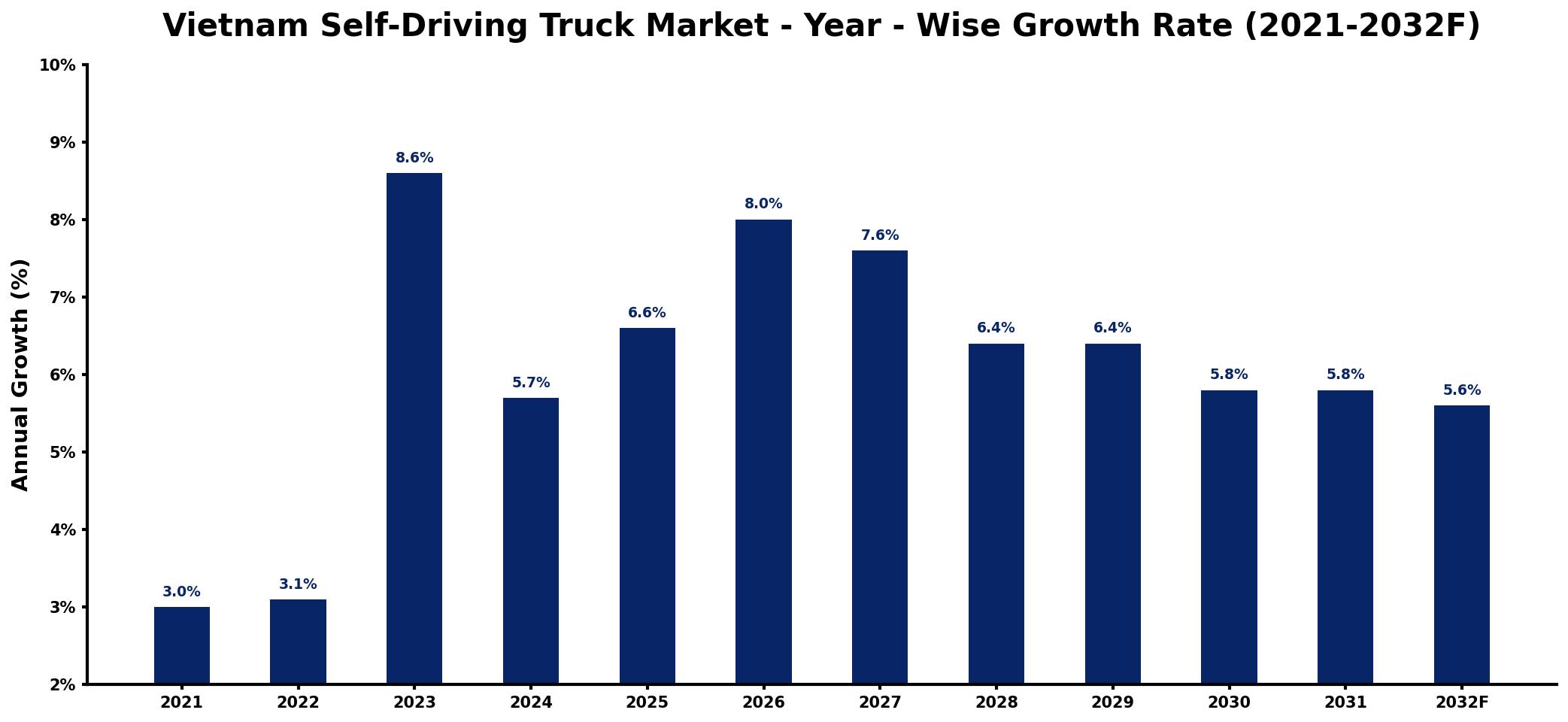
The table below presents the year‑wise growth rates along with the key drivers influencing the market
| Year | Growth Rate | Major Drivers |
| 2021 | 3.0% | Rise in logistics sector demand |
| 2022 | 3.1% | Increased investment in automation |
| 2023 | 8.6% | Growth in e-commerce logistics |
| 2024 | 5.7% | Expansion of smart infrastructure projects |
| 2025 | 6.6% | Surge in freight efficiency needs |
| 2026 | 8.0% | Heightened focus on sustainability initiatives |
| 2027 | 7.6% | Development of advanced technologies |
| 2028 | 6.4% | Growing urbanization and population |
| 2029 | 6.4% | Enhanced regulatory support measures |
| 2030 | 5.8% | Strengthened supply chain resilience |
| 2031 | 5.8% | Broadening applications in agriculture |
| 2032 | 5.6% | Increased demand for logistics solutions |
Note: Market size estimations and growth projections presented in this report are based on 6Wresearch's proprietary forecasting methodology, utilizing the latest available industry data, government publications, and primary research inputs.
Vietnam Self-Driving Truck Market Synopsis
The strongest force shaping the Vietnam Self-Driving Truck Market is the pressing need for enhanced logistics efficiency. As the countrys economy continues to expand, the demand for innovative transport solutions becomes increasingly critical to address cost pressures and improve operational effectiveness.
Moreover, government initiatives aimed at fostering autonomous vehicle technology are set to play a crucial role in shaping this market's landscape. The proactive stance taken by authorities will not only facilitate technological advancements but also encourage stakeholder investment, further solidifying the foundation for growth in this sector.
Vietnam Self-Driving Truck Market Key Takeaways
- The market is driven by the urgent need for efficient logistics solutions in light of growing e-commerce.
- Advancements in AI and sensor technology are enhancing the safety and reliability of self-driving trucks.
- Government regulations and incentives are essential for promoting the adoption of autonomous vehicles.
- The market is currently grappling with the need for a robust regulatory framework and public acceptance.
- Investment in infrastructure development is critical for the successful implementation of self-driving truck technologies.
Evaluation of Restraints in Vietnam Self-Driving Truck Market
Despite its promising prospects, the Vietnam Self-Driving Truck Market faces several substantial restraints. Establishing a comprehensive regulatory framework remains a primary challenge, as stakeholders seek clarity on safety standards and liability concerns. Public acceptance is another significant hurdle; many individuals harbor skepticism about the reliability of autonomous vehicles, necessitating proactive education and communication strategies. Furthermore, the requirement for high-definition mapping and reliable infrastructure is critical for safe navigation, yet this remains underdeveloped in many regions. The industry must also contend with cybersecurity threats that could compromise the safety of self-driving systems and the implications of job displacement as automation gains traction.
Vietnam Self-Driving Truck Market Trends
Current trends within the Vietnam Self-Driving Truck Market include an increased focus on integrating advanced AI capabilities into logistics operations. Companies are investing in innovative technologies, such as machine learning algorithms, to optimize route planning and improve delivery efficiency. Additionally, there is a growing collaboration between private sector entities and governmental bodies to develop supportive policies for autonomous vehicle deployment. Emerging partnerships aim to address infrastructural challenges while enhancing public confidence in self-driving technology, which is crucial for market acceptance.
Vietnam Self-Driving Truck Market Opportunities
The genuine growth opportunities within the Vietnam Self-Driving Truck Market lie in the intersection of technology and logistics. The e-commerce boom creates a pressing demand for faster, cost-effective delivery solutions that self-driving trucks can provide. Furthermore, investment in research and development is essential to bolster advancements in autonomous driving technology, presenting avenues for both startups and established players. Additionally, as the government continues to develop regulations, aligning with local authorities can unlock significant market entry advantages for companies venturing into this space.
Government Initiatives in the Vietnam Self-Driving Truck Market
The Vietnamese government is increasingly recognizing the potential of autonomous vehicle technologies, instituting various initiatives to spur innovation in this area. These include policies designed to promote research and development, as well as incentives for companies that invest in autonomous transportation solutions. Public spending on infrastructure improvements is also being allocated to facilitate the deployment of self-driving technologies, indicating a long-term commitment to embracing this transformative industry.
Future Insights of the Vietnam Self-Driving Truck Market
Looking ahead to the period from 2026 to 2032, the Vietnam Self-Driving Truck Market is anticipated to evolve significantly. With technological advancements continuing to progress, the integration of self-driving trucks into the logistics ecosystem will likely become more prevalent. Regulatory frameworks are expected to mature, providing a clearer pathway for industry players and fostering greater public acceptance. As the economy grows and demands for efficient logistics solutions rise, the market is set to leverage these dynamics, ultimately leading to enhanced operational efficiencies and a reshaped transportation landscape.
Vietnam Self-Driving Truck Market Latest Developments (2025 - 2026)
Recent developments in the Vietnam Self-Driving Truck Market include a series of pilot projects focusing on autonomous delivery logistics. Companies are collaborating with local authorities to establish controlled environments for testing, ensuring safety while gathering data to refine operational capabilities. Additionally, technological enhancements in sensor and AI applications are being prioritized to address efficiency and reliability concerns. These developments mark a significant step forward in demonstrating the practical viability of self-driving trucks in Vietnams evolving logistics landscape.
Vietnam Self-Driving Truck Market - Key Attractiveness of the Report
- 10 Years of Market Numbers
- Historical Data Starting from 2022 to 2025
- Base Year: 2025
- Forecast Data until 2032
- Key Performance Indicators Impacting the Market
- Major Upcoming Developments and Projects
Key Highlights of the Report:
- Vietnam Self-Driving Truck Market Outlook
- Market Size of Vietnam Self-Driving Truck Market, 2025
- Forecast of Vietnam Self-Driving Truck Market, 2032
- Historical Data and Forecast of Vietnam Self-Driving Truck Revenues & Volume for the Period 2022-2032F
- Vietnam Self-Driving Truck Market Trend Evolution
- Vietnam Self-Driving Truck Market Drivers and Challenges
- Vietnam Self-Driving Truck Price Trends
- Vietnam Self-Driving Truck Porter's Five Forces
- Vietnam Self-Driving Truck Industry Life Cycle
- Historical Data and Forecast of Vietnam Self-Driving Truck Market Revenues & Volume By Level Of Autonomy for the Period 2022-2032F
- Historical Data and Forecast of Vietnam Self-Driving Truck Market Revenues & Volume By Level One for the Period 2022-2032F
- Historical Data and Forecast of Vietnam Self-Driving Truck Market Revenues & Volume By Level Two for the Period 2022-2032F
- Historical Data and Forecast of Vietnam Self-Driving Truck Market Revenues & Volume By Level Three for the Period 2022-2032F
- Historical Data and Forecast of Vietnam Self-Driving Truck Market Revenues & Volume By Level Four for the Period 2022-2032F
- Historical Data and Forecast of Vietnam Self-Driving Truck Market Revenues & Volume By Industry Verticals for the Period 2022-2032F
- Historical Data and Forecast of Vietnam Self-Driving Truck Market Revenues & Volume By Logistics for the Period 2022-2032F
- Historical Data and Forecast of Vietnam Self-Driving Truck Market Revenues & Volume By Construction & Manufacturing for the Period 2022-2032F
- Historical Data and Forecast of Vietnam Self-Driving Truck Market Revenues & Volume By Mining for the Period 2022-2032F
- Historical Data and Forecast of Vietnam Self-Driving Truck Market Revenues & Volume By Port for the Period 2022-2032F
- Vietnam Self-Driving Truck Import Export Trade Statistics
- Market Opportunity Assessment By Level Of Autonomy
- Market Opportunity Assessment By Industry Verticals
- Vietnam Self-Driving Truck Top Companies Market Share
- Vietnam Self-Driving Truck Competitive Benchmarking By Technical and Operational Parameters
- Vietnam Self-Driving Truck Company Profiles
- Vietnam Self-Driving Truck Key Strategic Recommendations






































