Vietnam Service Delivery Automation Market Size & Growth Rate (2026-2032)
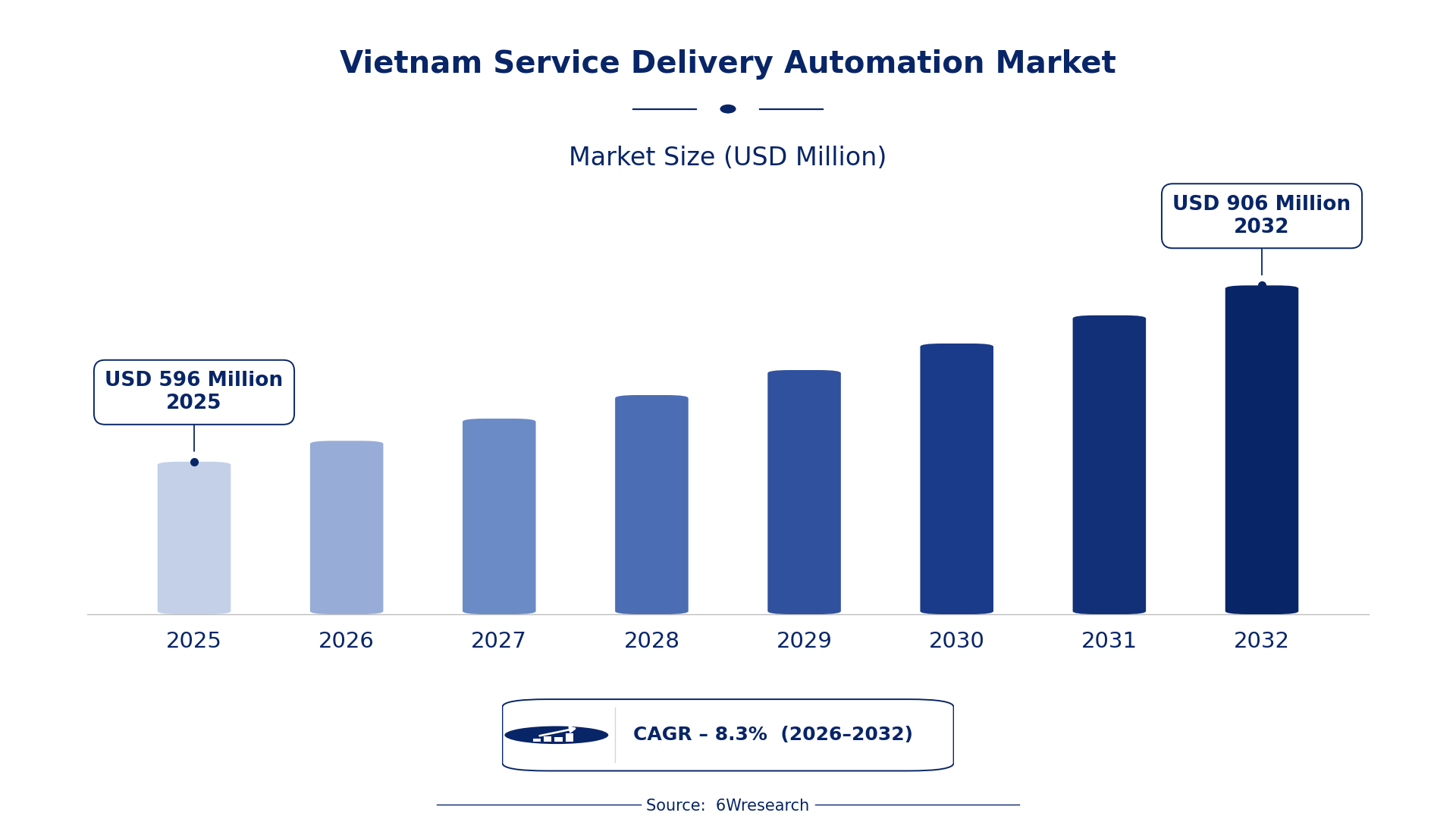
The Vietnam Service Delivery Automation Market was estimated at USD 596 Million in 2025 and is projected to reach USD 906 Million by 2032, growing at a CAGR of 8.3% from 2026 to 2032.
Vietnam Service Delivery Automation Market Synopsis
The drive for efficiency stands as the most potent force behind the Vietnam Service Delivery Automation market. Organizations across various sectors are urgently adopting automation technologies to streamline their operations and reduce operational costs.
Robotic Process Automation (RPA) and intelligent automation are at the forefront of this transformation. As businesses navigate the complexities of service delivery, these technologies enable faster, more reliable services, significantly enhancing customer experiences.
Vietnam Service Delivery Automation Market Year-wise Growth Rate and Key Drivers
This graph illustrates the annual growth rates of the Vietnam Service Delivery Automation Market from 2021 to 2032, highlighting a steady upward trajectory and projected expansion over the forecast period.
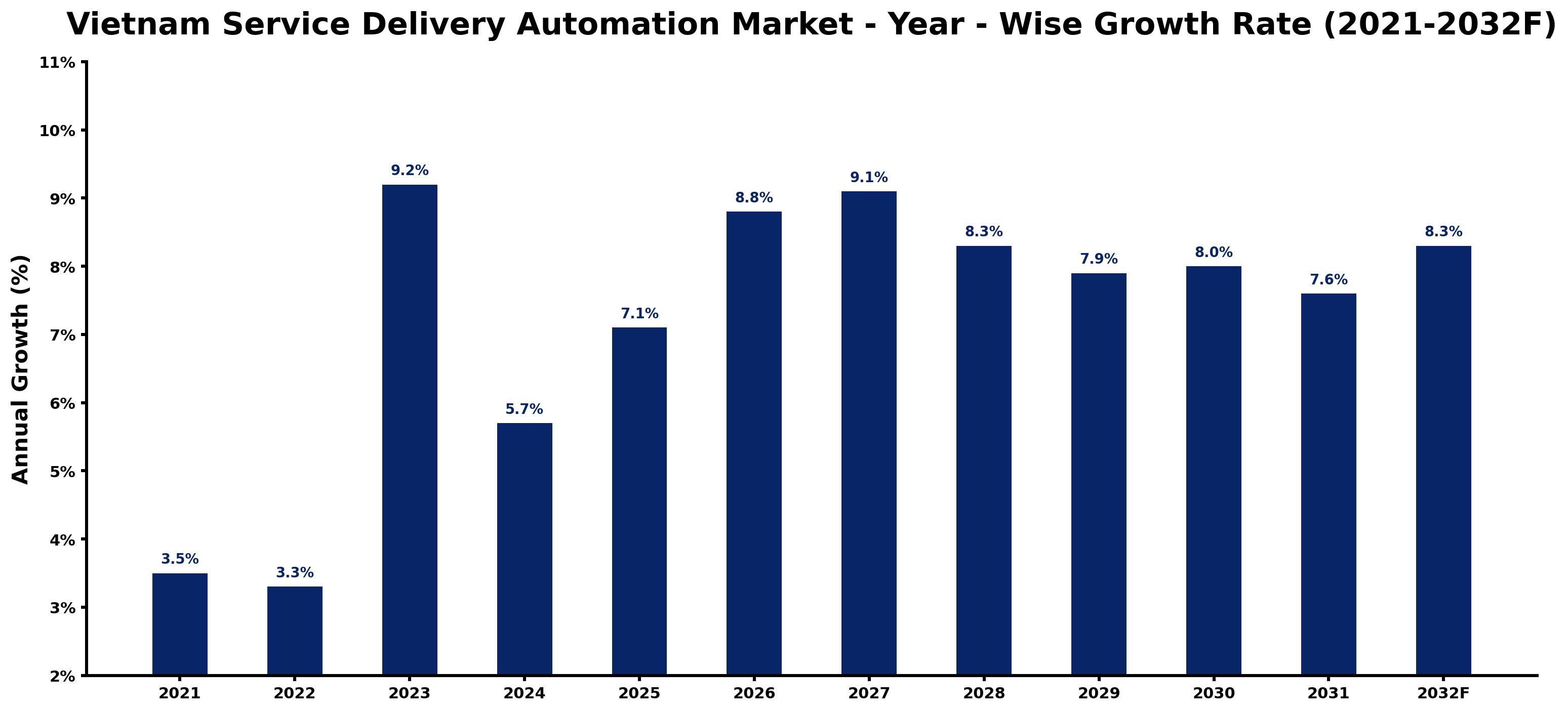
The table below presents the year‑wise growth rates along with the key drivers influencing the market
| Year | Growth Rate | Major Drivers |
| 2021 | 3.5% | Government's digital transformation initiative for service efficiency |
| 2022 | 3.3% | Increased demand for contactless services post-COVID-19 |
| 2023 | 9.2% | Rising adoption of AI technologies in automated services |
| 2024 | 5.7% | Government funding for digital service innovation projects |
| 2025 | 7.1% | Growing e-commerce sector driving automation needs |
| 2026 | 8.8% | Investment in cloud infrastructure enhancing service delivery |
| 2027 | 9.1% | Local startups pioneering automation solutions for businesses |
| 2028 | 8.3% | Increasing workforce training in digital automation technologies |
| 2029 | 7.9% | Youth demographic supporting tech-savvy service preferences |
| 2030 | 8.0% | Regulatory support for automation in hospitality sector |
| 2031 | 7.6% | Push for efficiency in government services via automation |
| 2032 | 8.3% | Rising consumer expectations for seamless digital experiences |
Note: Market size estimations and growth projections presented in this report are based on 6Wresearch's proprietary forecasting methodology, utilizing the latest available industry data, government publications, and primary research inputs.
Vietnam Service Delivery Automation Market Key Takeaways
Below are some of the specific key takeaways from the market, including:
- The market is rapidly evolving, driven by the demand for enhanced efficiency and cost-effectiveness.
- Key industries adopting automation include finance, telecommunications, and logistics.
- COVID-19 has accelerated the shift towards automation solutions, reshaping traditional service delivery models.
- Robotic Process Automation (RPA) is leading the charge in transforming service delivery processes.
- Companies are increasingly focused on reducing human error through automation technologies.
Evaluation of Restraints in Vietnam Service Delivery Automation Market
Despite the strong growth trajectory, the Vietnam Service Delivery Automation market faces notable restraints. One major challenge is the complexity of existing processes. Organizations often grapple with the intricacies of their workflows when attempting to implement automation solutions. This can lead to significant resistance from employees and necessitates careful change management to ensure a smooth transition to automated systems. on top of that, the need for ongoing employee training and adaptation to new technologies can further complicate implementation efforts.
Vietnam Service Delivery Automation Market Trends
Several trends are shaping the demand for service delivery automation in Vietnam. The increasing integration of AI with automation technologies is enhancing decision-making capabilities and predictive analytics in service delivery. Additionally, the focus on customer experience is prompting businesses to adopt solutions that provide faster and more personalized services. The rise of remote work has also pushed organizations to seek automation solutions that support digital interactions and streamline operations beyond traditional office environments.
Vietnam Service Delivery Automation Market Opportunities
Opportunities abound for businesses willing to invest in service delivery automation. Sectors such as healthcare are ripe for automation, as organizations look to improve patient services and operational efficiency. on top of that, the growing demand for e-commerce and digital services presents a unique opportunity for automation technologies to enhance order processing and customer support. As organizations aim to build resilience and agility in their operations, investments in automation will become increasingly vital.
Government Initiatives in the Vietnam Service Delivery Automation Market
The Vietnamese government plays a crucial role in fostering the Service Delivery Automation market through various initiatives aimed at digital transformation. With a focus on enhancing public services and driving economic growth, government policies are increasingly supportive of automation technologies. This regulatory landscape not only encourages investment but also lays the groundwork for a more innovative economy.
- A national digital infrastructure upgrade program was recently launched to enhance connectivity and support automation initiatives.
- Currently underway is a regulatory framework designed to standardize and promote automation practices across public and private sectors.
- A planned public-private partnership aims to expand automation in the logistics sector by 2028, enhancing efficiency in service delivery.
- The Ministry of Information and Communications is implementing training programs to equip the workforce with necessary skills for automation technologies.
- Ongoing initiatives focus on integrating AI into government services to improve citizen interactions and service efficiency.
Future Insights of the Vietnam Service Delivery Automation Market
Looking ahead, the Vietnam Service Delivery Automation market is set to flourish. As organizations increasingly recognize the importance of automation in achieving operational efficiency, investments will likely surge. The integration of AI and machine learning with automation processes will further drive innovation, leading to more sophisticated solutions. By 2032, we can expect a landscape where automation is not just an option but a necessity for competitive service delivery.
Vietnam Service Delivery Automation Market Latest Developments
Over the past year, the Vietnam Service Delivery Automation market has witnessed significant activity as businesses adapt to new operational realities. The push for automation has been fueled by the need for greater efficiency and reliability in service delivery. Companies are increasingly prioritizing automation solutions to streamline workflows and enhance customer satisfaction.
- A major technology vendor launched a new RPA tool in early 2025, aimed at improving financial service processes and reducing turnaround times.
- In mid-2025, a regional operator began implementing an AI-driven customer service chatbot, enhancing customer interactions and reducing response times.
- A partnership between local firms focused on developing innovative automation solutions is currently underway and expected to yield new products by mid-2026.
- In late 2025, a national initiative was announced to promote automation in small and medium enterprises, providing funding and resources to support implementation.
- A rollout of an advanced analytics platform for logistics operations is planned for early 2026, aimed at optimizing supply chain management.
Vietnam Service Delivery Automation Market - Key Attractiveness of the Report
- 10 Years of Market Numbers
- Historical Data Starting from 2022 to 2025
- Base Year: 2025
- Forecast Data until 2032
- Key Performance Indicators Impacting the Market
- Major Upcoming Developments and Projects
Key Highlights of the Report:
- Vietnam Service Delivery Automation Market Outlook
- Market Size of Vietnam Service Delivery Automation Market, 2025
- Forecast of Vietnam Service Delivery Automation Market, 2032
- Historical Data and Forecast of Vietnam Service Delivery Automation Revenues & Volume for the Period 2022-2032F
- Vietnam Service Delivery Automation Market Trend Evolution
- Vietnam Service Delivery Automation Market Drivers and Challenges
- Vietnam Service Delivery Automation Price Trends
- Vietnam Service Delivery Automation Porter's Five Forces
- Vietnam Service Delivery Automation Industry Life Cycle
- Historical Data and Forecast of Vietnam Service Delivery Automation Market Revenues & Volume By Type for the Period 2022-2032F
- Historical Data and Forecast of Vietnam Service Delivery Automation Market Revenues & Volume By IT Process Automation for the Period 2022-2032F
- Historical Data and Forecast of Vietnam Service Delivery Automation Market Revenues & Volume By Business Process Automation for the Period 2022-2032F
- Historical Data and Forecast of Vietnam Service Delivery Automation Market Revenues & Volume By Vertical for the Period 2022-2032F
- Historical Data and Forecast of Vietnam Service Delivery Automation Market Revenues & Volume By BFSI for the Period 2022-2032F
- Historical Data and Forecast of Vietnam Service Delivery Automation Market Revenues & Volume By IT, Telecommunication & Media for the Period 2022-2032F
- Historical Data and Forecast of Vietnam Service Delivery Automation Market Revenues & Volume By Travel, Hospitality & Transportation for the Period 2022-2032F
- Historical Data and Forecast of Vietnam Service Delivery Automation Market Revenues & Volume By Retail & Consumer Goods for the Period 2022-2032F
- Historical Data and Forecast of Vietnam Service Delivery Automation Market Revenues & Volume By Healthcare & Pharmaceuticals for the Period 2022-2032F
- Historical Data and Forecast of Vietnam Service Delivery Automation Market Revenues & Volume By Manufacturing & Logistics for the Period 2022-2032F
- Historical Data and Forecast of Vietnam Service Delivery Automation Market Revenues & Volume By Others for the Period 2022-2032F
- Historical Data and Forecast of Vietnam Service Delivery Automation Market Revenues & Volume By Organization Size for the Period 2022-2032F
- Historical Data and Forecast of Vietnam Service Delivery Automation Market Revenues & Volume By Large Enterprises for the Period 2022-2032F
- Historical Data and Forecast of Vietnam Service Delivery Automation Market Revenues & Volume By SME??s for the Period 2022-2032F
- Vietnam Service Delivery Automation Import Export Trade Statistics
- Market Opportunity Assessment By Type
- Market Opportunity Assessment By Vertical
- Market Opportunity Assessment By Organization Size
- Vietnam Service Delivery Automation Top Companies Market Share
- Vietnam Service Delivery Automation Competitive Benchmarking By Technical and Operational Parameters
- Vietnam Service Delivery Automation Company Profiles
- Vietnam Service Delivery Automation Key Strategic Recommendations






































