Vietnam Sheep Shearing Equipment Market Size, Share & Growth Rate
The Vietnam Sheep Shearing Equipment Market was estimated at USD 948 Million in 2025 and is projected to reach USD 1347 Million by 2032, growing at a CAGR of 5.1% from 2026 to 2032. This growth trajectory is largely fueled by the increasing demand for high-quality wool and meat products, driven by both domestic consumption and potential export opportunities. As Vietnam's agricultural sector modernizes, the need for efficient and humane shearing practices becomes paramount, leading farmers to invest in advanced shearing technologies.
Vietnam Sheep Shearing Equipment Market Year-wise Growth Rate and Key Drivers
This graph highlights how the Vietnam Sheep Shearing Equipment Market has steadily grown over the years, supported by major growth factors.
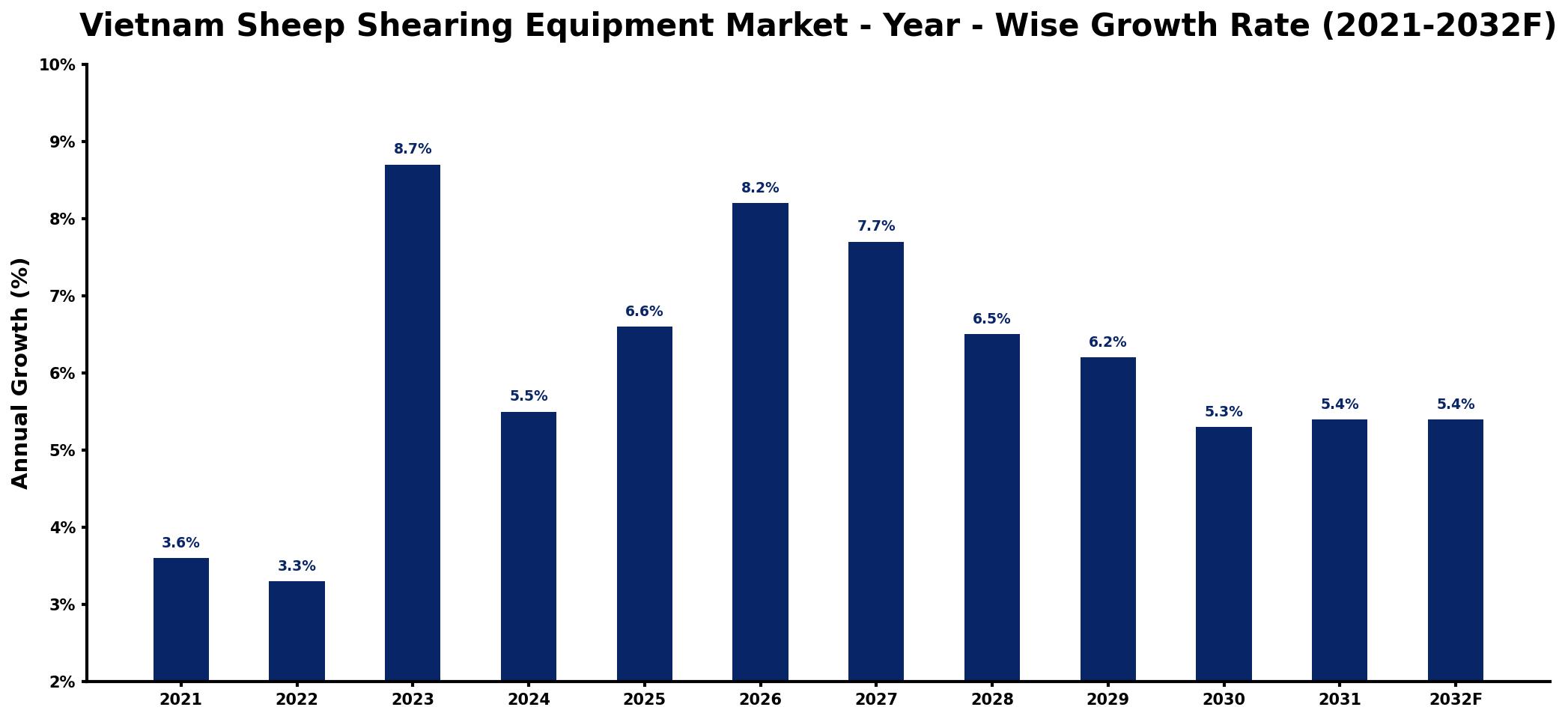
The table below presents the year‑wise growth rates along with the key drivers influencing the market
| Year | Growth Rate | Major Drivers |
| 2021 | 3.6% | Rising demand for livestock products |
| 2022 | 3.3% | Increasing investment in agriculture |
| 2023 | 8.7% | Technological advancements in farming |
| 2024 | 5.5% | Expansion of livestock farming operations |
| 2025 | 6.6% | Growth in rural economic development |
| 2026 | 8.2% | Higher export opportunities for farmers |
| 2027 | 7.7% | Increased awareness of animal welfare |
| 2028 | 6.5% | Development of supportive government policies |
| 2029 | 6.2% | Emerging trends in organic farming |
| 2030 | 5.3% | Diversification of agricultural practices |
| 2031 | 5.4% | Strengthening of agricultural cooperatives |
| 2032 | 5.4% | Enhanced supply chain efficiencies |
Note: Market size estimations and growth projections presented in this report are based on 6Wresearch's proprietary forecasting methodology, utilizing the latest available industry data, government publications, and primary research inputs.
Vietnam Sheep Shearing Equipment Market Synopsis
The primary force shaping the Vietnam Sheep Shearing Equipment Market is the growth of the livestock and wool industry. Sheep farming is integral to Vietnam's agricultural landscape, necessitating effective shearing tools to maximize wool production and enhance animal welfare. This increasing focus on productivity, coupled with consumer demand for quality wool products, is propelling the market forward.
Another pivotal factor is the emphasis on modernizing agricultural practices. As sheep farmers adopt more advanced technologies to improve yields, the demand for innovative sheep shearing equipment is rising. The industry's evolution reflects a broader trend towards sustainable and efficient farming, positioning the market for continued growth.
Vietnam Sheep Shearing Equipment Market Key Takeaways
- The market is poised for growth, driven by rising demand for wool and meat.
- Advancements in shearing technology are reshaping farmers' approach to sheep farming.
- Price sensitivity remains a key factor influencing equipment choices.
- Distribution challenges in rural areas require effective after-sales support.
- Animal welfare and sustainable practices are becoming increasingly important in industry standards.
Evaluation of Restraints in Vietnam Sheep Shearing Equipment Market
While the Vietnam Sheep Shearing Equipment Market shows promise, several restraints hinder its growth. The limited scale of the sheep farming industry poses a challenge, constraining the overall market size and potential for widespread equipment adoption. Additionally, the price-sensitive nature of the market makes it imperative for equipment manufacturers to balance quality with affordability, which can be a significant hurdle. Compounding these issues are distribution and after-sales service challenges, particularly in rural regions where many sheep farmers are located. There is also a pressing need for skilled shearers and technicians to maintain these advanced tools, which presents another hurdle to market expansion.
Vietnam Sheep Shearing Equipment Market Trends
Current trends in the Vietnam Sheep Shearing Equipment Market emphasize innovation and sustainability. The shift towards electric and battery-operated shearing equipment is gaining traction, as these tools not only enhance efficiency but also reduce physical strain on shearers. Additionally, the adoption of technology such as AI for improved shearing techniques is emerging. A notable trend is the increasing consumer preference for ethically produced wool, which is prompting farmers to adopt humane shearing practices and upgrade their equipment accordingly.
Vietnam Sheep Shearing Equipment Market Opportunities
Investment opportunities within the Vietnam Sheep Shearing Equipment Market lie primarily in the development of training programs for shearers and technicians. By enhancing skills in this area, businesses can improve equipment maintenance and operational efficiency. Moreover, the integration of smart technologies, such as IoT devices for real-time monitoring and performance analysis, presents an opportunity for equipment manufacturers to differentiate themselves in a competitive landscape. The growing focus on sustainable and ethical farming practices also offers avenues for growth, particularly as consumer awareness continues to rise.
Government Initiatives in the Vietnam Sheep Shearing Equipment Market
The Vietnamese government is increasingly supportive of agricultural modernization, with initiatives aimed at improving livestock farming practices. Public spending in agriculture has been on the rise, with an emphasis on technological advancements that enhance productivity and sustainability. Programs promoting education and training in modern farming techniques are also in place, encouraging the adoption of efficient sheep shearing practices. Such efforts reflect a commitment to boosting the overall agricultural sector and ensuring that farmers have access to the tools necessary for success.
Future Insights of the Vietnam Sheep Shearing Equipment Market
Looking ahead to 2026-2032, the Vietnam Sheep Shearing Equipment Market is expected to witness substantial advancements driven by technology and sustainability. As farmers increasingly prioritize efficiency and humane practices, the demand for innovative shearing solutions will rise. Additionally, the ongoing growth of the wool industry—both domestically and in export markets—will encourage investments in high-quality shearing tools. Furthermore, the emphasis on animal welfare is likely to influence market standards and practices, shaping the future landscape of sheep farming in Vietnam.
Vietnam Sheep Shearing Equipment Market Latest Developments (2025 - 2026)
Recent developments in the Vietnam Sheep Shearing Equipment Market indicate a shift towards more advanced and efficient technologies. Industry stakeholders are actively exploring partnerships to enhance equipment distribution and after-sales support, particularly in rural regions. The trend of promoting sustainable practices has led to more awareness campaigns aimed at educating farmers on ethical shearing methods and equipment maintenance. This evolving direction reflects a broader commitment to improving both the efficiency and sustainability of the sheep farming sector.
Vietnam Sheep Shearing Equipment Market - Key Attractiveness of the Report
- 10 Years of Market Numbers
- Historical Data Starting from 2022 to 2025
- Base Year: 2025
- Forecast Data until 2032
- Key Performance Indicators Impacting the Market
- Major Upcoming Developments and Projects
Key Highlights of the Report:
- Vietnam Sheep Shearing Equipment Market Outlook
- Market Size of Vietnam Sheep Shearing Equipment Market, 2025
- Forecast of Vietnam Sheep Shearing Equipment Market, 2032
- Historical Data and Forecast of Vietnam Sheep Shearing Equipment Revenues & Volume for the Period 2022-2032F
- Vietnam Sheep Shearing Equipment Market Trend Evolution
- Vietnam Sheep Shearing Equipment Market Drivers and Challenges
- Vietnam Sheep Shearing Equipment Price Trends
- Vietnam Sheep Shearing Equipment Porter's Five Forces
- Vietnam Sheep Shearing Equipment Industry Life Cycle
- Historical Data and Forecast of Vietnam Sheep Shearing Equipment Market Revenues & Volume By Type for the Period 2022-2032F
- Historical Data and Forecast of Vietnam Sheep Shearing Equipment Market Revenues & Volume By Cordless for the Period 2022-2032F
- Historical Data and Forecast of Vietnam Sheep Shearing Equipment Market Revenues & Volume By Wired for the Period 2022-2032F
- Historical Data and Forecast of Vietnam Sheep Shearing Equipment Market Revenues & Volume By Applications for the Period 2022-2032F
- Historical Data and Forecast of Vietnam Sheep Shearing Equipment Market Revenues & Volume By Individual for the Period 2022-2032F
- Historical Data and Forecast of Vietnam Sheep Shearing Equipment Market Revenues & Volume By Commercial for the Period 2022-2032F
- Vietnam Sheep Shearing Equipment Import Export Trade Statistics
- Market Opportunity Assessment By Type
- Market Opportunity Assessment By Applications
- Vietnam Sheep Shearing Equipment Top Companies Market Share
- Vietnam Sheep Shearing Equipment Competitive Benchmarking By Technical and Operational Parameters
- Vietnam Sheep Shearing Equipment Company Profiles
- Vietnam Sheep Shearing Equipment Key Strategic Recommendations






































