Vietnam Silicon Alloys Market Size, Share & Growth Rate
The Vietnam Silicon Alloys Market was estimated at USD 330 Million in 2025 and is projected to reach USD 468 Million by 2032, growing at a CAGR of 5.1% from 2026 to 2032. This growth trajectory is primarily fueled by the expanding metal and alloy industries within Vietnam, particularly in the construction and automotive sectors. As these industries thrive, the demand for silicon alloys, crucial for enhancing metal properties, continues to rise, further underpinning market growth.
Vietnam Silicon Alloys Market Year-wise Growth Rate and Key Drivers
This graph highlights how the Vietnam Silicon Alloys Market has steadily grown over the years, supported by major growth factors.
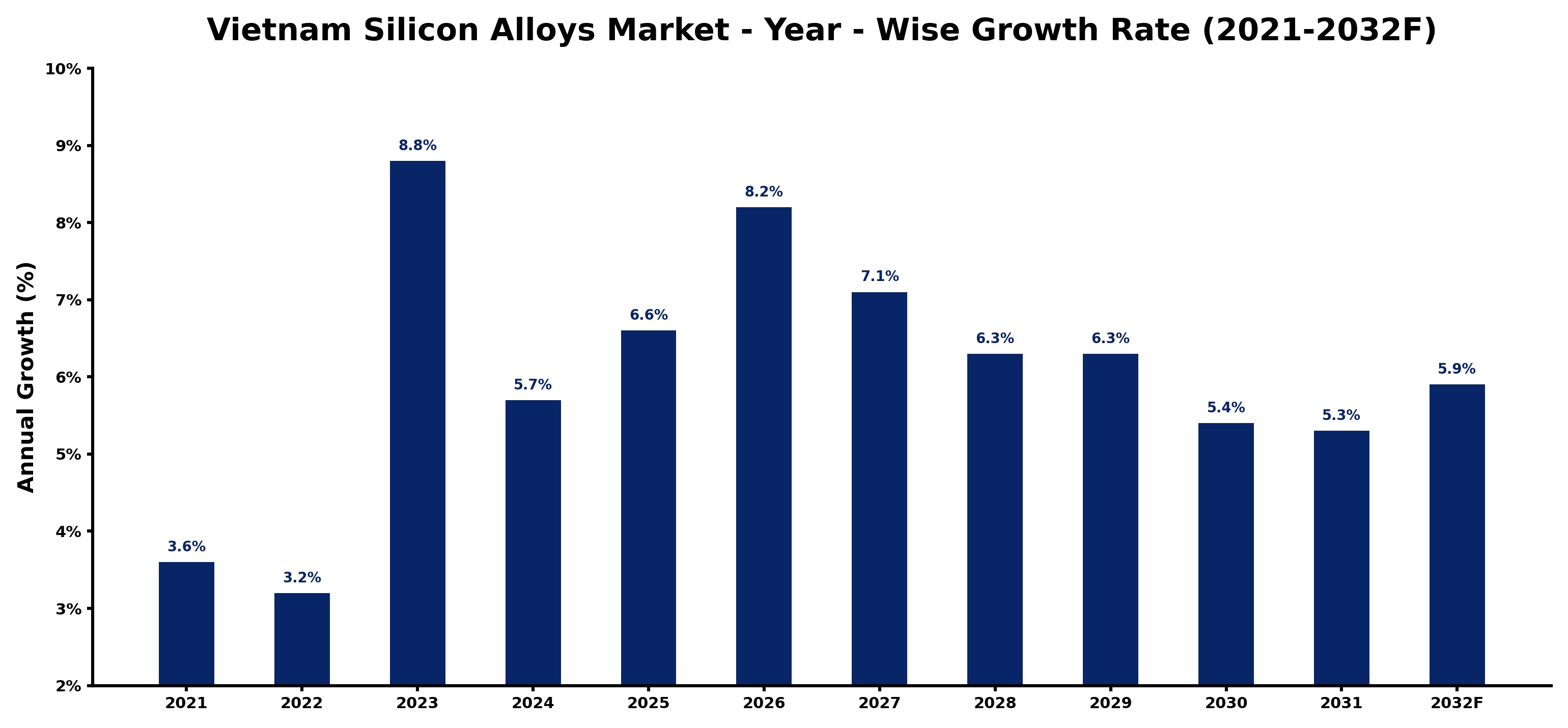
The table below presents the year‑wise growth rates along with the key drivers influencing the market
| Year | Growth Rate | Major Drivers |
| 2021 | 3.6% | Foreign investments boost silicon alloy production for automotive applications |
| 2022 | 3.2% | Silicon alloy production capacity expanded with new manufacturing investments |
| 2023 | 8.8% | Increased automotive assembly expansion drives demand for silicon alloys |
| 2024 | 5.7% | Increased foundry capacity enhanced silicon alloy export opportunities |
| 2025 | 6.6% | Technological upgrades in foundries boost silicon alloy production efficiency |
| 2026 | 8.2% | Domestic automotive assembly growth boosted silicon alloy demand significantly |
| 2027 | 7.1% | Export driven investments boost silicon alloy production for automotive suppliers |
| 2028 | 6.3% | Foreign direct investments boost silicon alloy production capabilities |
| 2029 | 6.3% | Increased foreign investments boost silicon alloy production capabilities |
| 2030 | 5.4% | Automotive assembly investments boosted demand for silicon alloy production |
| 2031 | 5.3% | New foundry technologies boost silicon alloy production efficiency |
| 2032 | 5.9% | Optimized furnace operations boost silicon alloy production efficiency |
Note - Market size estimations and growth projections presented in this report are based on 6Wresearch’s advanced forecasting approach, validated with industry datasets as of June 2026.
Vietnam Silicon Alloys Market Synopsis
The Vietnam Silicon Alloys market is experiencing significant momentum, largely driven by the burgeoning manufacturing landscape in the region. With the automotive and electronics industries leading the charge, silicon alloys have become indispensable, enhancing durability and performance across various applications.
Additionally, advancements in production technologies and a strong focus on R&D are paving the way for innovative silicon alloy formulations. This evolution caters to diverse industrial requirements, setting the stage for sustained demand and market stability.
Vietnam Silicon Alloys Market Key Takeaways
- The market is projected to grow from USD 330 Million in 2025 to USD 468 Million by 2032.
- Silicon alloys are vital for enhancing the mechanical properties of metals used in construction and manufacturing.
- Key demand drivers include the automotive and electronics industries in Vietnam.
- Increasing production efficiencies and R&D efforts are shaping product innovations.
- The market remains vulnerable to fluctuations in global silicon pricing and supply chain dynamics.
Evaluation of Restraints in Vietnam Silicon Alloys Market
While the Vietnam Silicon Alloys market is poised for growth, it faces several restraints that could impact its trajectory. Energy-intensive production processes lead to high operational costs, raising concerns about sustainability and environmental impact. The market's dependence on the global silicon market introduces a level of vulnerability; any price fluctuations or supply disruptions can significantly affect local producers' competitiveness. As the market expands, addressing these challenges will be crucial for maintaining a balanced and sustainable growth path.
Vietnam Silicon Alloys Market Trends
Emerging trends within the Vietnam Silicon Alloys market include a shift towards sustainable practices in production. Manufacturers are exploring renewable energy sources and energy-efficient technologies to mitigate environmental impact. Furthermore, the integration of advanced materials science in silicon alloy development is facilitating the creation of tailored products for specific applications in industries such as automotive and electronics.
Vietnam Silicon Alloys Market Opportunities
Investment opportunities within the Vietnam Silicon Alloys market are abundant. As infrastructure projects ramp up across the nation, the demand for high-quality silicon alloys is set to increase. Moreover, as local manufacturers enhance their R&D capabilities, there is potential for innovative products that cater to niche applications, expanding market reach and profitability. Companies can also explore partnerships with foreign entities to leverage technological advancements and best practices.
Government Initiatives in the Vietnam Silicon Alloys Market
The Vietnamese government has recognized the importance of the metallurgy sector and is implementing several initiatives to boost the Silicon Alloys market. These include policies aimed at promoting energy-efficient practices and encouraging investment in R&D within the metallurgical industry. Additionally, public spending on infrastructure projects is expected to stimulate demand for silicon alloys, aligning government objectives with market needs.
Future Insights of the Vietnam Silicon Alloys Market
Looking ahead to 2026-2032, the Vietnam Silicon Alloys market is set for transformative growth. As industrial activities resume robustly post-COVID-19, the demand for silicon alloys will be driven by renewed investments in manufacturing and infrastructure. Furthermore, the transition towards sustainable production methods will likely define the market landscape, leading to new technological innovations and operational efficiencies.
Vietnam Silicon Alloys Market Latest Developments (May 2025 - June 2026)
Recent industry developments indicate a surge in collaborative efforts among manufacturers to enhance production capabilities and product offerings. Companies are increasingly engaging in research partnerships aimed at developing advanced formulations of silicon alloys to meet the evolving demands of key industries. Additionally, there is a notable shift towards sustainability, with firms investing in renewable energy resources to power their manufacturing processes.
Vietnam Silicon Alloys Market - Key Attractiveness of the Report
- 10 Years of Market Numbers
- Historical Data Starting from 2022 to 2025
- Base Year: 2025
- Forecast Data until 2032
- Key Performance Indicators Impacting the Market
- Major Upcoming Developments and Projects
Key Highlights of the Report:
- Vietnam Silicon Alloys Market Outlook
- Market Size of Vietnam Silicon Alloys Market, 2025
- Forecast of Vietnam Silicon Alloys Market, 2032
- Historical Data and Forecast of Vietnam Silicon Alloys Revenues & Volume for the Period 2022-2032F
- Vietnam Silicon Alloys Market Trend Evolution
- Vietnam Silicon Alloys Market Drivers and Challenges
- Vietnam Silicon Alloys Price Trends
- Vietnam Silicon Alloys Porter's Five Forces
- Vietnam Silicon Alloys Industry Life Cycle
- Historical Data and Forecast of Vietnam Silicon Alloys Market Revenues & Volume By Type for the Period 2022-2032F
- Historical Data and Forecast of Vietnam Silicon Alloys Market Revenues & Volume By Ferrosilicon for the Period 2022-2032F
- Historical Data and Forecast of Vietnam Silicon Alloys Market Revenues & Volume By Deoxidizers for the Period 2022-2032F
- Historical Data and Forecast of Vietnam Silicon Alloys Market Revenues & Volume By Inoculants for the Period 2022-2032F
- Historical Data and Forecast of Vietnam Silicon Alloys Market Revenues & Volume By Others for the Period 2022-2032F
- Historical Data and Forecast of Vietnam Silicon Alloys Market Revenues & Volume By Application for the Period 2022-2032F
- Historical Data and Forecast of Vietnam Silicon Alloys Market Revenues & Volume By Carbon Steel & Other Alloy Steel for the Period 2022-2032F
- Historical Data and Forecast of Vietnam Silicon Alloys Market Revenues & Volume By Stainless Steel for the Period 2022-2032F
- Historical Data and Forecast of Vietnam Silicon Alloys Market Revenues & Volume By Electrical Steel for the Period 2022-2032F
- Historical Data and Forecast of Vietnam Silicon Alloys Market Revenues & Volume By Cast Iron for the Period 2022-2032F
- Historical Data and Forecast of Vietnam Silicon Alloys Market Revenues & Volume By Others for the Period 2022-2032F
- Vietnam Silicon Alloys Import Export Trade Statistics
- Market Opportunity Assessment By Type
- Market Opportunity Assessment By Application
- Vietnam Silicon Alloys Top Companies Market Share
- Vietnam Silicon Alloys Competitive Benchmarking By Technical and Operational Parameters
- Vietnam Silicon Alloys Company Profiles
- Vietnam Silicon Alloys Key Strategic Recommendations






































