Vietnam Smart Doorbell Market Size, Share & Growth Rate
The Vietnam Smart Doorbell Market was estimated at USD 859 Million in 2025 and is projected to reach USD 1339 Million by 2032, growing at a CAGR of 6.5% from 2026 to 2032. This impressive trajectory is driven primarily by a growing middle class increasingly willing to invest in modern home security solutions and convenience. Additionally, the rising trend of e-commerce is further propelling the demand for smart doorbells as consumers prioritize secure package delivery options.
Vietnam Smart Doorbell Market Year-wise Growth Rate and Key Drivers
This graph highlights how the Vietnam Smart Doorbell Market has steadily grown over the years, supported by major growth factors.
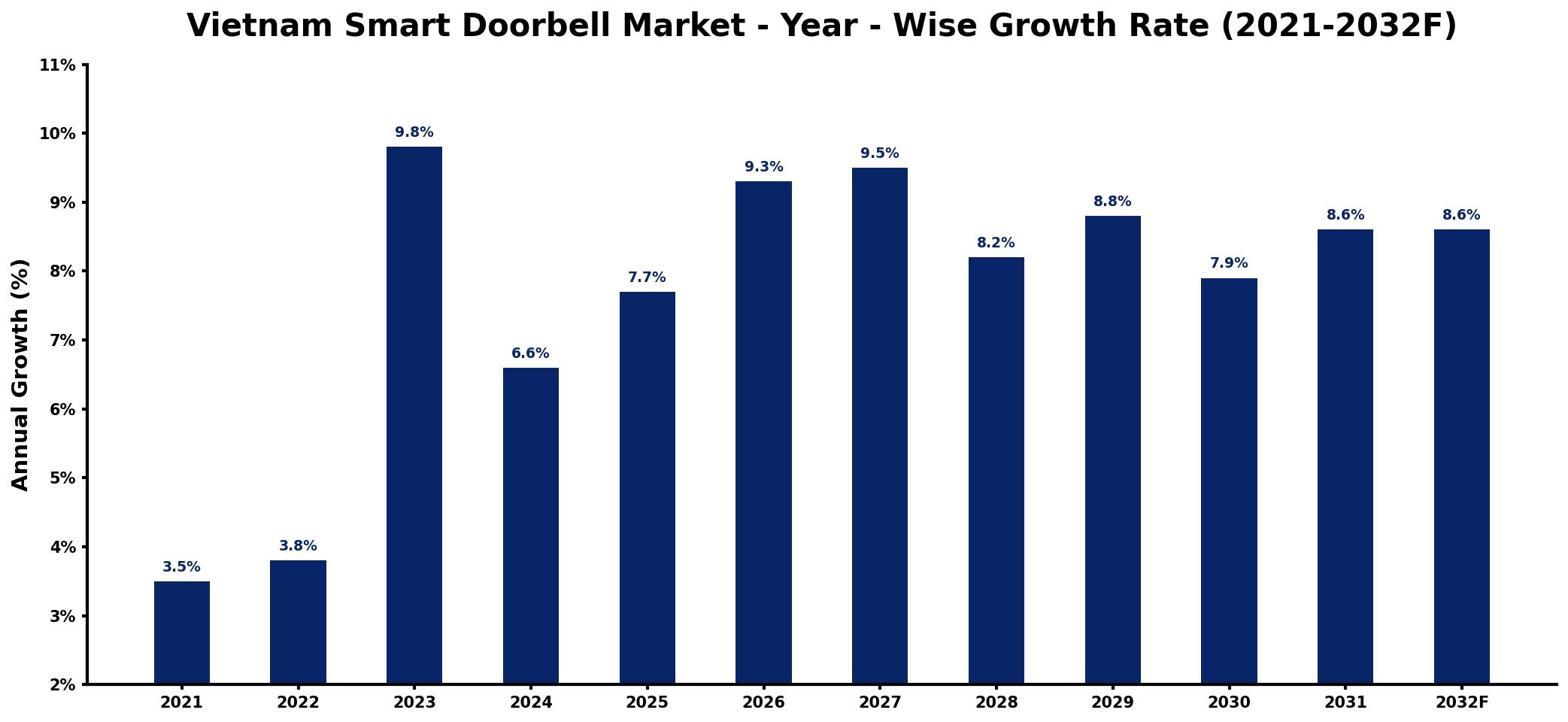
The table below presents the year‑wise growth rates along with the key drivers influencing the market
| Year | Growth Rate | Major Drivers |
| 2021 | 3.5% | Rising consumer interest in security |
| 2022 | 3.8% | Growth in home automation trends |
| 2023 | 9.8% | Increased investments in technology |
| 2024 | 6.6% | Expansion of e-commerce platforms |
| 2025 | 7.7% | Surge in urban residential development |
| 2026 | 9.3% | Higher disposable income levels |
| 2027 | 9.5% | Adoption of IoT in homes |
| 2028 | 8.2% | Growing awareness of safety features |
| 2029 | 8.8% | Improved connectivity infrastructure availability |
| 2030 | 7.9% | Increase in online retail sales |
| 2031 | 8.6% | stronger distribution network expansion |
| 2032 | 8.6% | Enhanced consumer education initiatives |
Note: Market size estimations and growth projections presented in this report are based on 6Wresearch's proprietary forecasting methodology, utilizing the latest available industry data, government publications, and primary research inputs.
Vietnam Smart Doorbell Market Synopsis
The Vietnam smart doorbell market is rapidly evolving as consumers embrace cutting-edge technologies that enhance both security and convenience in their homes. The growing integration of smart devices into everyday living has made smart doorbells not just a luxury, but a necessity for many Vietnamese households.
As urbanization continues and disposable incomes rise, homeowners are turning to smart doorbells to provide real-time monitoring and seamless integration with broader smart home ecosystems. These devices offer unparalleled peace of mind, making them an attractive addition to modern living.
Vietnam Smart Doorbell Market Key Takeaways
- The market is poised for significant growth driven by increasing demand for enhanced home security solutions.
- Consumers are increasingly prioritizing convenience and contactless entry systems, particularly in the context of e-commerce.
- The expanding middle class in Vietnam is a vital driver of market growth, leading to higher spending on smart home technologies.
- Product innovations and affordability are key strategies for manufacturers to broaden consumer accessibility.
- Consumer awareness and education are critical to overcoming market entry barriers and stimulating adoption rates.
Evaluation of Restraints in Vietnam Smart Doorbell Market
Despite the promising growth, the Vietnam smart doorbell market faces several constraints that could impede its expansion. One major hurdle is the limited consumer awareness regarding the benefits and functionalities of smart doorbells. Many potential buyers remain unaware of how these devices can enhance their home security and lifestyle. Furthermore, affordability remains a significant concern, as the price point of smart doorbells can be a barrier for budget-conscious consumers.
The necessity for a stable internet connection also limits adoption in rural areas with inadequate connectivity. Compounding these issues are ongoing concerns regarding data privacy and the security of smart devices, which can deter potential buyers. Additionally, competition from traditional doorbell systems and the resistance to new technologies among some consumers further complicate market penetration efforts.
Vietnam Smart Doorbell Market Trends
Several trends are currently shaping the Vietnam smart doorbell market, the most notable being the increasing preference for devices that integrate seamlessly with existing smart home technologies. Consumers are seeking products that not only offer security features but also interact effectively with their smartphones and home automation systems. Another emerging trend is the enhancement of product features, such as high-definition video, motion detection, and two-way communication, making smart doorbells more appealing to tech-savvy consumers.
Furthermore, the rise in environmental consciousness among consumers is leading manufacturers to explore sustainable product designs and energy-efficient technologies. The demand for affordable yet innovative solutions is prompting manufacturers to invest in R&D to create cost-effective products without compromising quality.
Vietnam Smart Doorbell Market Opportunities
The Vietnam smart doorbell market presents numerous opportunities for growth and innovation. First, targeting underserved segments of the population with more affordable options could significantly broaden the market base. Additionally, enhancing distribution channels through e-commerce platforms can facilitate greater accessibility and convenience for consumers. Partnerships with local home security companies could also foster a comprehensive offering that addresses consumer concerns about installation and ongoing support.
Furthermore, as awareness of smart home technologies increases, companies that invest in educational initiatives can position themselves as market leaders. Developing products tailored to the specific needs of the Vietnamese market, including features that cater to local preferences and conditions, will provide a competitive edge. Overall, the combination of technological advancements and consumer willingness to adopt smart solutions creates a fertile ground for growth in this sector.
Government Initiatives in the Vietnam Smart Doorbell Market
Government initiatives aimed at promoting digital transformation in Vietnam are expected to positively impact the smart doorbell market. Programs that encourage smart home technology adoption through public awareness campaigns can enhance consumer acceptance and demand. Moreover, the government's focus on improving internet infrastructure in urban and rural areas will be crucial in overcoming connectivity challenges and expanding market reach. Incentives for businesses to innovate and invest in smart home solutions could further stimulate growth in this segment, fostering an environment that supports technological advancements and consumer education.
Future Insights of the Vietnam Smart Doorbell Market
Looking ahead to 2026-2032, the Vietnam smart doorbell market is poised for substantial growth fueled by technological advancements and changing consumer behaviors. As security concerns persist and smart home integration becomes more mainstream, the adoption of smart doorbells will likely accelerate. Anticipated improvements in internet connectivity, particularly in rural areas, will enhance accessibility and encourage more consumers to invest in these devices.
The ongoing emphasis on product innovation and affordability will also play a crucial role in shaping the future landscape of the market. Manufacturers focusing on customization and enhanced user experience will likely capture significant market share, fostering a dynamic environment characterized by diverse offerings tailored to evolving consumer needs.
Vietnam Smart Doorbell Market Latest Developments (2025 - 2026)
Recent developments in the Vietnam smart doorbell market reflect a surge in innovation as companies roll out new product features designed to enhance user experience and security. There has been an increase in partnerships between tech firms and local businesses aimed at creating tailored solutions for Vietnamese consumers. Furthermore, marketing campaigns focusing on consumer education have gained traction, aiming to raise awareness about the benefits of smart doorbells. Overall, the market is witnessing a shift towards more integrated solutions that prioritize convenience and safety in response to evolving consumer preferences.
Vietnam Smart Doorbell Market - Key Attractiveness of the Report
- 10 Years of Market Numbers
- Historical Data Starting from 2022 to 2025
- Base Year: 2025
- Forecast Data until 2032
- Key Performance Indicators Impacting the Market
- Major Upcoming Developments and Projects
Key Highlights of the Report:
- Vietnam Smart Doorbell Market Outlook
- Market Size of Vietnam Smart Doorbell Market, 2025
- Forecast of Vietnam Smart Doorbell Market, 2032
- Historical Data and Forecast of Vietnam Smart Doorbell Revenues & Volume for the Period 2022-2032F
- Vietnam Smart Doorbell Market Trend Evolution
- Vietnam Smart Doorbell Market Drivers and Challenges
- Vietnam Smart Doorbell Price Trends
- Vietnam Smart Doorbell Porter's Five Forces
- Vietnam Smart Doorbell Industry Life Cycle
- Historical Data and Forecast of Vietnam Smart Doorbell Market Revenues & Volume By Product Type for the Period 2022-2032F
- Historical Data and Forecast of Vietnam Smart Doorbell Market Revenues & Volume By Wired Doorbell for the Period 2022-2032F
- Historical Data and Forecast of Vietnam Smart Doorbell Market Revenues & Volume By Wireless Doorbell for the Period 2022-2032F
- Historical Data and Forecast of Vietnam Smart Doorbell Market Revenues & Volume By Distribution Channel for the Period 2022-2032F
- Historical Data and Forecast of Vietnam Smart Doorbell Market Revenues & Volume By Online for the Period 2022-2032F
- Historical Data and Forecast of Vietnam Smart Doorbell Market Revenues & Volume By Offline for the Period 2022-2032F
- Historical Data and Forecast of Vietnam Smart Doorbell Market Revenues & Volume By End User for the Period 2022-2032F
- Historical Data and Forecast of Vietnam Smart Doorbell Market Revenues & Volume By Residential for the Period 2022-2032F
- Historical Data and Forecast of Vietnam Smart Doorbell Market Revenues & Volume By Commercial for the Period 2022-2032F
- Vietnam Smart Doorbell Import Export Trade Statistics
- Market Opportunity Assessment By Product Type
- Market Opportunity Assessment By Distribution Channel
- Market Opportunity Assessment By End User
- Vietnam Smart Doorbell Top Companies Market Share
- Vietnam Smart Doorbell Competitive Benchmarking By Technical and Operational Parameters
- Vietnam Smart Doorbell Company Profiles
- Vietnam Smart Doorbell Key Strategic Recommendations






































