Vietnam Smart Locks Market Size, Share & Growth Rate
The Vietnam Smart Locks Market was estimated at USD 471 Million in 2025 and is projected to reach USD 736 Million by 2032, growing at a CAGR of 6.6% from 2026 to 2032. This robust growth is primarily driven by increasing urbanization and the rising awareness of security solutions among consumers. Furthermore, the integration of smart locks with home automation systems and the growing trend towards keyless entry options are set to further propel market expansion.
Vietnam Smart Locks Market Year-wise Growth Rate and Key Drivers
This graph highlights how the Vietnam Smart Locks Market has steadily grown over the years, supported by major growth factors.
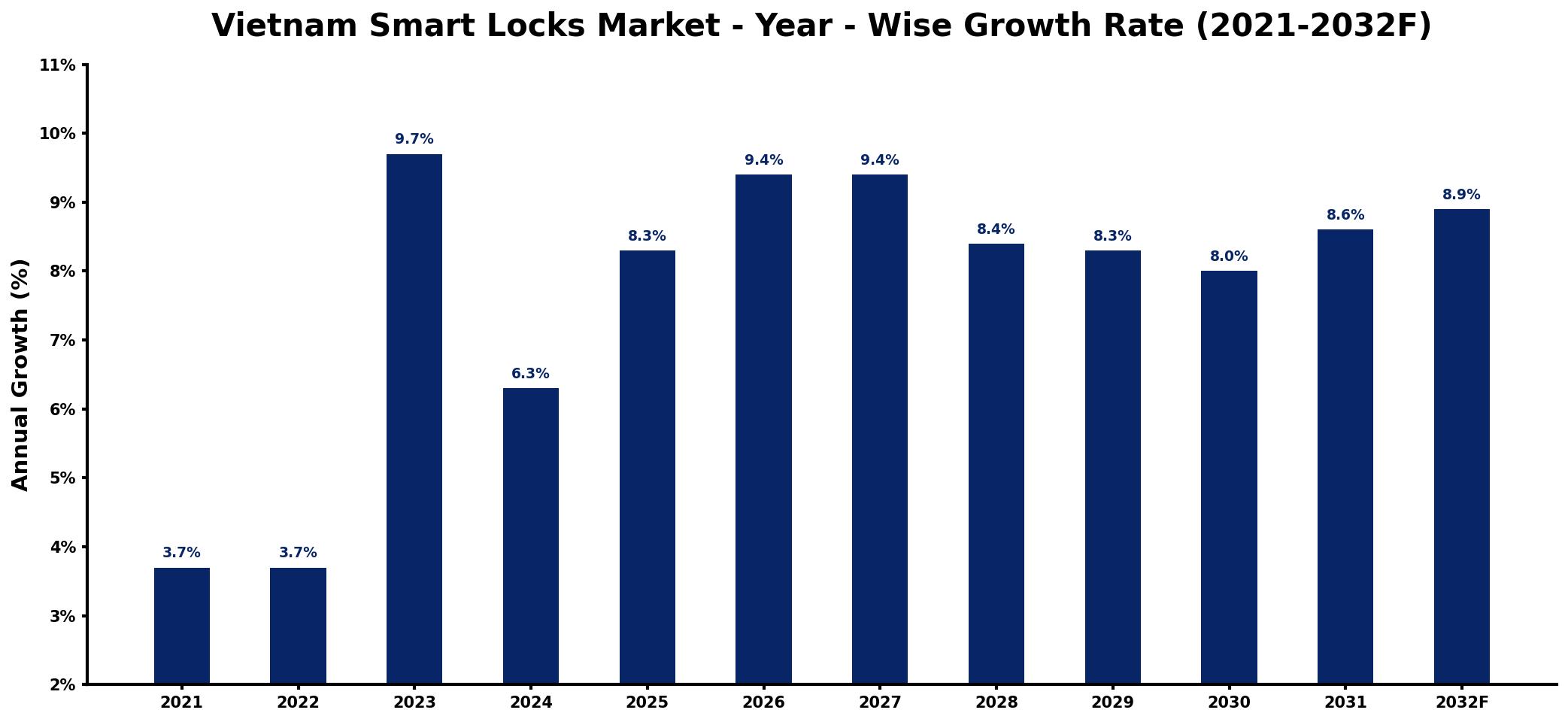
The table below presents the year‑wise growth rates along with the key drivers influencing the market
| Year | Growth Rate | Major Drivers |
| 2021 | 3.7% | Rising urbanization and modernization |
| 2022 | 3.7% | Growing demand for security solutions |
| 2023 | 9.7% | Increased investment in technology |
| 2024 | 6.3% | Expansion of online retail channels |
| 2025 | 8.3% | Surge in home automation trends |
| 2026 | 9.4% | Rising awareness of safety features |
| 2027 | 9.4% | Growing residential construction projects |
| 2028 | 8.4% | Increased focus on energy efficiency |
| 2029 | 8.3% | improved processing technologies adoption |
| 2030 | 8.0% | Increased adoption of IoT devices |
| 2031 | 8.6% | Growing interest in remote access |
| 2032 | 8.9% | Rising consumer preference for convenience |
Note: Market size estimations and growth projections presented in this report are based on 6Wresearch's proprietary forecasting methodology, utilizing the latest available industry data, government publications, and primary research inputs.
Vietnam Smart Locks Market Synopsis
The strongest force shaping the Vietnam Smart Locks Market today is the escalating demand for enhanced security solutions. As urban living evolves, the need for reliable and convenient access mechanisms has led to an uptick in smart lock adoption across both residential and commercial properties.
Additionally, the burgeoning real estate sector and the rise of short-term rentals have cemented smart locks as essential tools for property management. This growing consumer inclination towards technology-driven security systems presents significant opportunities for further market growth.
Vietnam Smart Locks Market Key Takeaways
- The market is on a promising trajectory driven by urbanization and rising security awareness.
- Integration with home automation systems is a major selling point for modern consumers.
- The real estate boom, including short-term rentals, is a key driver of smart lock adoption.
- Local players are increasingly innovating to meet the unique needs of Vietnamese consumers.
- Government support for smart city initiatives positively influences market dynamics.
Evaluation of Restraints in Vietnam Smart Locks Market
Despite the promising growth trajectory, several restraints impede the markets full potential. Affordability remains a significant concern, as smart locks typically cost more than traditional locks, limiting their accessibility for budget-conscious consumers. Moreover, apprehensions surrounding cybersecurity vulnerabilities can deter potential buyers, as the threat of hacking looms large. Issues regarding compatibility with various door types can also complicate installation, further complicating the decision-making process for consumers. Lastly, the absence of standardized regulations in the industry introduces ambiguity, which can make consumers hesitant to invest in smart locking solutions.
Vietnam Smart Locks Market Trends
Several trends are currently influencing the Vietnam Smart Locks Market. The shift towards smart home ecosystems is creating a demand for locks that seamlessly integrate with other devices. Moreover, an increasing number of consumers are prioritizing touchless technology, prompted by the pandemic's influence on safety and hygiene. The growth of the sharing economy, particularly home-sharing platforms, is also pushing for innovative access solutions. Finally, advancements in artificial intelligence and machine learning are leading to more sophisticated features in smart locks, enhancing user experience and security.
Vietnam Smart Locks Market Opportunities
The Vietnam Smart Locks Market is poised for significant growth, driven by various opportunities. Expanding urban populations and the continued rise of smart city initiatives create fertile ground for innovative access solutions. Additionally, as awareness of home automation increases, the potential for smart lock adoption will grow among both homeowners and businesses. The burgeoning market for short-term rentals presents unique opportunities for tailored smart lock solutions that cater to property owners seeking enhanced security and convenience in managing guest access. With technology evolving rapidly, there is a continuous demand for new features and improved functionalities, paving the way for innovation and investment.
Government Initiatives in the Vietnam Smart Locks Market
The Vietnamese government is increasingly promoting smart city technologies, which significantly benefits the smart locks market. Public initiatives that support the development of smart home automation systems help foster an environment conducive to innovation in security technologies. Investments in urban infrastructure aimed at improving living standards and safety are also encouraging stakeholders to explore advanced security solutions, including smart locks. Such governmental focus on modernization is likely to enhance the overall market landscape and stimulate further growth.
Future Insights of the Vietnam Smart Locks Market
Looking ahead to 2026-2032, the Vietnam Smart Locks Market is expected to continue its upward trajectory. The convergence of smart technologies in everyday life will deepen the integration of smart locks within broader smart home ecosystems. As more consumers recognize the value of innovative security solutions, demand for smart locks will increase. The ongoing emphasis on safety and convenience will likely encourage further advancements in lock technology. Additionally, as local manufacturers strive to keep pace with global standards, innovations specific to the Vietnamese market are anticipated to emerge, making this a dynamic sector to watch.
Vietnam Smart Locks Market Latest Developments (2025 - 2026)
In recent months, the Vietnam Smart Locks Market has witnessed significant developments, including enhanced product offerings and the launch of smart locks featuring advanced security functionalities. Companies are increasingly collaborating with technology firms to improve integration capabilities with various smart home devices. Furthermore, there has been a noticeable increase in marketing campaigns focused on educating consumers about the benefits of smart locking systems. Such initiatives aim to address consumer concerns regarding cybersecurity while highlighting the convenience and advanced features of smart locks.
Vietnam Smart Locks Market - Key Attractiveness of the Report
- 10 Years of Market Numbers
- Historical Data Starting from 2022 to 2025
- Base Year: 2025
- Forecast Data until 2032
- Key Performance Indicators Impacting the Market
- Major Upcoming Developments and Projects
Key Highlights of the Report:
- Vietnam Smart Locks Market Outlook
- Market Size of Vietnam Smart Locks Market, 2025
- Forecast of Vietnam Smart Locks Market, 2032
- Historical Data and Forecast of Vietnam Smart Locks Revenues & Volume for the Period 2022-2032F
- Vietnam Smart Locks Market Trend Evolution
- Vietnam Smart Locks Market Drivers and Challenges
- Vietnam Smart Locks Price Trends
- Vietnam Smart Locks Porter's Five Forces
- Vietnam Smart Locks Industry Life Cycle
- Historical Data and Forecast of Vietnam Smart Locks Market Revenues & Volume By Product for the Period 2022-2032F
- Historical Data and Forecast of Vietnam Smart Locks Market Revenues & Volume By Deadbolts for the Period 2022-2032F
- Historical Data and Forecast of Vietnam Smart Locks Market Revenues & Volume By Lever Handles for the Period 2022-2032F
- Historical Data and Forecast of Vietnam Smart Locks Market Revenues & Volume By Padlocks for the Period 2022-2032F
- Historical Data and Forecast of Vietnam Smart Locks Market Revenues & Volume By Others for the Period 2022-2032F
- Historical Data and Forecast of Vietnam Smart Locks Market Revenues & Volume By Technology for the Period 2022-2032F
- Historical Data and Forecast of Vietnam Smart Locks Market Revenues & Volume By Bluetooth for the Period 2022-2032F
- Historical Data and Forecast of Vietnam Smart Locks Market Revenues & Volume By Wi-Fi for the Period 2022-2032F
- Historical Data and Forecast of Vietnam Smart Locks Market Revenues & Volume By End User for the Period 2022-2032F
- Historical Data and Forecast of Vietnam Smart Locks Market Revenues & Volume By Residential for the Period 2022-2032F
- Historical Data and Forecast of Vietnam Smart Locks Market Revenues & Volume By Commercial for the Period 2022-2032F
- Vietnam Smart Locks Import Export Trade Statistics
- Market Opportunity Assessment By Product
- Market Opportunity Assessment By Technology
- Market Opportunity Assessment By End User
- Vietnam Smart Locks Top Companies Market Share
- Vietnam Smart Locks Competitive Benchmarking By Technical and Operational Parameters
- Vietnam Smart Locks Company Profiles
- Vietnam Smart Locks Key Strategic Recommendations






































