Vietnam Smart Retail Market Size, Share & Growth Rate
The Vietnam Smart Retail Market was estimated at USD 864 Million in 2025 and is projected to reach USD 1409 Million by 2032, growing at a CAGR of 7.2% from 2026 to 2032. This substantial growth trajectory is propelled by the rapid adoption of advanced technologies by retailers aiming to elevate customer experiences and streamline operations. Furthermore, a vibrant, young consumer base enthusiastic about digital shopping solutions reinforces this upward trend.
Vietnam Smart Retail Market Year-wise Growth Rate and Key Drivers
This graph highlights how the Vietnam Smart Retail Market has steadily grown over the years, supported by major growth factors.
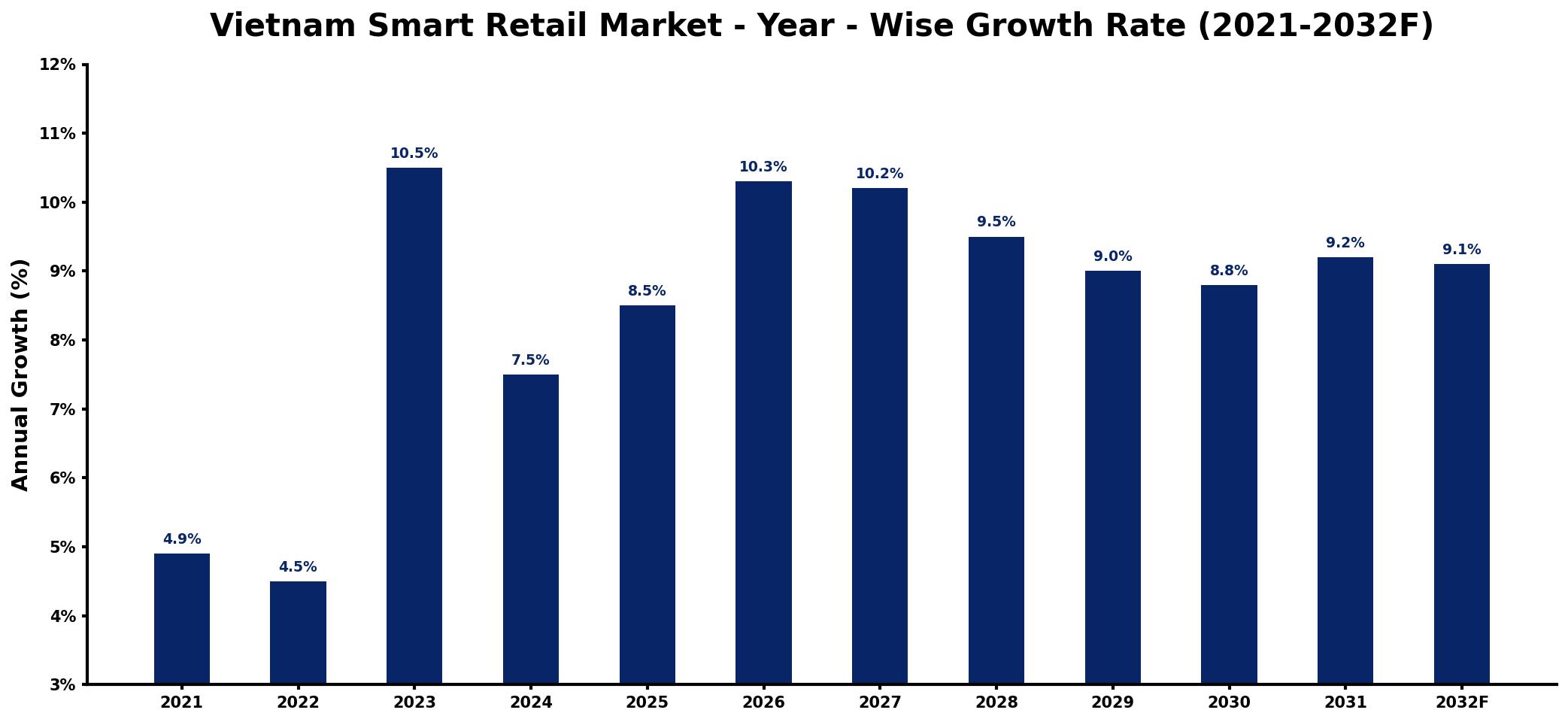
The table below presents the year‑wise growth rates along with the key drivers influencing the market
| Year | Growth Rate | Major Drivers |
| 2021 | 4.9% | rising consumer digital engagement |
| 2022 | 4.5% | expansion of e-commerce platforms |
| 2023 | 10.5% | increased mobile payment adoption |
| 2024 | 7.5% | growth in urban population density |
| 2025 | 8.5% | enhanced customer experience technologies |
| 2026 | 10.3% | surge in data analytics investments |
| 2027 | 10.2% | advancements in logistics infrastructure |
| 2028 | 9.5% | increased demand for convenience services |
| 2029 | 9.0% | improved processing technologies adoption |
| 2030 | 8.8% | rising interest in sustainability practices |
| 2031 | 9.2% | development of AI-driven solutions |
| 2032 | 9.1% | growing regional consumption patterns |
Note: Market size estimations and growth projections presented in this report are based on 6Wresearch's proprietary forecasting methodology, utilizing the latest available industry data, government publications, and primary research inputs.
Vietnam Smart Retail Market Synopsis
The most significant force shaping the Vietnam smart retail market currently is the swift transformation in consumer behavior. The growing preference for online and mobile shopping has compelled traditional retailers to integrate innovative smart retail technologies, enhancing in-store experiences and operational efficiencies.
Additionally, government initiatives focusing on digital transformation have created a conducive environment for the proliferation of smart retail solutions. As e-commerce continues to gain traction, retailers are increasingly deploying technologies such as AI-driven analytics and mobile payment systems to meet evolving consumer expectations.
Vietnam Smart Retail Market Key Takeaways
- The integration of smart technologies is enhancing the retail experience, particularly in urban centers.
- Consumer demand for personalization through data analytics is driving the adoption of AI in retail operations.
- Digital payment solutions are becoming a standard expectation among Vietnamese shoppers.
- Government efforts to boost e-commerce and digitalization are accelerating market growth.
- The trend towards omnichannel retail strategies is reshaping how consumers interact with brands.
Evaluation of Restraints in Vietnam Smart Retail Market
Despite the promising growth of the Vietnam smart retail market, several restraints pose significant challenges. The high cost associated with implementing sophisticated technologies like RFID and AI can be prohibitive, particularly for small businesses struggling with budget constraints. Additionally, growing concerns surrounding data privacy and the potential misuse of customer information may deter some consumers from fully embracing these innovations. Moreover, the varying levels of digital literacy among both employees and customers create an uneven landscape, complicating the widespread adoption of smart retail solutions.
Vietnam Smart Retail Market Trends
Key trends influencing the Vietnam smart retail market include the rise of omnichannel strategies that provide consumers with a seamless shopping experience across various platforms. The popularity of mobile payments is also surging, driven by convenience and security preferences. Retailers are leveraging AI to enhance customer engagement, with personalized marketing becoming more prevalent. Furthermore, the integration of IoT devices in retail spaces is increasingly common, facilitating real-time inventory management and improved customer service.
Vietnam Smart Retail Market Opportunities
Genuine growth opportunities in the Vietnam smart retail market lie in expanding the deployment of AI and data analytics for targeted marketing. As consumers seek enhanced personalization, retailers can capitalize on this trend by utilizing big data to understand purchasing behaviors and preferences better. Additionally, investment in e-commerce platforms that support omnichannel retailing presents a substantial opportunity for growth, especially as more Vietnamese consumers adopt online shopping.
Government Initiatives in the Vietnam Smart Retail Market
The Vietnamese government has undertaken various initiatives aimed at fostering a digital economy, with significant emphasis on promoting e-commerce and digital retail solutions. Policies encouraging investment in technology infrastructure and training programs focused on digital skills are pivotal in shaping a more advanced retail landscape. By supporting public-private partnerships, the government is creating an ecosystem conducive to the advancement of smart retail technologies across the country.
Future Insights of the Vietnam Smart Retail Market
Looking ahead to 2026-2032, the Vietnam smart retail market is poised for significant transformation as technology continues to evolve. As retailers increasingly adopt innovative solutions, such as AI and IoT, the shopping experience will become more personalized and efficient. Furthermore, the expected growth of the digital payment infrastructure will facilitate greater consumer trust and convenience. Ultimately, the fusion of online and offline retail will redefine consumer engagement and loyalty in the coming years.
Vietnam Smart Retail Market Latest Developments (2025 - 2026)
Recent developments in the Vietnam smart retail market indicate a strong trend towards the implementation of automated retail solutions. Retailers are increasingly adopting contactless payment systems and self-service kiosks to enhance safety and convenience for consumers. Additionally, significant investments in AI-driven analytics are enabling businesses to better understand consumer behavior, leading to more targeted marketing strategies and improved customer engagement.
Vietnam Smart Retail Market - Key Attractiveness of the Report
- 10 Years of Market Numbers
- Historical Data Starting from 2022 to 2025
- Base Year: 2025
- Forecast Data until 2032
- Key Performance Indicators Impacting the Market
- Major Upcoming Developments and Projects
Key Highlights of the Report:
- Vietnam Smart Retail Market Outlook
- Market Size of Vietnam Smart Retail Market, 2025
- Forecast of Vietnam Smart Retail Market, 2032
- Historical Data and Forecast of Vietnam Smart Retail Revenues & Volume for the Period 2022-2032F
- Vietnam Smart Retail Market Trend Evolution
- Vietnam Smart Retail Market Drivers and Challenges
- Vietnam Smart Retail Price Trends
- Vietnam Smart Retail Porter's Five Forces
- Vietnam Smart Retail Industry Life Cycle
- Historical Data and Forecast of Vietnam Smart Retail Market Revenues & Volume By System for the Period 2022-2032F
- Historical Data and Forecast of Vietnam Smart Retail Market Revenues & Volume By Digital Signage Solutions for the Period 2022-2032F
- Historical Data and Forecast of Vietnam Smart Retail Market Revenues & Volume By Smart Labels for the Period 2022-2032F
- Historical Data and Forecast of Vietnam Smart Retail Market Revenues & Volume By Smart Payment Systems for the Period 2022-2032F
- Historical Data and Forecast of Vietnam Smart Retail Market Revenues & Volume By Intelligent Vending Machines for the Period 2022-2032F
- Historical Data and Forecast of Vietnam Smart Retail Market Revenues & Volume By Augmented Reality Solutions for the Period 2022-2032F
- Historical Data and Forecast of Vietnam Smart Retail Market Revenues & Volume By Virtual Reality Solutions for the Period 2022-2032F
- Historical Data and Forecast of Vietnam Smart Retail Market Revenues & Volume By POS Solutions for the Period 2022-2032F
- Historical Data and Forecast of Vietnam Digital Signage Solutions Smart Retail Market Revenues & Volume By Smart Carts for the Period 2022-2032F
- Historical Data and Forecast of Vietnam Smart Retail Market Revenues & Volume By Application for the Period 2022-2032F
- Historical Data and Forecast of Vietnam Smart Retail Market Revenues & Volume By Foot-traffic Monitoring for the Period 2022-2032F
- Historical Data and Forecast of Vietnam Smart Retail Market Revenues & Volume By Inventory Management for the Period 2022-2032F
- Historical Data and Forecast of Vietnam Smart Retail Market Revenues & Volume By Loyalty Management and Payment for the Period 2022-2032F
- Historical Data and Forecast of Vietnam Smart Retail Market Revenues & Volume By Predictive Equipment Maintenance for the Period 2022-2032F
- Historical Data and Forecast of Vietnam Smart Retail Market Revenues & Volume By Brand Protection for the Period 2022-2032F
- Historical Data and Forecast of Vietnam Smart Retail Market Revenues & Volume By Smart Fitting Rooms for the Period 2022-2032F
- Historical Data and Forecast of Vietnam Smart Retail Market Revenues & Volume By Retail Offering for the Period 2022-2032F
- Historical Data and Forecast of Vietnam Smart Retail Market Revenues & Volume By Apparel and Accessories for the Period 2022-2032F
- Historical Data and Forecast of Vietnam Smart Retail Market Revenues & Volume By Fast-moving Consumer Goods for the Period 2022-2032F
- Historical Data and Forecast of Vietnam Smart Retail Market Revenues & Volume By Hardlines and Leisure Goods for the Period 2022-2032F
- Historical Data and Forecast of Vietnam Smart Retail Market Revenues & Volume By Others for the Period 2022-2032F
- Vietnam Smart Retail Import Export Trade Statistics
- Market Opportunity Assessment By System
- Market Opportunity Assessment By Application
- Market Opportunity Assessment By Retail Offering
- Vietnam Smart Retail Top Companies Market Share
- Vietnam Smart Retail Competitive Benchmarking By Technical and Operational Parameters
- Vietnam Smart Retail Company Profiles
- Vietnam Smart Retail Key Strategic Recommendations






































