Vietnam Smart Weapons Market Size, Share & Growth Rate
The Vietnam Smart Weapons Market was estimated at USD 480 Million in 2025 and is projected to reach USD 752 Million by 2032, growing at a CAGR of 6.6% from 2026 to 2032. This trajectory is underpinned by a robust commitment from the Vietnamese government to modernize its defense capabilities amidst rising regional security challenges. The increasing focus on precision-guided munitions and unmanned systems reflects Vietnams strategic vision for a more advanced military posture.
Vietnam Smart Weapons Market Year-wise Growth Rate and Key Drivers
This graph highlights how the Vietnam Smart Weapons Market has steadily grown over the years, supported by major growth factors.
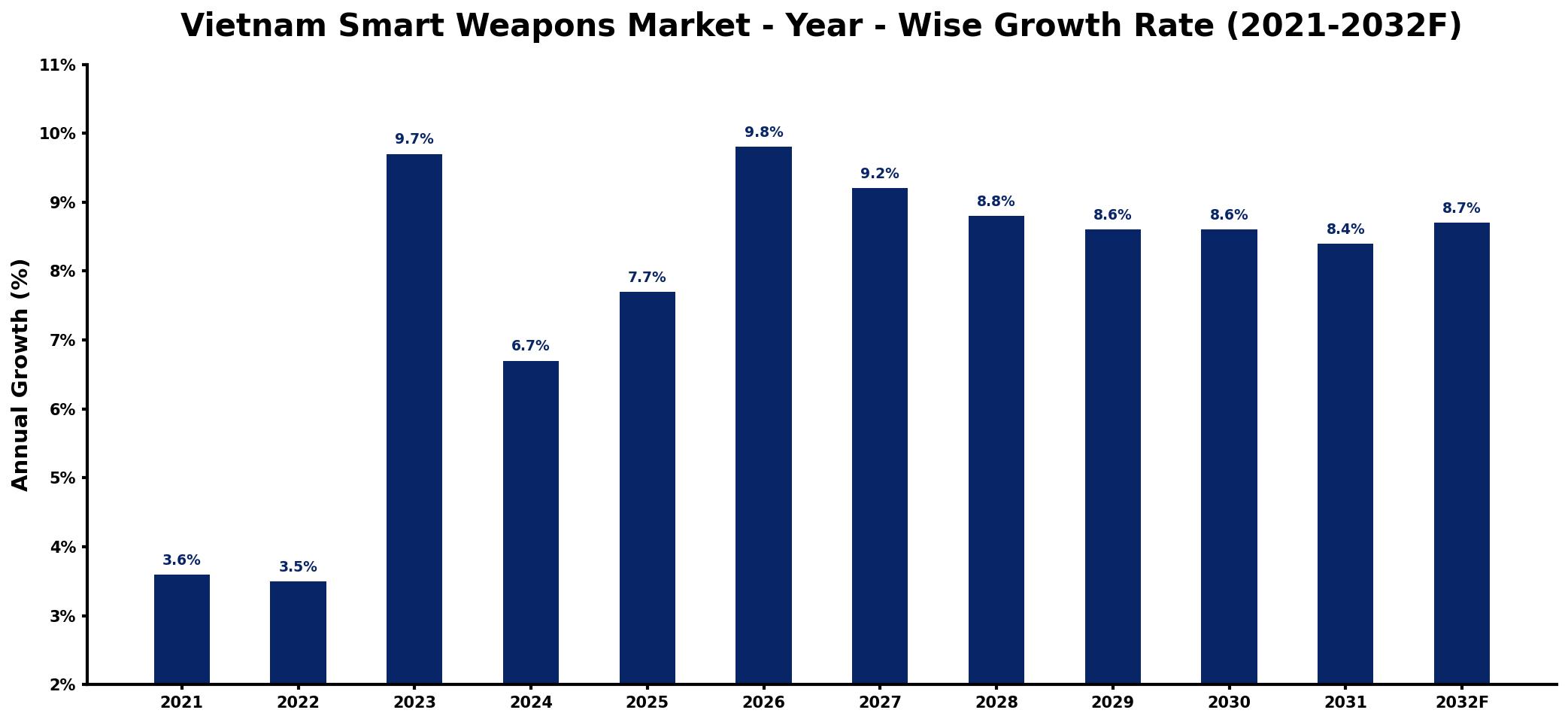
The table below presents the year‑wise growth rates along with the key drivers influencing the market
| Year | Growth Rate | Major Drivers |
| 2021 | 3.6% | growing downstream application demand |
| 2022 | 3.5% | Increased technological advancements adoption |
| 2023 | 9.7% | Growing regional security concerns |
| 2024 | 6.7% | Expansion of military modernization plans |
| 2025 | 7.7% | Strengthening international defense partnerships |
| 2026 | 9.8% | Surge in defense research investments |
| 2027 | 9.2% | Emergence of new market entrants |
| 2028 | 8.8% | Enhanced training and simulation programs |
| 2029 | 8.6% | Boost in domestic manufacturing capabilities |
| 2030 | 8.6% | Growing emphasis on cybersecurity solutions |
| 2031 | 8.4% | Development of advanced military strategies |
| 2032 | 8.7% | growing commercial sector adoption |
Note: Market size estimations and growth projections presented in this report are based on 6Wresearch's proprietary forecasting methodology, utilizing the latest available industry data, government publications, and primary research inputs.
Vietnam Smart Weapons Market Synopsis
The Vietnam smart weapons market is currently at a pivotal moment, transitioning from traditional military assets to advanced technological solutions. As the defense landscape evolves, the demand for smart weapons is set to escalate, driven by both government initiatives and global collaborations.
Looking ahead, the landscape is expected to expand significantly, fueled by ongoing investments in defense technology and the pressing need for enhanced military capabilities. The integration of international defense partnerships is pivotal in shaping a modern and efficient military force that aligns with Vietnam's strategic objectives.
Vietnam Smart Weapons Market Key Takeaways
- The market is projected to grow significantly, reflecting increasing defense budgets and modernization efforts.
- Precision and accuracy of smart weapons are crucial for reducing collateral damage in military operations.
- Collaborations with international defense firms are enhancing technological advancements in Vietnam.
- Rising security concerns in the region, particularly related to territorial disputes, are driving market demand.
- Government investments in smart weapons technology are expected to accelerate market growth.
Evaluation of Restraints in Vietnam Smart Weapons Market
While the Vietnam smart weapons market holds great potential, it is also subject to certain constraints. The acquisition and development of advanced military technologies require substantial financial investments, often coupled with compliance with stringent international arms regulations. The challenge of integrating these technologies into existing military frameworks further complicates the modernization process. Additionally, the focus on responsible usage and maintenance of smart weapons adds layers of complexity to the operational landscape.
Vietnam Smart Weapons Market Trends
Current trends indicate a strong shift towards unmanned systems and guided munitions within the Vietnam smart weapons market. The emphasis on precision warfare is driving advancements in electronic warfare capabilities and the development of autonomous systems. Furthermore, the integration of artificial intelligence into military strategy is emerging as a vital trend, enhancing decision-making processes in real-time combat scenarios.
Vietnam Smart Weapons Market Opportunities
The market presents numerous growth opportunities, particularly in the realm of joint defense initiatives with international partners. Such collaborations could facilitate the transfer of technology and expertise, fostering a more robust domestic defense industry. Additionally, the growing focus on research and development initiatives aimed at creating next-generation smart weapon systems positions Vietnam favorably to capitalize on future advancements in military technology.
Government Initiatives in the Vietnam Smart Weapons Market
The Vietnamese government is actively promoting the modernization of its military through various initiatives aimed at enhancing defense capabilities. Significant public spending on defense technology is directed toward acquiring advanced weaponry and fostering partnerships with leading defense companies worldwide. Furthermore, policies encouraging local defense production are also being developed to boost self-reliance in military technology.
Future Insights of the Vietnam Smart Weapons Market
Looking ahead to the period from 2026 to 2032, the Vietnam smart weapons market is set to flourish as defense priorities evolve. The combination of increased government expenditure, strategic partnerships, and technological innovation will likely propel the market forward. As regional threats remain a concern, Vietnams commitment to enhancing its military prowess through advanced smart weapons systems will be a pivotal factor in its defense strategy.
Vietnam Smart Weapons Market Latest Developments (2025 - 2026)
In recent months, the Vietnam smart weapons market has seen a notable influx of international collaborations aimed at enhancing local capabilities. Initiatives focused on integrating advanced technologies into the existing military framework are underway, emphasizing the importance of a modernized defense infrastructure. Additionally, ongoing discussions regarding defense procurement have indicated a strategic shift towards acquiring cutting-edge smart weapon systems.
Vietnam Smart Weapons Market - Key Attractiveness of the Report
- 10 Years of Market Numbers
- Historical Data Starting from 2022 to 2025
- Base Year: 2025
- Forecast Data until 2032
- Key Performance Indicators Impacting the Market
- Major Upcoming Developments and Projects
Key Highlights of the Report:
- Vietnam Smart Weapons Market Outlook
- Market Size of Vietnam Smart Weapons Market, 2025
- Forecast of Vietnam Smart Weapons Market, 2032
- Historical Data and Forecast of Vietnam Smart Weapons Revenues & Volume for the Period 2022-2032F
- Vietnam Smart Weapons Market Trend Evolution
- Vietnam Smart Weapons Market Drivers and Challenges
- Vietnam Smart Weapons Price Trends
- Vietnam Smart Weapons Porter's Five Forces
- Vietnam Smart Weapons Industry Life Cycle
- Historical Data and Forecast of Vietnam Smart Weapons Market Revenues & Volume By Product for the Period 2022-2032F
- Historical Data and Forecast of Vietnam Smart Weapons Market Revenues & Volume By Missiles for the Period 2022-2032F
- Historical Data and Forecast of Vietnam Smart Weapons Market Revenues & Volume By Munitions for the Period 2022-2032F
- Historical Data and Forecast of Vietnam Smart Weapons Market Revenues & Volume By Guided Projectiles for the Period 2022-2032F
- Historical Data and Forecast of Vietnam Smart Weapons Market Revenues & Volume By Guided Rockets for the Period 2022-2032F
- Historical Data and Forecast of Vietnam Smart Weapons Market Revenues & Volume By Guided Firearms for the Period 2022-2032F
- Historical Data and Forecast of Vietnam Smart Weapons Market Revenues & Volume By Directed Energy Weapons for the Period 2022-2032F
- Historical Data and Forecast of Vietnam Smart Weapons Market Revenues & Volume By Technology for the Period 2022-2032F
- Historical Data and Forecast of Vietnam Smart Weapons Market Revenues & Volume By Laser for the Period 2022-2032F
- Historical Data and Forecast of Vietnam Smart Weapons Market Revenues & Volume By Infrared for the Period 2022-2032F
- Historical Data and Forecast of Vietnam Smart Weapons Market Revenues & Volume By Radar for the Period 2022-2032F
- Historical Data and Forecast of Vietnam Smart Weapons Market Revenues & Volume By GPS for the Period 2022-2032F
- Historical Data and Forecast of Vietnam Smart Weapons Market Revenues & Volume By Others for the Period 2022-2032F
- Historical Data and Forecast of Vietnam Smart Weapons Market Revenues & Volume By Platform for the Period 2022-2032F
- Historical Data and Forecast of Vietnam Smart Weapons Market Revenues & Volume By Air for the Period 2022-2032F
- Historical Data and Forecast of Vietnam Smart Weapons Market Revenues & Volume By Land for the Period 2022-2032F
- Historical Data and Forecast of Vietnam Smart Weapons Market Revenues & Volume By Naval for the Period 2022-2032F
- Vietnam Smart Weapons Import Export Trade Statistics
- Market Opportunity Assessment By Product
- Market Opportunity Assessment By Technology
- Market Opportunity Assessment By Platform
- Vietnam Smart Weapons Top Companies Market Share
- Vietnam Smart Weapons Competitive Benchmarking By Technical and Operational Parameters
- Vietnam Smart Weapons Company Profiles
- Vietnam Smart Weapons Key Strategic Recommendations






































