Vietnam Sodium fluoride Market Size, Share & Growth Rate
The Vietnam Sodium fluoride Market was estimated at USD 255 Million in 2025 and is projected to reach USD 359 Million by 2032, growing at a CAGR of 5.0% from 2026 to 2032. This growth trajectory is primarily fueled by the compound's extensive use in dental care products, particularly toothpaste, as well as its essential role in various industrial processes such as metallurgy and aluminum manufacturing. Additionally, a growing public awareness regarding oral hygiene is bolstering demand, indicating a robust future for the market.
Vietnam Sodium fluoride Market Year-wise Growth Rate and Key Drivers
This graph highlights how the Vietnam Sodium fluoride Market has steadily grown over the years, supported by major growth factors.
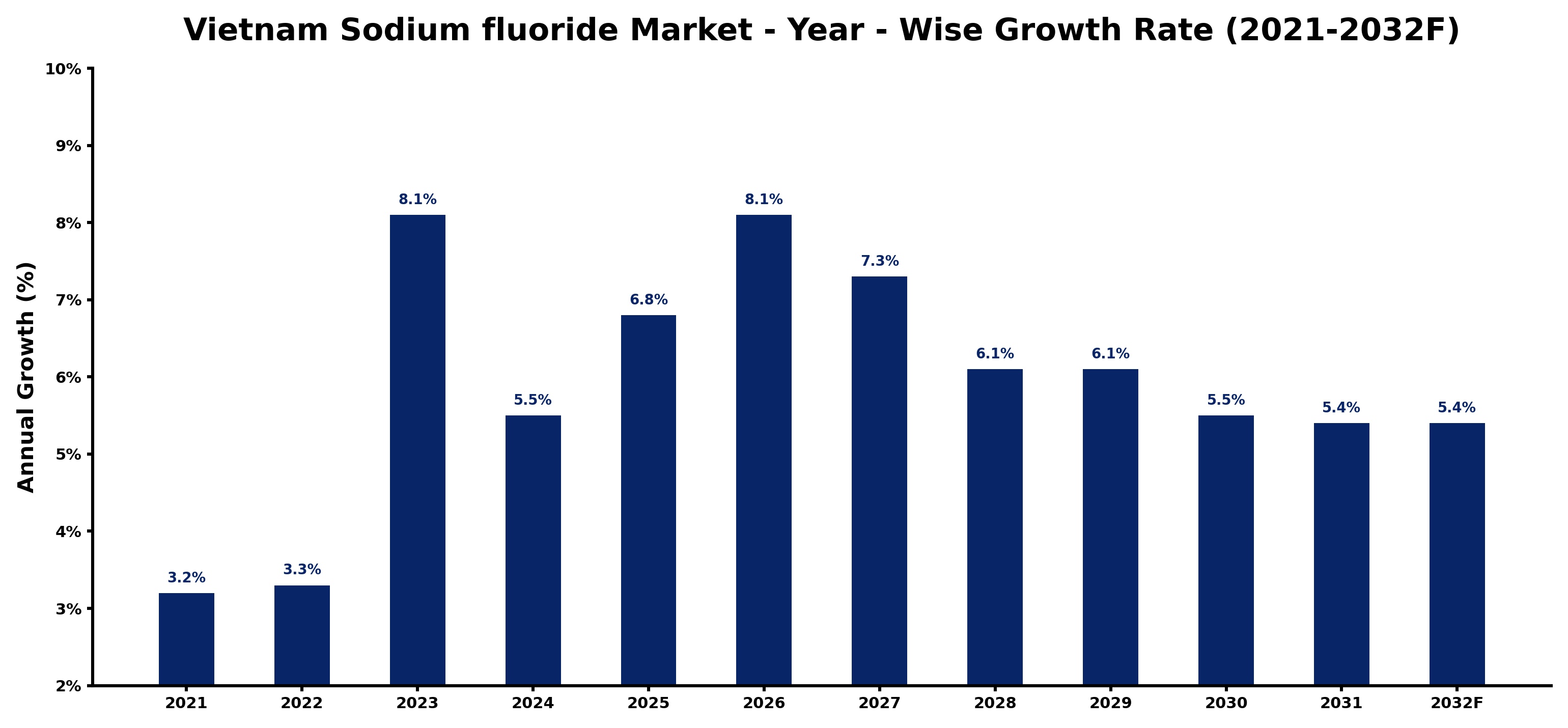
The table below presents the year‑wise growth rates along with the key drivers influencing the market
| Year | Growth Rate | Major Drivers |
| 2021 | 3.2% | Technology integration in export manufacturing boosts sodium fluoride production efficiency |
| 2022 | 3.3% | Foreign investments in manufacturing boosted sodium fluoride production capacity |
| 2023 | 8.1% | New foreign investments boost sodium fluoride production capacity in Vietnam |
| 2024 | 5.5% | Foreign investments boosted chemical production capacity for export markets |
| 2025 | 6.8% | Foreign investment in chemical production boosts sodium fluoride exports |
| 2026 | 8.1% | Automotive assembly growth boosts demand for sodium fluoride supplies |
| 2027 | 7.3% | Foreign investment in chemical facilities boosts sodium fluoride production |
| 2028 | 6.1% | Export demand for sodium fluoride boosted local manufacturing capacity utilization |
| 2029 | 6.1% | New export contracts boost sodium fluoride production capacities in Vietnam |
| 2030 | 5.5% | Foreign investments in manufacturing bolster sodium fluoride production capabilities |
| 2031 | 5.4% | Improved chemical processing technology boosted sodium fluoride production efficiency |
| 2032 | 5.4% | Foreign investments in automotive assembly boost sodium fluoride demand |
Note - Market size estimations and growth projections presented in this report are based on 6Wresearch's advanced forecasting approach, validated with industry datasets as of June 2026.
Vietnam Sodium fluoride Market Synopsis
In recent years, the Vietnam Sodium fluoride market has experienced considerable momentum, driven by its critical applications in health and industry. However, as market players navigate evolving regulations and environmental concerns, a shift is anticipated towards more sustainable practices that align with public health goals.
Looking forward, the market is poised to capitalize on emerging opportunities in dental health and industrial applications. As the Vietnamese government increasingly prioritizes health and safety standards, there is potential for innovative solutions that address both regulatory needs and market demands.
Vietnam Sodium fluoride Market Key Takeaways
- The market is forecasted to witness a steady growth rate, driven by increasing industrial applications.
- A heightened focus on dental hygiene and health has amplified sodium fluoride's role in dental care products.
- Environmental regulations are prompting companies to innovate in sustainable production methods.
- Competition from alternative compounds is shaping market dynamics and influencing pricing strategies.
- Strong government initiatives aimed at public health are creating opportunities for market expansion.
Evaluation of Restraints in Vietnam Sodium fluoride Market
The Vietnam Sodium fluoride market faces significant constraints primarily stemming from environmental concerns and stringent safety regulations. The production processes associated with sodium fluoride can lead to ecological contamination, raising alarms about sustainability and prompting regulatory scrutiny. Moreover, health regulations surrounding fluoride exposure can further restrict its usage across various sectors, complicating market access. Additionally, the emergence of alternative compounds and synthetic substitutes poses competitive challenges, compelling market players to innovate continuously and address these pressing limitations.
Vietnam Sodium fluoride Market Trends
The market is witnessing several notable trends, such as increasing investment in research and development to create safer and more effective sodium fluoride formulations. Furthermore, the rise of eco-friendly practices is prompting companies to adapt their production methods. This aligns with the global shift towards sustainability, aiming to reduce the ecological footprint associated with chemical manufacturing. Additionally, the integration of advanced technologies in production processes is enhancing efficiency, ultimately benefiting both the market and consumers.
Vietnam Sodium fluoride Market Opportunities
Opportunities for growth in the Vietnam Sodium fluoride market are abundant, particularly in the dental and industrial sectors. The increasing awareness of oral health is driving demand for fluoride-based dental products, while the metallurgical industry continues to seek innovative applications of sodium fluoride for metal refinement. Moreover, as Vietnam enhances its industrial capabilities, sodium fluoride's role in aluminum production offers further avenues for expansion. Companies that invest in sustainable practices and product innovation will likely lead the charge in capturing these burgeoning opportunities.
Government Initiatives in the Vietnam Sodium fluoride Market
The Vietnamese government is actively promoting public health initiatives that underscore the importance of oral hygiene and water fluoridation. There are ongoing programs aimed at raising public awareness about the benefits of fluoride in preventing dental cavities. Additionally, policy frameworks are being developed to improve the safety standards surrounding the production and use of sodium fluoride, ensuring it aligns with health and environmental priorities. Such initiatives are set to catalyze growth in the sodium fluoride market while maintaining a focus on ecological sustainability.
Future Insights of the Vietnam Sodium fluoride Market
Between 2026 and 2032, the Vietnam Sodium fluoride market is expected to evolve significantly. As industrial sectors rebound from the impacts of the pandemic, demand for sodium fluoride across various applications will likely rise. Government policies emphasizing public health and environmental protection will shape market dynamics, encouraging innovation and responsible practices. Consequently, market players who align their strategies with these trends will position themselves advantageously in an increasingly competitive landscape.
Vietnam Sodium fluoride Market Latest Developments (May 2025 - June 2026)
Recent developments in the Vietnam Sodium fluoride market have underscored the industry's commitment to innovation and sustainability. Companies are exploring new production techniques to enhance efficiency while reducing environmental impact. Moreover, there has been an uptick in partnerships focused on improving fluoride formulations, particularly in dental care applications. This collaborative effort reflects an industry-wide push towards meeting regulatory standards and consumer demand for safe, effective products.
Vietnam Sodium fluoride Market - Key Attractiveness of the Report
- 10 Years of Market Numbers
- Historical Data Starting from 2022 to 2025
- Base Year: 2025
- Forecast Data until 2032
- Key Performance Indicators Impacting the Market
- Major Upcoming Developments and Projects
Key Highlights of the Report:
- Vietnam Sodium fluoride Market Outlook
- Market Size of Vietnam Sodium fluoride Market, 2025
- Forecast of Vietnam Sodium fluoride Market, 2032
- Historical Data and Forecast of Vietnam Sodium fluoride Revenues & Volume for the Period 2022-2032F
- Vietnam Sodium fluoride Market Trend Evolution
- Vietnam Sodium fluoride Market Drivers and Challenges
- Vietnam Sodium fluoride Price Trends
- Vietnam Sodium fluoride Porter's Five Forces
- Vietnam Sodium fluoride Industry Life Cycle
- Historical Data and Forecast of Vietnam Sodium fluoride Market Revenues & Volume By Grade for the Period 2022-2032F
- Historical Data and Forecast of Vietnam Sodium fluoride Market Revenues & Volume By Food Grade for the Period 2022-2032F
- Historical Data and Forecast of Vietnam Sodium fluoride Market Revenues & Volume By Pharmaceutical Grade for the Period 2022-2032F
- Historical Data and Forecast of Vietnam Sodium fluoride Market Revenues & Volume By Industrial Grade for the Period 2022-2032F
- Historical Data and Forecast of Vietnam Sodium fluoride Market Revenues & Volume By Applications for the Period 2022-2032F
- Historical Data and Forecast of Vietnam Sodium fluoride Market Revenues & Volume By Dental Products for the Period 2022-2032F
- Historical Data and Forecast of Vietnam Sodium fluoride Market Revenues & Volume By Water Treatment for the Period 2022-2032F
- Historical Data and Forecast of Vietnam Sodium fluoride Market Revenues & Volume By Insecticides & Pesticides for the Period 2022-2032F
- Historical Data and Forecast of Vietnam Sodium fluoride Market Revenues & Volume By Pharmaceuticals for the Period 2022-2032F
- Historical Data and Forecast of Vietnam Sodium fluoride Market Revenues & Volume By Others for the Period 2022-2032F
- Vietnam Sodium fluoride Import Export Trade Statistics
- Market Opportunity Assessment By Grade
- Market Opportunity Assessment By Applications
- Vietnam Sodium fluoride Top Companies Market Share
- Vietnam Sodium fluoride Competitive Benchmarking By Technical and Operational Parameters
- Vietnam Sodium fluoride Company Profiles
- Vietnam Sodium fluoride Key Strategic Recommendations






































