Vietnam Sodium Hydride Market Size, Share & Growth Rate
The Vietnam Sodium Hydride Market was estimated at USD 838 Million in 2025 and is projected to reach USD 1193 Million by 2032, growing at a CAGR of 5.2% from 2026 to 2032. This positive trajectory can be attributed to the increasing demand from the pharmaceutical and chemical sectors, where sodium hydride serves as a pivotal reagent in various synthesis processes. Moreover, the growing emphasis on clean energy production and the rise of high-purity chemicals in electronics manufacturing further bolster market growth.
Vietnam Sodium Hydride Market Year-wise Growth Rate and Key Drivers
This graph highlights how the Vietnam Sodium Hydride Market has steadily grown over the years, supported by major growth factors.
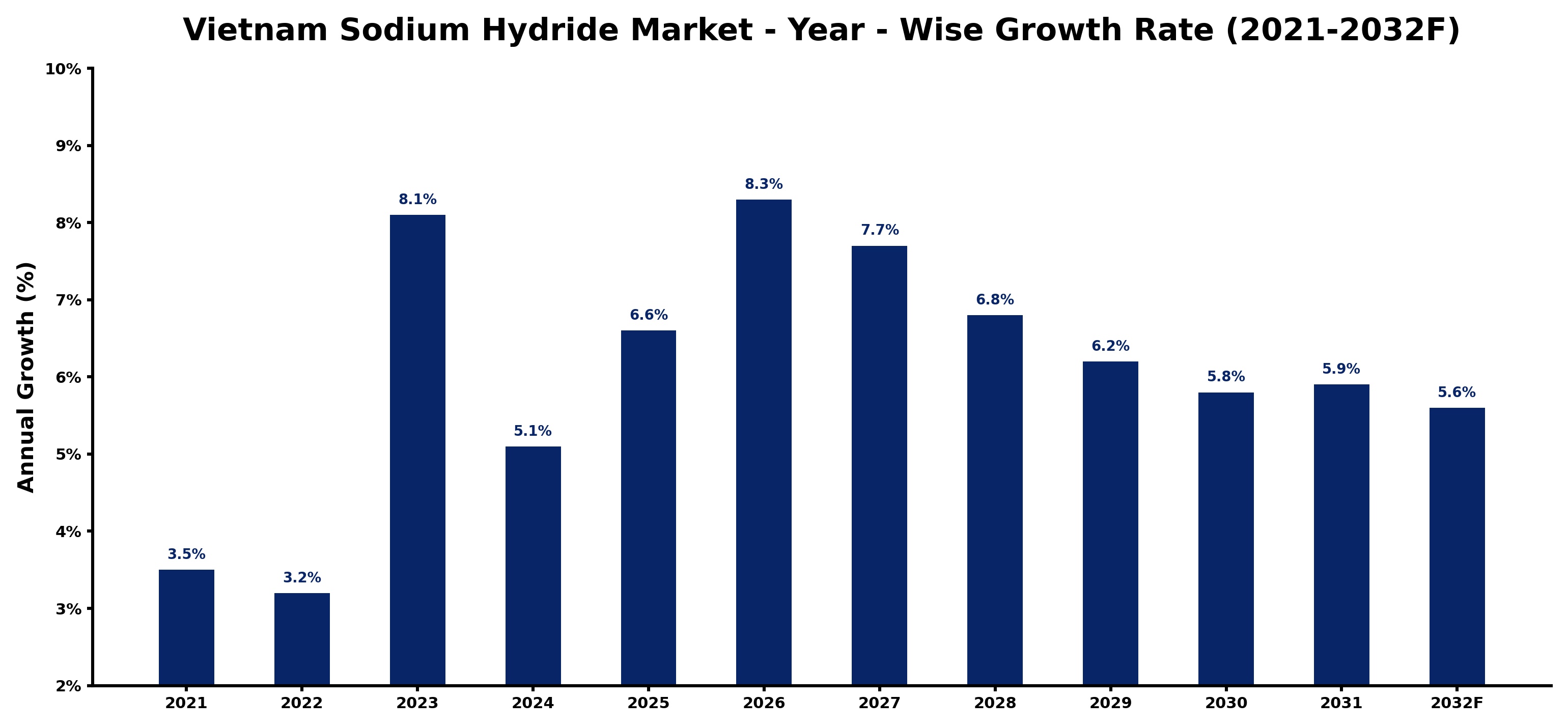
The table below presents the year‑wise growth rates along with the key drivers influencing the market
| Year | Growth Rate | Major Drivers |
| 2021 | 3.5% | Chemical manufacturing sector expanded rapidly |
| 2022 | 3.2% | Increased demand from pharmaceuticals sector |
| 2023 | 8.1% | Emerging technologies enhanced production efficiency |
| 2024 | 5.1% | Rising industrial applications drove consumption |
| 2025 | 6.6% | Growing demand in energy storage |
| 2026 | 8.3% | Research investments boosted innovation efforts |
| 2027 | 7.7% | Sustainable practices gained market traction |
| 2028 | 6.8% | Export opportunities expanded significantly |
| 2029 | 6.2% | Strategic partnerships enhanced market reach |
| 2030 | 5.8% | Regulatory support encouraged industry growth |
| 2031 | 5.9% | Consumer awareness of chemical applications |
| 2032 | 5.6% | Technological advancements improved product quality |
Note - Market size estimations and growth projections presented in this report are based on 6Wresearch’s advanced forecasting approach, validated with industry datasets as of June 2026.
Vietnam Sodium Hydride Market Synopsis
The most significant force shaping the Vietnam Sodium Hydride Market is the robust growth of the pharmaceutical industry. As research and development initiatives expand in this sector, the need for sodium hydride continues to rise, underscoring its importance in organic synthesis. Additionally, the increasing demand for specialty chemicals across a variety of applications reinforces sodium hydride's critical role in chemical manufacturing.
In addition to pharmaceuticals, the shift toward sustainable energy solutions is a crucial driver in the market. Sodium hydride is being increasingly recognized for its application in hydrogen production, aligning with global trends towards greener energy sources. This convergence of demand across sectors positions Vietnam's sodium hydride market for sustained growth in the coming years.
Vietnam Sodium Hydride Market Key Takeaways
- The market is experiencing growth driven by pharmaceutical applications and organic synthesis.
- Increasing investments in clean energy initiatives are expanding sodium hydride usage.
- Demand for high-purity chemicals in the electronics sector is contributing to market expansion.
- Regulatory compliance and environmental concerns present challenges for market players.
- Research and development into new applications for sodium hydride could open additional opportunities.
Evaluation of Restraints in Vietnam Sodium Hydride Market
Despite its growth potential, the Vietnam Sodium Hydride Market faces notable restraints. The compound's limited applications in certain industries lead to fluctuating demand, which can challenge stability in the market. Additionally, regulatory frameworks surrounding the handling and storage of sodium hydride pose significant hurdles for compliance. The potential rise of alternative materials further complicates the landscape, underscoring the importance of ongoing innovation and adaptation among market participants.
Vietnam Sodium Hydride Market Trends
One of the most pertinent trends in the market is the increasing focus on sustainable practices. This is reflected in the growing interest in using sodium hydride for hydrogen production, as industries seek cleaner energy alternatives. Furthermore, advancements in technology related to chemical synthesis are paving the way for new applications, broadening the scope of sodium hydride beyond traditional uses.
Additionally, the rise of high-purity chemicals, driven by the electronics industry, is leading manufacturers to explore innovative production methods involving sodium hydride. This trend not only meets industry demands but also aligns with global moves toward efficiency and sustainability in chemical manufacturing.
Vietnam Sodium Hydride Market Opportunities
The Vietnam Sodium Hydride Market is ripe with opportunities for growth and investment. The pharmaceutical industry's expansion offers significant potential for increased sodium hydride applications in drug development and manufacturing. Additionally, the push for clean energy solutions highlights a unique avenue for market players to innovate and position themselves as leaders in hydrogen production technologies. Finally, fostering collaborations with research institutions can pave the way for the discovery of new applications and improved production techniques, creating a more resilient market landscape.
Government Initiatives in the Vietnam Sodium Hydride Market
The Vietnamese government is increasingly prioritizing policies that support sustainable chemical manufacturing and clean energy initiatives. Various programs and incentives are being developed to encourage research and innovation in this sector. Public spending aimed at enhancing the capabilities of the pharmaceutical and chemical industries reflects the government's commitment to fostering growth in the sodium hydride market and ensuring compliance with environmental standards.
Future Insights of the Vietnam Sodium Hydride Market
Looking ahead to 2026-2032, the Vietnam Sodium Hydride Market is expected to continue its upward trajectory. With the pharmaceutical and clean energy sectors on the rise, sodium hydride's role will likely evolve, increasing its importance in innovative chemical processes. As regulatory frameworks tighten globally, market players will need to adapt and invest in sustainable practices to capitalize on new opportunities while navigating the challenges that may arise.
Vietnam Sodium Hydride Market Latest Developments (May 2025 - June 2026)
Recent developments in the Vietnam Sodium Hydride Market indicate a growing interest in technology partnerships aimed at improving production efficiency. Industry discussions have increasingly centered around sustainable practices, reflecting a wider trend towards environmental responsibility. As the pharmaceutical sector stabilizes post-COVID-19 disruptions, there's anticipation of increased demand that will further influence market dynamics.
Vietnam Sodium Hydride Market - Key Attractiveness of the Report
- 10 Years of Market Numbers
- Historical Data Starting from 2022 to 2025
- Base Year: 2025
- Forecast Data until 2032
- Key Performance Indicators Impacting the Market
- Major Upcoming Developments and Projects
Key Highlights of the Report:
- Vietnam Sodium Hydride Market Outlook
- Market Size of Vietnam Sodium Hydride Market, 2025
- Forecast of Vietnam Sodium Hydride Market, 2032
- Historical Data and Forecast of Vietnam Sodium Hydride Revenues & Volume for the Period 2022-2032F
- Vietnam Sodium Hydride Market Trend Evolution
- Vietnam Sodium Hydride Market Drivers and Challenges
- Vietnam Sodium Hydride Price Trends
- Vietnam Sodium Hydride Porter's Five Forces
- Vietnam Sodium Hydride Industry Life Cycle
- Historical Data and Forecast of Vietnam Sodium Hydride Market Revenues & Volume By Product Range for the Period 2022-2032F
- Historical Data and Forecast of Vietnam Sodium Hydride Market Revenues & Volume By Sodium Hydride 60% for the Period 2022-2032F
- Historical Data and Forecast of Vietnam Sodium Hydride Market Revenues & Volume By Sodium Hydride 55% for the Period 2022-2032F
- Historical Data and Forecast of Vietnam Sodium Hydride Market Revenues & Volume By Sodium Hydride 45% for the Period 2022-2032F
- Historical Data and Forecast of Vietnam Sodium Hydride Market Revenues & Volume By Other for the Period 2022-2032F
- Historical Data and Forecast of Vietnam Sodium Hydride Market Revenues & Volume By Application for the Period 2022-2032F
- Historical Data and Forecast of Vietnam Sodium Hydride Market Revenues & Volume By Chemical Industry for the Period 2022-2032F
- Historical Data and Forecast of Vietnam Sodium Hydride Market Revenues & Volume By Pharmaceutical Industry for the Period 2022-2032F
- Historical Data and Forecast of Vietnam Sodium Hydride Market Revenues & Volume By Pesticide Industry for the Period 2022-2032F
- Vietnam Sodium Hydride Import Export Trade Statistics
- Market Opportunity Assessment By Product Range
- Market Opportunity Assessment By Application
- Vietnam Sodium Hydride Top Companies Market Share
- Vietnam Sodium Hydride Competitive Benchmarking By Technical and Operational Parameters
- Vietnam Sodium Hydride Company Profiles
- Vietnam Sodium Hydride Key Strategic Recommendations






































