Vietnam Soybeans Seed Market Size, Share & Growth Rate
The Vietnam Soybeans Seed Market was estimated at USD 430 Million in 2025 and is projected to reach USD 607 Million by 2032, growing at a CAGR of 5.0% from 2026 to 2032. This robust growth trajectory is driven by the increasing consumer interest in sustainable agriculture, the rising demand for protein-rich food sources, and a notable trend toward home gardening. As consumers prioritize health and nutrition, the cultivation of soybeans offers a versatile solution to meet diverse dietary preferences.
Vietnam Soybeans Seed Market Year-wise Growth Rate and Key Drivers
This graph highlights how the Vietnam Soybeans Seed Market has steadily grown over the years, supported by major growth factors.
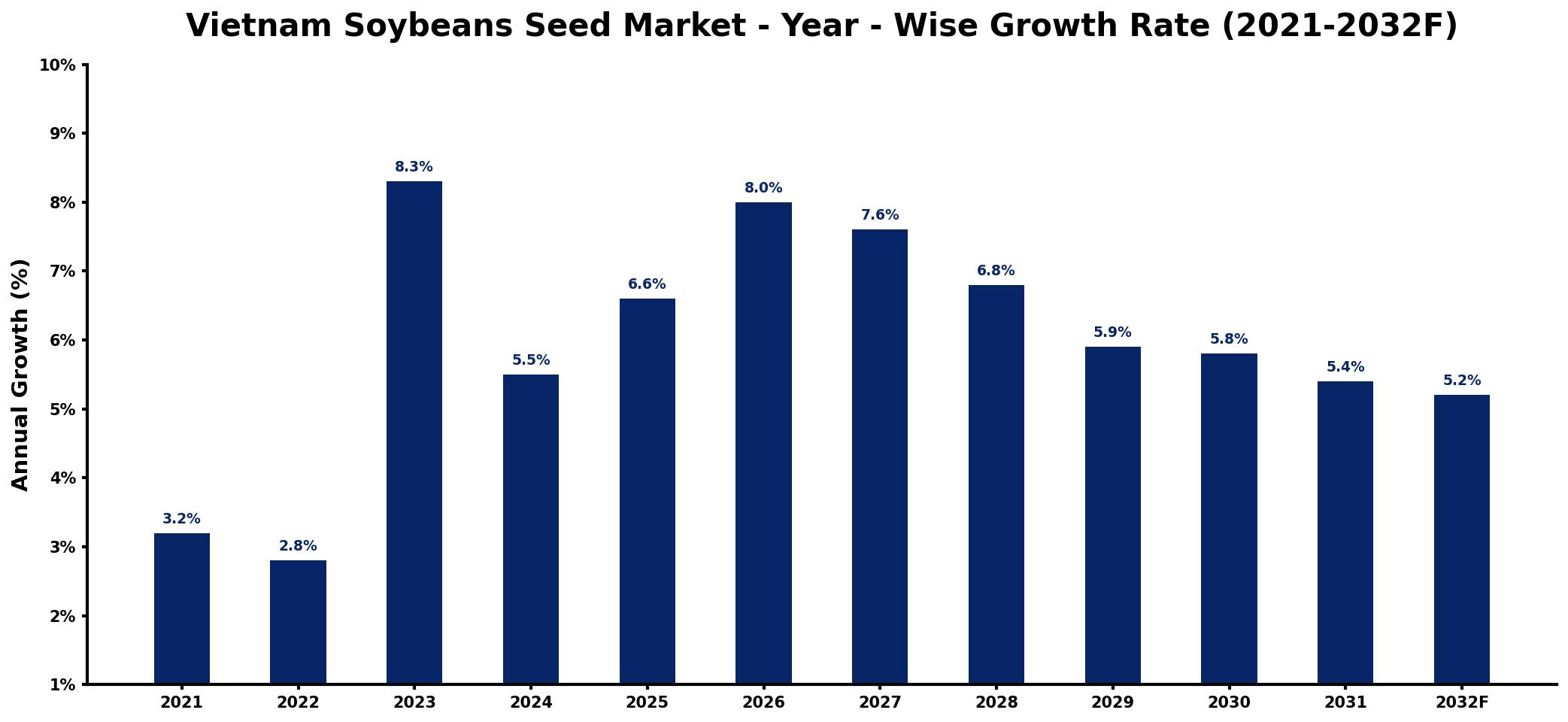
The table below presents the year‑wise growth rates along with the key drivers influencing the market
| Year | Growth Rate | Major Drivers |
| 2021 | 3.2% | Rising agricultural technology adoption |
| 2022 | 2.8% | Increasing consumer health awareness |
| 2023 | 8.3% | Expansion of organic farming practices |
| 2024 | 5.5% | Growing demand for plant-based proteins |
| 2025 | 6.6% | Investment in sustainable farming methods |
| 2026 | 8.0% | Enhanced irrigation infrastructure development |
| 2027 | 7.6% | Strengthening export market opportunities |
| 2028 | 6.8% | Innovations in crop management solutions |
| 2029 | 5.9% | Growing interest in biofuels production |
| 2030 | 5.8% | Strengthening local agricultural cooperatives |
| 2031 | 5.4% | Expanding research and development initiatives |
| 2032 | 5.2% | Increasing focus on climate resilience |
Note: Market size estimations and growth projections presented in this report are based on 6Wresearch's proprietary forecasting methodology, utilizing the latest available industry data, government publications, and primary research inputs.
Vietnam Soybeans Seed Market Synopsis
The soybean seed market in Vietnam is experiencing significant momentum, fueled by a growing recognition of the benefits of soybean cultivation. As agricultural practices evolve, farmers and home gardeners alike are increasingly turning to soybeans for their adaptability and nutritional value.
This market serves as the backbone of the soybean industry in Vietnam, ensuring a steady supply of high-quality seeds. The burgeoning popularity of soybeans for both food processing and animal feed applications underlines its critical role in the nations agricultural landscape.
Vietnam Soybeans Seed Market Key Takeaways
- The market is projected to experience steady growth, reflecting increased consumer demand for plant-based proteins.
- Home gardening initiatives are significantly boosting the adoption of soybean seeds among urban consumers.
- International suppliers complement local producers, enhancing the diversity of available seed varieties.
- There is a rising trend toward sustainable agricultural practices that favor soybean cultivation.
- COVID-19 has reshaped agricultural practices, leading to a surge in domestic crop diversification, particularly with soybeans.
Evaluation of Restraints in Vietnam Soybeans Seed Market
Despite its growth potential, the Vietnam soybeans seed market grapples with several challenges. Farmer adoption remains inconsistent due to a lack of agricultural extension services that educate about best practices in soybean cultivation. Furthermore, pest and disease management is critical, as these factors can severely hinder crop yields. Addressing these restraints will be essential for unlocking the full potential of the market, requiring targeted interventions and effective support systems to assist farmers.
Vietnam Soybeans Seed Market Trends
Current trends in the Vietnam soybeans seed market highlight a shift towards organic and sustainable farming methods. As consumers become more environmentally conscious, there is a marked increase in demand for non-GMO and organic soybean seeds. Additionally, advancements in agricultural technology, such as precision farming techniques, are emerging to support effective soybean cultivation practices. These trends indicate an evolving landscape where farmers seek not just yield, but also sustainable approaches to meet the growing consumer appetite for healthy food options.
Vietnam Soybeans Seed Market Opportunities
The Vietnam soybeans seed market offers significant growth and investment opportunities, especially in the development of high-yield and disease-resistant seed varieties. With the increasing interest in plant-based diets and home gardening, suppliers can capitalize on these trends by providing tailored seed solutions. Moreover, as Vietnam positions itself as a key player in the regional agricultural sector, there is ample scope for innovation in seed technologies and sustainable farming practices that align with consumer demands.
Government Initiatives in the Vietnam Soybeans Seed Market
The Vietnamese government has shown a commitment to enhancing agricultural productivity through various initiatives aimed at improving seed quality and farmer education. Public spending on agricultural research and development is focused on creating resilient crop varieties that can withstand climatic changes. Additionally, programs promoting sustainable farming practices are gaining traction, encouraging farmers to diversify their crops, including soybeans, as a strategic move to boost food security and economic resilience.
Future Insights of the Vietnam Soybeans Seed Market
Looking ahead to 2026-2032, the Vietnam soybeans seed market is expected to continue on its upward trajectory. The increasing incorporation of soybeans into local diets, paired with a growing number of urban gardeners, will drive demand for seed varieties that cater to both health trends and culinary diversity. As agricultural practices become more sophisticated, and with an emphasis on sustainability, the market will likely see innovative solutions that enhance crop management and yield, positioning Vietnam as a key player in the soybean landscape.
Vietnam Soybeans Seed Market Latest Developments (2025 - 2026)
In recent months, the Vietnam soybeans seed market has witnessed notable advancements, particularly in the realm of research and development. Suppliers have increasingly focused on introducing innovative soybean seed varieties that promise higher yields and resilience against common agricultural challenges. Moreover, there has been a marked increase in collaborations between local and international entities to enhance seed distribution networks, thereby improving access to quality seeds for farmers across the country.
Vietnam Soybeans Seed Market - Key Attractiveness of the Report
- 10 Years of Market Numbers
- Historical Data Starting from 2022 to 2025
- Base Year: 2025
- Forecast Data until 2032
- Key Performance Indicators Impacting the Market
- Major Upcoming Developments and Projects
Key Highlights of the Report:
- Vietnam Soybeans Seed Market Outlook
- Market Size of Vietnam Soybeans Seed Market, 2025
- Forecast of Vietnam Soybeans Seed Market, 2032
- Historical Data and Forecast of Vietnam Soybeans Seed Revenues & Volume for the Period 2022-2032F
- Vietnam Soybeans Seed Market Trend Evolution
- Vietnam Soybeans Seed Market Drivers and Challenges
- Vietnam Soybeans Seed Price Trends
- Vietnam Soybeans Seed Porter's Five Forces
- Vietnam Soybeans Seed Industry Life Cycle
- Historical Data and Forecast of Vietnam Soybeans Seed Market Revenues & Volume By Type for the Period 2022-2032F
- Historical Data and Forecast of Vietnam Soybeans Seed Market Revenues & Volume By GMO for the Period 2022-2032F
- Historical Data and Forecast of Vietnam Soybeans Seed Market Revenues & Volume By Non-GMO for the Period 2022-2032F
- Historical Data and Forecast of Vietnam Soybeans Seed Market Revenues & Volume By Applications for the Period 2022-2032F
- Historical Data and Forecast of Vietnam Soybeans Seed Market Revenues & Volume By Agriculture for the Period 2022-2032F
- Historical Data and Forecast of Vietnam Soybeans Seed Market Revenues & Volume By Scientific Research for the Period 2022-2032F
- Historical Data and Forecast of Vietnam Soybeans Seed Market Revenues & Volume By Others for the Period 2022-2032F
- Vietnam Soybeans Seed Import Export Trade Statistics
- Market Opportunity Assessment By Type
- Market Opportunity Assessment By Applications
- Vietnam Soybeans Seed Top Companies Market Share
- Vietnam Soybeans Seed Competitive Benchmarking By Technical and Operational Parameters
- Vietnam Soybeans Seed Company Profiles
- Vietnam Soybeans Seed Key Strategic Recommendations






































