Vietnam Spinning Machinery Market Size, Share & Growth Rate
The Vietnam Spinning Machinery Market was estimated at USD 498 Million in 2025 and is projected to reach USD 705 Million by 2032, growing at a CAGR of 5.1% from 2026 to 2032. This upward trajectory is driven primarily by the robust expansion of the textile and apparel industry, which has increasingly relied on advanced spinning technologies to enhance production efficiency. As Vietnam cements its status as a global textile hub, the demand for modern and efficient spinning machinery is expected to surge, supported by favorable labor conditions and strategic investments in automation.
Vietnam Spinning Machinery Market Year-wise Growth Rate and Key Drivers
This graph highlights how the Vietnam Spinning Machinery Market has steadily grown over the years, supported by major growth factors.
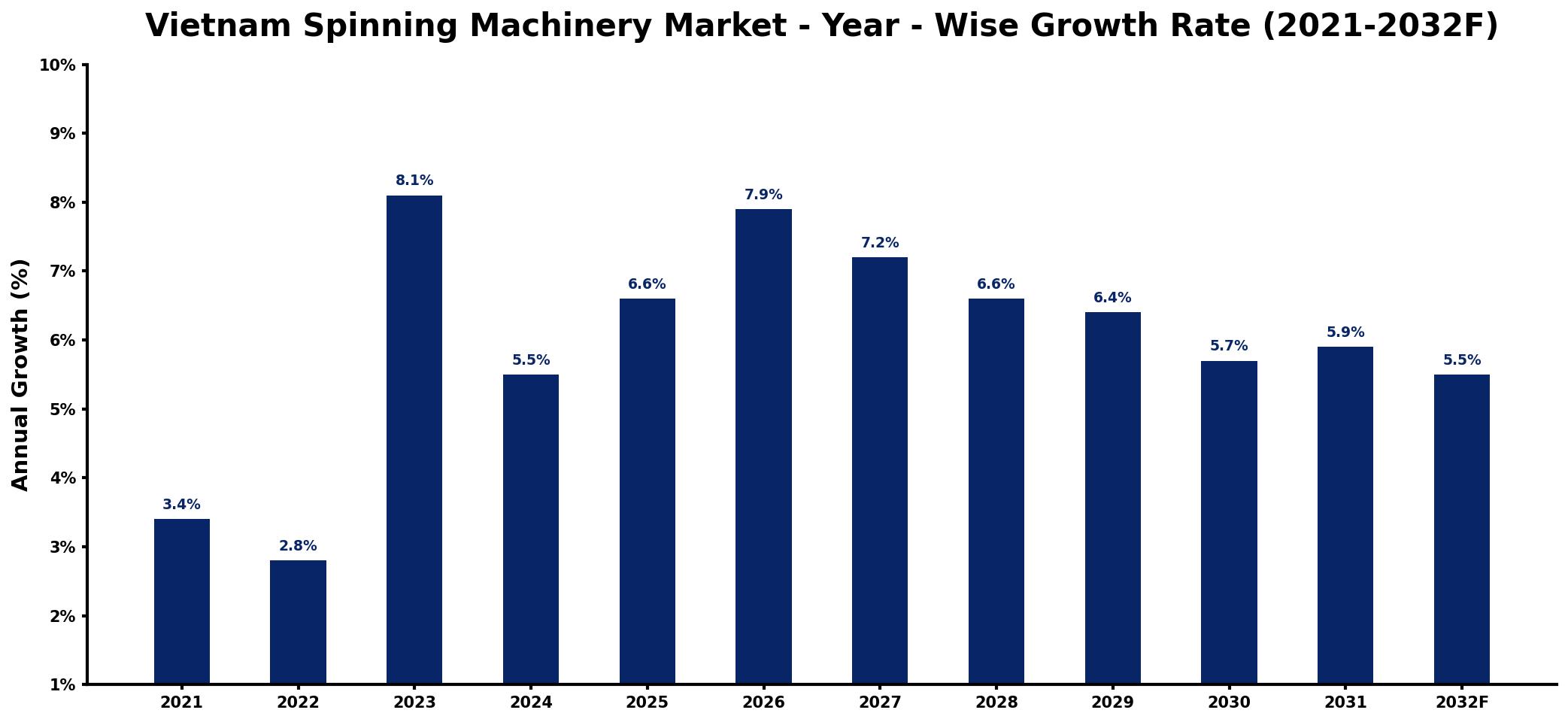
The table below presents the year‑wise growth rates along with the key drivers influencing the market
| Year | Growth Rate | Major Drivers |
| 2021 | 3.4% | Rising textile production capacity |
| 2022 | 2.8% | Increased foreign investment interest |
| 2023 | 8.1% | Expansion of export markets |
| 2024 | 5.5% | Growing domestic consumption trends |
| 2025 | 6.6% | stronger distribution network expansion |
| 2026 | 7.9% | Strengthening supply chain networks |
| 2027 | 7.2% | Emergence of eco-friendly practices |
| 2028 | 6.6% | Diversification of product offerings |
| 2029 | 6.4% | Heightened demand for innovation |
| 2030 | 5.7% | Investment in infrastructure development |
| 2031 | 5.9% | Focus on sustainability initiatives |
| 2032 | 5.5% | Boost in skilled labor availability |
Note: Market size estimations and growth projections presented in this report are based on 6Wresearch's proprietary forecasting methodology, utilizing the latest available industry data, government publications, and primary research inputs.
Vietnam Spinning Machinery Market Synopsis
The Vietnam spinning machinery market has witnessed significant momentum, underpinned by the country's ascendance in textile manufacturing. With a combination of competitive labor costs and a burgeoning skilled workforce, the market is set to continue its growth as manufacturers invest in modern machinery to meet rising production demands.
Looking ahead, the market is characterized by a blend of domestic and imported spinning solutions, enabling manufacturers to choose from a diverse array of technologies. This adaptability positions the market for sustained growth, provided that manufacturers overcome the challenges associated with technological advancements and fluctuating raw material costs.
Vietnam Spinning Machinery Market Key Takeaways
- The market is expected to grow at a CAGR of 5.1% from 2026 to 2032.
- Modern spinning machinery is essential for enhancing production efficiency in the textile industry.
- Competitive labor costs and government incentives are fostering investment in textile manufacturing.
- Technological advancements are driving demand for automation and modern spinning technologies.
- The market comprises a mix of domestic production and imports to meet diverse manufacturer needs.
Evaluation of Restraints in Vietnam Spinning Machinery Market
While the Vietnam spinning machinery market is poised for growth, several restraints may hinder its trajectory. One major concern is technological obsolescence; manufacturers must continually invest in the latest machinery to maintain a competitive edge. Additionally, volatility in cotton prices can directly impact production costs, thereby affecting the overall profitability of spinning operations. To remain competitive, firms must navigate these financial commitments while adapting to a fast-evolving technological landscape.
Vietnam Spinning Machinery Market Trends
Key trends shaping the Vietnam spinning machinery market include the integration of automation and smart technologies within production processes. Manufacturers are increasingly adopting Industry 4.0 practices, which enhance operational efficiency and reduce downtime. Moreover, the demand for sustainable textile production is leading to innovations in spinning technologies, focusing on minimizing waste and energy consumption. As the industry evolves, these trends will likely define the competitive landscape of the spinning machinery market.
Vietnam Spinning Machinery Market Opportunities
The opportunities for growth in the Vietnam spinning machinery market are substantial, particularly as the country seeks to increase its export capacity. Investment in advanced spinning technologies that support sustainable practices presents a significant avenue for manufacturers. Additionally, partnerships with technology providers can facilitate the integration of automated solutions, further enhancing production efficiencies. As global demand for textiles remains strong, the scope for innovation and investment continues to expand.
Government Initiatives in the Vietnam Spinning Machinery Market
The Vietnamese government has been proactive in supporting the textile and garment industry through various initiatives. Policies aimed at promoting foreign direct investment are coupled with incentives for local manufacturers to upgrade their technology and machinery. Additionally, training programs targeting the skilled workforce are being implemented to ensure that labor remains competitive and meets the evolving demands of the industry. Such initiatives create a conducive environment for the spinning machinery market to thrive.
Future Insights of the Vietnam Spinning Machinery Market
From 2026 to 2032, the Vietnam spinning machinery market is expected to evolve significantly, driven by the interplay of technological advancement and industry demand. As manufacturers increasingly prioritize automation, the need for sophisticated machinery that can handle varied production scales will become essential. Moreover, with an increased focus on sustainability, the integration of eco-friendly practices into spinning processes will likely shape the next generation of machinery, reinforcing Vietnam's position in the global textile supply chain.
Vietnam Spinning Machinery Market Latest Developments (2025 - 2026)
Recent developments in the Vietnam spinning machinery market indicate a strong trend towards automation and smart technology integration. Manufacturers are actively exploring advanced spinning solutions that not only enhance productivity but also focus on sustainability. Additionally, partnerships between domestic firms and international technology providers are becoming more common, setting the stage for collaborative innovation in spinning technologies. This trend reflects a broader commitment to meeting global standards and consumer expectations in textile production.
Vietnam Spinning Machinery Market - Key Attractiveness of the Report
- 10 Years of Market Numbers
- Historical Data Starting from 2022 to 2025
- Base Year: 2025
- Forecast Data until 2032
- Key Performance Indicators Impacting the Market
- Major Upcoming Developments and Projects
Key Highlights of the Report:
- Vietnam Spinning Machinery Market Outlook
- Market Size of Vietnam Spinning Machinery Market, 2025
- Forecast of Vietnam Spinning Machinery Market, 2032
- Historical Data and Forecast of Vietnam Spinning Machinery Revenues & Volume for the Period 2022-2032F
- Vietnam Spinning Machinery Market Trend Evolution
- Vietnam Spinning Machinery Market Drivers and Challenges
- Vietnam Spinning Machinery Price Trends
- Vietnam Spinning Machinery Porter's Five Forces
- Vietnam Spinning Machinery Industry Life Cycle
- Historical Data and Forecast of Vietnam Spinning Machinery Market Revenues & Volume By Type for the Period 2022-2032F
- Historical Data and Forecast of Vietnam Spinning Machinery Market Revenues & Volume By Ring for the Period 2022-2032F
- Historical Data and Forecast of Vietnam Spinning Machinery Market Revenues & Volume By Rotor Spinning for the Period 2022-2032F
- Historical Data and Forecast of Vietnam Spinning Machinery Market Revenues & Volume By Material for the Period 2022-2032F
- Historical Data and Forecast of Vietnam Spinning Machinery Market Revenues & Volume By Natural for the Period 2022-2032F
- Historical Data and Forecast of Vietnam Spinning Machinery Market Revenues & Volume By Synthetic for the Period 2022-2032F
- Historical Data and Forecast of Vietnam Spinning Machinery Market Revenues & Volume By Others for the Period 2022-2032F
- Historical Data and Forecast of Vietnam Spinning Machinery Market Revenues & Volume By End-Use Industry for the Period 2022-2032F
- Historical Data and Forecast of Vietnam Spinning Machinery Market Revenues & Volume By Clothing for the Period 2022-2032F
- Historical Data and Forecast of Vietnam Spinning Machinery Market Revenues & Volume By Textile for the Period 2022-2032F
- Historical Data and Forecast of Vietnam Spinning Machinery Market Revenues & Volume By Other Industry for the Period 2022-2032F
- Vietnam Spinning Machinery Import Export Trade Statistics
- Market Opportunity Assessment By Type
- Market Opportunity Assessment By Material
- Market Opportunity Assessment By End-Use Industry
- Vietnam Spinning Machinery Top Companies Market Share
- Vietnam Spinning Machinery Competitive Benchmarking By Technical and Operational Parameters
- Vietnam Spinning Machinery Company Profiles
- Vietnam Spinning Machinery Key Strategic Recommendations






































