Vietnam Sports Equipment Market Size, Share & Growth Rate
The Vietnam Sports Equipment Market was estimated at USD 1048 Million in 2025 and is projected to reach USD 1486 Million by 2032, growing at a CAGR of 5.1% from 2026 to 2032. This growth trajectory is propelled by increasing sports participation among the population and a burgeoning emphasis on health and fitness. A shift towards an active lifestyle is prompting more individuals to invest in diverse sports equipment, thus enhancing market potential.
Vietnam Sports Equipment Market Year-wise Growth Rate and Key Drivers
This graph highlights how the Vietnam Sports Equipment Market has steadily grown over the years, supported by major growth factors.
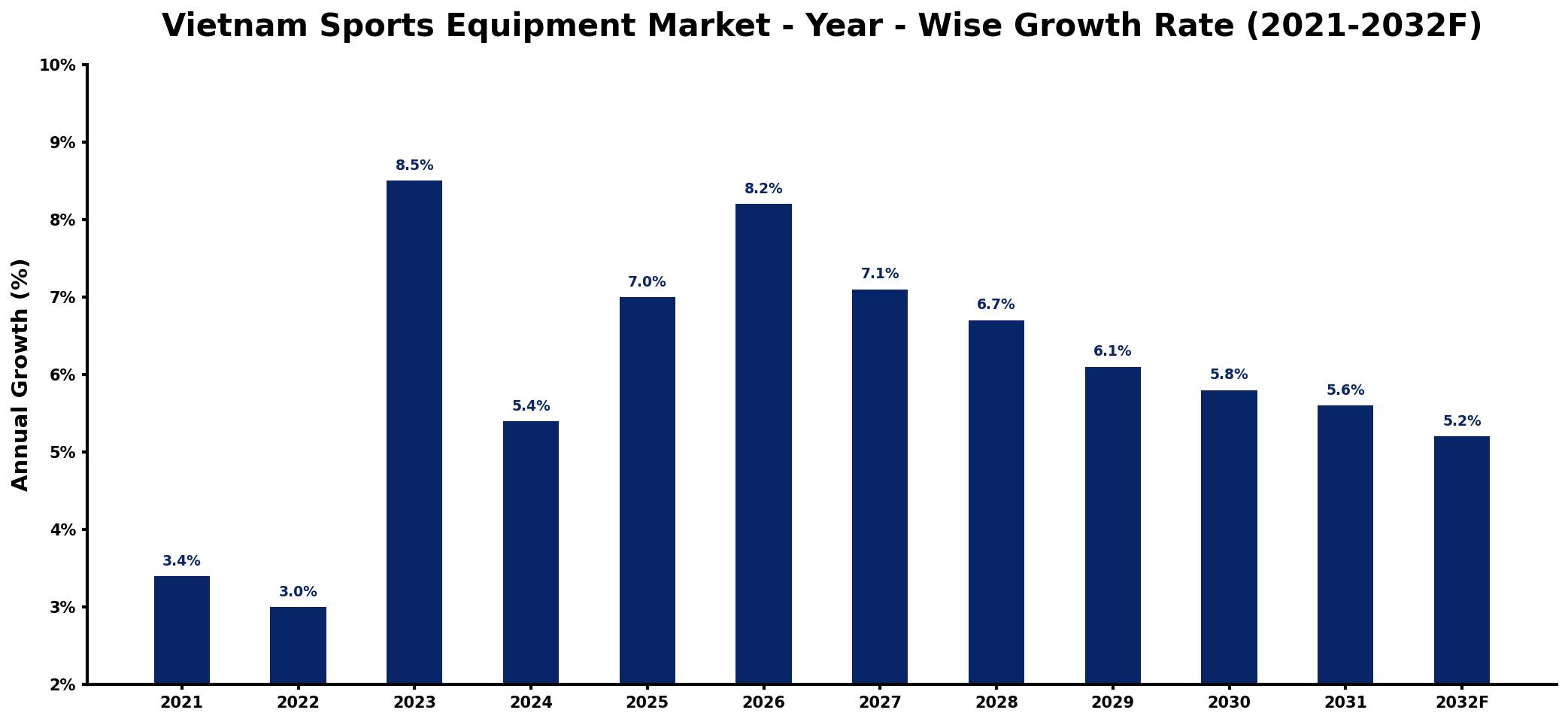
The table below presents the year‑wise growth rates along with the key drivers influencing the market
| Year | Growth Rate | Major Drivers |
| 2021 | 3.4% | Rising health awareness among consumers |
| 2022 | 3.0% | Increased participation in fitness activities |
| 2023 | 8.5% | Growing online retail platforms emergence |
| 2024 | 5.4% | Expansion of fitness centers nationwide |
| 2025 | 7.0% | expanding healthcare application demand |
| 2026 | 8.2% | Investment in local manufacturing facilities |
| 2027 | 7.1% | Improvement in distribution networks efficiency |
| 2028 | 6.7% | Enhanced marketing strategies by brands |
| 2029 | 6.1% | Collaboration with fitness influencers increases |
| 2030 | 5.8% | Adoption of innovative technology trends |
| 2031 | 5.6% | Growing interest in outdoor activities |
| 2032 | 5.2% | Strengthening community engagement initiatives |
Note: Market size estimations and growth projections presented in this report are based on 6Wresearch's proprietary forecasting methodology, utilizing the latest available industry data, government publications, and primary research inputs.
Vietnam Sports Equipment Market Synopsis
The Vietnam sports equipment market has recently experienced a surge, rebounding strongly from the disruptions caused by the COVID-19 pandemic. The reopening of gyms, sports clubs, and recreational areas has led to a renewed enthusiasm for sports activities. As a result, consumer interest in acquiring a wide array of sports gear is on the rise.
Looking ahead, the market is poised for sustained growth, driven by evolving consumer preferences that prioritize fitness and wellness. The increasing popularity of both individual and team sports is likely to broaden the demand spectrum, fostering innovations in sports equipment and enhancing accessibility for various demographics.
Vietnam Sports Equipment Market Key Takeaways
- The market is set for significant growth, with a projected value increase from USD 1048 Million in 2025 to USD 1486 Million by 2032.
- Growing interest in physical fitness and recreational sports is key to market expansion.
- Challenges such as affordability and competition from digital entertainment need addressing.
- Quality and durability of sports equipment are crucial for consumer retention and loyalty.
- Government initiatives aimed at promoting sports and fitness present further market opportunities.
Evaluation of Restraints in Vietnam Sports Equipment Market
The Vietnam sports equipment market faces several inherent restraints that could temper its growth. A significant challenge lies in the affordability of quality sports gear, which can hinder lower-income individuals from participating in various sports. Additionally, the allure of digital entertainment options competes for leisure time, potentially diminishing the priority of sports engagement. Quality assurance remains another vital factor, as consumers are increasingly discerning about the durability and performance of the equipment they purchase. Manufacturers must adapt to these challenges through innovative pricing strategies and enhanced product offerings to maintain market momentum.
Vietnam Sports Equipment Market Trends
Current trends within the Vietnam sports equipment market reflect a shift towards eco-friendly and sustainable products, as consumers become more environmentally conscious. The integration of technology into sports gear, including smart wearables and performance-tracking devices, is also gaining traction, appealing to tech-savvy athletes and fitness enthusiasts. Additionally, community-driven sports initiatives are fostering a culture of participation, encouraging various demographics to engage in physical activity.
Vietnam Sports Equipment Market Opportunities
Significant opportunities for growth are emerging in niche segments, including specialized gear for emerging sports and activities. The rise of outdoor and adventure sports, fueled by Vietnam's rich natural landscapes, offers avenues for investment in specific equipment tailored for these pursuits. Furthermore, the increasing incorporation of e-commerce platforms provides a channel for broader market reach, allowing consumers to access a diverse range of products easily. Addressing these areas could unlock substantial revenue streams for stakeholders in the market.
Government Initiatives in the Vietnam Sports Equipment Market
The Vietnamese government has been proactive in promoting sports and physical activities through various initiatives. Policies aimed at enhancing community sports programs and investing in sports infrastructure play a pivotal role in increasing participation rates. Additionally, public spending on health and wellness campaigns, combined with initiatives to encourage youth sports participation, aligns with broader national goals of improving public health and lifestyle quality. Such government support is crucial in propelling market growth and shaping consumer behaviors towards fitness and sports.
Future Insights of the Vietnam Sports Equipment Market
Looking toward 2026-2032, the Vietnam sports equipment market is expected to continue its upward trajectory, driven by ongoing trends in health and wellness. The anticipated rise in disposable income among consumers will likely enable more individuals to invest in quality sports gear. Additionally, as awareness around the importance of physical activity grows, innovations in product offerings will cater to evolving consumer demands, further propelling market expansion. The integration of technology into sports equipment will be paramount, attracting a new generation of athletes and fitness enthusiasts.
Vietnam Sports Equipment Market Latest Developments (2025 - 2026)
Recent developments in the Vietnam sports equipment market indicate a dynamic shift towards online sales channels, reflecting changing consumer buying habits post-pandemic. Local brands are increasingly collaborating with international manufacturers to enhance product offerings and improve market competitiveness. Furthermore, community-based sports events and campaigns are gaining popularity, driving engagement and interest in various sports activities. As these trends develop, they will significantly shape the future landscape of the sports equipment sector in Vietnam.
Vietnam Sports Equipment Market - Key Attractiveness of the Report
- 10 Years of Market Numbers
- Historical Data Starting from 2022 to 2025
- Base Year: 2025
- Forecast Data until 2032
- Key Performance Indicators Impacting the Market
- Major Upcoming Developments and Projects
Key Highlights of the Report:
- Vietnam Sports Equipment Market Outlook
- Market Size of Vietnam Sports Equipment Market, 2025
- Forecast of Vietnam Sports Equipment Market, 2032
- Historical Data and Forecast of Vietnam Sports Equipment Revenues & Volume for the Period 2022-2032F
- Vietnam Sports Equipment Market Trend Evolution
- Vietnam Sports Equipment Market Drivers and Challenges
- Vietnam Sports Equipment Price Trends
- Vietnam Sports Equipment Porter's Five Forces
- Vietnam Sports Equipment Industry Life Cycle
- Historical Data and Forecast of Vietnam Sports Equipment Market Revenues & Volume By Product for the Period 2022-2032F
- Historical Data and Forecast of Vietnam Sports Equipment Market Revenues & Volume By Ball over net games for the Period 2022-2032F
- Historical Data and Forecast of Vietnam Sports Equipment Market Revenues & Volume By Ball games for the Period 2022-2032F
- Historical Data and Forecast of Vietnam Sports Equipment Market Revenues & Volume By Fitness/Strength equipment for the Period 2022-2032F
- Historical Data and Forecast of Vietnam Sports Equipment Market Revenues & Volume By Athletic training equipment for the Period 2022-2032F
- Historical Data and Forecast of Vietnam Sports Equipment Market Revenues & Volume By Others for the Period 2022-2032F
- Historical Data and Forecast of Vietnam Sports Equipment Market Revenues & Volume By Distribution Channel for the Period 2022-2032F
- Historical Data and Forecast of Vietnam Sports Equipment Market Revenues & Volume By Online retail for the Period 2022-2032F
- Historical Data and Forecast of Vietnam Sports Equipment Market Revenues & Volume By Specialty & sports shops for the Period 2022-2032F
- Historical Data and Forecast of Vietnam Sports Equipment Market Revenues & Volume By Department & discount stores for the Period 2022-2032F
- Vietnam Sports Equipment Import Export Trade Statistics
- Market Opportunity Assessment By Product
- Market Opportunity Assessment By Distribution Channel
- Vietnam Sports Equipment Top Companies Market Share
- Vietnam Sports Equipment Competitive Benchmarking By Technical and Operational Parameters
- Vietnam Sports Equipment Company Profiles
- Vietnam Sports Equipment Key Strategic Recommendations






































