Vietnam Structural Adhesives, Sealants, and Thermal Materials for EV Batteries Market Size, Share & Growth Rate
The Vietnam Structural Adhesives, Sealants, and Thermal Materials for EV Batteries Market was estimated at USD 1111 Million in 2025 and is projected to reach USD 1796 Million by 2032, growing at a CAGR of 7.1% from 2026 to 2032. This robust growth is primarily driven by the increasing adoption of electric vehicles (EVs) as part of Vietnam's commitment to sustainable transportation. As local manufacturers innovate to meet rising demand, the focus on advanced materials that enhance EV battery performance, safety, and longevity further propels market expansion.
Vietnam Structural Adhesives, Sealants, and Thermal Materials for EV Batteries Market Year-wise Growth Rate and Key Drivers
This graph highlights how the Vietnam Structural Adhesives, Sealants, and Thermal Materials for EV Batteries Market has steadily grown over the years, supported by major growth factors.
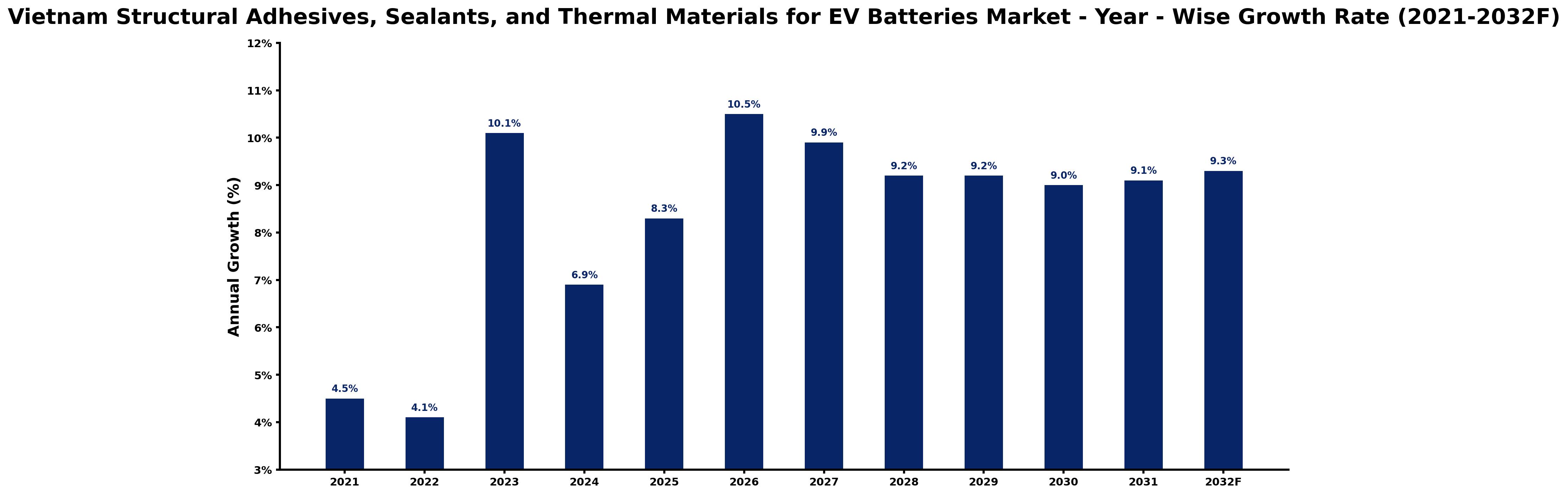
The table below presents the year‑wise growth rates along with the key drivers influencing the market
| Year | Growth Rate | Major Drivers |
| 2021 | 4.5% | Expansion of transportation and logistics networks |
| 2022 | 4.1% | Increasing adoption of advanced technologies |
| 2023 | 10.1% | Rapid growth in telecom and data center sectors |
| 2024 | 6.9% | Rising electricity demand across industries |
| 2025 | 8.3% | Increasing industrial infrastructure investments |
| 2026 | 10.5% | Increasing smart city development projects |
| 2027 | 9.9% | Growing renewable energy integration projects |
| 2028 | 9.2% | Increasing smart city development projects |
| 2029 | 9.2% | Rising electricity demand across industries |
| 2030 | 9.0% | Increasing smart city development projects |
| 2031 | 9.1% | Increasing adoption of advanced technologies |
| 2032 | 9.3% | Growing renewable energy integration projects |
Note - Market size estimations and growth projections presented in this report are based on 6Wresearch’s advanced forecasting approach, validated with industry datasets as of June 2026.
Vietnam Structural Adhesives, Sealants, and Thermal Materials for EV Batteries Market Synopsis
In recent years, the Vietnam Structural Adhesives, Sealants, and Thermal Materials for EV Batteries Market has gained substantial momentum, largely fueled by government policies aimed at reducing carbon emissions. However, as the market continues to mature, there is an increasing need for high-performance, cost-effective materials that meet the stringent requirements of modern EV batteries.
Looking ahead, the market trajectory indicates a strong potential for further growth. Investment in research and development is becoming increasingly crucial as manufacturers aim to differentiate their offerings in a competitive landscape. The collaboration with international players is also expected to enhance the quality and reliability of local products.
Vietnam Structural Adhesives, Sealants, and Thermal Materials for EV Batteries Market Key Takeaways
- The market is on a strong upward trajectory, supported by increasing EV adoption and government initiatives.
- Investment in research and development is vital for local manufacturers to remain competitive.
- Collaboration with international players is enhancing product quality and innovation.
- There is a significant focus on sustainable materials that improve EV battery safety and performance.
- Government policies are providing a conducive environment for market growth.
Evaluation of Restraints in Vietnam Structural Adhesives, Sealants, and Thermal Materials for EV Batteries Market
Despite the market's promising outlook, certain restraints can hinder progress. The development of high-performance materials for EV batteries demands significant investment and expertise in research and testing. Local manufacturers may struggle to keep pace with established global competitors who have more resources and advanced technology at their disposal. Additionally, ensuring consistent product quality while managing costs can pose a substantial challenge as the market evolves.
Vietnam Structural Adhesives, Sealants, and Thermal Materials for EV Batteries Market Trends
Current trends indicate a surge in the demand for environmentally friendly materials, as consumers and regulators increasingly prioritize sustainability. Innovations in adhesive technologies and thermal management solutions are shaping product development to cater to the complexities of modern EV designs. Furthermore, digitalization in manufacturing processes and supply chain management is improving efficiency and responsiveness in the market.
Vietnam Structural Adhesives, Sealants, and Thermal Materials for EV Batteries Market Opportunities
There are genuine opportunities for growth within the Vietnam Structural Adhesives, Sealants, and Thermal Materials for EV Batteries Market, particularly in niche applications like battery packaging and thermal interface materials. Expanding partnerships with automotive manufacturers and investing in new technologies will allow local companies to better meet the demands of the evolving EV landscape. Additionally, tapping into emerging markets within the Southeast Asian region may offer new avenues for expansion.
Government Initiatives in the Vietnam Structural Adhesives, Sealants, and Thermal Materials for EV Batteries Market
The Vietnamese government has launched a variety of initiatives aimed at supporting the electric vehicle industry. Incentives for EV manufacturing and the establishment of eco-friendly transportation policies are key components of the national strategy. By promoting research and development and enhancing public-private partnerships, these initiatives are designed to foster innovation in the production of structural adhesives, sealants, and thermal materials, creating a conducive environment for sustainable growth.
Future Insights of the Vietnam Structural Adhesives, Sealants, and Thermal Materials for EV Batteries Market
Between 2026 and 2032, the Vietnam Structural Adhesives, Sealants, and Thermal Materials for EV Batteries Market is expected to continue its growth trajectory. The increasing regulatory focus on reducing carbon emissions, coupled with rising consumer demand for electric vehicles, will drive the need for advanced materials. As technology advances, we anticipate a trend toward higher-performance materials that offer enhanced safety features and durability, making this sector increasingly attractive for investment.
Vietnam Structural Adhesives, Sealants, and Thermal Materials for EV Batteries Market Latest Developments (May 2025 - June 2026)
In the latest industry direction, manufacturers are focusing on developing innovative materials that not only enhance battery performance but also improve environmental sustainability. Collaborations between local firms and international research institutions are becoming more common, aimed at accelerating the development of cutting-edge technologies. Additionally, there is a growing emphasis on the circular economy, with efforts to recycle and repurpose materials in the production process.
Vietnam Structural Adhesives, Sealants, and Thermal Materials for EV Batteries Market - Key Attractiveness of the Report
- 10 Years of Market Numbers
- Historical Data Starting from 2022 to 2025
- Base Year: 2025
- Forecast Data until 2032
- Key Performance Indicators Impacting the Market
- Major Upcoming Developments and Projects
Key Highlights of the Report:
- Vietnam Structural Adhesives, Sealants, and Thermal Materials for EV Batteries Market Outlook
- Market Size of Vietnam Structural Adhesives, Sealants, and Thermal Materials for EV Batteries Market, 2025
- Forecast of Vietnam Structural Adhesives, Sealants, and Thermal Materials for EV Batteries Market, 2032
- Historical Data and Forecast of Vietnam Structural Adhesives, Sealants, and Thermal Materials for EV Batteries Revenues & Volume for the Period 2022-2032F
- Vietnam Structural Adhesives, Sealants, and Thermal Materials for EV Batteries Market Trend Evolution
- Vietnam Structural Adhesives, Sealants, and Thermal Materials for EV Batteries Market Drivers and Challenges
- Vietnam Structural Adhesives, Sealants, and Thermal Materials for EV Batteries Price Trends
- Vietnam Structural Adhesives, Sealants, and Thermal Materials for EV Batteries Porter's Five Forces
- Vietnam Structural Adhesives, Sealants, and Thermal Materials for EV Batteries Industry Life Cycle
- Historical Data and Forecast of Vietnam Structural Adhesives, Sealants, and Thermal Materials for EV Batteries Market Revenues & Volume By Type for the Period 2022-2032F
- Historical Data and Forecast of Vietnam Structural Adhesives, Sealants, and Thermal Materials for EV Batteries Market Revenues & Volume By Structural Adhesives and Sealants for the Period 2022-2032F
- Historical Data and Forecast of Vietnam Structural Adhesives, Sealants, and Thermal Materials for EV Batteries Market Revenues & Volume By Thermal materials for the Period 2022-2032F
- Historical Data and Forecast of Vietnam Structural Adhesives, Sealants, and Thermal Materials for EV Batteries Market Revenues & Volume By Applications for the Period 2022-2032F
- Historical Data and Forecast of Vietnam Structural Adhesives, Sealants, and Thermal Materials for EV Batteries Market Revenues & Volume By Hybrid Electric Vehicles for the Period 2022-2032F
- Historical Data and Forecast of Vietnam Structural Adhesives, Sealants, and Thermal Materials for EV Batteries Market Revenues & Volume By Battery Electric Vehicles for the Period 2022-2032F
- Vietnam Structural Adhesives, Sealants, and Thermal Materials for EV Batteries Import Export Trade Statistics
- Market Opportunity Assessment By Type
- Market Opportunity Assessment By Applications
- Vietnam Structural Adhesives, Sealants, and Thermal Materials for EV Batteries Top Companies Market Share
- Vietnam Structural Adhesives, Sealants, and Thermal Materials for EV Batteries Competitive Benchmarking By Technical and Operational Parameters
- Vietnam Structural Adhesives, Sealants, and Thermal Materials for EV Batteries Company Profiles
- Vietnam Structural Adhesives, Sealants, and Thermal Materials for EV Batteries Key Strategic Recommendations






































