Vietnam Sulphur Market Size, Share & Growth Rate
The Vietnam Sulphur Market was estimated at USD 921 Million in 2025 and is projected to reach USD 1309 Million by 2032, growing at a CAGR of 5.2% from 2026 to 2032. This growth is primarily fueled by the increasing demand for sulfur in the production of sulfuric acid, a fundamental chemical for various industries, and fertilizers that support the nation's robust agricultural sector. Additionally, the construction industry's expansion is further driving the market, with sulfur playing a crucial role in enhancing construction materials.
Vietnam Sulphur Market Year-wise Growth Rate and Key Drivers
This graph highlights how the Vietnam Sulphur Market has steadily grown over the years, supported by major growth factors.
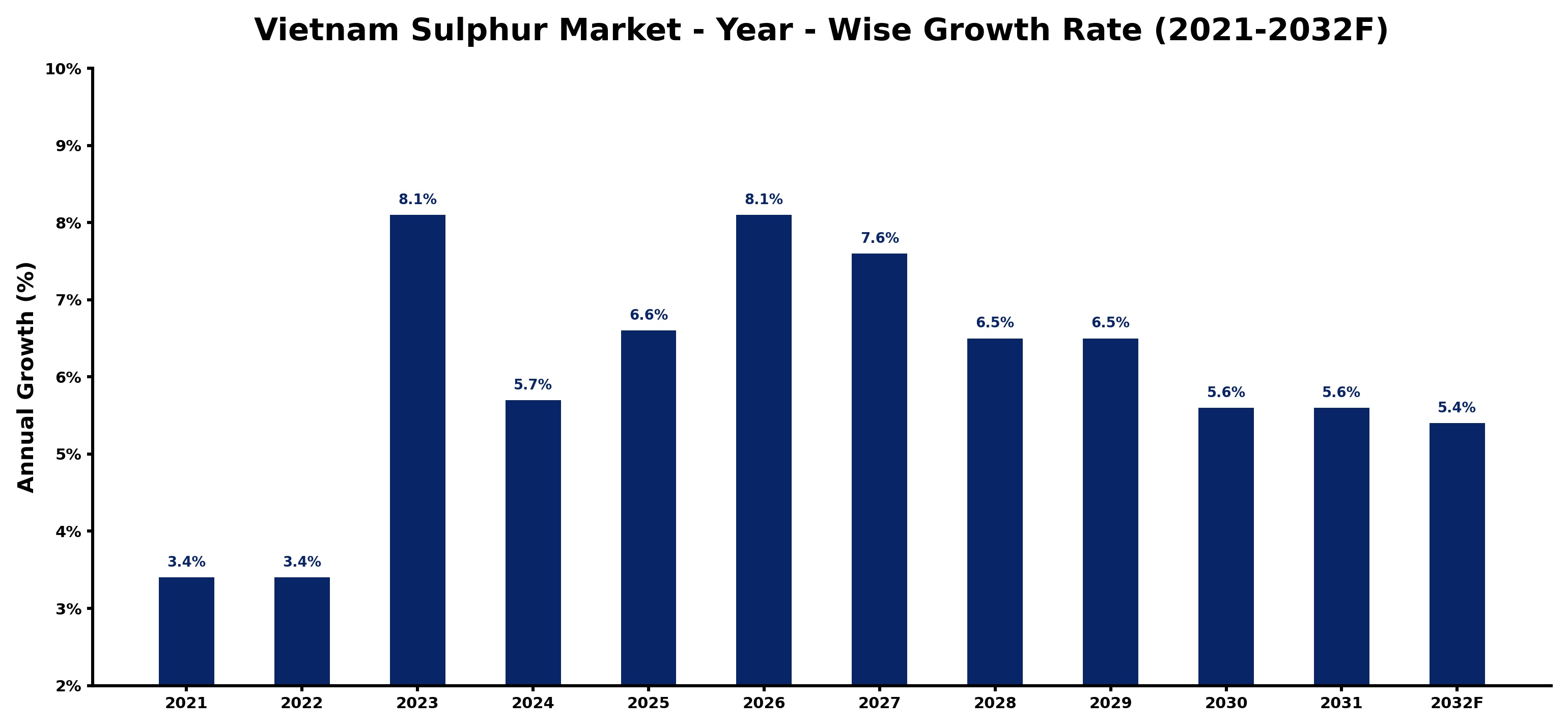
The table below presents the year‑wise growth rates along with the key drivers influencing the market
| Year | Growth Rate | Major Drivers |
| 2021 | 3.4% | Infrastructure development enhanced logistics |
| 2022 | 3.4% | Industrial demand for fertilizers increased |
| 2023 | 8.1% | Chemical manufacturing expansion accelerated |
| 2024 | 5.7% | Agricultural sector growth supported demand |
| 2025 | 6.6% | Environmental regulations boosted adoption |
| 2026 | 8.1% | Energy sector investments drove usage |
| 2027 | 7.6% | Export opportunities expanded significantly |
| 2028 | 6.5% | Technological advancements improved production |
| 2029 | 6.5% | Sustainable practices gained market traction |
| 2030 | 5.6% | Consumer awareness of benefits increased |
| 2031 | 5.6% | Partnerships with local farmers strengthened |
| 2032 | 5.4% | Market diversification strategies enhanced growth |
Note - Market size estimations and growth projections presented in this report are based on 6Wresearch's advanced forecasting approach, validated with industry datasets as of June 2026.
Vietnam Sulphur Market Synopsis
In recent years, Vietnam's sulfur market has become increasingly significant, reflecting the nation's ongoing industrialization and agricultural development. As a critical input in sulfuric acid and fertilizer production, the market is responding dynamically to both domestic and international demands.
The interplay between local agricultural practices and the broader chemical manufacturing landscape is particularly noteworthy. With Vietnam positioning itself as a key player in the Southeast Asian market, the dynamics of supply and demand are evolving rapidly, presenting both opportunities and challenges for stakeholders.
Vietnam Sulphur Market Key Takeaways
- The Vietnam Sulphur Market is poised for significant growth, driven by the agricultural and chemical sectors.
- Sourcing and environmental regulations present notable challenges for market players.
- Investment in sustainable practices is becoming increasingly vital for competitiveness.
- The construction industry's needs further amplify sulfur demand in various applications.
- Strategic partnerships and technological advancements are essential for enhancing supply chain efficiencies.
Evaluation of Restraints in Vietnam Sulphur Market
While the Vietnam Sulphur Market exhibits promising growth potential, several restraints pose challenges to stakeholders. A primary concern is the reliance on imported raw sulfur, as domestic production remains limited. This dependency not only makes the market susceptible to global price fluctuations but also complicates supply chain logistics. Furthermore, as environmental regulations tighten, businesses are compelled to invest in cleaner technologies, which can inflate operational costs. The need for responsible disposal of sulfur byproducts also looms large, posing an ongoing environmental challenge that market players must address effectively.
Vietnam Sulphur Market Trends
Current trends in the Vietnam Sulphur Market indicate a growing emphasis on sustainability and efficient resource management. With increasing regulatory pressure, companies are exploring advanced sulfur recovery methods to reduce emissions and ensure compliance. Additionally, the rise in precision agriculture practices is driving demand for high-quality fertilizers, thus enhancing sulfur's role in crop yields. Technological innovations in chemical processing are also making it feasible to utilize sulfur more effectively, opening new avenues for product development and application.
Vietnam Sulphur Market Opportunities
As the Vietnamese economy continues to expand, significant growth opportunities lie ahead for sulfur producers and stakeholders. The ongoing modernization of agriculture, combined with increased urbanization, creates a substantial need for fertilizers and construction materials, both reliant on sulfur. Moreover, the push for sustainable practices opens avenues for investment in clean technologies and sulfur recycling initiatives. By leveraging these opportunities, market players can enhance their competitive edge while contributing positively to environmental sustainability.
Government Initiatives in the Vietnam Sulphur Market
The Vietnamese government has been proactive in creating a conducive environment for the growth of the sulfur market. Initiatives aimed at boosting agricultural productivity include increased public spending on research and development for fertilizers and enhanced regulatory frameworks that promote sustainable practices. Furthermore, government policies are encouraging investment in cleaner technologies to mitigate environmental impacts, aligning with global sustainability goals. These initiatives not only support local producers but also aim to position Vietnam as a competitive player in the Southeast Asian sulfur market.
Future Insights of the Vietnam Sulphur Market
Looking ahead to 2026-2032, the Vietnam Sulphur Market is poised for remarkable evolution. As industries adapt to shifting regulatory landscapes and environmental concerns, the emphasis on sustainable practices will shape operational strategies. Technological advancements in sulfur recovery and processing are expected to create efficiencies that could alter market dynamics. Additionally, as Vietnam continues to strengthen its agricultural and industrial sectors, the increasing reliance on sulfur for fertilizers and chemical production will further underpin the market's robust growth trajectory.
Vietnam Sulphur Market Latest Developments (May 2025 - June 2026)
Recent developments in the Vietnam Sulphur Market indicate a heightened focus on sustainable practices and innovation. Companies are increasingly investing in sulfur recovery technologies to optimize production processes and reduce environmental impacts. Additionally, collaborations between agricultural stakeholders and chemical manufacturers are emerging, aimed at developing more effective fertilizer formulations that utilize sulfur more efficiently. These trends suggest a positive shift toward a more sustainable and competitive market landscape.
Vietnam Sulphur Market - Key Attractiveness of the Report
- 10 Years of Market Numbers
- Historical Data Starting from 2022 to 2025
- Base Year: 2025
- Forecast Data until 2032
- Key Performance Indicators Impacting the Market
- Major Upcoming Developments and Projects
Key Highlights of the Report:
- Vietnam Sulphur Market Outlook
- Market Size of Vietnam Sulphur Market, 2025
- Forecast of Vietnam Sulphur Market, 2032
- Historical Data and Forecast of Vietnam Sulphur Revenues & Volume for the Period 2022-2032F
- Vietnam Sulphur Market Trend Evolution
- Vietnam Sulphur Market Drivers and Challenges
- Vietnam Sulphur Price Trends
- Vietnam Sulphur Porter's Five Forces
- Vietnam Sulphur Industry Life Cycle
- Historical Data and Forecast of Vietnam Sulphur Market Revenues & Volume By Product Type for the Period 2022-2032F
- Historical Data and Forecast of Vietnam Sulphur Market Revenues & Volume By Natural Gas for the Period 2022-2032F
- Historical Data and Forecast of Vietnam Sulphur Market Revenues & Volume By Crude Oil for the Period 2022-2032F
- Historical Data and Forecast of Vietnam Sulphur Market Revenues & Volume By Others for the Period 2022-2032F
- Historical Data and Forecast of Vietnam Sulphur Market Revenues & Volume By End Users for the Period 2022-2032F
- Historical Data and Forecast of Vietnam Sulphur Market Revenues & Volume By Sulfuric Acid (Fertilizers) for the Period 2022-2032F
- Historical Data and Forecast of Vietnam Sulphur Market Revenues & Volume By Sulfuric Acid (Metal Manufacturing) for the Period 2022-2032F
- Historical Data and Forecast of Vietnam Sulphur Market Revenues & Volume By Chemical Processing for the Period 2022-2032F
- Vietnam Sulphur Import Export Trade Statistics
- Market Opportunity Assessment By Product Type
- Market Opportunity Assessment By End Users
- Vietnam Sulphur Top Companies Market Share
- Vietnam Sulphur Competitive Benchmarking By Technical and Operational Parameters
- Vietnam Sulphur Company Profiles
- Vietnam Sulphur Key Strategic Recommendations






































