Vietnam Swine Feed Market Size, Share & Growth Rate
The Vietnam Swine Feed Market was estimated at USD 202 Million in 2025 and is projected to reach USD 286 Million by 2032, growing at a CAGR of 5.1% from 2026 to 2032. This growth trajectory is fueled by the surging demand for pork, driven by rising population and changing dietary preferences. Additionally, advancements in feed technology and a heightened focus on swine health and nutrition are critical factors sustaining this positive market momentum.
Vietnam Swine Feed Market Year-wise Growth Rate and Key Drivers
This graph highlights how the Vietnam Swine Feed Market has steadily grown over the years, supported by major growth factors.
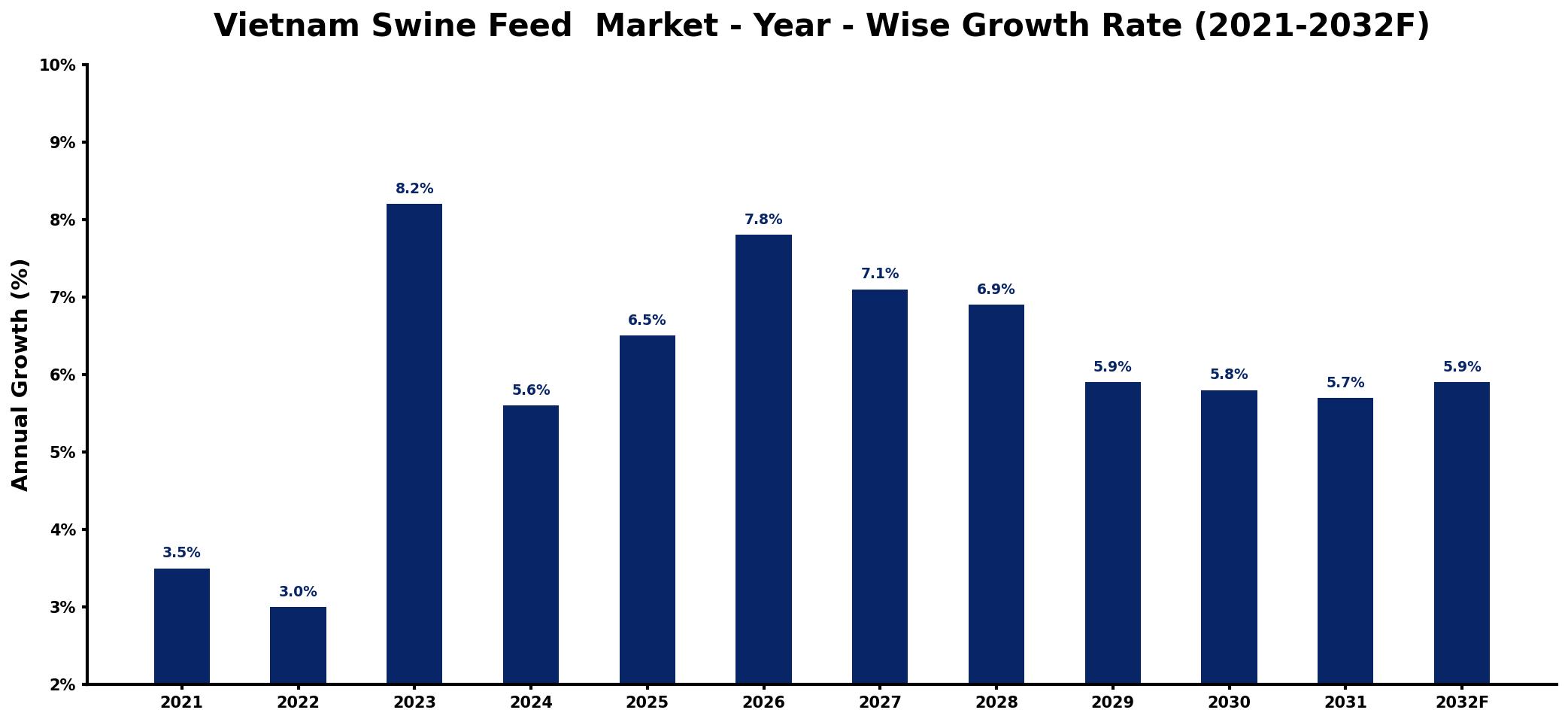
The table below presents the year‑wise growth rates along with the key drivers influencing the market
| Year | Growth Rate | Major Drivers |
| 2021 | 3.5% | Rising livestock farming investments |
| 2022 | 3.0% | Growing consumer protein demand |
| 2023 | 8.2% | Technological advancements in nutrition |
| 2024 | 5.6% | Increased exports of livestock products |
| 2025 | 6.5% | Expansion of local production facilities |
| 2026 | 7.8% | Enhanced distribution network efficiency |
| 2027 | 7.1% | Growing awareness of animal health |
| 2028 | 6.9% | Government support for agriculture sector |
| 2029 | 5.9% | Rising disposable income levels |
| 2030 | 5.8% | Adoption of sustainable farming practices |
| 2031 | 5.7% | Diversification of livestock breeds |
| 2032 | 5.9% | Strengthened partnerships with suppliers |
Note: Market size estimations and growth projections presented in this report are based on 6Wresearch's proprietary forecasting methodology, utilizing the latest available industry data, government publications, and primary research inputs.
Vietnam Swine Feed Market Synopsis
Currently, the Vietnam Swine Feed Market is undergoing significant transformation, marked by a shift towards more specialized and nutritionally advanced feed formulations. As the nation grapples with its status as a leading pork consumer in Southeast Asia, the quality of swine feed is increasingly recognized as a pivotal factor in driving production efficiency and animal health.
The importance of swine feed in Vietnam's agricultural landscape cannot be overstated. With pork consumption continuing to rise, swine farming remains integral to the economy. Manufacturers are now competing not just on price, but also on the nutritional efficacy and sustainability of their products, reflecting a broader trend towards responsible farming practices.
Vietnam Swine Feed Market Key Takeaways
- The market is characterized by a diverse range of feed formulations, reflecting varying nutritional needs.
- Technological advancements are enhancing feed efficiency and contributing to sustainable practices.
- Government policies are fostering growth by supporting the livestock sector.
- Challenges such as feed cost volatility and disease management continue to impact the industry.
- Consumer preferences are shifting, emphasizing the need for high-quality and safe pork products.
Evaluation of Restraints in Vietnam Swine Feed Market
Despite the optimistic outlook, several restraints hinder the Vietnam Swine Feed Market's full potential. The recurring outbreaks of diseases within swine populations can disrupt both production and supply chains, creating uncertainty in the market. Additionally, fluctuating prices for key feed ingredients present a significant challenge to producers. This volatility often squeezes profit margins and complicates long-term planning for feed manufacturers. Environmental concerns regarding swine farming practices are also prompting scrutiny and may necessitate adjustments in production methods, adding to the operational complexities for feed producers.
Vietnam Swine Feed Market Trends
The ongoing trends in the Vietnam Swine Feed Market emphasize the integration of technology and sustainability into feed production. Enhanced genetic research is fostering the development of disease-resistant swine breeds, which in turn increases the demand for specialized feed formulations tailored to these animals. Furthermore, there is a growing trend towards using alternative protein sources in swine feed, which not only helps in cost management but also addresses environmental concerns associated with traditional feed ingredients.
Vietnam Swine Feed Market Opportunities
Opportunities abound in the Vietnam Swine Feed Market, particularly for companies willing to innovate. The rising demand for organic and non-GMO feed products presents a lucrative avenue for market entrants. Furthermore, as swine farmers adopt more advanced production techniques, there is significant room for growth in providing specialized feed products that enhance productivity and health outcomes. Investing in research and development can enable producers to capitalize on emerging nutritional insights and refine their offerings to better meet the evolving demands of the industry.
Government Initiatives in the Vietnam Swine Feed Market
The Vietnamese government has recognized the importance of the livestock sector and is actively supporting its growth through various initiatives. Policies aimed at modernizing agricultural practices and promoting sustainability are being implemented to ensure that the swine industry remains competitive. Investment in veterinary services and disease control measures is also a priority, helping to stabilize the swine feed market by addressing one of its primary vulnerabilities.
Future Insights of the Vietnam Swine Feed Market
Looking ahead to 2026-2032, the Vietnam Swine Feed Market is poised for robust development, influenced by several interrelated factors. The growing emphasis on sustainability and animal welfare will likely steer producers towards more eco-friendly feed production methods. Additionally, as consumer preferences continue to shift towards higher-quality pork, the demand for premium swine feed that enhances health outcomes will grow. The market's resilience in adapting to external pressures, including price fluctuations and supply chain disruptions, will also play a critical role in shaping its future.
Vietnam Swine Feed Market Latest Developments (2025 - 2026)
In recent months, the Vietnam Swine Feed Market has seen a concerted push towards enhancing product innovation. Companies are launching new feed formulations that incorporate functional ingredients aimed at boosting immunity and overall health in swine. Additionally, there has been an increased focus on building resilient supply chains, particularly in response to the disruptions experienced during the COVID-19 pandemic. Industry players are also collaborating more closely with agricultural researchers to develop feed solutions that align with emerging best practices in sustainable farming.
Vietnam Swine Feed Market - Key Attractiveness of the Report
- 10 Years of Market Numbers
- Historical Data Starting from 2022 to 2025
- Base Year: 2025
- Forecast Data until 2032
- Key Performance Indicators Impacting the Market
- Major Upcoming Developments and Projects
Key Highlights of the Report:
- Vietnam Swine Feed Market Outlook
- Market Size of Vietnam Swine Feed Market, 2025
- Forecast of Vietnam Swine Feed Market, 2032
- Historical Data and Forecast of Vietnam Swine Feed Revenues & Volume for the Period 2022-2032F
- Vietnam Swine Feed Market Trend Evolution
- Vietnam Swine Feed Market Drivers and Challenges
- Vietnam Swine Feed Price Trends
- Vietnam Swine Feed Porter's Five Forces
- Vietnam Swine Feed Industry Life Cycle
- Historical Data and Forecast of Vietnam Swine Feed Market Revenues & Volume By Product Type for the Period 2022-2032F
- Historical Data and Forecast of Vietnam Swine Feed Market Revenues & Volume By Grower for the Period 2022-2032F
- Historical Data and Forecast of Vietnam Swine Feed Market Revenues & Volume By Starter for the Period 2022-2032F
- Historical Data and Forecast of Vietnam Swine Feed Market Revenues & Volume By Sow for the Period 2022-2032F
- Historical Data and Forecast of Vietnam Swine Feed Market Revenues & Volume By Others for the Period 2022-2032F
- Historical Data and Forecast of Vietnam Swine Feed Market Revenues & Volume By Feed Essence for the Period 2022-2032F
- Historical Data and Forecast of Vietnam Swine Feed Market Revenues & Volume By Vitamins for the Period 2022-2032F
- Historical Data and Forecast of Vietnam Swine Feed Market Revenues & Volume By Antioxidants for the Period 2022-2032F
- Historical Data and Forecast of Vietnam Swine Feed Market Revenues & Volume By Feed Acidifiers for the Period 2022-2032F
- Historical Data and Forecast of Vietnam Swine Feed Market Revenues & Volume By Feed Enzymes for the Period 2022-2032F
- Historical Data and Forecast of Vietnam Swine Feed Market Revenues & Volume By Amino Acids for the Period 2022-2032F
- Historical Data and Forecast of Vietnam Swine Feed Market Revenues & Volume By Others for the Period 2022-2032F
- Historical Data and Forecast of Vietnam Swine Feed Market Revenues & Volume By Feed Additive Type for the Period 2022-2032F
- Historical Data and Forecast of Vietnam Swine Feed Market Revenues & Volume By Zootechnical Feed Additives for the Period 2022-2032F
- Historical Data and Forecast of Vietnam Swine Feed Market Revenues & Volume By Sensory Feed Additives for the Period 2022-2032F
- Historical Data and Forecast of Vietnam Swine Feed Market Revenues & Volume By Nutritional Feed Additives for the Period 2022-2032F
- Vietnam Swine Feed Import Export Trade Statistics
- Market Opportunity Assessment By Product Type
- Market Opportunity Assessment By Feed Essence
- Market Opportunity Assessment By Feed Additive Type
- Vietnam Swine Feed Top Companies Market Share
- Vietnam Swine Feed Competitive Benchmarking By Technical and Operational Parameters
- Vietnam Swine Feed Company Profiles
- Vietnam Swine Feed Key Strategic Recommendations






































