Vietnam Tailors Scissor Market Size, Share & Growth Rate
The Vietnam Tailors Scissor Market was estimated at USD 986 Million in 2025 and is projected to reach USD 1604 Million by 2032, growing at a CAGR of 7.2% from 2026 to 2032. This robust growth trajectory is primarily fueled by the surge in Vietnam's textile and garment industry, which has become a global player in fashion retail. As consumers increasingly opt for custom clothing solutions, the demand for high-quality scissors among tailors has never been more critical.
Vietnam Tailors Scissor Market Year-wise Growth Rate and Key Drivers
This graph highlights how the Vietnam Tailors Scissor Market has steadily grown over the years, supported by major growth factors.
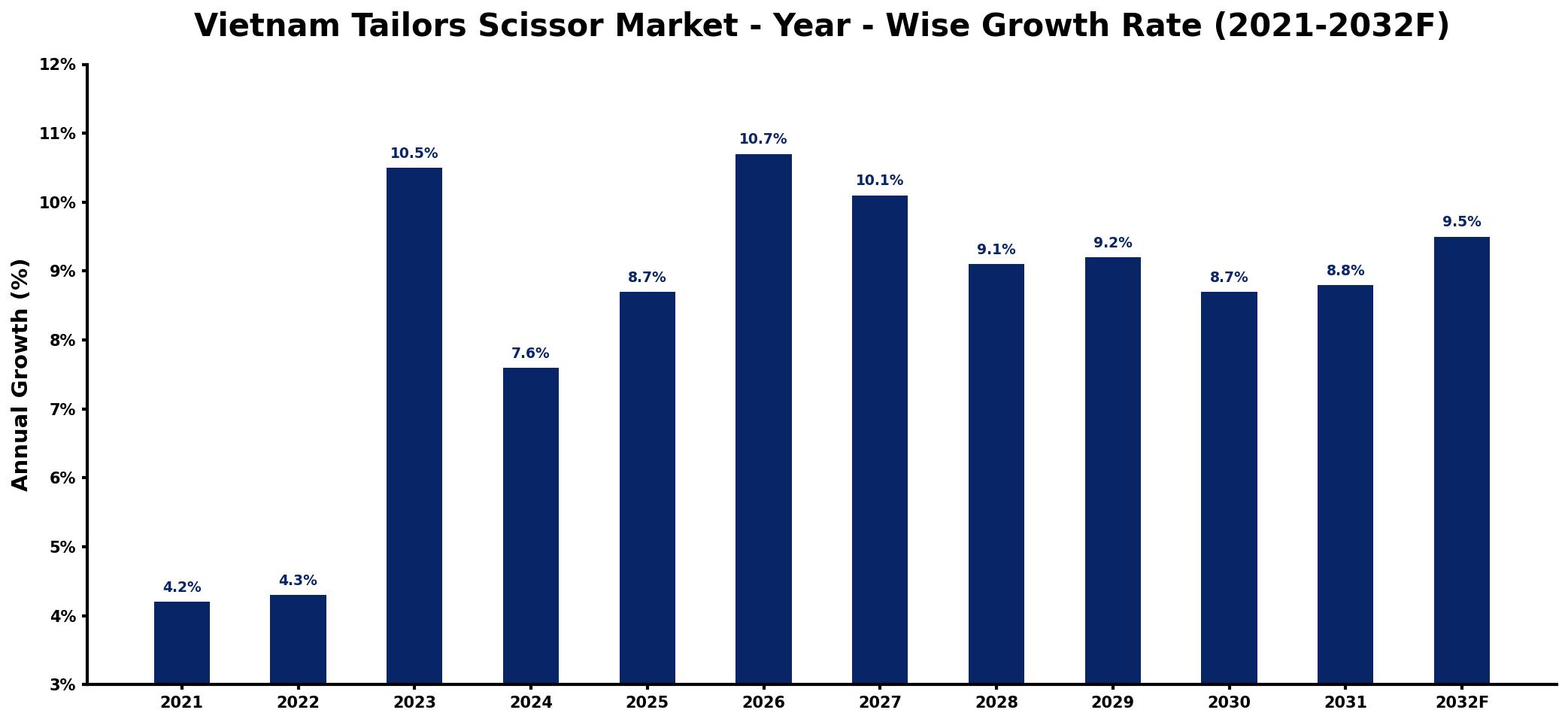
The table below presents the year‑wise growth rates along with the key drivers influencing the market
| Year | Growth Rate | Major Drivers |
| 2021 | 4.2% | Rising demand from fashion industry |
| 2022 | 4.3% | Increased investment in manufacturing |
| 2023 | 10.5% | Growth in home sewing activities |
| 2024 | 7.6% | Expansion of textile production facilities |
| 2025 | 8.7% | Surge in DIY crafting popularity |
| 2026 | 10.7% | Emergence of online retail platforms |
| 2027 | 10.1% | Boom in personalized fashion trends |
| 2028 | 9.1% | improved processing technologies adoption |
| 2029 | 9.2% | Increase in artisanal craftsmanship interest |
| 2030 | 8.7% | Rising popularity of sustainable materials |
| 2031 | 8.8% | expanding manufacturing base activity |
| 2032 | 9.5% | Increased collaboration with designers |
Note: Market size estimations and growth projections presented in this report are based on 6Wresearch's proprietary forecasting methodology, utilizing the latest available industry data, government publications, and primary research inputs.
Vietnam Tailors Scissor Market Synopsis
The Vietnam tailors scissor market is currently experiencing a notable expansion, driven by the dynamic interplay between the fashion industry and the rising demand for bespoke garments. Tailors and seamstresses rely on precision tools, underscoring the importance of quality scissors in the fabric cutting process.
Vietnam's position as a leading textile manufacturing hub amplifies this need, where both local and international fashion brands are setting high standards for quality. The emphasis on ergonomic designs and sharpness highlights manufacturers' commitment to meeting the diverse requirements of their clientele.
Vietnam Tailors Scissor Market Key Takeaways
- The market is projected to grow significantly, reaching USD 1604 Million by 2032.
- Increasing consumer preference for customized clothing is driving demand for precision cutting tools.
- Manufacturers are focusing on ergonomic designs to enhance user experience for tailors.
- The rise of e-commerce is facilitating easier access to high-quality scissors for end-users.
- Counterfeit products pose a threat to legitimate manufacturers, necessitating strong anti-counterfeiting measures.
Evaluation of Restraints in Vietnam Tailors Scissor Market
The Vietnam tailors scissor market faces significant constraints, particularly due to the infiltration of counterfeit and low-quality products. These substandard alternatives not only compromise the cutting experience for tailors but also tarnish the reputation of reputable manufacturers. This challenge necessitates a multifaceted approach, where companies must invest in anti-counterfeiting measures and actively promote the superiority of their offerings. Protecting brand integrity becomes paramount in an increasingly competitive landscape.
Vietnam Tailors Scissor Market Trends
Current trends in the Vietnam tailors scissor market reflect a growing inclination towards advanced materials and cutting-edge technologies in scissor production. Manufacturers are increasingly leveraging high-grade stainless steel and innovative designs to improve durability and precision. Additionally, the trend towards sustainability is influencing consumer preferences, with more tailors seeking eco-friendly tools. The pandemic has also sparked interest in DIY sewing and fashion projects, further boosting demand for quality scissors.
Vietnam Tailors Scissor Market Opportunities
Opportunities in the Vietnam tailors scissor market are abundant, especially as the global fashion landscape continues to evolve. The increasing acceptance of online shopping platforms presents a unique avenue for manufacturers to reach a broader audience. Furthermore, partnerships with fashion schools and vocational training institutes can help cultivate brand loyalty among upcoming tailors. The emphasis on customization in the clothing sector underscores the potential for specialized scissors tailored to specific fabric types and cutting techniques.
Government Initiatives in the Vietnam Tailors Scissor Market
The Vietnamese government has implemented various initiatives aimed at bolstering the textile and garment sectors, which include subsidies and incentives for manufacturers. These policies are designed to enhance productivity and competitiveness in the global market. Additionally, programs promoting vocational training in tailoring and fashion design contribute to skill development, ensuring a skilled workforce adept at utilizing high-quality cutting tools such as tailors' scissors.
Future Insights of the Vietnam Tailors Scissor Market
Looking ahead to the 2026-2032 period, the Vietnam tailors scissor market is poised for substantial growth, driven by continuous innovation and rising consumer demands for personalized fashion. The integration of technology in production processes will likely enhance product quality and efficiency. Additionally, as sustainability becomes a core value in consumer purchasing decisions, eco-friendly scissors may see increased popularity. By aligning with industry trends and addressing emerging consumer needs, manufacturers can position themselves effectively for the future.
Vietnam Tailors Scissor Market Latest Developments (2025 - 2026)
Recent developments in the Vietnam tailors scissor market include a notable increase in collaborative efforts between manufacturers and design schools to foster innovation. Additionally, the expansion of e-commerce platforms has led to greater visibility for local brands, enabling them to reach a wider customer base. Furthermore, manufacturers are focusing on developing unique selling propositions through value-added features, such as customizable designs and enhanced ergonomic comfort.
Vietnam Tailors Scissor Market - Key Attractiveness of the Report
- 10 Years of Market Numbers
- Historical Data Starting from 2022 to 2025
- Base Year: 2025
- Forecast Data until 2032
- Key Performance Indicators Impacting the Market
- Major Upcoming Developments and Projects
Key Highlights of the Report:
- Vietnam Tailors Scissor Market Outlook
- Market Size of Vietnam Tailors Scissor Market, 2025
- Forecast of Vietnam Tailors Scissor Market, 2032
- Historical Data and Forecast of Vietnam Tailors Scissor Revenues & Volume for the Period 2022-2032F
- Vietnam Tailors Scissor Market Trend Evolution
- Vietnam Tailors Scissor Market Drivers and Challenges
- Vietnam Tailors Scissor Price Trends
- Vietnam Tailors Scissor Porter's Five Forces
- Vietnam Tailors Scissor Industry Life Cycle
- Historical Data and Forecast of Vietnam Tailors Scissor Market Revenues & Volume By Product for the Period 2022-2032F
- Historical Data and Forecast of Vietnam Tailors Scissor Market Revenues & Volume By Standard Scissors for the Period 2022-2032F
- Historical Data and Forecast of Vietnam Tailors Scissor Market Revenues & Volume By Customized Scissors for the Period 2022-2032F
- Historical Data and Forecast of Vietnam Tailors Scissor Market Revenues & Volume By Applications for the Period 2022-2032F
- Historical Data and Forecast of Vietnam Tailors Scissor Market Revenues & Volume By Household for the Period 2022-2032F
- Historical Data and Forecast of Vietnam Tailors Scissor Market Revenues & Volume By Commercial for the Period 2022-2032F
- Vietnam Tailors Scissor Import Export Trade Statistics
- Market Opportunity Assessment By Product
- Market Opportunity Assessment By Applications
- Vietnam Tailors Scissor Top Companies Market Share
- Vietnam Tailors Scissor Competitive Benchmarking By Technical and Operational Parameters
- Vietnam Tailors Scissor Company Profiles
- Vietnam Tailors Scissor Key Strategic Recommendations






































