Vietnam Telecom Cloud Market Size & Growth Rate (2026-2032)
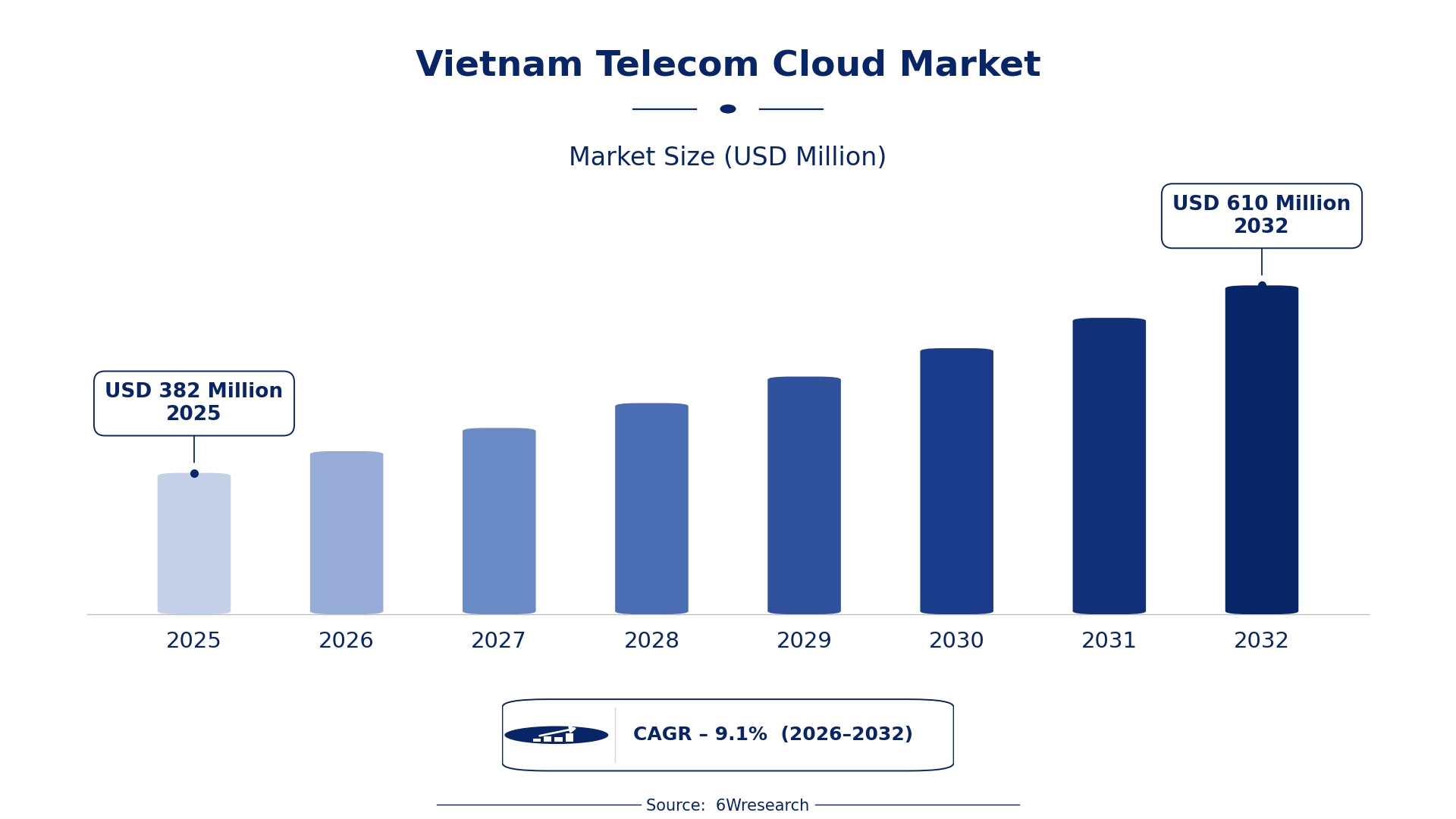
The Vietnam Telecom Cloud Market was estimated at USD 382 Million in 2025 and is projected to reach USD 610 Million by 2032, growing at a CAGR of 9.1% from 2026 to 2032.
Vietnam Telecom Cloud Market Synopsis
The Vietnam Telecom Cloud Market is currently experiencing strong growth, driven by the increasing adoption of cloud solutions among telecom operators. As these providers shift their networks to cloud-based infrastructures, the demand for agile and scalable solutions is surging, setting the stage for significant advancements in service delivery.
Looking ahead, the market is poised for further evolution, particularly with the ongoing rollout of 5G technology. This shift necessitates a more sophisticated cloud architecture to support high-speed connectivity, and as such, telecom operators are prioritizing investments in cloud-native solutions to meet both consumer and business demands.
Vietnam Telecom Cloud Market Year-wise Growth Rate and Key Drivers
This graph illustrates the annual growth rates of the Vietnam Telecom Cloud Market from 2021 to 2032, highlighting a steady upward trajectory and projected expansion over the forecast period.
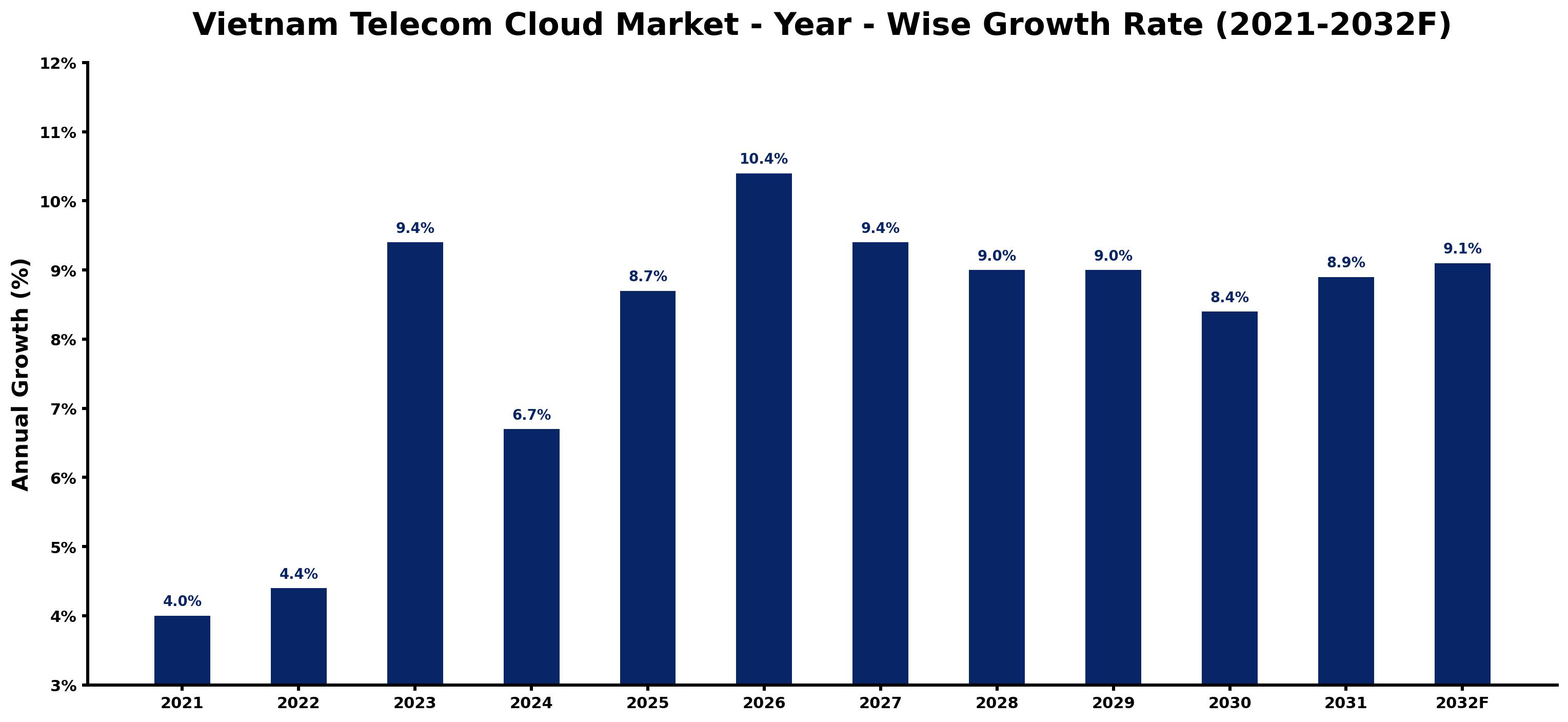
The table below presents the year‑wise growth rates along with the key drivers influencing the market
| Year | Growth Rate | Major Drivers |
| 2021 | 4.0% | Vietnam's 5G rollout enhances telecom cloud infrastructure. |
| 2022 | 4.4% | Increased mobile internet penetration drives cloud adoption. |
| 2023 | 9.4% | Government boosts investment in digital economy infrastructure. |
| 2024 | 6.7% | Local startups leverage cloud for scalable services. |
| 2025 | 8.7% | Growing urbanization accelerates telecom cloud service demand. |
| 2026 | 10.4% | Government policies favoring tech startups promote growth. |
| 2027 | 9.4% | Rising cybersecurity needs drive cloud service expansion. |
| 2028 | 9.0% | Digital content creation surge increases cloud service utilization. |
| 2029 | 9.0% | Vietnamese enterprises migrate to cloud for efficiency. |
| 2030 | 8.4% | Local telecom operators expand cloud service offerings. |
| 2031 | 8.9% | Increased online education accelerates telecom cloud growth. |
| 2032 | 9.1% | Government's push for smart city development fuels demand. |
Note: Market size estimations and growth projections presented in this report are based on 6Wresearch's proprietary forecasting methodology, utilizing the latest available industry data, government publications, and primary research inputs.
Vietnam Telecom Cloud Market Key Takeaways
Below are some of the specific key takeaways from the market, including:
- Cloud solutions are becoming essential for telecom operators to enhance operational efficiency and service delivery.
- The transition to 5G networks is driving the need for advanced cloud-native architectures.
- Government initiatives are fostering a supportive regulatory environment for cloud adoption.
- Competition in the market is intensifying as new entrants emerge alongside established players.
- Data privacy and security concerns remain critical challenges that telecom operators must address.
Evaluation of Restraints in Vietnam Telecom Cloud Market
Despite the momentum, several barriers are hindering the growth of the Vietnam Telecom Cloud Market. Established telecom providers are facing stiff competition from emerging players, which is forcing them to innovate and adapt quickly. The integration of traditional telecom services with cloud offerings often requires substantial investments and technical expertise, creating a bottleneck for smaller operators. on top of that, regulatory constraints and compliance issues complicate the deployment of cloud services, as providers must ensure adherence to local laws while remaining competitive. Lastly, the challenge of building customer trust in cloud services, particularly regarding data privacy and security, remains a significant obstacle.
Vietnam Telecom Cloud Market Trends
Several trends are shaping the future of the Vietnam Telecom Cloud Market. First, there's an increasing emphasis on virtualization and automation within telecom networks, allowing operators to enhance efficiency and reduce costs. The move towards 5G is also driving demand for cloud-native solutions that can support high bandwidth and low-latency applications. Additionally, partnerships between telecom operators and cloud service providers are becoming more common, facilitating the development of tailored solutions to meet specific customer needs. Finally, the demand for secure cloud environments is prompting operators to adopt advanced cybersecurity measures as a standard part of their service offerings.
Vietnam Telecom Cloud Market Opportunities
The Vietnam Telecom Cloud Market presents several promising opportunities for growth and investment. As businesses increasingly migrate to cloud-based services, telecom operators can capitalize on this trend by developing tailored solutions that meet specific industry needs. There is also substantial potential for investment in infrastructure upgrades, particularly as 5G adoption accelerates. on top of that, with the government's support for digital transformation, telecom providers can explore partnerships and collaborations that enhance their service offerings. Lastly, the growing emphasis on data security opens doors for telecom operators to offer specialized cloud services that prioritize compliance and customer trust.
Government Initiatives in the Vietnam Telecom Cloud Market
The Vietnamese government is actively shaping the Telecom Cloud Market through a variety of initiatives aimed at fostering digital transformation and enhancing telecom infrastructure. This supportive regulatory environment is critical for telecom operators seeking to adopt cloud technologies. By prioritizing investment in digital infrastructure, the government is paving the way for a more competitive and innovative telecom sector.
- A national digital infrastructure upgrade programme launched in 2023 aims to enhance broadband connectivity across urban and rural areas.
- Current efforts include a regulatory framework introduced in 2024, mandating data protection standards for cloud services.
- Planned initiatives involve a public-private partnership expected to expand telecom infrastructure access by 2028, focusing on underserved regions.
- Recently completed assessments of telecom cloud capabilities are guiding future investments and policy adjustments in the sector.
- Ongoing initiatives are promoting training programmes for telecom professionals to build expertise in cloud technologies.
Future Insights of the Vietnam Telecom Cloud Market
Between 2026 and 2032, the Vietnam Telecom Cloud Market is expected to continue its upward trajectory, fueled by the increasing integration of cloud solutions within telecom networks. As 5G technology becomes more prevalent, the demand for scalable and efficient cloud infrastructure will only intensify. Telecom operators that prioritize innovation and invest in advanced cloud-native solutions will likely capture a larger market share. Additionally, the emphasis on data security will drive operators to differentiate their services by offering robust protection measures, further shaping the market's future.
Vietnam Telecom Cloud Market Latest Developments
In the past year, the Vietnam Telecom Cloud Market has seen a flurry of activity, reflecting a strong commitment from telecom operators to adapt to the growing demand for cloud services. This momentum highlights the industry's focus on enhancing connectivity and service delivery through innovative cloud solutions.
- A leading regional operator launched a new cloud platform in early 2025, aimed at providing businesses with enhanced data management capabilities.
- In mid-2025, a partnership between a major technology vendor and a telecom provider was announced to develop advanced AI-driven solutions for network optimization.
- A cloud service upgrade initiative is currently underway, expected to be completed by late 2025, enhancing service quality for end-users.
- Plans for an upcoming regional cloud data center, set to begin construction in early 2026, aim to boost local data processing capabilities.
- A pilot project for a new security framework focused on cloud services is ongoing, with the goal of improving customer trust by mid-2026.
Vietnam Telecom Cloud Market - Key Attractiveness of the Report
- 10 Years of Market Numbers
- Historical Data Starting from 2022 to 2025
- Base Year: 2025
- Forecast Data until 2032
- Key Performance Indicators Impacting the Market
- Major Upcoming Developments and Projects
Key Highlights of the Report:
- Vietnam Telecom Cloud Market Outlook
- Market Size of Vietnam Telecom Cloud Market, 2025
- Forecast of Vietnam Telecom Cloud Market, 2032
- Historical Data and Forecast of Vietnam Telecom Cloud Revenues & Volume for the Period 2022-2032F
- Vietnam Telecom Cloud Market Trend Evolution
- Vietnam Telecom Cloud Market Drivers and Challenges
- Vietnam Telecom Cloud Price Trends
- Vietnam Telecom Cloud Porter's Five Forces
- Vietnam Telecom Cloud Industry Life Cycle
- Historical Data and Forecast of Vietnam Telecom Cloud Market Revenues & Volume By Component for the Period 2022-2032F
- Historical Data and Forecast of Vietnam Telecom Cloud Market Revenues & Volume By Platform for the Period 2022-2032F
- Historical Data and Forecast of Vietnam Telecom Cloud Market Revenues & Volume By Solutions for the Period 2022-2032F
- Historical Data and Forecast of Vietnam Telecom Cloud Market Revenues & Volume By Services for the Period 2022-2032F
- Historical Data and Forecast of Vietnam Telecom Cloud Market Revenues & Volume By Organization Size for the Period 2022-2032F
- Historical Data and Forecast of Vietnam Telecom Cloud Market Revenues & Volume By SMEs for the Period 2022-2032F
- Historical Data and Forecast of Vietnam Telecom Cloud Market Revenues & Volume By Large Enterprises for the Period 2022-2032F
- Historical Data and Forecast of Vietnam Telecom Cloud Market Revenues & Volume By Deployment Model for the Period 2022-2032F
- Historical Data and Forecast of Vietnam Telecom Cloud Market Revenues & Volume By Public for the Period 2022-2032F
- Historical Data and Forecast of Vietnam Telecom Cloud Market Revenues & Volume By Private for the Period 2022-2032F
- Historical Data and Forecast of Vietnam Telecom Cloud Market Revenues & Volume By Hybrid for the Period 2022-2032F
- Historical Data and Forecast of Vietnam Telecom Cloud Market Revenues & Volume By Cloud Service Model for the Period 2022-2032F
- Historical Data and Forecast of Vietnam Telecom Cloud Market Revenues & Volume By Software as a Service for the Period 2022-2032F
- Historical Data and Forecast of Vietnam Telecom Cloud Market Revenues & Volume By Platform as a Service for the Period 2022-2032F
- Historical Data and Forecast of Vietnam Telecom Cloud Market Revenues & Volume By Infrastructure as a Service for the Period 2022-2032F
- Historical Data and Forecast of Vietnam Telecom Cloud Market Revenues & Volume By NFV Software for the Period 2022-2032F
- Historical Data and Forecast of Vietnam Telecom Cloud Market Revenues & Volume By VNFs/CNFS for the Period 2022-2032F
- Historical Data and Forecast of Vietnam Telecom Cloud Market Revenues & Volume By NFVI for the Period 2022-2032F
- Vietnam Telecom Cloud Import Export Trade Statistics
- Market Opportunity Assessment By Component
- Market Opportunity Assessment By Organization Size
- Market Opportunity Assessment By Deployment Model
- Market Opportunity Assessment By Cloud Service Model
- Market Opportunity Assessment By NFV Software
- Vietnam Telecom Cloud Top Companies Market Share
- Vietnam Telecom Cloud Competitive Benchmarking By Technical and Operational Parameters
- Vietnam Telecom Cloud Company Profiles
- Vietnam Telecom Cloud Key Strategic Recommendations






































