Vietnam Tensile Testing Equipment Market Size, Share & Growth Rate
The Vietnam Tensile Testing Equipment Market was estimated at USD 1133 Million in 2025 and is projected to reach USD 1611 Million by 2032, growing at a CAGR of 5.2% from 2026 to 2032. This upward trajectory is primarily driven by the rapid expansion of Vietnam's manufacturing and construction sectors, which are increasingly prioritizing stringent quality control measures. Furthermore, the automotive and aerospace industries are amplifying their demand for advanced testing equipment to guarantee material integrity and performance.
Vietnam Tensile Testing Equipment Market Year-wise Growth Rate and Key Drivers
This graph highlights how the Vietnam Tensile Testing Equipment Market has steadily grown over the years, supported by major growth factors.
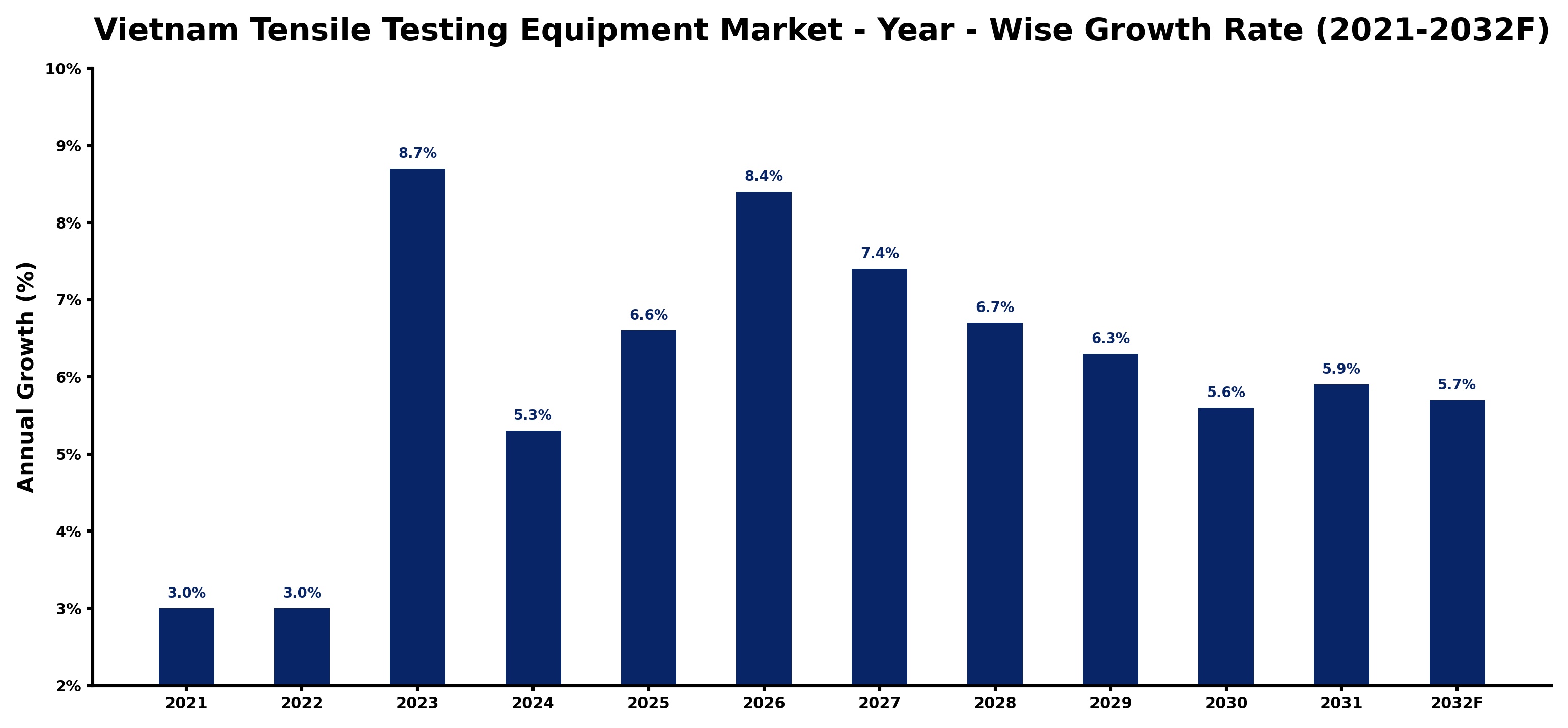
The table below presents the year‑wise growth rates along with the key drivers influencing the market
| Year | Growth Rate | Major Drivers |
| 2021 | 3.0% | Expansion of transportation and logistics networks |
| 2022 | 3.0% | Growing urbanization and commercial development |
| 2023 | 8.7% | Expansion of manufacturing activities |
| 2024 | 5.3% | Growing renewable energy integration projects |
| 2025 | 6.6% | Increasing adoption of advanced technologies |
| 2026 | 8.4% | Expansion of transportation and logistics networks |
| 2027 | 7.4% | Expansion of manufacturing activities |
| 2028 | 6.7% | Expansion of transportation and logistics networks |
| 2029 | 6.3% | Rising electricity demand across industries |
| 2030 | 5.6% | Expansion of commercial construction activities |
| 2031 | 5.9% | Increasing industrial automation investments |
| 2032 | 5.7% | Increasing smart city development projects |
Note - Market size estimations and growth projections presented in this report are based on 6Wresearch's advanced forecasting approach, validated with industry datasets as of June 2026.
Vietnam Tensile Testing Equipment Market Synopsis
The tensile testing equipment market in Vietnam is witnessing significant momentum as industries recognize the importance of material testing in ensuring compliance with safety and performance standards. This necessity is particularly pronounced in sectors like aerospace and automotive, where material performance is critical for component reliability.
In addition, the country's increasing emphasis on research and development is fostering an environment conducive to technological advancements in testing equipment. As R&D initiatives expand, there is a growing need for precision testing apparatus capable of supporting innovative material research and product development.
Vietnam Tensile Testing Equipment Market Key Takeaways
- The Vietnam tensile testing equipment market is strongly supported by the growth of the manufacturing and construction sectors.
- Research and development activities are becoming a significant driver of demand for advanced testing solutions.
- Automotive and aerospace industries are expected to contribute substantially to the market's growth.
- Initial investment costs and the availability of skilled technicians remain critical challenges for widespread adoption.
- The market is anticipated to remain resilient in the face of economic uncertainties stemming from global events.
Evaluation of Restraints in Vietnam Tensile Testing Equipment Market
Despite the promising outlook, the market faces notable restraints. One significant limitation is the high initial investment required for acquiring state-of-the-art tensile testing equipment. This cost can be prohibitive for smaller enterprises, thereby hindering widespread adoption. Additionally, the proficiency needed to operate and maintain these sophisticated machines poses another challenge, as there is a shortage of skilled technicians in this domain. Addressing these issues through training programs and awareness campaigns will be crucial for market growth.
Vietnam Tensile Testing Equipment Market Trends
Emerging trends in the Vietnam tensile testing equipment market indicate a shift towards automation and integration of advanced technologies such as IoT and AI. These technologies are enhancing testing accuracy and efficiency, facilitating real-time data collection and analysis. Furthermore, sustainability considerations are prompting companies to seek materials with higher performance metrics, thereby driving demand for precise testing capabilities.
Vietnam Tensile Testing Equipment Market Opportunities
Opportunities for growth in the tensile testing equipment market are abundant, especially as Vietnam strengthens its position as a manufacturing hub in Southeast Asia. Investments in infrastructure projects and a burgeoning focus on local R&D initiatives present favorable conditions for market expansion. Furthermore, as global standards for material testing evolve, manufacturers will require upgraded equipment to comply with these regulations, offering a prime opportunity for suppliers.
Government Initiatives in the Vietnam Tensile Testing Equipment Market
The Vietnamese government has been actively supporting the industrial sector through various initiatives aimed at enhancing quality control and technological advancement. Policies promoting investment in R&D and public spending on infrastructure projects are designed to stimulate market growth. Additionally, government incentives for high-tech investments may encourage businesses to adopt advanced testing technologies, paving the way for improved material safety and performance standards.
Future Insights of the Vietnam Tensile Testing Equipment Market
Looking ahead, the Vietnam tensile testing equipment market is set to evolve significantly between 2026 and 2032. With ongoing industrialization and increased regulatory scrutiny on material quality, the demand for advanced testing equipment will likely grow. Companies that invest in innovative technologies and cater to the specific needs of industries like automotive and aerospace are poised to capture substantial market share in this expanding landscape.
Vietnam Tensile Testing Equipment Market Latest Developments (May 2025 - June 2026)
Recent developments in the Vietnamese tensile testing equipment market reflect a trend towards enhanced automation and digital integration. Companies are increasingly focusing on adopting smart technologies to facilitate faster and more reliable testing processes. Furthermore, the demand for equipment that can meet evolving international standards has led to innovative product launches and collaborations aimed at expanding technological capabilities.
Vietnam Tensile Testing Equipment Market - Key Attractiveness of the Report
- 10 Years of Market Numbers
- Historical Data Starting from 2022 to 2025
- Base Year: 2025
- Forecast Data until 2032
- Key Performance Indicators Impacting the Market
- Major Upcoming Developments and Projects
Key Highlights of the Report:
- Vietnam Tensile Testing Equipment Market Outlook
- Market Size of Vietnam Tensile Testing Equipment Market, 2025
- Forecast of Vietnam Tensile Testing Equipment Market, 2032
- Historical Data and Forecast of Vietnam Tensile Testing Equipment Revenues & Volume for the Period 2022-2032F
- Vietnam Tensile Testing Equipment Market Trend Evolution
- Vietnam Tensile Testing Equipment Market Drivers and Challenges
- Vietnam Tensile Testing Equipment Price Trends
- Vietnam Tensile Testing Equipment Porter's Five Forces
- Vietnam Tensile Testing Equipment Industry Life Cycle
- Historical Data and Forecast of Vietnam Tensile Testing Equipment Market Revenues & Volume By Equipment Type for the Period 2022-2032F
- Historical Data and Forecast of Vietnam Tensile Testing Equipment Market Revenues & Volume By Universal Testing Machine for the Period 2022-2032F
- Historical Data and Forecast of Vietnam Tensile Testing Equipment Market Revenues & Volume By Hydraulic for the Period 2022-2032F
- Historical Data and Forecast of Vietnam Tensile Testing Equipment Market Revenues & Volume By Electromechanical for the Period 2022-2032F
- Historical Data and Forecast of Vietnam Tensile Testing Equipment Market Revenues & Volume By Others for the Period 2022-2032F
- Historical Data and Forecast of Vietnam Tensile Testing Equipment Market Revenues & Volume By End-User Industry for the Period 2022-2032F
- Historical Data and Forecast of Vietnam Tensile Testing Equipment Market Revenues & Volume By Industrial Manufacturing for the Period 2022-2032F
- Historical Data and Forecast of Vietnam Tensile Testing Equipment Market Revenues & Volume By Automotive for the Period 2022-2032F
- Historical Data and Forecast of Vietnam Tensile Testing Equipment Market Revenues & Volume By Construction for the Period 2022-2032F
- Historical Data and Forecast of Vietnam Tensile Testing Equipment Market Revenues & Volume By Others for the Period 2022-2032F
- Vietnam Tensile Testing Equipment Import Export Trade Statistics
- Market Opportunity Assessment By Equipment Type
- Market Opportunity Assessment By End-User Industry
- Vietnam Tensile Testing Equipment Top Companies Market Share
- Vietnam Tensile Testing Equipment Competitive Benchmarking By Technical and Operational Parameters
- Vietnam Tensile Testing Equipment Company Profiles
- Vietnam Tensile Testing Equipment Key Strategic Recommendations






































