Vietnam Textile Bags Market Size, Share & Growth Rate
The Vietnam Textile Bags Market was estimated at USD 1071 Million in 2025 and is projected to reach USD 1519 Million by 2032, growing at a CAGR of 5.1% from 2026 to 2032. This promising trajectory is underpinned by the increasing demand for sustainable products, as more consumers and businesses pivot away from plastic bags. Enhanced corporate social responsibility initiatives and evolving consumer preferences are further propelling the market forward.
Vietnam Textile Bags Market Year-wise Growth Rate and Key Drivers
This graph highlights how the Vietnam Textile Bags Market has steadily grown over the years, supported by major growth factors.
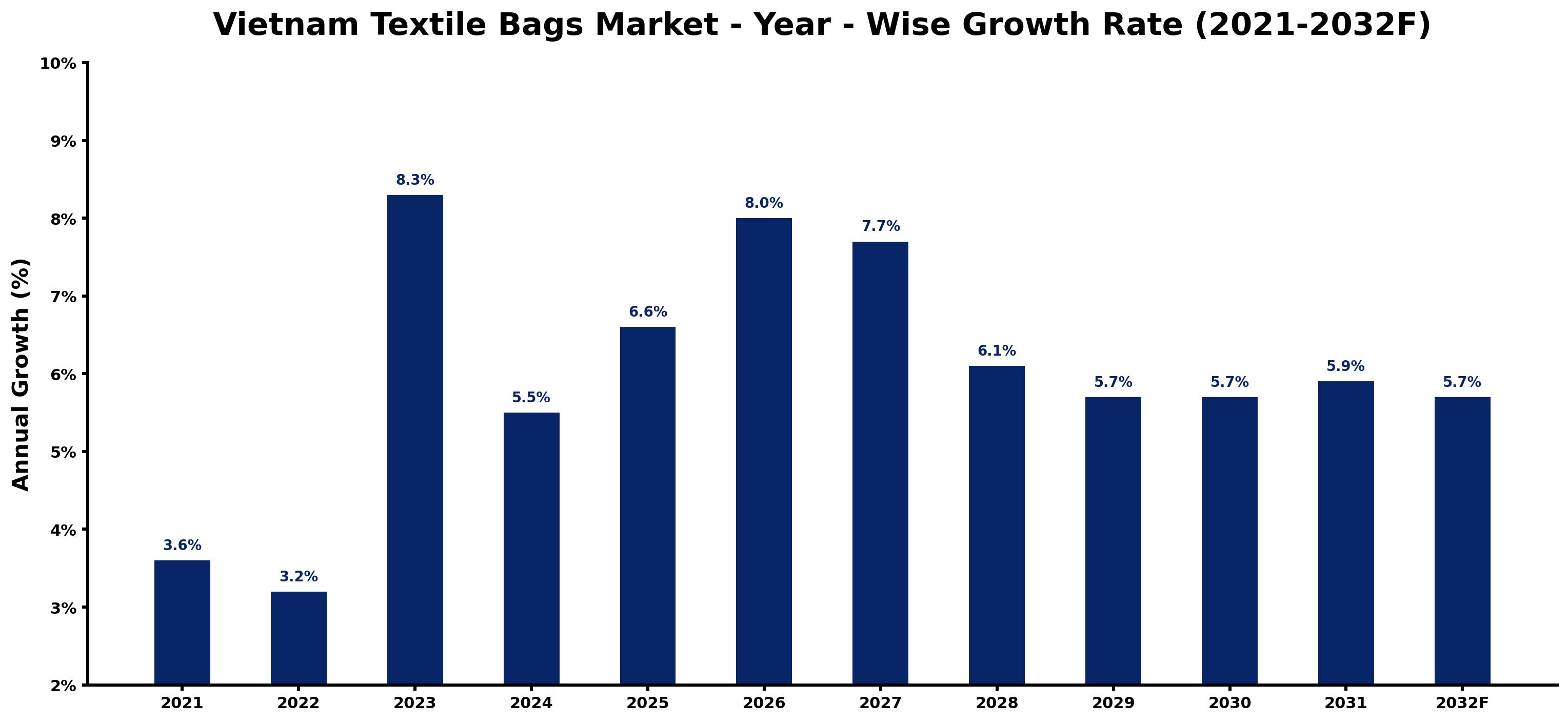
The table below presents the year‑wise growth rates along with the key drivers influencing the market
| Year | Growth Rate | Major Drivers |
| 2021 | 3.6% | Increasing industrial infrastructure investments |
| 2022 | 3.2% | Increasing industrial infrastructure investments |
| 2023 | 8.3% | Rapid growth in telecom and data center sectors |
| 2024 | 5.5% | Rapid growth in telecom and data center sectors |
| 2025 | 6.6% | Rapid growth in telecom and data center sectors |
| 2026 | 8.0% | Expansion of manufacturing activities |
| 2027 | 7.7% | Increasing adoption of advanced technologies |
| 2028 | 6.1% | Growing renewable energy integration projects |
| 2029 | 5.7% | Increasing industrial infrastructure investments |
| 2030 | 5.7% | Expansion of commercial construction activities |
| 2031 | 5.9% | Increasing industrial infrastructure investments |
| 2032 | 5.7% | Rising electricity demand across industries |
Note - Market size estimations and growth projections presented in this report are based on 6Wresearch’s advanced forecasting approach, validated with industry datasets as of June 2026.
Vietnam Textile Bags Market Synopsis
The Vietnam Textile Bags Market is experiencing significant growth, driven by an expanding textile and garment sector. With a rising awareness of environmental issues, consumers are increasingly favoring textile bags as a practical and eco-friendly alternative for shopping and packaging.
Manufacturers are diversifying their offerings, introducing a broad spectrum of designs and materials to cater to varied consumer preferences. This dynamic landscape creates opportunities for both small businesses and large textile enterprises, positioning Vietnam as a key player in the global textile bags market.
Vietnam Textile Bags Market Key Takeaways
- The market is driven by heightened environmental awareness and a shift towards sustainable practices.
- Diverse manufacturing capabilities cater to both domestic and international demand.
- Competition from lower-cost alternatives remains a notable challenge.
- Government initiatives are enhancing the focus on eco-friendly products.
- The COVID-19 pandemic spurred a shift in consumer behavior, favoring online shopping and reusable bags.
Evaluation of Restraints in Vietnam Textile Bags Market
Despite its growth potential, the Vietnam Textile Bags Market faces notable restraints, particularly from cheaper plastic alternatives that remain widely accessible to consumers. This cost-effective competition can hinder the uptake of textile bags, particularly among price-sensitive segments. Additionally, the end-of-life management of textile bags poses a significant challenge; establishing a robust recycling infrastructure is essential to prevent these products from contributing to waste. Addressing these issues is crucial for sustainable growth in the market.
Vietnam Textile Bags Market Trends
Several trends are emerging within the Vietnam Textile Bags Market. First, the development of innovative materials that enhance durability and functionality is gaining traction. Additionally, personalization and customization options are becoming popular, allowing consumers to express their individuality through their choices of textile bags. The integration of smart technology into textile bags, such as RFID tags for tracking and inventory management, also represents an exciting frontier. Furthermore, collaborations between manufacturers and environmental organizations are driving initiatives aimed at increasing consumer awareness of sustainable practices.
Vietnam Textile Bags Market Opportunities
As the demand for eco-friendly products continues to rise, significant growth opportunities exist in the Vietnam Textile Bags Market. Expanding into untapped domestic markets and enhancing export capabilities can yield lucrative prospects. Additionally, partnerships with retailers and brands focusing on sustainability can open new distribution channels. There is also a growing potential in the corporate sector, as companies increasingly seek branded textile bags for promotional and packaging purposes, aligning their initiatives with broader environmental goals.
Government Initiatives in the Vietnam Textile Bags Market
The Vietnamese government is actively promoting sustainable practices through various initiatives aimed at reducing plastic waste. Policies encouraging the use of textile bags, alongside public awareness campaigns, are designed to foster a culture of environmental responsibility. Incentives for manufacturers developing eco-friendly products further enhance the attractiveness of the textile bags sector, signaling strong governmental support for businesses committed to sustainability.
Future Insights of the Vietnam Textile Bags Market
Looking ahead to 2026-2032, the Vietnam Textile Bags Market is poised for steady growth, driven by ongoing shifts in consumer attitudes towards sustainability. As more Vietnamese businesses adopt eco-conscious practices, the market will likely witness a surge in demand for innovative and high-quality textile bags. Additionally, technological advancements and collaborative efforts between stakeholders in the industry will support the development of more efficient production processes and recycling solutions, paving the way for a more sustainable future.
Vietnam Textile Bags Market Latest Developments (May 2025 - June 2026)
Recent developments in the Vietnam Textile Bags Market indicate a growing focus on sustainability across the industry. Manufacturers are increasingly adopting eco-friendly practices in their production processes while exploring new, sustainable materials. Simultaneously, retailers are launching campaigns to promote the use of textile bags among consumers. Collaborative partnerships between industry players and environmental organizations are emerging, with initiatives aimed at raising awareness and fostering responsible consumption patterns among the public.
Vietnam Textile Bags Market - Key Attractiveness of the Report
- 10 Years of Market Numbers
- Historical Data Starting from 2022 to 2025
- Base Year: 2025
- Forecast Data until 2032
- Key Performance Indicators Impacting the Market
- Major Upcoming Developments and Projects
Key Highlights of the Report:
- Vietnam Textile Bags Market Outlook
- Market Size of Vietnam Textile Bags Market, 2025
- Forecast of Vietnam Textile Bags Market, 2032
- Historical Data and Forecast of Vietnam Textile Bags Revenues & Volume for the Period 2022-2032F
- Vietnam Textile Bags Market Trend Evolution
- Vietnam Textile Bags Market Drivers and Challenges
- Vietnam Textile Bags Price Trends
- Vietnam Textile Bags Porter's Five Forces
- Vietnam Textile Bags Industry Life Cycle
- Historical Data and Forecast of Vietnam Textile Bags Market Revenues & Volume By Size for the Period 2022-2032F
- Historical Data and Forecast of Vietnam Textile Bags Market Revenues & Volume By Less than 14" x 26" for the Period 2022-2032F
- Historical Data and Forecast of Vietnam Textile Bags Market Revenues & Volume By 18" x 30" for the Period 2022-2032F
- Historical Data and Forecast of Vietnam Textile Bags Market Revenues & Volume By 22" x 36" for the Period 2022-2032F
- Historical Data and Forecast of Vietnam Textile Bags Market Revenues & Volume By 22" x 40" for the Period 2022-2032F
- Historical Data and Forecast of Vietnam Textile Bags Market Revenues & Volume By Above 28" x 40" for the Period 2022-2032F
- Historical Data and Forecast of Vietnam Textile Bags Market Revenues & Volume By Material Type for the Period 2022-2032F
- Historical Data and Forecast of Vietnam Textile Bags Market Revenues & Volume By Cotton for the Period 2022-2032F
- Historical Data and Forecast of Vietnam Textile Bags Market Revenues & Volume By Burlap for the Period 2022-2032F
- Historical Data and Forecast of Vietnam Textile Bags Market Revenues & Volume By Others for the Period 2022-2032F
- Historical Data and Forecast of Vietnam Textile Bags Market Revenues & Volume By Sales Channel for the Period 2022-2032F
- Historical Data and Forecast of Vietnam Textile Bags Market Revenues & Volume By Retailers for the Period 2022-2032F
- Historical Data and Forecast of Vietnam Textile Bags Market Revenues & Volume By Wholesalers for the Period 2022-2032F
- Historical Data and Forecast of Vietnam Textile Bags Market Revenues & Volume By E-commerce for the Period 2022-2032F
- Vietnam Textile Bags Import Export Trade Statistics
- Market Opportunity Assessment By Size
- Market Opportunity Assessment By Material Type
- Market Opportunity Assessment By Sales Channel
- Vietnam Textile Bags Top Companies Market Share
- Vietnam Textile Bags Competitive Benchmarking By Technical and Operational Parameters
- Vietnam Textile Bags Company Profiles
- Vietnam Textile Bags Key Strategic Recommendations






































