Vietnam Thermoformed Plastic Products Market Size, Share & Growth Rate
The Vietnam Thermoformed Plastic Products Market was estimated at USD 182 Million in 2025 and is projected to reach USD 256 Million by 2032, growing at a CAGR of 5.0% from 2026 to 2032. This growth trajectory is primarily driven by the increasing demand for lightweight and cost-effective packaging solutions across multiple industries, including automotive, food and beverage, and consumer goods. The ongoing urbanization and rise in disposable incomes among the Vietnamese population further amplify the market's potential, as consumers seek innovative packaging and product designs.
Vietnam Thermoformed Plastic Products Market Year-wise Growth Rate and Key Drivers
This graph highlights how the Vietnam Thermoformed Plastic Products Market has steadily grown over the years, supported by major growth factors.
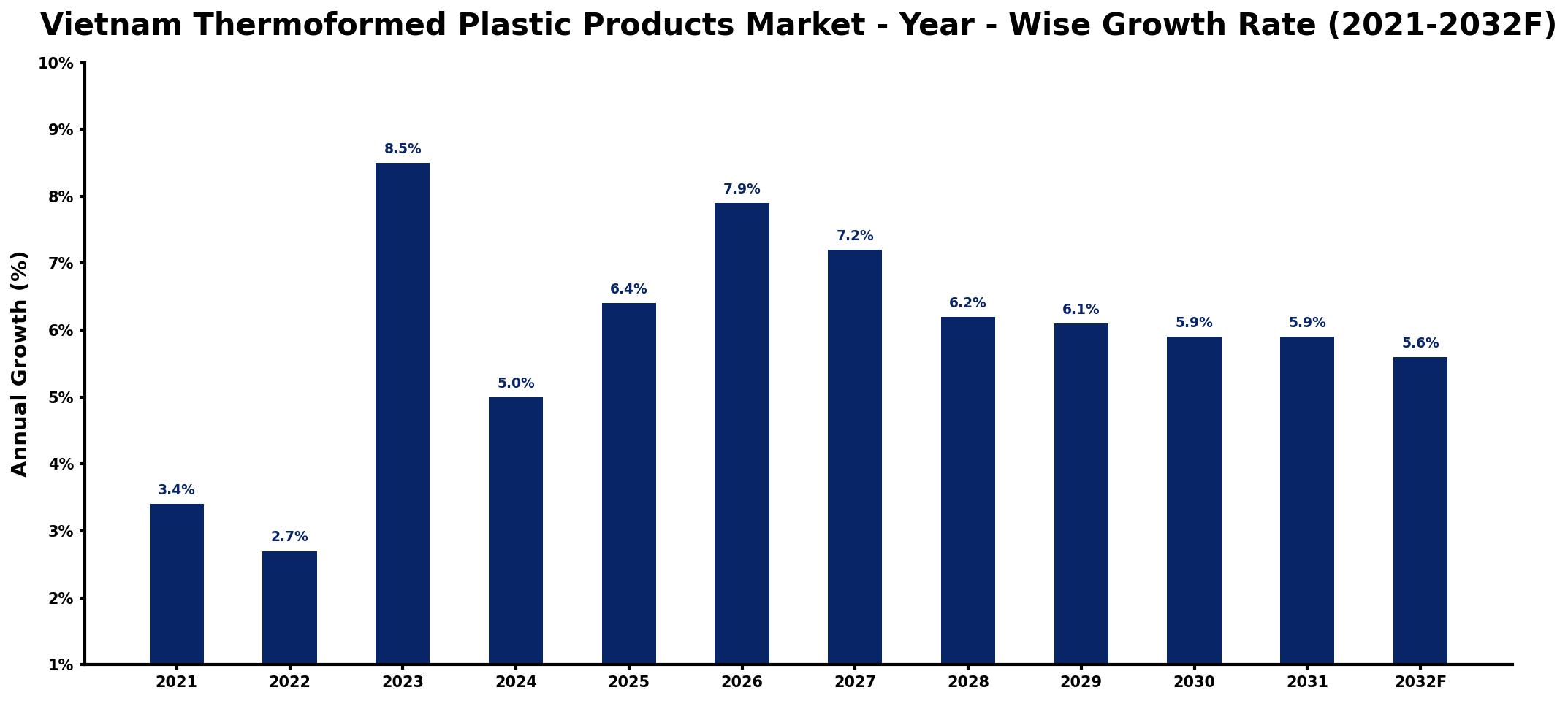
The table below presents the year‑wise growth rates along with the key drivers influencing the market
| Year | Growth Rate | Major Drivers |
| 2021 | 3.4% | Rising demand in packaging sector |
| 2022 | 2.7% | Increased investment in manufacturing facilities |
| 2023 | 8.5% | Expansion of food service industry |
| 2024 | 5.0% | Growth in consumer electronics market |
| 2025 | 6.4% | Surge in e-commerce activities |
| 2026 | 7.9% | Advancements in sustainable materials |
| 2027 | 7.2% | Increased focus on recycling initiatives |
| 2028 | 6.2% | Rising automotive industry requirements |
| 2029 | 6.1% | growing commercial sector adoption |
| 2030 | 5.9% | Demand from retail sector increases |
| 2031 | 5.9% | expanding healthcare application demand |
| 2032 | 5.6% | Investment in renewable energy projects |
Note: Market size estimations and growth projections presented in this report are based on 6Wresearch's proprietary forecasting methodology, utilizing the latest available industry data, government publications, and primary research inputs.
Vietnam Thermoformed Plastic Products Market Synopsis
The surge in demand for thermoformed plastic products in Vietnam is profoundly influenced by urbanization, which not only increases consumer accessibility but also elevates the standard of living. As more people move to cities, there is a clear shift toward convenience and modern packaging solutions, propelling the market forward.
Moreover, the automotive and packaging sectors are expanding rapidly, as they seek cost-effective, versatile materials that can be molded into various shapes and sizes. This versatility allows manufacturers to tailor products that meet the diverse needs of consumers and industries alike, solidifying the foundation of growth for the thermoformed plastics market in Vietnam.
Vietnam Thermoformed Plastic Products Market Key Takeaways
- Robust growth is expected, with the market projected to reach USD 256 Million by 2032.
- Urbanization and rising disposable incomes are key driving factors in the market.
- Thermoforming technology supports versatility, appealing to various industries.
- Sustainability concerns are prompting a shift towards biodegradable alternatives.
- Emerging trends in hygiene and safety are increasing the demand for single-use products.
Evaluation of Restraints in Vietnam Thermoformed Plastic Products Market
Despite the promising growth, the Vietnam thermoformed plastic products market faces significant challenges. Environmental sustainability remains a pressing issue as regulations surrounding plastic usage become increasingly stringent. Manufacturers are under pressure to comply with these regulations, which could impact production processes. Furthermore, the rising popularity of alternative materials, such as bioplastics, poses a competitive threat to traditional thermoformed products. Companies must navigate these challenges while maintaining quality control and operational efficiency to thrive in this evolving landscape.
Vietnam Thermoformed Plastic Products Market Trends
A key trend in the market is the growing emphasis on eco-friendly packaging solutions, driven by heightened consumer awareness around sustainability. Companies are increasingly investing in research to develop biodegradable and recyclable thermoformed products. Additionally, the rise of e-commerce is stimulating demand for packaging that not only protects products but also enhances brand visibility and consumer experience. Innovations in manufacturing processes, such as the adoption of automated technologies, are also enabling faster production cycles, responding to the evolving market needs.
Vietnam Thermoformed Plastic Products Market Opportunities
The Vietnam thermoformed plastic products market presents several avenues for growth and investment. The ongoing urbanization creates demand for innovative packaging solutions in fast-moving consumer goods (FMCG) and the food sector. Manufacturers that adapt quickly to sustainability trends and explore the development of biodegradable materials will find favorable opportunities. Moreover, as the automotive industry transitions towards lightweight components for fuel efficiency, thermoformed plastics will play a critical role in meeting these requirements. Collaboration with tech companies to enhance production efficiency and product design further paves the way for market expansion.
Government Initiatives in the Vietnam Thermoformed Plastic Products Market
The Vietnamese government is actively promoting sustainable development through various initiatives aimed at reducing plastic waste. Policies encouraging recycling and the use of eco-friendly materials are gaining momentum, reflecting a commitment to environmental sustainability. Public spending on waste management and recycling infrastructure is also being prioritized. These efforts create a conducive environment for manufacturers to invest in innovative thermoformed plastic solutions that align with government objectives, ultimately benefiting both the industry and the economy.
Future Insights of the Vietnam Thermoformed Plastic Products Market
Looking ahead to 2026-2032, the Vietnam thermoformed plastic products market is anticipated to grow robustly, fueled by continual industrial advancements and shifting consumer preferences. Companies that invest in sustainable practices and technology will likely gain a competitive edge. The increasing focus on hygiene and safety, particularly in food packaging and healthcare sectors, is expected to sustain demand for thermoformed products. As innovations continue to shape the landscape, players in this market will need to remain agile and responsive to consumer and regulatory changes to capitalize on emerging opportunities.
Vietnam Thermoformed Plastic Products Market Latest Developments (2025 - 2026)
In recent months, the thermoformed plastic products market has seen notable shifts, particularly in response to sustainability trends. Many manufacturers are ramping up investments in eco-friendly technologies and exploring biodegradable materials. There has also been a marked increase in collaboration between companies and environmental organizations to innovate sustainable packaging solutions. The demand for single-use products remains strong in healthcare, further reinforcing the sectors reliance on thermoformed plastics as a key resource.
Vietnam Thermoformed Plastic Products Market - Key Attractiveness of the Report
- 10 Years of Market Numbers
- Historical Data Starting from 2022 to 2025
- Base Year: 2025
- Forecast Data until 2032
- Key Performance Indicators Impacting the Market
- Major Upcoming Developments and Projects
Key Highlights of the Report:
- Vietnam Thermoformed Plastic Products Market Outlook
- Market Size of Vietnam Thermoformed Plastic Products Market, 2025
- Forecast of Vietnam Thermoformed Plastic Products Market, 2032
- Historical Data and Forecast of Vietnam Thermoformed Plastic Products Revenues & Volume for the Period 2022-2032F
- Vietnam Thermoformed Plastic Products Market Trend Evolution
- Vietnam Thermoformed Plastic Products Market Drivers and Challenges
- Vietnam Thermoformed Plastic Products Price Trends
- Vietnam Thermoformed Plastic Products Porter's Five Forces
- Vietnam Thermoformed Plastic Products Industry Life Cycle
- Historical Data and Forecast of Vietnam Thermoformed Plastic Products Market Revenues & Volume By Product for the Period 2022-2032F
- Historical Data and Forecast of Vietnam Thermoformed Plastic Products Market Revenues & Volume By Polymethyl Methacrylate (PMMA) for the Period 2022-2032F
- Historical Data and Forecast of Vietnam Thermoformed Plastic Products Market Revenues & Volume By Bio-degradable polymers for the Period 2022-2032F
- Historical Data and Forecast of Vietnam Thermoformed Plastic Products Market Revenues & Volume By Polyethylene (PE) for the Period 2022-2032F
- Historical Data and Forecast of Vietnam Thermoformed Plastic Products Market Revenues & Volume By Acrylonitrile Butadiene Styrene (ABS) for the Period 2022-2032F
- Historical Data and Forecast of Vietnam Thermoformed Plastic Products Market Revenues & Volume By Poly Vinyl Chloride (PVC) for the Period 2022-2032F
- Historical Data and Forecast of Vietnam Thermoformed Plastic Products Market Revenues & Volume By High Impact Polystyrene (HIPS) for the Period 2022-2032F
- Historical Data and Forecast of Vietnam Thermoformed Plastic Products Market Revenues & Volume By Polystyrene (PS) for the Period 2022-2032F
- Historical Data and Forecast of Vietnam Polymethyl Methacrylate (PMMA) Thermoformed Plastic Products Market Revenues & Volume By Polypropylene (PP) for the Period 2022-2032F
- Historical Data and Forecast of Vietnam Thermoformed Plastic Products Market Revenues & Volume By Process for the Period 2022-2032F
- Historical Data and Forecast of Vietnam Thermoformed Plastic Products Market Revenues & Volume By Plug Assist Forming for the Period 2022-2032F
- Historical Data and Forecast of Vietnam Thermoformed Plastic Products Market Revenues & Volume By Thick Gauge Thermoforming for the Period 2022-2032F
- Historical Data and Forecast of Vietnam Thermoformed Plastic Products Market Revenues & Volume By Thin Gauge Thermoforming for the Period 2022-2032F
- Historical Data and Forecast of Vietnam Thermoformed Plastic Products Market Revenues & Volume By Vacuum Snapback for the Period 2022-2032F
- Historical Data and Forecast of Vietnam Thermoformed Plastic Products Market Revenues & Volume By Application for the Period 2022-2032F
- Historical Data and Forecast of Vietnam Thermoformed Plastic Products Market Revenues & Volume By Healthcare & Medical for the Period 2022-2032F
- Historical Data and Forecast of Vietnam Thermoformed Plastic Products Market Revenues & Volume By Food Packaging for the Period 2022-2032F
- Historical Data and Forecast of Vietnam Thermoformed Plastic Products Market Revenues & Volume By Electrical & Electronics for the Period 2022-2032F
- Historical Data and Forecast of Vietnam Thermoformed Plastic Products Market Revenues & Volume By Automotive for the Period 2022-2032F
- Historical Data and Forecast of Vietnam Thermoformed Plastic Products Market Revenues & Volume By Construction for the Period 2022-2032F
- Historical Data and Forecast of Vietnam Thermoformed Plastic Products Market Revenues & Volume By Consumer Goods & Appliances for the Period 2022-2032F
- Vietnam Thermoformed Plastic Products Import Export Trade Statistics
- Market Opportunity Assessment By Product
- Market Opportunity Assessment By Process
- Market Opportunity Assessment By Application
- Vietnam Thermoformed Plastic Products Top Companies Market Share
- Vietnam Thermoformed Plastic Products Competitive Benchmarking By Technical and Operational Parameters
- Vietnam Thermoformed Plastic Products Company Profiles
- Vietnam Thermoformed Plastic Products Key Strategic Recommendations






































