Vietnam Tractor Market Size, Share & Growth Rate
The Vietnam Tractor Market was estimated at USD 155 Million in 2025 and is projected to reach USD 219 Million by 2032, growing at a CAGR of 5.1% from 2026 to 2032. This trajectory is primarily fueled by the ongoing modernization of the agriculture sector, where increasing efficiency and productivity are paramount. Farmers are increasingly turning to mechanized solutions to address labor shortages and enhance operational capabilities, ensuring a robust demand for tractors across the country.
Vietnam Tractor Market Year-wise Growth Rate and Key Drivers
This graph highlights how the Vietnam Tractor Market has steadily grown over the years, supported by major growth factors.
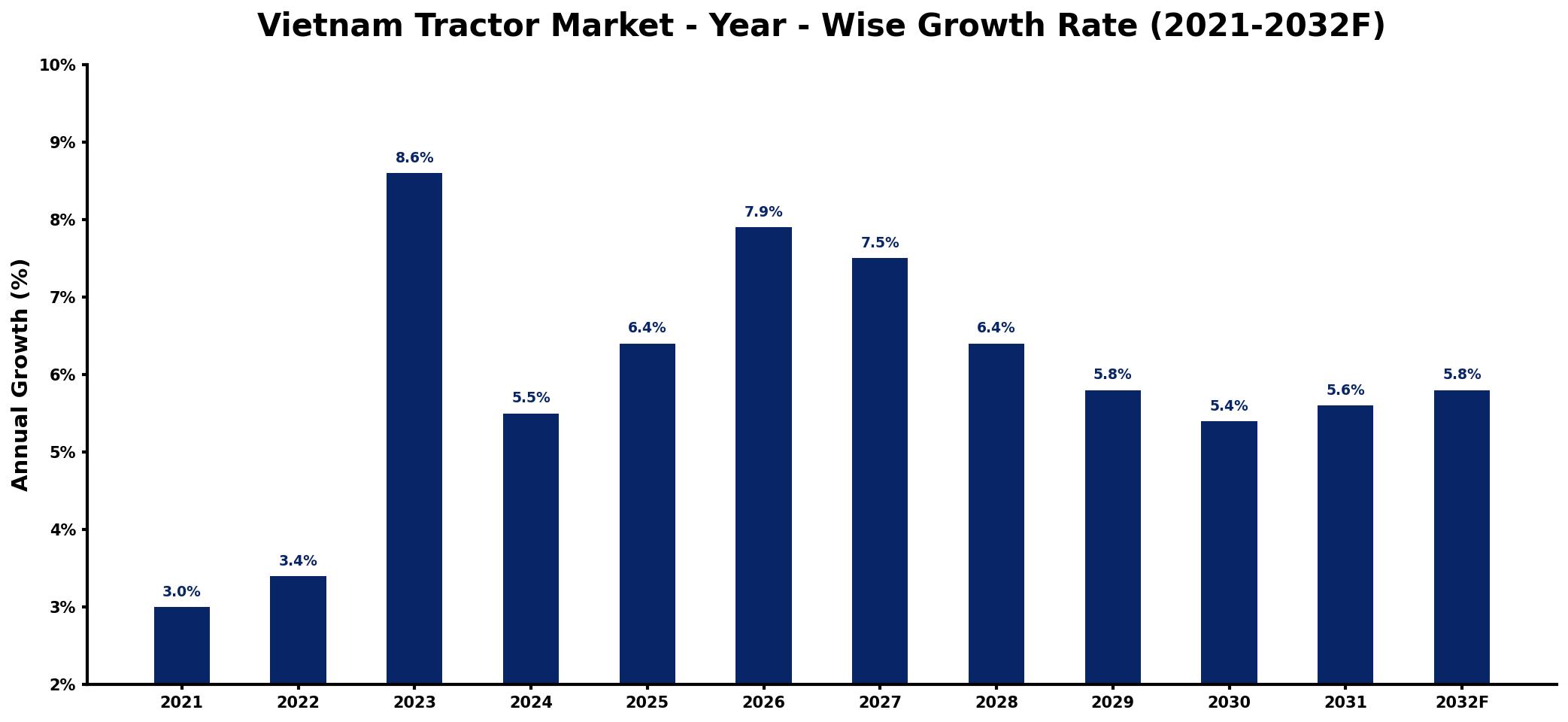
The table below presents the year‑wise growth rates along with the key drivers influencing the market
| Year | Growth Rate | Major Drivers |
| 2021 | 3.0% | Rising agricultural investment trends |
| 2022 | 3.4% | Increased mechanization in farming |
| 2023 | 8.6% | Growth in export-oriented agriculture |
| 2024 | 5.5% | Expansion of rural infrastructure projects |
| 2025 | 6.4% | Technological advancements in farming |
| 2026 | 7.9% | Government incentives for modernization |
| 2027 | 7.5% | Surge in eco-friendly practices |
| 2028 | 6.4% | Higher demand for crop efficiency |
| 2029 | 5.8% | Boost in agricultural productivity initiatives |
| 2030 | 5.4% | Growing importance of sustainable farming |
| 2031 | 5.6% | expanding manufacturing base activity |
| 2032 | 5.8% | Increased focus on food security |
Note: Market size estimations and growth projections presented in this report are based on 6Wresearch's proprietary forecasting methodology, utilizing the latest available industry data, government publications, and primary research inputs.
Vietnam Tractor Market Synopsis
The Vietnam tractor market has witnessed notable momentum in recent years, driven by a significant push towards mechanization in agriculture. As farmers recognize the benefits of modern equipment, particularly small to medium-sized tractors, the market is set on an upward trajectory, supported by both government incentives and farmer interest.
However, as the market progresses, it faces challenges such as land fragmentation and financing accessibility. Nevertheless, the demand remains strong as the agricultural sector strives to meet the food needs of a growing population, ensuring that the market continues to evolve and expand.
Vietnam Tractor Market Key Takeaways
- The Vietnam Tractor Market is projected to grow significantly due to the modernization of agriculture.
- Government initiatives play a crucial role in promoting tractor adoption among farmers.
- Small and medium-sized tractors are highly favored for their versatility and efficiency.
- Challenges like land fragmentation affect purchasing decisions and market expansion.
- Rural infrastructure development is expected to further enhance tractor sales.
Evaluation of Restraints in Vietnam Tractor Market
Despite the favorable growth outlook, the Vietnam tractor market grapples with significant restraints. The prevalence of small-scale farming means that many farmers operate on limited budgets, making it challenging to invest in higher-cost machinery. Moreover, land fragmentation presents hurdles; fragmented land holdings complicate the efficient use of tractors, limiting their practicality in certain scenarios. Additionally, while there are some financing options available, access remains limited for many smallholders. This creates a barrier that can stifle growth and the adoption of modern agricultural practices, ultimately impacting productivity.
Vietnam Tractor Market Trends
Several trends are shaping the Vietnam tractor market, reflecting a shift towards advanced technology and sustainability. For instance, there is a growing interest in tractors equipped with precision agriculture technologies, allowing for better resource management and crop monitoring. Furthermore, manufacturers are increasingly focusing on producing eco-friendly machinery to meet the rising demand for sustainable farming practices. Additionally, as the digital landscape expands, the integration of IoT technologies is becoming more prevalent, offering farmers enhanced operational capabilities through data-driven decision-making.
Vietnam Tractor Market Opportunities
The Vietnam tractor market presents various opportunities for growth and investment. With increasing urbanization and the expansion of agricultural practices, there is a burgeoning demand for new and innovative machinery. Potential investors should consider the integration of advanced technologies like automated systems and smart connectivity to meet modern farming needs. Additionally, leveraging government support and subsidies aimed at promoting mechanization can further enhance investment returns, particularly in underdeveloped rural areas that lack access to modern farming equipment.
Government Initiatives in the Vietnam Tractor Market
The Vietnamese government has launched several initiatives to foster agricultural modernization, with a strong emphasis on mechanization. Policies encouraging the adoption of modern agricultural practices, including the provision of subsidies for machinery purchase, have significantly influenced market dynamics. Programs aimed at improving rural infrastructure and facilitating better access to financing are also pivotal. By focusing on enhancing agricultural productivity and supporting farmers, these initiatives not only benefit individual farmers but also contribute to the overall growth of the tractor market in Vietnam.
Future Insights of the Vietnam Tractor Market
Looking ahead, the Vietnam tractor market is set to witness robust growth through 2026-2032, driven by continued government support and the persistent demand for increased agricultural productivity. As farmers increasingly adopt mechanization, we can expect to see an uptick in the sales of both traditional and technologically advanced tractors. Moreover, the ongoing modernization of rural infrastructure will likely create new opportunities for market players, enabling them to expand their reach and innovate. The trajectory of this market suggests a thriving future, with substantial implications for agricultural efficiency in Vietnam.
Vietnam Tractor Market Latest Developments (2025 - 2026)
Recent developments in the Vietnam tractor market indicate a strong recovery following challenges faced during the COVID-19 pandemic. Enhanced supply chain resilience has emerged as a focal point, with manufacturers exploring new partnerships to mitigate future disruptions. The emphasis on research and development has increased, with stakeholders keen to introduce eco-friendly and technologically advanced machinery. Furthermore, collaboration with financial institutions is becoming more common, aiming to provide farmers with better access to credit facilities for purchasing modern tractors.
Vietnam Tractor Market - Key Attractiveness of the Report
- 10 Years of Market Numbers
- Historical Data Starting from 2022 to 2025
- Base Year: 2025
- Forecast Data until 2032
- Key Performance Indicators Impacting the Market
- Major Upcoming Developments and Projects
Key Highlights of the Report:
- Vietnam Tractor Market Outlook
- Market Size of Vietnam Tractor Market, 2025
- Forecast of Vietnam Tractor Market, 2032
- Historical Data and Forecast of Vietnam Tractor Revenues & Volume for the Period 2022-2032F
- Vietnam Tractor Market Trend Evolution
- Vietnam Tractor Market Drivers and Challenges
- Vietnam Tractor Price Trends
- Vietnam Tractor Porter's Five Forces
- Vietnam Tractor Industry Life Cycle
- Historical Data and Forecast of Vietnam Tractor Market Revenues & Volume By Power Output for the Period 2022-2032F
- Historical Data and Forecast of Vietnam Tractor Market Revenues & Volume By Less Than 30 HP for the Period 2022-2032F
- Historical Data and Forecast of Vietnam Tractor Market Revenues & Volume By 30-50 HP for the Period 2022-2032F
- Historical Data and Forecast of Vietnam Tractor Market Revenues & Volume By 51-100 HP for the Period 2022-2032F
- Historical Data and Forecast of Vietnam Tractor Market Revenues & Volume By More Than 100 HP for the Period 2022-2032F
- Historical Data and Forecast of Vietnam Tractor Market Revenues & Volume By Drive Type for the Period 2022-2032F
- Historical Data and Forecast of Vietnam Tractor Market Revenues & Volume By 2 Wheel Drive for the Period 2022-2032F
- Historical Data and Forecast of Vietnam Tractor Market Revenues & Volume By 4 Wheel Drive for the Period 2022-2032F
- Historical Data and Forecast of Vietnam Tractor Market Revenues & Volume By Application for the Period 2022-2032F
- Historical Data and Forecast of Vietnam Tractor Market Revenues & Volume By Agriculture for the Period 2022-2032F
- Vietnam Tractor Import Export Trade Statistics
- Market Opportunity Assessment By Power Output
- Market Opportunity Assessment By Drive Type
- Market Opportunity Assessment By Application
- Vietnam Tractor Top Companies Market Share
- Vietnam Tractor Competitive Benchmarking By Technical and Operational Parameters
- Vietnam Tractor Company Profiles
- Vietnam Tractor Key Strategic Recommendations






































