Vietnam Trolley Market Size, Share & Growth Rate
The Vietnam Trolley Market was estimated at USD 471 Million in 2025 and is projected to reach USD 665 Million by 2032, growing at a CAGR of 5.1% from 2026 to 2032. This significant growth trajectory is largely driven by the rapid expansion of the logistics and material handling sectors, alongside the boom in e-commerce and manufacturing activities. As industries modernize, the demand for efficient, cost-effective material transportation solutions continues to rise, positioning trolleys as indispensable tools in a variety of settings.
Vietnam Trolley Market Year-wise Growth Rate and Key Drivers
This graph highlights how the Vietnam Trolley Market has steadily grown over the years, supported by major growth factors.
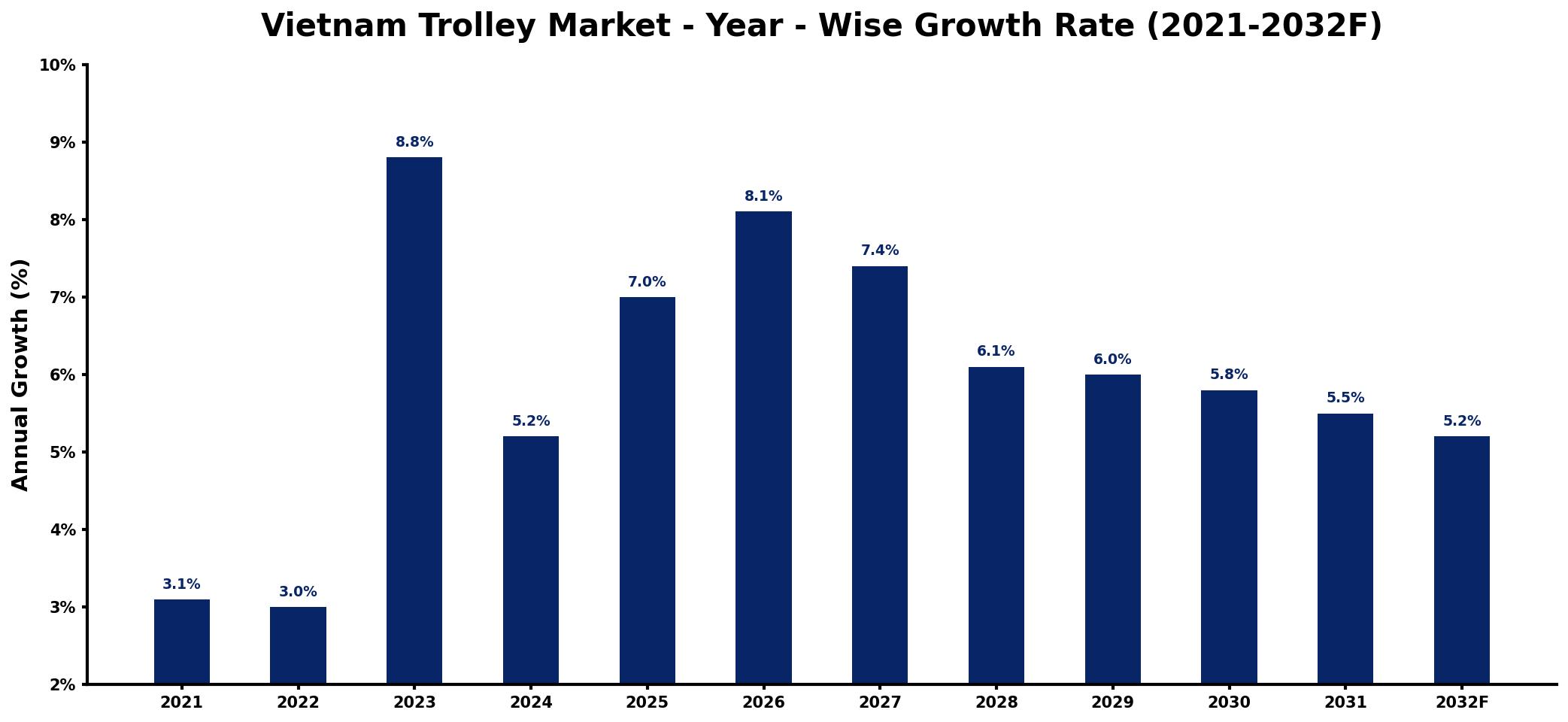
The table below presents the year‑wise growth rates along with the key drivers influencing the market
| Year | Growth Rate | Major Drivers |
| 2021 | 3.1% | Rising consumer purchasing power |
| 2022 | 3.0% | Increased urbanization and mobility |
| 2023 | 8.8% | Growth in e-commerce logistics |
| 2024 | 5.2% | Expansion of retail sector |
| 2025 | 7.0% | Investment in infrastructure projects |
| 2026 | 8.1% | Surge in tourism activities |
| 2027 | 7.4% | Growing demand for convenience |
| 2028 | 6.1% | Emergence of smart solutions |
| 2029 | 6.0% | Increased focus on sustainability |
| 2030 | 5.8% | Rising disposable income levels |
| 2031 | 5.5% | Enhanced supply chain efficiency |
| 2032 | 5.2% | expanding healthcare application demand |
Note: Market size estimations and growth projections presented in this report are based on 6Wresearch's proprietary forecasting methodology, utilizing the latest available industry data, government publications, and primary research inputs.
Vietnam Trolley Market Synopsis
A primary force shaping the Vietnam trolley market is the ongoing evolution of logistics practices. As businesses increasingly invest in modern warehousing and transportation solutions, the demand for specialized trolley designs that cater to diverse operational needs has surged. This adaptation is essential for companies looking to enhance efficiency and streamline their material handling processes.
Moreover, the retail landscape in Vietnam is also evolving, with heightened consumer expectations for shopping convenience. This is driving innovations in shopping cart designs and functionalities, as retailers aim to improve the shopping experience while optimizing store layouts. Both industrial and retail sectors are propelling the trolley market forward.
Vietnam Trolley Market Key Takeaways
- The market is experiencing robust growth, driven by advancements in logistics and e-commerce.
- Customization and innovation are crucial for manufacturers to meet diverse customer demands.
- Sustainability and eco-friendly designs are becoming increasingly important in the trolley market.
- Safety and operational efficiency remain top priorities for industries utilizing trolleys.
- The impact of COVID-19 has reshaped consumer behavior, increasing reliance on online shopping solutions.
Evaluation of Restraints in Vietnam Trolley Market
Despite its growth, the Vietnam trolley market is not without its challenges. One of the most significant constraints is competition from alternative transportation solutions such as forklifts and automated guided vehicles. These alternatives can be perceived as more efficient for heavy load management, compelling trolley manufacturers to continually innovate and differentiate their offerings. Furthermore, safety concerns in industrial settings remain paramount, as mishaps can lead to serious liabilities. Economic fluctuations also pose a threat, as the markets growth is closely tied to the performance of the broader manufacturing and logistics sectors. Additionally, adapting to the evolving demand for customization adds complexity for manufacturers, who must balance traditional designs with the need for innovative solutions. Lastly, the increasing emphasis on sustainability demands that manufacturers invest in eco-friendly materials and practices to align with regulatory and consumer expectations.
Vietnam Trolley Market Trends
Key trends are emerging within the Vietnam trolley market, notably the shift towards greater customization and personalization. As industries evolve, customers seek trolleys that not only fulfill basic functional requirements but also enhance the user experience through tailored designs. Additionally, technological advancements, such as integration with smart systems and IoT solutions, are beginning to redefine how trolleys are utilized in logistics and retail environments. The focus on safety and ergonomics is also intensifying, as companies strive to protect their workforce while maximizing efficiency. Furthermore, eco-conscious initiatives are gaining traction, with many manufacturers exploring sustainable materials and production methods.
Vietnam Trolley Market Opportunities
The Vietnam trolley market is rife with genuine growth opportunities, particularly in the burgeoning e-commerce sector. As online shopping continues to expand, there is significant potential for customized shopping carts that enhance the consumer experience. In the industrial segment, investments in automation and smart logistics present avenues for growth, as businesses seek to integrate trolleys within automated systems. Manufacturers who prioritize sustainability will also find a receptive market, especially as consumers increasingly demand eco-friendly products. Additionally, regions experiencing rapid urbanization may witness an uptick in demand for trolleys that address specific local logistical challenges.
Government Initiatives in the Vietnam Trolley Market
Government initiatives play a significant role in shaping the landscape of the Vietnam trolley market. Policies aimed at boosting manufacturing and logistics capabilities are fostering an environment conducive to industry growth. Public investments in infrastructure, coupled with incentives for companies that innovate in material handling technologies, are paving the way for enhanced market development. Furthermore, regulations focused on sustainability are encouraging manufacturers to adopt greener practices, aligning their operations with the government's broader environmental objectives.
Future Insights of the Vietnam Trolley Market
Looking forward to the period of 2026-2032, the Vietnam trolley market is poised for dynamic transformation. With a projected growth rate of 5.1%, driven by the integration of advanced technologies and a shift towards sustainable practices, manufacturers will need to stay agile. The increasing reliance on e-commerce and the necessity for efficient logistics will continue to shape product development. Additionally, the trend towards customization will likely expand, presenting manufacturers with both challenges and exciting new avenues for innovation. As safety and operational efficiency remain paramount, companies must focus on developing trolleys that not only meet these demands but also align with evolving consumer expectations.
Vietnam Trolley Market Latest Developments (2025 - 2026)
In recent months, the Vietnam trolley market has seen a noticeable shift towards digital transformation, with several manufacturers implementing online platforms to enhance customer engagement. Additionally, innovations in materials and design have been introduced, aligning with consumer demand for sustainability. There has also been an increase in collaborative efforts among companies to promote safety and efficiency in trolley operations, particularly in industrial applications. These developments indicate a proactive approach by the industry to adapt to changing market conditions and consumer preferences.
Vietnam Trolley Market - Key Attractiveness of the Report
- 10 Years of Market Numbers
- Historical Data Starting from 2022 to 2025
- Base Year: 2025
- Forecast Data until 2032
- Key Performance Indicators Impacting the Market
- Major Upcoming Developments and Projects
Key Highlights of the Report:
- Vietnam Trolley Market Outlook
- Market Size of Vietnam Trolley Market, 2025
- Forecast of Vietnam Trolley Market, 2032
- Historical Data and Forecast of Vietnam Trolley Revenues & Volume for the Period 2022-2032F
- Vietnam Trolley Market Trend Evolution
- Vietnam Trolley Market Drivers and Challenges
- Vietnam Trolley Price Trends
- Vietnam Trolley Porter's Five Forces
- Vietnam Trolley Industry Life Cycle
- Historical Data and Forecast of Vietnam Trolley Market Revenues & Volume By Product for the Period 2022-2032F
- Historical Data and Forecast of Vietnam Trolley Market Revenues & Volume By Manual for the Period 2022-2032F
- Historical Data and Forecast of Vietnam Trolley Market Revenues & Volume By Electric for the Period 2022-2032F
- Historical Data and Forecast of Vietnam Trolley Market Revenues & Volume By Application for the Period 2022-2032F
- Historical Data and Forecast of Vietnam Trolley Market Revenues & Volume By Commercial for the Period 2022-2032F
- Historical Data and Forecast of Vietnam Trolley Market Revenues & Volume By Non-commercial for the Period 2022-2032F
- Historical Data and Forecast of Vietnam Trolley Market Revenues & Volume By Distribution for the Period 2022-2032F
- Historical Data and Forecast of Vietnam Trolley Market Revenues & Volume By Offline for the Period 2022-2032F
- Historical Data and Forecast of Vietnam Trolley Market Revenues & Volume By Online for the Period 2022-2032F
- Vietnam Trolley Import Export Trade Statistics
- Market Opportunity Assessment By Product
- Market Opportunity Assessment By Application
- Market Opportunity Assessment By Distribution
- Vietnam Trolley Top Companies Market Share
- Vietnam Trolley Competitive Benchmarking By Technical and Operational Parameters
- Vietnam Trolley Company Profiles
- Vietnam Trolley Key Strategic Recommendations






































