Vietnam Tufted Carpet Market Size, Share & Growth Rate
The Vietnam Tufted Carpet Market was estimated at USD 333 Million in 2025 and is projected to reach USD 474 Million by 2032, growing at a CAGR of 5.2% from 2026 to 2032. This growth trajectory is largely attributed to the robust expansion in the construction and hospitality sectors, which continually seek high-quality, customizable tufted carpet solutions. Furthermore, the rising demand for modern and aesthetically pleasing interiors in both commercial and residential spaces is further driving this market forward.
Vietnam Tufted Carpet Market Year-wise Growth Rate and Key Drivers
This graph highlights how the Vietnam Tufted Carpet Market has steadily grown over the years, supported by major growth factors.
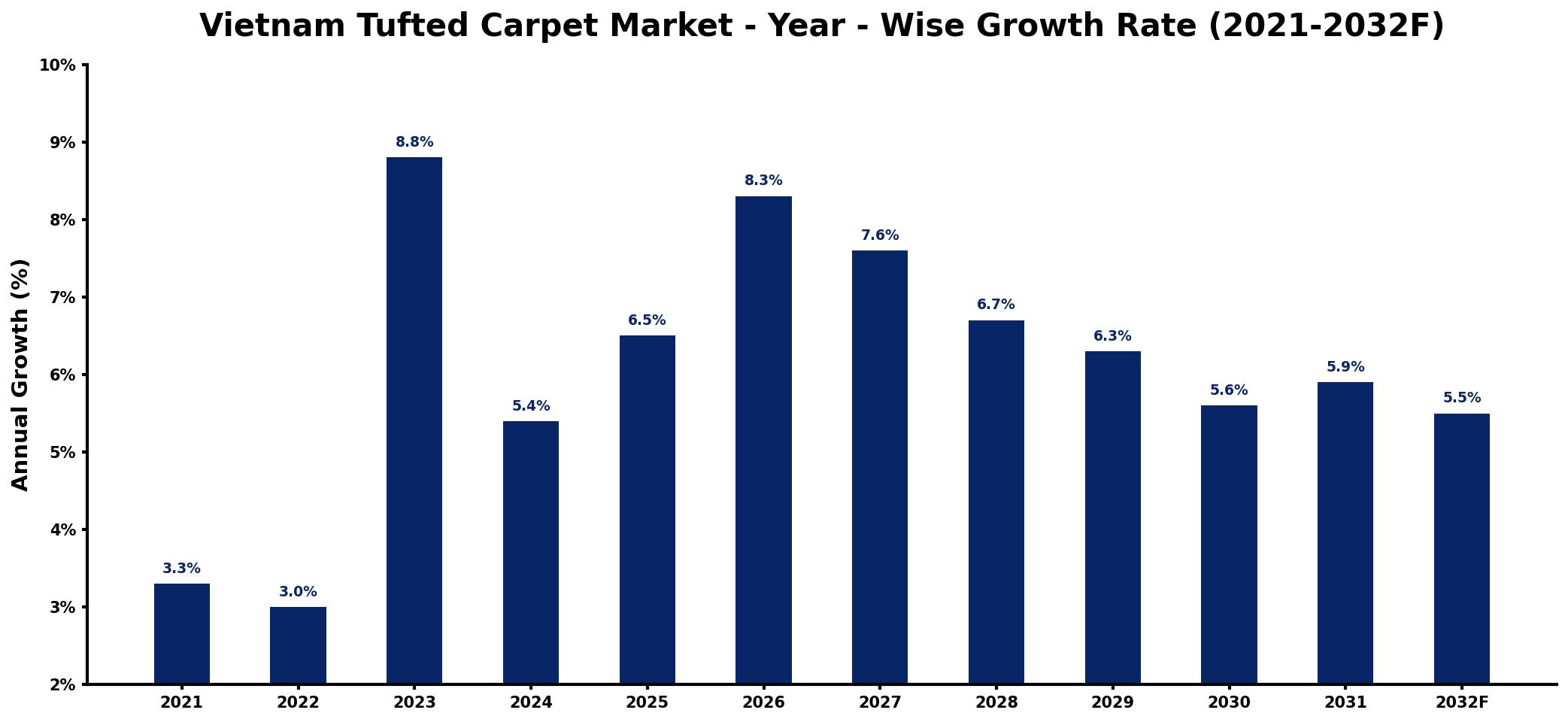
The table below presents the year‑wise growth rates along with the key drivers influencing the market
| Year | Growth Rate | Major Drivers |
| 2021 | 3.3% | Rising disposable income levels |
| 2022 | 3.0% | Increased interior design projects |
| 2023 | 8.8% | Growth in real estate sector |
| 2024 | 5.4% | Expansion of hospitality industry |
| 2025 | 6.5% | Surge in home renovation activities |
| 2026 | 8.3% | Growing demand for eco-friendly materials |
| 2027 | 7.6% | Increase in commercial construction projects |
| 2028 | 6.7% | Rising awareness of home aesthetics |
| 2029 | 6.3% | Boost in online retail platforms |
| 2030 | 5.6% | growing regional consumption patterns |
| 2031 | 5.9% | increased production capacity utilization |
| 2032 | 5.5% | Increased focus on sustainable design |
Note: Market size estimations and growth projections presented in this report are based on 6Wresearch's proprietary forecasting methodology, utilizing the latest available industry data, government publications, and primary research inputs.
Vietnam Tufted Carpet Market Synopsis
The Vietnam tufted carpet market has seen significant momentum recently, driven by an upsurge in construction and interior design projects. As businesses and homeowners look for durable and stylish flooring options, tufted carpets have become the preferred choice due to their versatility and comfort.
Looking ahead, the market is set to evolve with trends favoring sustainable and customizable design solutions. This shift aligns with the growing consumer demand for unique flooring options that not only enhance the aesthetic appeal but also reflect individual preferences and branding needs.
Vietnam Tufted Carpet Market Key Takeaways
- The market is driven by the expanding construction, hospitality, and interior design industries.
- Customization and design versatility are key factors influencing consumer preferences.
- Recovery from the COVID-19 pandemic is expected to spur market growth as tourism and hospitality sectors rebound.
- Competition is intensifying, necessitating innovation and adaptation among manufacturers.
- Online sales and export opportunities are becoming increasingly important in reaching diverse markets.
Evaluation of Restraints in Vietnam Tufted Carpet Market
While the Vietnam tufted carpet market presents various growth opportunities, it is not without its constraints. One primary limitation is the ongoing challenge of design customization, where manufacturers must effectively cater to distinct consumer preferences and trends. The frequent shifts in consumer behavior regarding flooring materials can also affect demand levels, requiring brands to be agile in their offerings. Additionally, the competitive landscape has intensified, putting pressure on pricing structures and product quality, which could impede the potential for profit margins in this sector.
Vietnam Tufted Carpet Market Trends
Several trends are emerging that are shaping the demand for tufted carpets in Vietnam. A growing inclination towards environmentally sustainable materials is leading manufacturers to explore eco-friendly options in tufted carpet production. Simultaneously, advancements in technology are enabling innovative design capabilities, allowing for more intricate patterns and textures. Furthermore, the rise of online retail platforms is expanding consumer access, making tufted carpets more readily available to a wider audience.
Vietnam Tufted Carpet Market Opportunities
There are ample opportunities for growth in the Vietnam tufted carpet market, particularly in the realm of customization. Businesses that can offer unique designs tailored to specific customer needs will stand out in this competitive landscape. Moreover, the resurgence of the hospitality industry post-COVID-19 presents significant potential for increased sales, as hotels and resorts seek to enhance their interiors. Investing in technology-driven solutions and establishing a strong online presence will also be crucial for tapping into emerging markets.
Government Initiatives in the Vietnam Tufted Carpet Market
The Vietnamese government has been proactive in fostering a supportive environment for the textile and flooring industries, which includes the tufted carpet sector. Initiatives aimed at boosting domestic manufacturing and promoting exports are in place, along with policies encouraging foreign investment. Programs focusing on infrastructure development also aid the construction and interior design markets, which are integral to the tufted carpet industry's growth.
Future Insights of the Vietnam Tufted Carpet Market
From 2026 to 2032, the Vietnam tufted carpet market is anticipated to continue its upward trajectory, driven by a combination of economic growth and changing consumer preferences. The shift towards innovative and customizable design solutions will likely dominate market dynamics. Additionally, as sustainability takes precedence globally, incorporating eco-friendly practices will become essential for maintaining competitive advantage. Overall, the outlook remains positive as the market adapts to new challenges and opportunities.
Vietnam Tufted Carpet Market Latest Developments (2025 - 2026)
In recent months, the Vietnam tufted carpet market has been witnessing a range of developments aimed at enhancing product offerings. Manufacturers are increasingly investing in advanced technology to facilitate customization and improve production efficiency. Concurrently, there has been a noticeable shift towards digital marketing strategies, allowing brands to engage with consumers more effectively. As the hospitality sector rebounds, several companies are tailoring their product lines to meet the specific needs of hotels and commercial spaces, paving the way for future collaborations.
Vietnam Tufted Carpet Market - Key Attractiveness of the Report
- 10 Years of Market Numbers
- Historical Data Starting from 2022 to 2025
- Base Year: 2025
- Forecast Data until 2032
- Key Performance Indicators Impacting the Market
- Major Upcoming Developments and Projects
Key Highlights of the Report:
- Vietnam Tufted Carpet Market Outlook
- Market Size of Vietnam Tufted Carpet Market, 2025
- Forecast of Vietnam Tufted Carpet Market, 2032
- Historical Data and Forecast of Vietnam Tufted Carpet Revenues & Volume for the Period 2022-2032F
- Vietnam Tufted Carpet Market Trend Evolution
- Vietnam Tufted Carpet Market Drivers and Challenges
- Vietnam Tufted Carpet Price Trends
- Vietnam Tufted Carpet Porter's Five Forces
- Vietnam Tufted Carpet Industry Life Cycle
- Historical Data and Forecast of Vietnam Tufted Carpet Market Revenues & Volume By Material Type for the Period 2022-2032F
- Historical Data and Forecast of Vietnam Tufted Carpet Market Revenues & Volume By Nylon for the Period 2022-2032F
- Historical Data and Forecast of Vietnam Tufted Carpet Market Revenues & Volume By Polyester for the Period 2022-2032F
- Historical Data and Forecast of Vietnam Tufted Carpet Market Revenues & Volume By Polypropylene for the Period 2022-2032F
- Historical Data and Forecast of Vietnam Tufted Carpet Market Revenues & Volume By Cotton for the Period 2022-2032F
- Historical Data and Forecast of Vietnam Tufted Carpet Market Revenues & Volume By Wool for the Period 2022-2032F
- Historical Data and Forecast of Vietnam Tufted Carpet Market Revenues & Volume By Silk for the Period 2022-2032F
- Historical Data and Forecast of Vietnam Tufted Carpet Market Revenues & Volume By Jute for the Period 2022-2032F
- Historical Data and Forecast of Vietnam Nylon Tufted Carpet Market Revenues & Volume By Others for the Period 2022-2032F
- Historical Data and Forecast of Vietnam Tufted Carpet Market Revenues & Volume By End-Users for the Period 2022-2032F
- Historical Data and Forecast of Vietnam Tufted Carpet Market Revenues & Volume By Residential for the Period 2022-2032F
- Historical Data and Forecast of Vietnam Tufted Carpet Market Revenues & Volume By Commercial for the Period 2022-2032F
- Historical Data and Forecast of Vietnam Tufted Carpet Market Revenues & Volume By Sales Channel for the Period 2022-2032F
- Historical Data and Forecast of Vietnam Tufted Carpet Market Revenues & Volume By Specialty Stores for the Period 2022-2032F
- Historical Data and Forecast of Vietnam Tufted Carpet Market Revenues & Volume By Supermarkets/Hypermarkets for the Period 2022-2032F
- Historical Data and Forecast of Vietnam Tufted Carpet Market Revenues & Volume By Online for the Period 2022-2032F
- Historical Data and Forecast of Vietnam Tufted Carpet Market Revenues & Volume By Others for the Period 2022-2032F
- Vietnam Tufted Carpet Import Export Trade Statistics
- Market Opportunity Assessment By Material Type
- Market Opportunity Assessment By End-Users
- Market Opportunity Assessment By Sales Channel
- Vietnam Tufted Carpet Top Companies Market Share
- Vietnam Tufted Carpet Competitive Benchmarking By Technical and Operational Parameters
- Vietnam Tufted Carpet Company Profiles
- Vietnam Tufted Carpet Key Strategic Recommendations






































