Vietnam Urea Market Size, Share & Growth Rate
The Vietnam Urea Market was estimated at USD 267 Million in 2025 and is projected to reach USD 377 Million by 2032, growing at a CAGR of 5.1% from 2026 to 2032. This growth trajectory is primarily driven by the surging demand for nitrogen fertilizers, which are vital for enhancing crop yield and quality. As Vietnam continues to modernize its agricultural practices and expand its farming capabilities, the reliance on efficient urea fertilizers is expected to intensify, supporting both smallholder and commercial farming initiatives.
Vietnam Urea Market Year-wise Growth Rate and Key Drivers
This graph highlights how the Vietnam Urea Market has steadily grown over the years, supported by major growth factors.
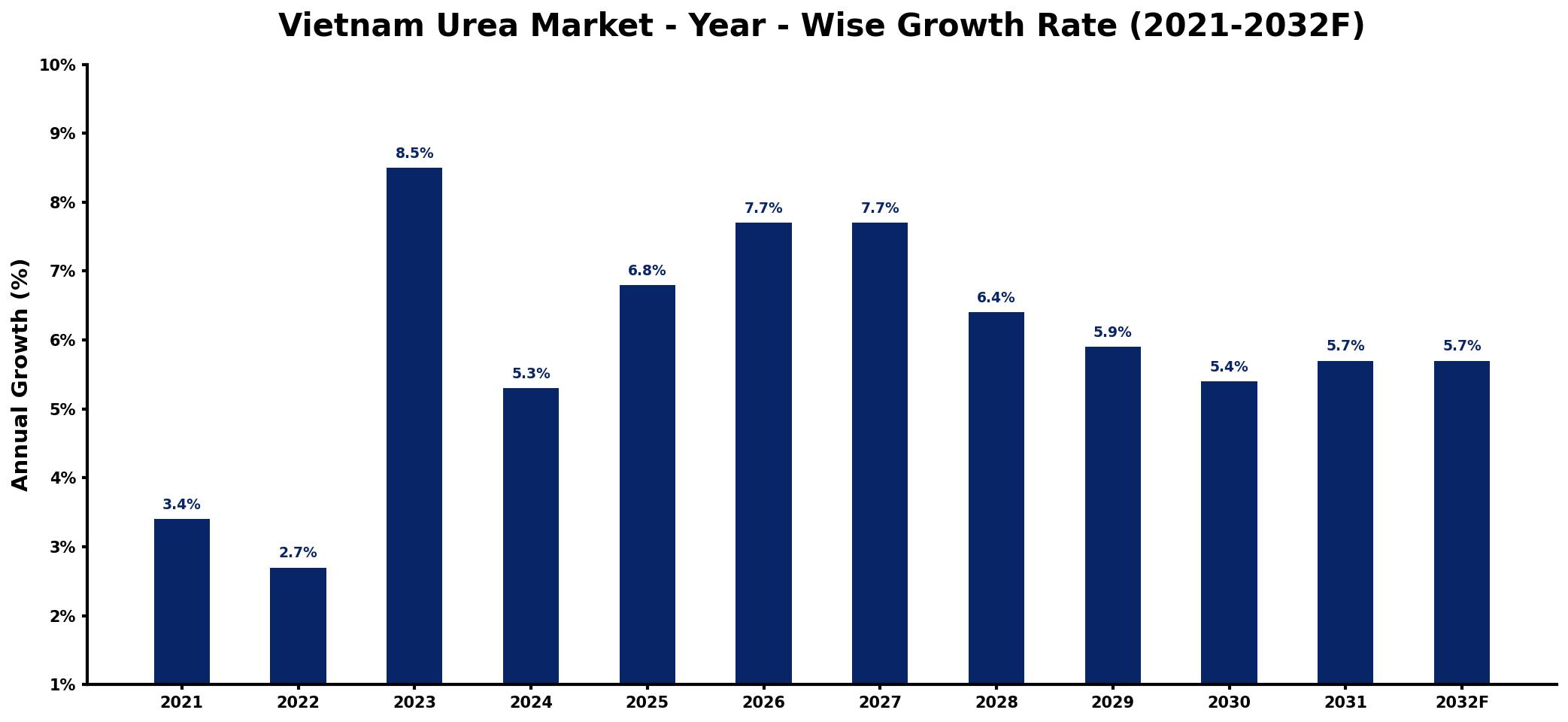
The table below presents the year‑wise growth rates along with the key drivers influencing the market
| Year | Growth Rate | Major Drivers |
| 2021 | 3.4% | Rising agricultural investment trends |
| 2022 | 2.7% | Increased crop yield expectations |
| 2023 | 8.5% | Expansion of fertilizer manufacturing capacity |
| 2024 | 5.3% | Growing demand from export markets |
| 2025 | 6.8% | Technological advancements in agriculture |
| 2026 | 7.7% | Higher adoption of precision farming |
| 2027 | 7.7% | Strengthening of supply chain networks |
| 2028 | 6.4% | Increased focus on sustainable practices |
| 2029 | 5.9% | Growth in agrochemical partnerships |
| 2030 | 5.4% | strengthening underlying market demand |
| 2031 | 5.7% | Investments in agricultural research initiatives |
| 2032 | 5.7% | rising infrastructure development spending |
Note: Market size estimations and growth projections presented in this report are based on 6Wresearch's proprietary forecasting methodology, utilizing the latest available industry data, government publications, and primary research inputs.
Vietnam Urea Market Synopsis
In recent years, the Vietnam urea market has witnessed a notable shift towards sustainable agricultural practices and increased input from technological advancements. Farmers are increasingly turning to urea to meet the nitrogen requirements of their crops, thereby boosting agricultural productivity and food security in the region. However, as the market progresses, it faces evolving challenges and dynamics that may shape its future landscape.
Looking ahead, the Vietnam urea market is poised for significant growth, with a strong correlation between agricultural output and fertilizer demand. As the government continues to focus on enhancing agricultural output and efficiency, the urea market is likely to adapt and evolve, catering to the changing needs of Vietnams diverse agricultural sector.
Vietnam Urea Market Key Takeaways
- Expanding agricultural sector is a key driver of urea demand in Vietnam.
- Market growth is supported by the need for enhanced crop productivity through nitrogen fertilizers.
- Competitive pressures and raw material costs are critical factors influencing pricing strategies.
- COVID-19 disruptions highlighted vulnerabilities in supply chains, prompting operational adaptations.
- Ongoing recovery in agricultural activities is expected to stabilize the market moving forward.
Evaluation of Restraints in Vietnam Urea Market
The Vietnam urea market faces several restraints that could hinder its growth potential. Primarily, intense market competition among local and international suppliers creates downward pressure on prices, potentially affecting profit margins. Additionally, fluctuations in raw material prices, especially natural gas, which is essential for urea production, can lead to increased production costs. Manufacturers must strategically navigate these dynamics to maintain competitiveness and optimize operational efficiency.
Vietnam Urea Market Trends
Current trends in the Vietnam urea market indicate a growing inclination towards precision agriculture and data-driven farming practices. The adoption of technology, such as soil testing and nutrient management systems, is facilitating targeted urea application, enhancing efficiency and environmental sustainability. Furthermore, the integration of sustainable practices and organic farming methods is increasingly influencing fertilizer use, opening avenues for innovative product development.
Vietnam Urea Market Opportunities
Opportunities within the Vietnam urea market are abundant, particularly in the realm of value-added products and sustainable fertilizers. As demand for environmentally friendly agricultural solutions grows, there is potential for market players to develop slow-release urea products and blended fertilizers that meet specific crop needs. Additionally, initiatives aimed at improving supply chain logistics and enhancing distribution networks can significantly boost market access and efficiency.
Government Initiatives in the Vietnam Urea Market
The Vietnamese government has been actively promoting agricultural modernization and sustainability through various policies and initiatives. Public spending on agricultural research and development aims to enhance crop resilience and productivity. Additionally, programs encouraging the use of eco-friendly fertilizers and efficient farming techniques are expected to create a more favorable regulatory environment for the urea market.
Future Insights of the Vietnam Urea Market
Between 2026 and 2032, the Vietnam urea market is likely to experience notable advancements driven by innovations in fertilizer technology and a growing emphasis on sustainable agriculture. As farmers increasingly adopt precision farming techniques, the demand for high-quality, reliable nitrogen fertilizers will continue to rise. Furthermore, supportive government policies will facilitate market growth, paving the way for enhanced agricultural productivity and food security in Vietnam.
Vietnam Urea Market Latest Developments (2025 - 2026)
Recent developments in the Vietnam urea market have focused on improving supply chain efficiency and technological upgrades in production processes. Manufacturers have started to explore partnerships with logistics companies to ensure timely distribution of urea products to farmers. Additionally, ongoing research into alternative urea formulations and enhanced application methods is anticipated to yield further benefits for crop yields and sustainability.
Vietnam Urea Market - Key Attractiveness of the Report
- 10 Years of Market Numbers
- Historical Data Starting from 2022 to 2025
- Base Year: 2025
- Forecast Data until 2032
- Key Performance Indicators Impacting the Market
- Major Upcoming Developments and Projects
Key Highlights of the Report:
- Vietnam Urea Market Outlook
- Market Size of Vietnam Urea Market, 2025
- Forecast of Vietnam Urea Market, 2032
- Historical Data and Forecast of Vietnam Urea Revenues & Volume for the Period 2022-2032F
- Vietnam Urea Market Trend Evolution
- Vietnam Urea Market Drivers and Challenges
- Vietnam Urea Price Trends
- Vietnam Urea Porter's Five Forces
- Vietnam Urea Industry Life Cycle
- Historical Data and Forecast of Vietnam Urea Market Revenues & Volume By Grade for the Period 2022-2032F
- Historical Data and Forecast of Vietnam Urea Market Revenues & Volume By Fertilizer for the Period 2022-2032F
- Historical Data and Forecast of Vietnam Urea Market Revenues & Volume By Feed for the Period 2022-2032F
- Historical Data and Forecast of Vietnam Urea Market Revenues & Volume By Technical for the Period 2022-2032F
- Historical Data and Forecast of Vietnam Urea Market Revenues & Volume By End-user Industry for the Period 2022-2032F
- Historical Data and Forecast of Vietnam Urea Market Revenues & Volume By Agriculture for the Period 2022-2032F
- Historical Data and Forecast of Vietnam Urea Market Revenues & Volume By Chemical for the Period 2022-2032F
- Historical Data and Forecast of Vietnam Urea Market Revenues & Volume By Automotive for the Period 2022-2032F
- Historical Data and Forecast of Vietnam Urea Market Revenues & Volume By Medical for the Period 2022-2032F
- Historical Data and Forecast of Vietnam Urea Market Revenues & Volume By Others for the Period 2022-2032F
- Vietnam Urea Import Export Trade Statistics
- Market Opportunity Assessment By Grade
- Market Opportunity Assessment By End-user Industry
- Vietnam Urea Top Companies Market Share
- Vietnam Urea Competitive Benchmarking By Technical and Operational Parameters
- Vietnam Urea Company Profiles
- Vietnam Urea Key Strategic Recommendations






































