Vietnam Virtual Private Server Market Size & Growth Rate (2026-2032)
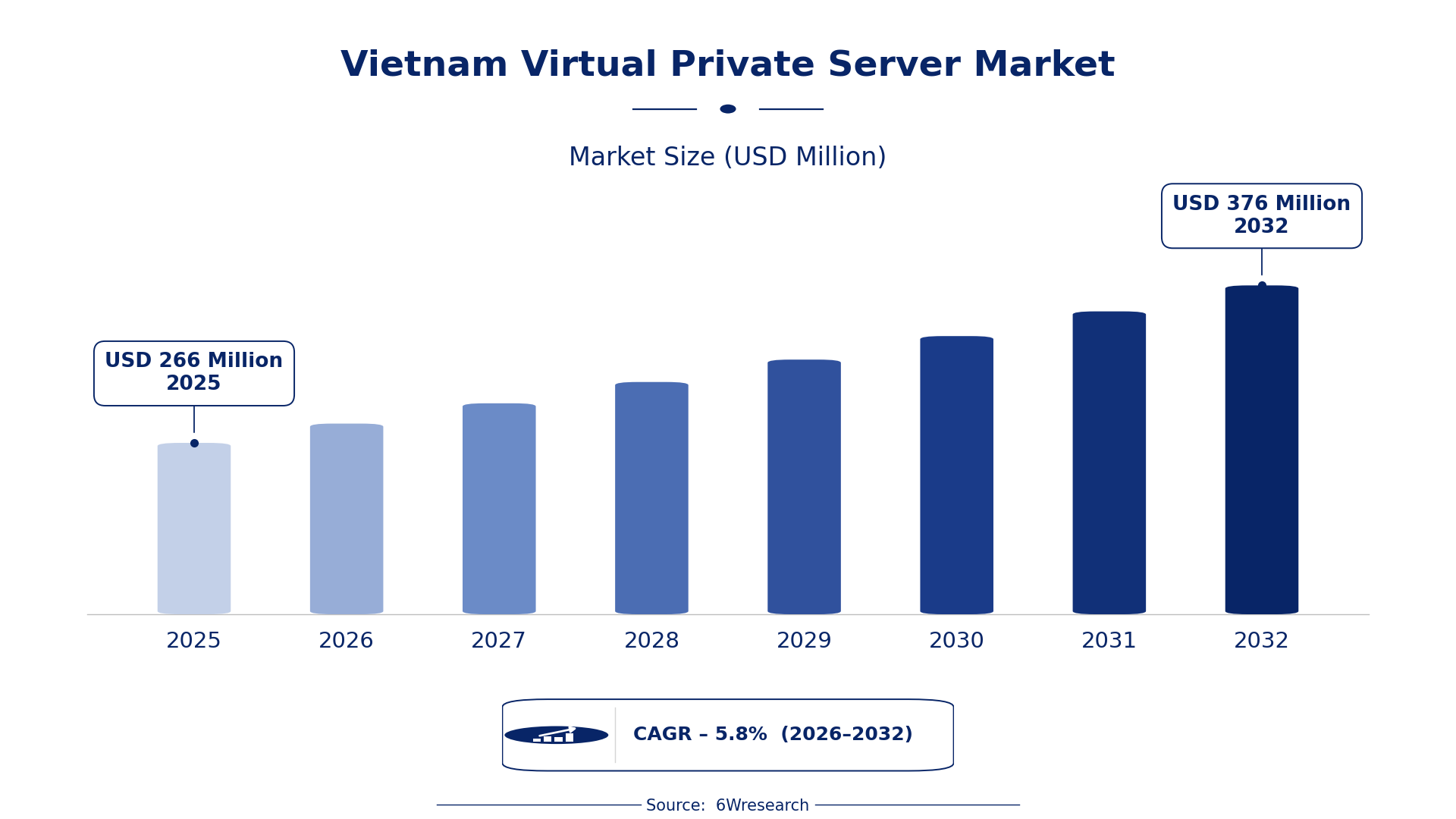
The Vietnam Virtual Private Server Market was estimated at USD 266 Million in 2025 and is projected to reach USD 376 Million by 2032, growing at a CAGR of 5.8% from 2026 to 2032.
Vietnam Virtual Private Server Market Synopsis
The demand for cost-effective and scalable hosting solutions is currently the strongest force shaping the Vietnam Virtual Private Server Market. As businesses increasingly recognize the advantages of VPS over traditional dedicated servers, the shift is proving advantageous, especially for small and medium-sized enterprises (SMEs).
A surge in digital transformation initiatives is also influencing market dynamics. With e-commerce and online platforms gaining traction, companies are seeking reliable infrastructures to support their operations, further driving the growth of virtual private servers across various sectors.
Vietnam Virtual Private Server Market Year-wise Growth Rate and Key Drivers
This graph illustrates the annual growth rates of the Vietnam Virtual Private Server Market from 2021 to 2032, highlighting a steady upward trajectory and projected expansion over the forecast period.
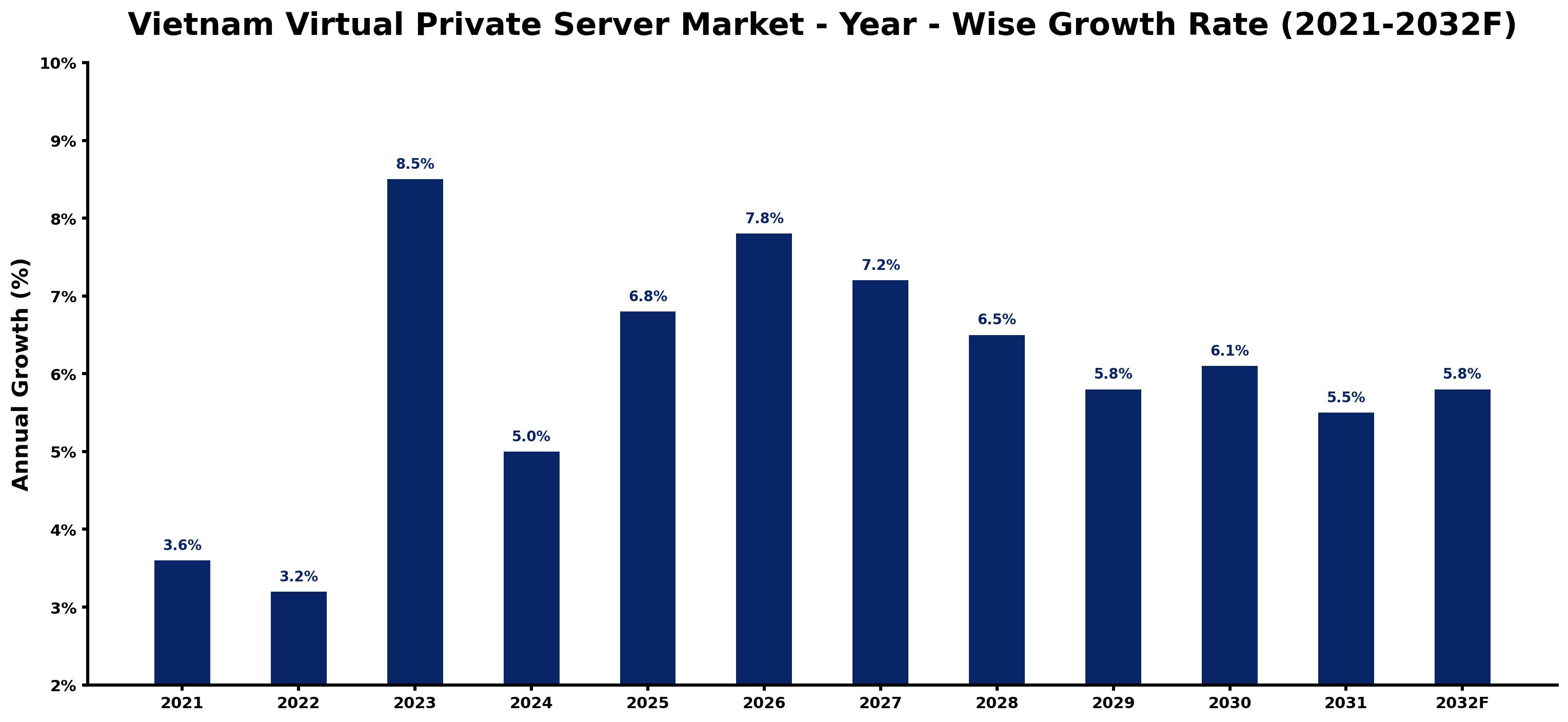
The table below presents the year‑wise growth rates along with the key drivers influencing the market
| Year | Growth Rate | Major Drivers |
| 2021 | 3.6% | Growing e-commerce sector necessitates reliable server infrastructure. |
| 2022 | 3.2% | Rising cybersecurity projects stimulate VPS adoption trends. |
| 2023 | 8.5% | Increased local start-ups demand scalable cloud solutions. |
| 2024 | 5.0% | Government support for tech hubs boosts VPS investment. |
| 2025 | 6.8% | Emergence of digital banking spurs data protection needs. |
| 2026 | 7.8% | Increased regional cloud service competition drives pricing flexibility. |
| 2027 | 7.2% | Local gaming industry expansion fuels server capacity needs. |
| 2028 | 6.5% | Growing digital advertising requires dependable web hosting solutions. |
| 2029 | 5.8% | Government initiatives promote data localization increasing VPS uptake. |
| 2030 | 6.1% | Increased mobile penetration enhances VPS reliance for businesses. |
| 2031 | 5.5% | Growing interest in managed services positively affects VPS usage. |
| 2032 | 5.8% | Rise in remote consulting leads to higher server demand. |
Note: Market size estimations and growth projections presented in this report are based on 6Wresearch's proprietary forecasting methodology, utilizing the latest available industry data, government publications, and primary research inputs.
Vietnam Virtual Private Server Market Key Takeaways
Below are some of the specific key takeaways from the market, including:
- The Vietnam VPS market is projected to expand due to the increasing number of SMEs opting for VPS solutions.
- Security and control remain top priorities for businesses when choosing hosting solutions.
- The rise of e-commerce has directly contributed to the growing demand for VPS infrastructures.
- Continuous upgrades in technology are necessary to meet the evolving expectations of customers.
- The COVID-19 pandemic accelerated the shift towards virtual hosting solutions as remote work became the norm.
Evaluation of Restraints in Vietnam Virtual Private Server Market
Despite its growth trajectory, the Vietnam Virtual Private Server Market faces real challenges. A major concern is the rapid evolution of customer expectations for enhanced scalability and flexibility. Providers are under pressure to consistently update their infrastructure to offer high performance and reliability.
on top of that, as businesses demand greater control and customization, the complexity of user management interfaces can create barriers. Security remains a critical issue, as data breaches can severely impact trust and financial stability. Addressing these challenges is essential for sustained growth.
Vietnam Virtual Private Server Market Trends
One prominent trend is the increasing adoption of cloud-based solutions among businesses of all sizes. Companies are shifting their focus to VPS as a more flexible and cost-effective alternative to traditional hosting methods. This trend aligns with the growing recognition of the need for efficient IT resource management.
Another trend is the rising importance of cybersecurity measures in VPS offerings. Businesses are becoming more aware of the potential threats associated with virtual servers and are prioritizing solutions that provide enhanced security features, ensuring data integrity and privacy.
Vietnam Virtual Private Server Market Opportunities
The Vietnam VPS market presents several avenues for growth and investment. The increasing digitalization of businesses across industries creates a fertile ground for VPS providers to expand their offerings.
Particularly, opportunities exist in the development of tailored solutions for niche sectors such as e-commerce, healthcare, and education. Additionally, partnerships with local startups can foster innovation and enhance service delivery, further driving market growth.
Government Initiatives in the Vietnam Virtual Private Server Market
The Vietnamese government is actively promoting digital transformation and enhancing the regulatory framework for technology services, which directly influences the Virtual Private Server Market. Public sector initiatives are designed to improve digital infrastructure and support the growth of cloud-based services. This proactive approach is essential for fostering a competitive environment in the VPS sector.
- A national digital infrastructure upgrade programme, currently in its rollout phase, aims to enhance internet access and reliability across the country.
- Ongoing efforts to establish a regulatory framework mandating higher standards for data security in VPS offerings are underway.
- Recently launched initiatives focus on incentivizing local tech startups to adopt VPS solutions, thereby boosting innovation in the market.
- Plans for a public-private partnership to expand telecom infrastructure access by 2028 are in development, which will further benefit VPS providers.
Future Insights of the Vietnam Virtual Private Server Market
Looking ahead to 2026-2032, the Vietnam Virtual Private Server Market is set for substantial growth. The ongoing digitization of businesses across various sectors will continue to drive demand for flexible and cost-effective hosting solutions. As SMEs increasingly embrace VPS technology, providers will need to innovate to meet the diverse needs of their clients.
Investment in security features and user-friendly management interfaces will be critical for maintaining market competitiveness. The alignment of VPS offerings with emerging technologies like AI and IoT will also play a significant role in shaping the future of the market.
Vietnam Virtual Private Server Market Latest Developments
In the past year, the Vietnam Virtual Private Server Market has witnessed notable developments, reflecting the increasing emphasis on digital transformation and enhanced service offerings. Providers are actively working to expand their capabilities and improve customer experiences through innovative solutions.
- A leading regional operator initiated a service upgrade in early 2023, enhancing its VPS offerings with advanced security features.
- In Q3 2023, a major technology vendor launched a partnership with a local startup to provide tailored VPS solutions for e-commerce platforms.
- Currently underway is a project aimed at expanding VPS infrastructure to underserved regions, expected to enhance accessibility by mid-2024.
- Plans for a new VPS product line targeting specific industries, such as healthcare and finance, are set to be unveiled in early 2024.
Vietnam Virtual Private Server Market - Key Attractiveness of the Report
- 10 Years of Market Numbers
- Historical Data Starting from 2022 to 2025
- Base Year: 2025
- Forecast Data until 2032
- Key Performance Indicators Impacting the Market
- Major Upcoming Developments and Projects
Key Highlights of the Report:
- Vietnam Virtual Private Server Market Outlook
- Market Size of Vietnam Virtual Private Server Market, 2025
- Forecast of Vietnam Virtual Private Server Market, 2032
- Historical Data and Forecast of Vietnam Virtual Private Server Revenues & Volume for the Period 2022-2032F
- Vietnam Virtual Private Server Market Trend Evolution
- Vietnam Virtual Private Server Market Drivers and Challenges
- Vietnam Virtual Private Server Price Trends
- Vietnam Virtual Private Server Porter's Five Forces
- Vietnam Virtual Private Server Industry Life Cycle
- Historical Data and Forecast of Vietnam Virtual Private Server Market Revenues & Volume By Operating System for the Period 2022-2032F
- Historical Data and Forecast of Vietnam Virtual Private Server Market Revenues & Volume By Windows for the Period 2022-2032F
- Historical Data and Forecast of Vietnam Virtual Private Server Market Revenues & Volume By Linux for the Period 2022-2032F
- Historical Data and Forecast of Vietnam Virtual Private Server Market Revenues & Volume By Vertical for the Period 2022-2032F
- Historical Data and Forecast of Vietnam Virtual Private Server Market Revenues & Volume By BFSI for the Period 2022-2032F
- Historical Data and Forecast of Vietnam Virtual Private Server Market Revenues & Volume By Government for the Period 2022-2032F
- Historical Data and Forecast of Vietnam Virtual Private Server Market Revenues & Volume By Defense for the Period 2022-2032F
- Historical Data and Forecast of Vietnam Virtual Private Server Market Revenues & Volume By IT for the Period 2022-2032F
- Historical Data and Forecast of Vietnam Virtual Private Server Market Revenues & Volume By Telecommunication for the Period 2022-2032F
- Historical Data and Forecast of Vietnam Virtual Private Server Market Revenues & Volume By Retail for the Period 2022-2032F
- Historical Data and Forecast of Vietnam Virtual Private Server Market Revenues & Volume By Healthcare for the Period 2022-2032F
- Historical Data and Forecast of Vietnam Virtual Private Server Market Revenues & Volume By Organization Size for the Period 2022-2032F
- Historical Data and Forecast of Vietnam Virtual Private Server Market Revenues & Volume By SMEs for the Period 2022-2032F
- Historical Data and Forecast of Vietnam Virtual Private Server Market Revenues & Volume By Large Enterprises for the Period 2022-2032F
- Vietnam Virtual Private Server Import Export Trade Statistics
- Market Opportunity Assessment By Operating System
- Market Opportunity Assessment By Vertical
- Market Opportunity Assessment By Organization Size
- Vietnam Virtual Private Server Top Companies Market Share
- Vietnam Virtual Private Server Competitive Benchmarking By Technical and Operational Parameters
- Vietnam Virtual Private Server Company Profiles
- Vietnam Virtual Private Server Key Strategic Recommendations






































