Vietnam Visual Analytics Market Size & Growth Rate (2026-2032)
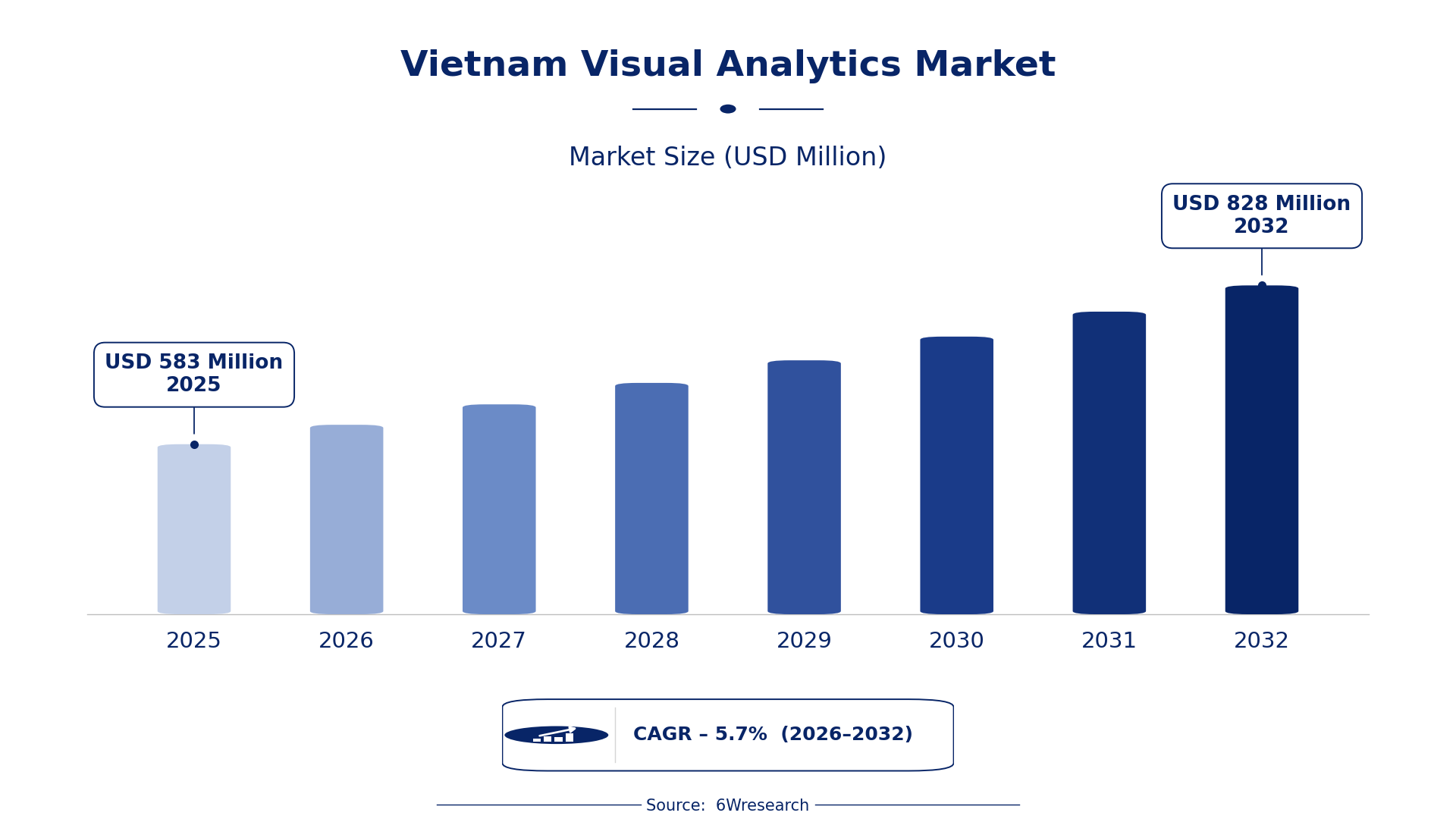
The Vietnam Visual Analytics Market was estimated at USD 583 Million in 2025 and is projected to reach USD 828 Million by 2032, growing at a CAGR of 5.7% from 2026 to 2032.
Vietnam Visual Analytics Market Synopsis
The Vietnam Visual Analytics Market is experiencing a surge as organizations across various sectors increasingly recognize the importance of data visualization in their strategic operations. This upward momentum is supported by a growing emphasis on data-driven decision-making, which is reshaping how businesses approach complex datasets.
As the market evolves, the integration of advanced visualization tools is expected to enhance the ability of businesses to communicate insights effectively. Sectors like finance, healthcare, and marketing are rapidly adopting these solutions, indicating a promising future for visual analytics in Vietnam.
Vietnam Visual Analytics Market Year-wise Growth Rate and Key Drivers
This graph illustrates the annual growth rates of the Vietnam Visual Analytics Market from 2021 to 2032, highlighting a steady upward trajectory and projected expansion over the forecast period.
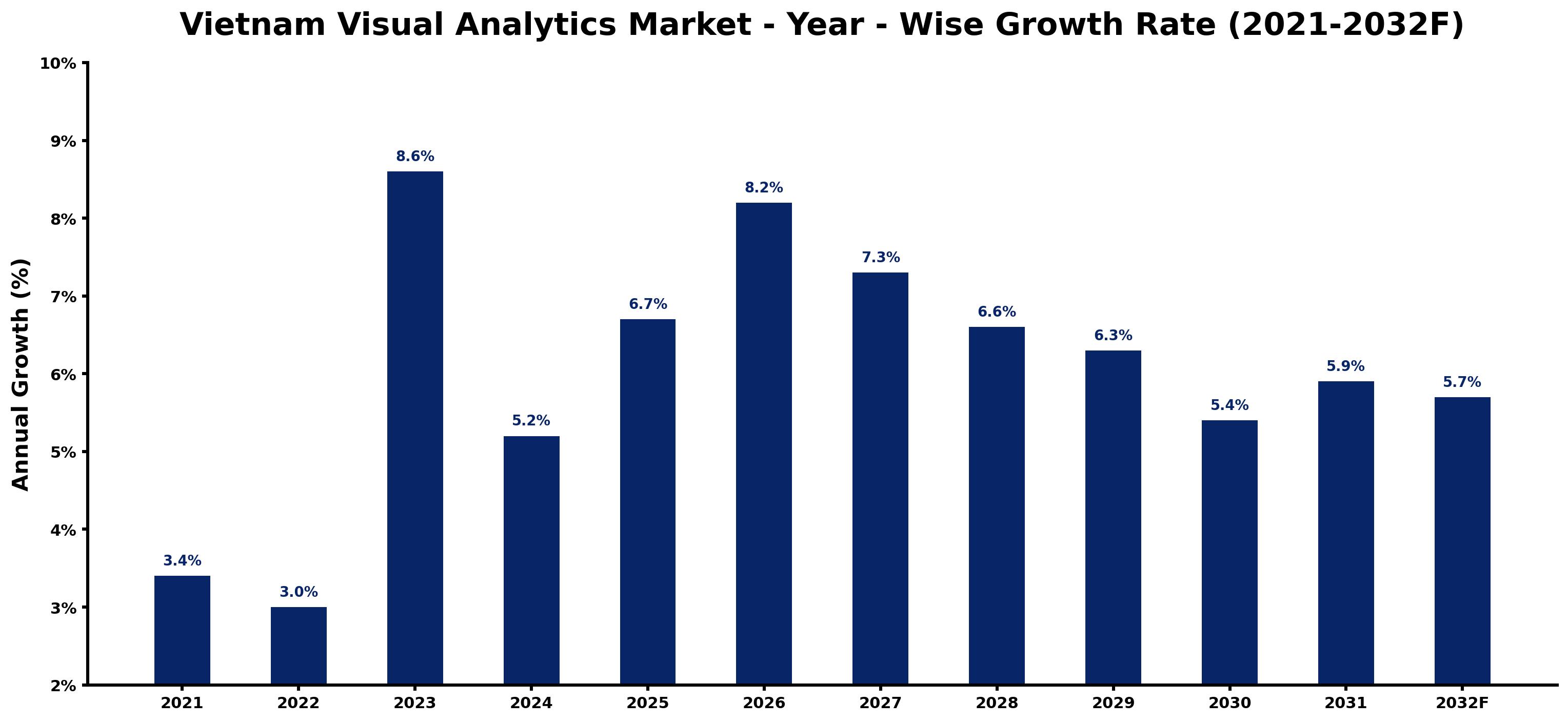
The table below presents the year‑wise growth rates along with the key drivers influencing the market
| Year | Growth Rate | Major Drivers |
| 2021 | 3.4% | Increasing smartphone penetration enhancing data visualization access. |
| 2022 | 3.0% | Local startups leveraging visual analytics for competitive advantage. |
| 2023 | 8.6% | Booming e-commerce sector driving demand for consumer insights. |
| 2024 | 5.2% | Growing interest in AI technologies integrates visual analytics. |
| 2025 | 6.7% | Rising popularity of online education fostering visualization tools. |
| 2026 | 8.2% | Healthcare sector adopting data visualization for patient analytics. |
| 2027 | 7.3% | Increased foreign investment in tech heightening analytics needs. |
| 2028 | 6.6% | Government partnerships promoting data literacy in enterprises. |
| 2029 | 6.3% | Expanding retail sector utilizing visuals for market analysis. |
| 2030 | 5.4% | Adoption of smart manufacturing techniques enhances data visualization. |
| 2031 | 5.9% | Rise of social media analytics necessitating comprehensive visual tools. |
| 2032 | 5.7% | Emergence of big data policies boosting analytics framework development. |
Note: Market size estimations and growth projections presented in this report are based on 6Wresearch's proprietary forecasting methodology, utilizing the latest available industry data, government publications, and primary research inputs.
Vietnam Visual Analytics Market Key Takeaways
Below are some of the specific key takeaways from the market, including:
- The demand for visual analytics tools is surging across multiple sectors, driven by the need for intuitive data presentation.
- Adoption is particularly high in finance and healthcare, where effective data communication can significantly influence decision-making.
- Data literacy initiatives are contributing to a workforce more adept at utilizing visual analytics tools.
- Concerns around data privacy and accuracy remain paramount, influencing how businesses approach visual analytics solutions.
- The ongoing impact of COVID-19 has accelerated the demand for clear data visualization in organizational operations.
Evaluation of Restraints in Vietnam Visual Analytics Market
Despite its growth, the Vietnam Visual Analytics Market faces notable challenges that hinder its full potential. One significant restraint is the difficulty organizations encounter in transforming complex data into easily digestible visual formats. This requires not only advanced technology but also a skilled workforce capable of crafting effective visual narratives. Many businesses struggle to find professionals who possess the necessary expertise, which limits their ability to fully exploit visual analytics.
on top of that, maintaining data accuracy and ensuring real-time updates for visualizations are ongoing hurdles. The market's evolution is also complicated by strict regulations concerning data privacy and security, which necessitate compliance while implementing visual analytics solutions.
Vietnam Visual Analytics Market Trends
Several trends are shaping the Vietnam Visual Analytics Market. A rising focus on data storytelling is compelling businesses to present insights in ways that are not only informative but also engaging. This approach is particularly relevant for communicating with non-technical stakeholders, who may struggle with complex data sets.
Additionally, the integration of artificial intelligence and machine learning into visual analytics tools is becoming more prevalent. These technologies enhance the capability to generate insights from vast amounts of data, making it easier for organizations to understand and act on the information presented.
Vietnam Visual Analytics Market Opportunities
The Vietnam Visual Analytics Market offers various opportunities for growth and investment. Organizations that prioritize data-driven strategies are increasingly seeking innovative solutions that can provide them with actionable insights. The healthcare sector, in particular, is ripe for advancement, as visual analytics can significantly improve patient care and operational efficiency.
Another area of opportunity lies in training programs aimed at enhancing data literacy among employees. Companies that invest in developing these skills will likely see improved adoption rates of visual analytics tools, ultimately leading to more informed decision-making across all levels of the organization.
Government Initiatives in the Vietnam Visual Analytics Market
Government initiatives in Vietnam are playing a crucial role in shaping the Visual Analytics Market. With a strong emphasis on digital transformation and data-driven governance, public policy is increasingly favoring the adoption of analytical tools. Such policies are designed to enhance transparency and efficiency across various sectors, making visual analytics a focal point for future growth.
- A national digital infrastructure upgrade programme launched in early 2023 aims to improve access to data analytics resources across public and private sectors.
- Ongoing collaborations between government and technology firms are focused on developing frameworks that promote data-sharing practices and best-use cases of visual analytics.
- A planned public-private initiative is expected to establish training centers by 2025, aimed at boosting data literacy and skills related to visual analytics.
- Regulatory guidelines introduced in 2024 emphasize data accuracy and privacy, impacting how visual analytics solutions are implemented in business operations.
Future Insights of the Vietnam Visual Analytics Market
Looking ahead to 2026-2032, the Vietnam Visual Analytics Market is expected to witness substantial growth as organizations become more data-centric. The increasing reliance on visual analytics will likely be driven by advancements in technology, particularly in AI and machine learning, which will enhance data processing capabilities. Businesses that invest in these technologies will be better positioned to harness the power of data, ultimately leading to improved operational efficiencies and decision-making.
Vietnam Visual Analytics Market Latest Developments
Over the past year, the Vietnam Visual Analytics Market has seen dynamic developments, with numerous organizations focusing on enhancing their analytical capabilities. The COVID-19 pandemic has acted as a catalyst, prompting businesses to adopt more sophisticated data visualization techniques to navigate uncertainties.
- A major technology vendor announced a partnership with local firms in Q1 2025 to roll out a suite of visual analytics tools tailored for the healthcare sector, aimed at improving patient data management.
- In early 2025, a regional operator launched a new platform incorporating AI-driven visual analytics capabilities to assist businesses in making data-informed decisions.
- An ongoing initiative that began in late 2024 focuses on integrating visual analytics into educational curricula, aiming to foster a new generation of data-savvy professionals.
- A planned upgrade to national data infrastructure is expected to start in mid-2026, enhancing the accessibility of analytical tools across various industries.
Vietnam Visual Analytics Market - Key Attractiveness of the Report
- 10 Years of Market Numbers
- Historical Data Starting from 2022 to 2025
- Base Year: 2025
- Forecast Data until 2032
- Key Performance Indicators Impacting the Market
- Major Upcoming Developments and Projects
Key Highlights of the Report:
- Vietnam Visual Analytics Market Outlook
- Market Size of Vietnam Visual Analytics Market, 2025
- Forecast of Vietnam Visual Analytics Market, 2032
- Historical Data and Forecast of Vietnam Visual Analytics Revenues & Volume for the Period 2022-2032F
- Vietnam Visual Analytics Market Trend Evolution
- Vietnam Visual Analytics Market Drivers and Challenges
- Vietnam Visual Analytics Price Trends
- Vietnam Visual Analytics Porter's Five Forces
- Vietnam Visual Analytics Industry Life Cycle
- Historical Data and Forecast of Vietnam Visual Analytics Market Revenues & Volume By Component for the Period 2022-2032F
- Historical Data and Forecast of Vietnam Visual Analytics Market Revenues & Volume By Software for the Period 2022-2032F
- Historical Data and Forecast of Vietnam Visual Analytics Market Revenues & Volume By Services for the Period 2022-2032F
- Historical Data and Forecast of Vietnam Visual Analytics Market Revenues & Volume By Deployment Model for the Period 2022-2032F
- Historical Data and Forecast of Vietnam Visual Analytics Market Revenues & Volume By On-Premises for the Period 2022-2032F
- Historical Data and Forecast of Vietnam Visual Analytics Market Revenues & Volume By On-Demand for the Period 2022-2032F
- Historical Data and Forecast of Vietnam Visual Analytics Market Revenues & Volume By Business Function for the Period 2022-2032F
- Historical Data and Forecast of Vietnam Visual Analytics Market Revenues & Volume By IT for the Period 2022-2032F
- Historical Data and Forecast of Vietnam Visual Analytics Market Revenues & Volume By Sales and marketing for the Period 2022-2032F
- Historical Data and Forecast of Vietnam Visual Analytics Market Revenues & Volume By Supply chain for the Period 2022-2032F
- Historical Data and Forecast of Vietnam Visual Analytics Market Revenues & Volume By Finance for the Period 2022-2032F
- Historical Data and Forecast of Vietnam Visual Analytics Market Revenues & Volume By Human resources (HR) for the Period 2022-2032F
- Historical Data and Forecast of Vietnam Visual Analytics Market Revenues & Volume By Others for the Period 2022-2032F
- Historical Data and Forecast of Vietnam Visual Analytics Market Revenues & Volume By Industry for the Period 2022-2032F
- Historical Data and Forecast of Vietnam Visual Analytics Market Revenues & Volume By Banking, Financial Services, and Insurance (BFSI) for the Period 2022-2032F
- Historical Data and Forecast of Vietnam Visual Analytics Market Revenues & Volume By Telecom and IT for the Period 2022-2032F
- Historical Data and Forecast of Vietnam Visual Analytics Market Revenues & Volume By Retail and Consumer goods for the Period 2022-2032F
- Historical Data and Forecast of Vietnam Visual Analytics Market Revenues & Volume By Healthcare and Life Sciences for the Period 2022-2032F
- Historical Data and Forecast of Vietnam Visual Analytics Market Revenues & Volume By Manufacturing for the Period 2022-2032F
- Historical Data and Forecast of Vietnam Visual Analytics Market Revenues & Volume By Government and Defense for the Period 2022-2032F
- Historical Data and Forecast of Vietnam Visual Analytics Market Revenues & Volume By Energy and utilities for the Period 2022-2032F
- Historical Data and Forecast of Vietnam Visual Analytics Market Revenues & Volume By Media and entertainment for the Period 2022-2032F
- Historical Data and Forecast of Vietnam Visual Analytics Market Revenues & Volume By Organization Size for the Period 2022-2032F
- Historical Data and Forecast of Vietnam Visual Analytics Market Revenues & Volume By Small and Medium-sized Enterprises (SMEs) for the Period 2022-2032F
- Historical Data and Forecast of Vietnam Visual Analytics Market Revenues & Volume By Large Enterprises for the Period 2022-2032F
- Vietnam Visual Analytics Import Export Trade Statistics
- Market Opportunity Assessment By Component
- Market Opportunity Assessment By Deployment Model
- Market Opportunity Assessment By Business Function
- Market Opportunity Assessment By Industry
- Market Opportunity Assessment By Organization Size
- Vietnam Visual Analytics Top Companies Market Share
- Vietnam Visual Analytics Competitive Benchmarking By Technical and Operational Parameters
- Vietnam Visual Analytics Company Profiles
- Vietnam Visual Analytics Key Strategic Recommendations






































