Vietnam Wall Lamps Market Summary
The vietnam wall lamps market was estimated at USD 975 Million in 2025 and is projected to reach USD 1385 Million by 2032, growing at a CAGR of 7.9% from 2026 to 2032.
Vietnam Wall Lamps Market Year-wise Growth Rate and Key Drivers
This graph highlights how the Vietnam Wall Lamps Market has steadily grown over the past five years, supported by major growth factors.
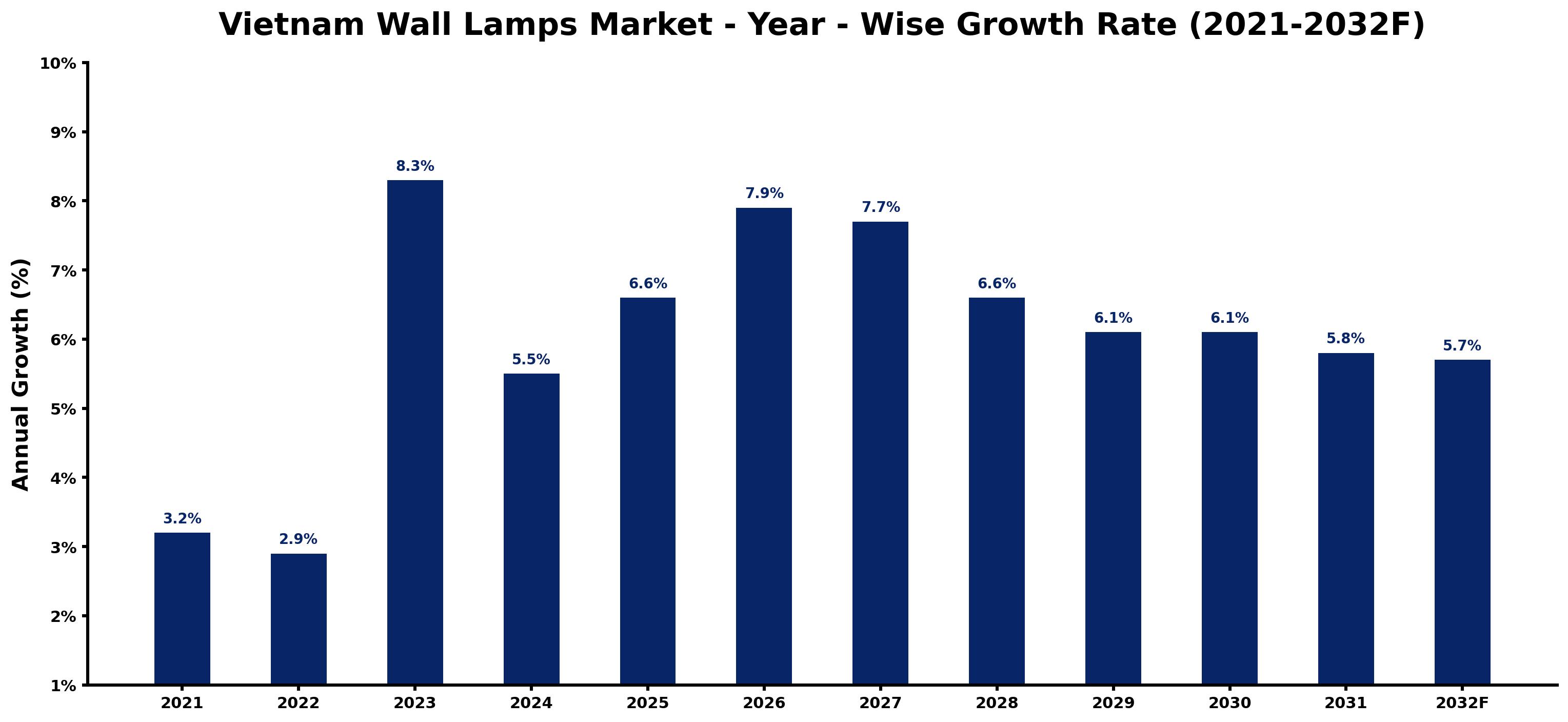
The table below presents the year wise growth rates along with the key drivers influencing the market
| Year | Growth Rate | Major Drivers |
| 2021 | 3.2% | Post-lockdown retail projects created new opportunities for decorative interior lighting solutions. |
| 2022 | 2.9% | Increased urbanization trends fueled demand for stylish yet functional wall lamp designs. |
| 2023 | 8.3% | Rural electrification initiatives are expanding reach, increasing wall lamp market accessibility. |
| 2024 | 5.5% | Growing disposable income among consumers enhances spending on home decor and lighting. |
| 2025 | 6.6% | Sustainability trends prompt manufacturers to explore eco-friendly materials for lamp production. |
| 2026 | 7.9% | An upswing in hospitality projects amplifies requirements for customized wall lighting installations. |
| 2027 | 7.7% | Home renovation projects surge as urban dwellers seek modernized lighting aesthetics. |
| 2028 | 6.6% | Technological integration in smart homes creates interest in advanced, energy-efficient lighting solutions. |
| 2029 | 6.1% | E-commerce platforms simplify access to diverse wall lamp options across varied demographics. |
| 2030 | 6.1% | Emerging interior design trends emphasize minimalist styles, boosting demand for sleek wall lamps. |
| 2031 | 5.8% | Collaboration between designers and manufacturers enhances creative offerings in wall lighting. |
| 2032 | 5.7% | Investment in local manufacturing facilities reduces costs, leading to lower consumer prices. |
Note - Market size estimations and growth projections presented in this report are based on 6Wresearch's advanced forecasting approach, validated with industry datasets as of June 2026.
Vietnam Wall Lamps Market Synopsis
The Vietnam Wall Lamps Market is projected to reach 7.9% and witness significant growth during the forecast period (2026-2032). The market has observed substantial transformations driven by an increased emphasis on interior design and a growing demand for stylish and functional lighting solutions. Factors such as rising disposable incomes, accelerated urbanization, and a flourishing real estate sector have contributed to this surge in demand. The hospitality industry is also a critical factor in market expansion, with investments directed towards enhancing aesthetic appeal and ambiance through innovative lighting. Additionally, consumer preferences are shifting towards energy-efficient and smart lighting technologies, further propelling the demand for wall lamps in both residential and commercial applications.
Vietnam Wall Lamps Market Growth Drivers
Several key drivers are influencing the growth trajectory of the Vietnam Wall Lamps Market:
- The increasing awareness of energy conservation has notably influenced consumer preferences, with a considerable shift toward LED-based wall lamps, which are recognized for their energy efficiency and longevity.
- The expansion of the real estate and construction sectors has led to heightened demand for wall lamps in residential and commercial properties. Architects and interior designers are increasingly prioritizing the integration of well-designed lighting setups to improve overall ambiance.
- A growing trend in home renovation and remodeling has further escalated the demand for decorative and functional wall lamps, as homeowners seek to create aesthetically pleasing environments.
- Rising disposable incomes have empowered consumers to invest in high-quality and unique lighting solutions, encouraging manufacturers to innovate with advanced designs and technologies.
- The increase in urban lifestyles has led to a greater focus on creating warm and inviting home settings, with wall lamps playing a crucial role in achieving the desired atmosphere.
Vietnam Wall Lamps Market Challenges and Restraints
Despite the favorable market conditions, the Vietnam Wall Lamps Market faces several challenges:
- The influx of low-quality and counterfeit products poses a significant threat, compromising performance and safety standards within the market. Ensuring the availability of reliable wall lamps is essential to maintain consumer trust.
- Competition from alternative lighting solutions, including ceiling lights and floor lamps, requires wall lamp manufacturers to differentiate their offerings through innovative designs and features that appeal to modern consumers.
- Price fluctuations in raw materials and currency exchange rates can lead to increased production costs, impacting profitability for manufacturers and potentially leading to higher retail prices for consumers.
- Consumer spending patterns can be influenced by economic fluctuations, affecting demand for non-essential items, including wall lamps, particularly in times of uncertainty.
- Keeping pace with evolving consumer preferences and technological advancements in lighting solutions requires continuous innovation, which can be resource-intensive.
Vietnam Wall Lamps Market COVID-19 Impact
The COVID-19 pandemic has had notable impacts on the Vietnam Wall Lamps Market. Initially, supply chain disruptions and manufacturing halts led to delays in product deliveries and installations. Economic uncertainties resulted in reduced consumer spending on non-essential items, including wall lamps.
However, as individuals spent more time at home during lockdowns, there was a marked increase in interest regarding home improvement projects, including lighting upgrades. Consumers sought functional and aesthetically pleasing wall lamps to enhance their living spaces. This period also witnessed an acceleration in the adoption of smart lighting solutions, as homeowners desired convenience and automation features. As the situation stabilizes and economic activities resume, the demand for wall lamps has rebounded, with a focus on adapting to diverse consumer needs.
Vietnam Wall Lamps Market Government Investment and Initiatives
The Vietnamese government has implemented various initiatives aimed at promoting energy efficiency and sustainable practices in the lighting sector. Investments in infrastructure development and urbanization projects have favored the adoption of modern lighting solutions, including wall lamps.
The government encourages the use of energy-efficient technologies, providing incentives for manufacturers and consumers to transition to LED lighting. Additionally, public spending on urban renewal and construction projects has created new opportunities for the wall lamps market as local authorities prioritize aesthetic enhancements in public spaces and residential areas.
Various development plans focus on creating smart cities, which include integrated lighting solutions that contribute to energy savings and improved urban environments. Furthermore, public awareness campaigns related to energy conservation are expected to bolster consumer interest in sustainable lighting options in the wall lamps market.
Vietnam Wall Lamps Market Latest Developments (May 2025 - June 2026)
Recent developments within the Vietnam Wall Lamps Market from May 2025 to June 2026 reflect a growing emphasis on innovation and consumer-centric designs. Manufacturers have increasingly adopted smart lighting technologies, providing consumers with advanced features such as remote control and automation capabilities.
The trend towards eco-friendly and sustainable wall lamps has gained momentum, with several initiatives focused on promoting LED technology and energy-efficient designs. Several manufacturers have launched campaigns highlighting the benefits of energy conservation while enhancing interior aesthetics.
The competitive landscape has seen increased collaboration between companies and technology providers to develop integrated smart home lighting solutions that include wall lamps, which can be seamlessly controlled via mobile applications.
Consumer preferences are shifting towards unique and artistic designs, prompting manufacturers to focus on aesthetic components alongside functionality. This shift is particularly prevalent in urban areas, where consumers seek to make personalized statements through their home lighting choices.
Overall, the Vietnam Wall Lamps Market is adapting to the evolving landscape by embracing technological advancements and focusing on consumer needs, setting a favorable stage for continued growth.
Vietnam Wall Lamps Market - Key Attractiveness of the Report
- 10 Years of Market Numbers
- Historical Data Starting from 2022 to 2025
- Base Year: 2025
- Forecast Data until 2032
- Key Performance Indicators Impacting the Market
- Major Upcoming Developments and Projects
Key Highlights of the Report:
- Vietnam Wall Lamps Market Outlook
- Market Size of Vietnam Wall Lamps Market, 2025
- Forecast of Vietnam Wall Lamps Market, 2032
- Historical Data and Forecast of Vietnam Wall Lamps Revenues & Volume for the Period 2022-2032F
- Vietnam Wall Lamps Market Trend Evolution
- Vietnam Wall Lamps Market Drivers and Challenges
- Vietnam Wall Lamps Price Trends
- Vietnam Wall Lamps Porter's Five Forces
- Vietnam Wall Lamps Industry Life Cycle
- Historical Data and Forecast of Vietnam Wall Lamps Market Revenues & Volume By Types for the Period 2022-2032F
- Historical Data and Forecast of Vietnam Wall Lamps Market Revenues & Volume By Bronze for the Period 2022-2032F
- Historical Data and Forecast of Vietnam Wall Lamps Market Revenues & Volume By Plastic for the Period 2022-2032F
- Historical Data and Forecast of Vietnam Wall Lamps Market Revenues & Volume By Steel for the Period 2022-2032F
- Historical Data and Forecast of Vietnam Wall Lamps Market Revenues & Volume By Wood for the Period 2022-2032F
- Historical Data and Forecast of Vietnam Wall Lamps Market Revenues & Volume By Other for the Period 2022-2032F
- Historical Data and Forecast of Vietnam Wall Lamps Market Revenues & Volume By Applications for the Period 2022-2032F
- Historical Data and Forecast of Vietnam Wall Lamps Market Revenues & Volume By Commercial for the Period 2022-2032F
- Historical Data and Forecast of Vietnam Wall Lamps Market Revenues & Volume By Residential for the Period 2022-2032F
- Vietnam Wall Lamps Import Export Trade Statistics
- Market Opportunity Assessment By Types
- Market Opportunity Assessment By Applications
- Vietnam Wall Lamps Top Companies Market Share
- Vietnam Wall Lamps Competitive Benchmarking By Technical and Operational Parameters
- Vietnam Wall Lamps Company Profiles
- Vietnam Wall Lamps Key Strategic Recommendations






































