Vietnam Warehousing and Storage Market Size, Share & Growth Rate
The Vietnam Warehousing and Storage Market was estimated at USD 368 Million in 2025 and is projected to reach USD 521 Million by 2032, growing at a CAGR of 5.1% from 2026 to 2032. This impressive growth trajectory is propelled by the surging e-commerce sector, which demands sophisticated warehousing solutions for efficient goods distribution. Additionally, as Vietnam's economy continues to expand, so does the need for modern storage facilities that can accommodate diverse product ranges, from industrial materials to perishables.
Vietnam Warehousing and Storage Market Year-wise Growth Rate and Key Drivers
This graph highlights how the Vietnam Warehousing and Storage Market has steadily grown over the years, supported by major growth factors.
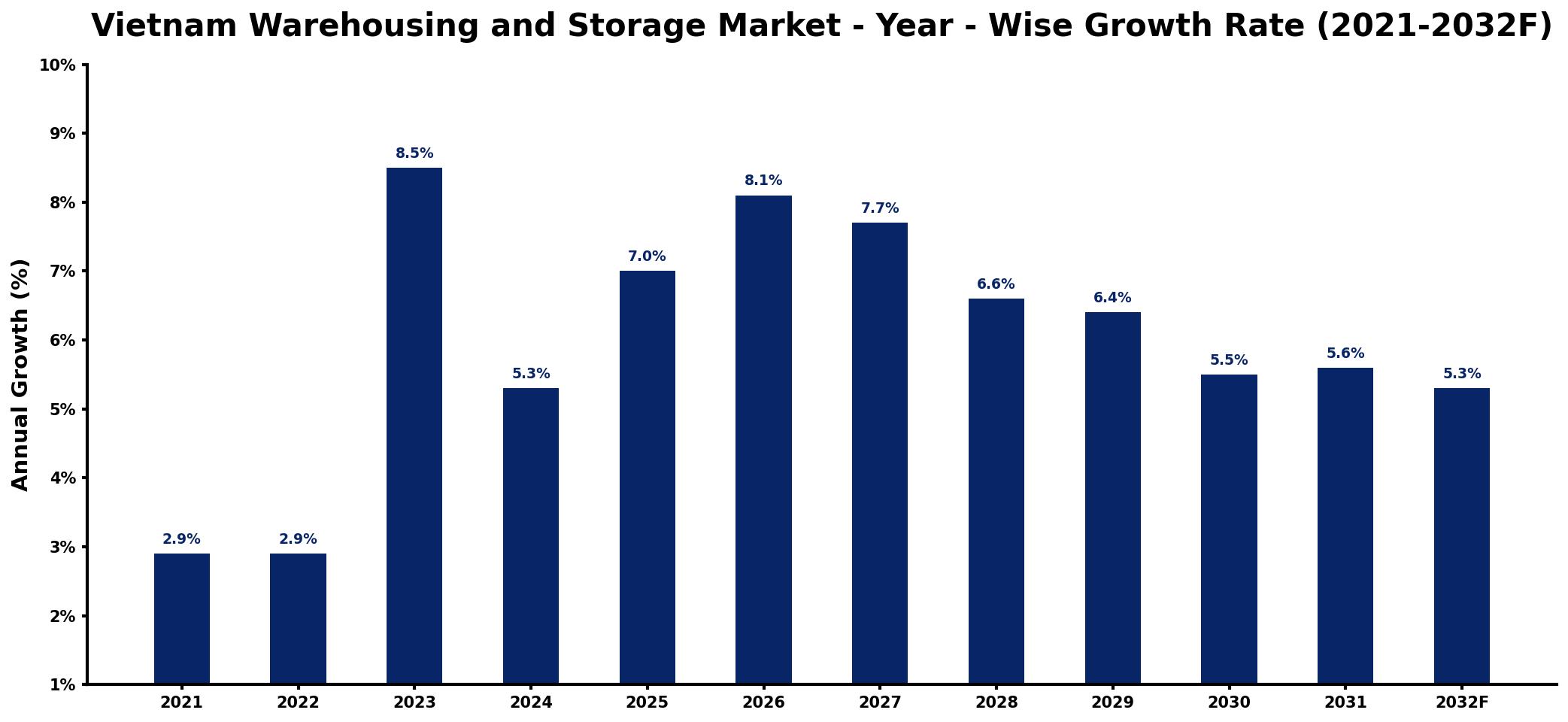
The table below presents the year‑wise growth rates along with the key drivers influencing the market
| Year | Growth Rate | Major Drivers |
| 2021 | 2.9% | E-commerce expansion driving demand |
| 2022 | 2.9% | Increased foreign investments influx |
| 2023 | 8.5% | Rising consumer goods consumption |
| 2024 | 5.3% | Growth in logistics sector innovations |
| 2025 | 7.0% | Urbanization boosting distribution networks |
| 2026 | 8.1% | Technological advancements in operations |
| 2027 | 7.7% | Growing third-party logistics partnerships |
| 2028 | 6.6% | Strengthening supply chain resilience |
| 2029 | 6.4% | Rising demand for cold chain |
| 2030 | 5.5% | Emerging markets require better logistics |
| 2031 | 5.6% | Sustainability initiatives driving efficiency |
| 2032 | 5.3% | Increased focus on automation solutions |
Note: Market size estimations and growth projections presented in this report are based on 6Wresearch's proprietary forecasting methodology, utilizing the latest available industry data, government publications, and primary research inputs.
Vietnam Warehousing and Storage Market Synopsis
In Vietnam, the warehousing and storage market plays a pivotal role in supporting the country's logistics framework. As e-commerce activities escalate, companies require advanced warehousing solutions that can handle increased volumes and provide rapid order fulfillment. This dynamic shift highlights the need for inventory management systems that effectively track and optimize stock levels.
The warehousing landscape is evolving, with a growing emphasis on technology adoption. Providers are increasingly leveraging automation and real-time tracking systems to improve operational efficiency. This not only enhances the overall customer experience but also ensures better space utilization within warehouses, crucial for meeting rising demand.
Vietnam Warehousing and Storage Market Key Takeaways
- The market is undergoing significant growth fueled by e-commerce expansion and urbanization trends.
- Investments in technology are transforming warehousing capabilities, with a focus on automation and advanced inventory systems.
- Local and international logistics providers are increasingly competing to offer modern warehousing solutions.
- Challenges related to infrastructure development persist, yet there are ample opportunities for innovation in inventory management.
- Government initiatives are gradually supporting the modernization of warehousing facilities across the nation.
Evaluation of Restraints in Vietnam Warehousing and Storage Market
Despite the promising growth, the Vietnam warehousing and storage market faces notable constraints. One significant issue is the pressing need for modernization of existing facilities, which can be a lengthy and costly endeavor. Many warehouses still operate with outdated systems that hinder efficiency. Additionally, the sector grapples with labor shortages, affecting operational performance and increasing employee turnover. As the market matures, adapting to evolving consumer expectations and regulatory requirements will also be crucial in navigating these challenges.
Vietnam Warehousing and Storage Market Trends
Emerging trends within the Vietnam warehousing and storage market are increasingly technology-driven. The adoption of IoT (Internet of Things) and AI (Artificial Intelligence) is enabling smarter inventory management, which allows for predictive analytics and enhanced decision-making processes. Moreover, sustainability is gaining traction, with companies prioritizing eco-friendly practices and energy-efficient facilities. This focus on sustainability not only aligns with global trends but also attracts environmentally conscious consumers.
Vietnam Warehousing and Storage Market Opportunities
The landscape of the Vietnam warehousing and storage market is ripe with growth opportunities. The ongoing boom in e-commerce presents an unparalleled chance for logistics providers to enhance their service offerings. Furthermore, as urban areas expand, the demand for strategically located warehouses is set to rise. Investment in technology, particularly automation and data analytics, will be essential for companies aiming to gain a competitive edge. Additionally, the governments efforts to improve infrastructure can open up new regions for warehousing development.
Government Initiatives in the Vietnam Warehousing and Storage Market
The Vietnamese government is increasingly recognizing the significance of the logistics and warehousing sectors in driving economic growth. Initiatives aimed at improving transport infrastructure are underway, enhancing connectivity between key trade hubs. Additionally, public policies are being developed to incentivize investments in advanced warehousing technologies and practices. These measures are expected to facilitate modernization efforts within the industry, ultimately promoting efficiency and competitiveness.
Future Insights of the Vietnam Warehousing and Storage Market
Looking ahead to 2026-2032, the Vietnam warehousing and storage market is anticipated to experience robust expansion. As consumer preferences shift towards quicker delivery times and personalized services, logistics providers must adapt their warehousing strategies accordingly. Embracing digital transformation and innovative storage solutions will be paramount for companies seeking to thrive in this evolving market. Moreover, collaboration among industry stakeholders will play a crucial role in addressing challenges and capitalizing on emerging opportunities.
Vietnam Warehousing and Storage Market Latest Developments (2025 - 2026)
Recent developments in the Vietnam warehousing and storage market indicate a strong trend toward modernization. Companies are increasingly investing in high-tech solutions, such as automated sorting systems and real-time inventory tracking technologies. These advancements are improving operational efficiency and reducing turnaround times for deliveries. Additionally, the government is moving forward with infrastructure projects that aim to enhance connectivity, further supporting the logistics sector's growth.
Vietnam Warehousing and Storage Market - Key Attractiveness of the Report
- 10 Years of Market Numbers
- Historical Data Starting from 2022 to 2025
- Base Year: 2025
- Forecast Data until 2032
- Key Performance Indicators Impacting the Market
- Major Upcoming Developments and Projects
Key Highlights of the Report:
- Vietnam Warehousing and Storage Market Outlook
- Market Size of Vietnam Warehousing and Storage Market, 2025
- Forecast of Vietnam Warehousing and Storage Market, 2032
- Historical Data and Forecast of Vietnam Warehousing and Storage Revenues & Volume for the Period 2022-2032F
- Vietnam Warehousing and Storage Market Trend Evolution
- Vietnam Warehousing and Storage Market Drivers and Challenges
- Vietnam Warehousing and Storage Price Trends
- Vietnam Warehousing and Storage Porter's Five Forces
- Vietnam Warehousing and Storage Industry Life Cycle
- Historical Data and Forecast of Vietnam Warehousing and Storage Market Revenues & Volume By Type for the Period 2022-2032F
- Historical Data and Forecast of Vietnam Warehousing and Storage Market Revenues & Volume By General Warehousing and Storage for the Period 2022-2032F
- Historical Data and Forecast of Vietnam Warehousing and Storage Market Revenues & Volume By Refrigerated Warehousing and Storage for the Period 2022-2032F
- Historical Data and Forecast of Vietnam Warehousing and Storage Market Revenues & Volume By Farm Product Warehousing and Storage for the Period 2022-2032F
- Historical Data and Forecast of Vietnam Warehousing and Storage Market Revenues & Volume By Ownership for the Period 2022-2032F
- Historical Data and Forecast of Vietnam Warehousing and Storage Market Revenues & Volume By Private Warehouses for the Period 2022-2032F
- Historical Data and Forecast of Vietnam Warehousing and Storage Market Revenues & Volume By Public Warehouses for the Period 2022-2032F
- Historical Data and Forecast of Vietnam Warehousing and Storage Market Revenues & Volume By Bonded Warehouses for the Period 2022-2032F
- Historical Data and Forecast of Vietnam Warehousing and Storage Market Revenues & Volume By End-Use for the Period 2022-2032F
- Historical Data and Forecast of Vietnam Warehousing and Storage Market Revenues & Volume By Manufacturing for the Period 2022-2032F
- Historical Data and Forecast of Vietnam Warehousing and Storage Market Revenues & Volume By Consumer Goods for the Period 2022-2032F
- Historical Data and Forecast of Vietnam Warehousing and Storage Market Revenues & Volume By Retail for the Period 2022-2032F
- Historical Data and Forecast of Vietnam Warehousing and Storage Market Revenues & Volume By Food and Beverage for the Period 2022-2032F
- Historical Data and Forecast of Vietnam Warehousing and Storage Market Revenues & Volume By IT Hardware for the Period 2022-2032F
- Historical Data and Forecast of Vietnam Warehousing and Storage Market Revenues & Volume By Healthcare for the Period 2022-2032F
- Historical Data and Forecast of Vietnam Warehousing and Storage Market Revenues & Volume By Chemicals for the Period 2022-2032F
- Historical Data and Forecast of Vietnam Warehousing and Storage Market Revenues & Volume By Others for the Period 2022-2032F
- Vietnam Warehousing and Storage Import Export Trade Statistics
- Market Opportunity Assessment By Type
- Market Opportunity Assessment By Ownership
- Market Opportunity Assessment By End-Use
- Vietnam Warehousing and Storage Top Companies Market Share
- Vietnam Warehousing and Storage Competitive Benchmarking By Technical and Operational Parameters
- Vietnam Warehousing and Storage Company Profiles
- Vietnam Warehousing and Storage Key Strategic Recommendations






































