Vietnam Water Color Market Size, Share & Growth Rate
The Vietnam Water Color Market was estimated at USD 304 Million in 2025 and is projected to reach USD 431 Million by 2032, growing at a CAGR of 5.1% from 2026 to 2032. This upward trajectory is primarily driven by an increasing passion for art among the Vietnamese population, particularly among younger generations and art students. The vibrant arts scene and the rising demand for watercolor paintings as unique souvenirs are further propelling market expansion.
Vietnam Water Color Market Year-wise Growth Rate and Key Drivers
This graph highlights how the Vietnam Water Color Market has steadily grown over the years, supported by major growth factors.
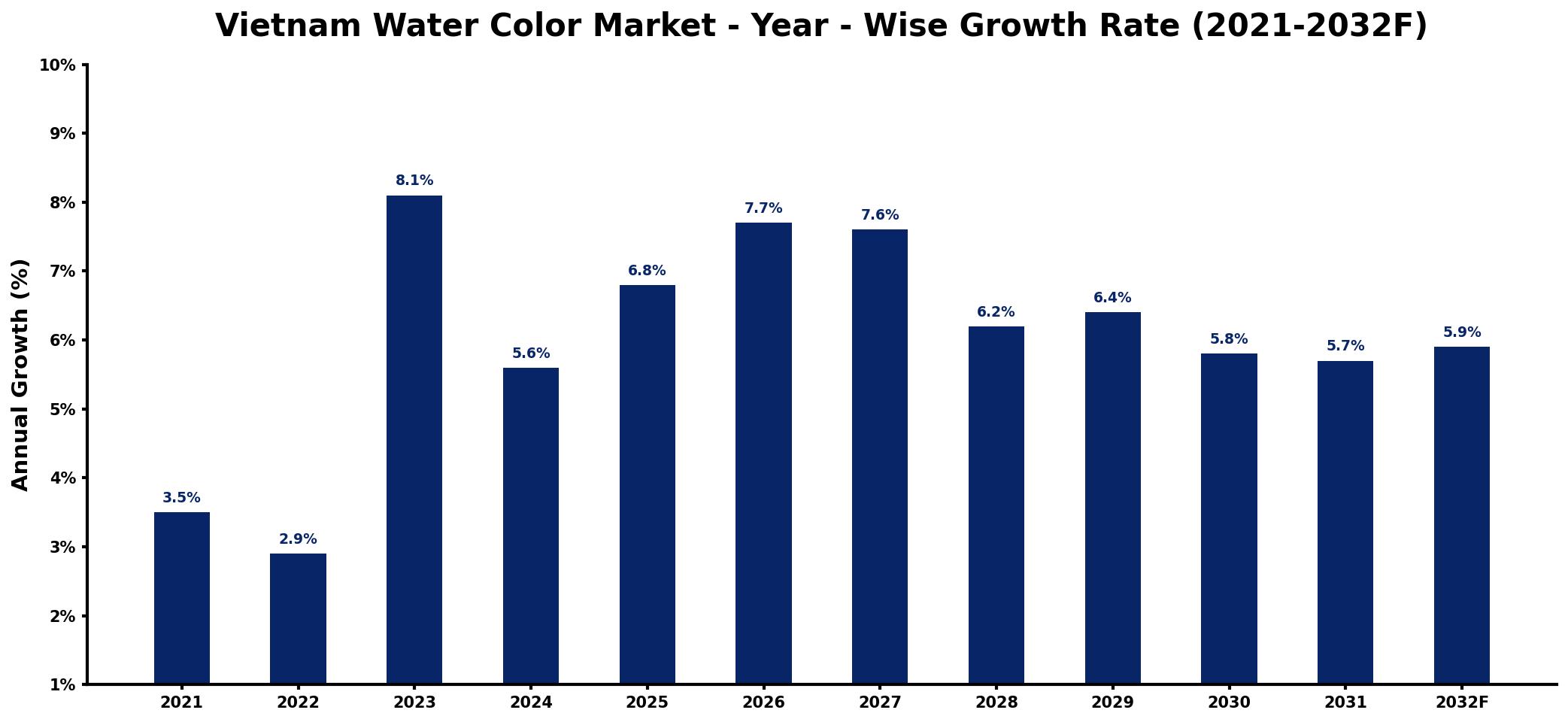
The table below presents the year‑wise growth rates along with the key drivers influencing the market
| Year | Growth Rate | Major Drivers |
| 2021 | 3.5% | Rising interest in arts education |
| 2022 | 2.9% | Growth in online art sales |
| 2023 | 8.1% | Increased demand for creative supplies |
| 2024 | 5.6% | Expansion of local art communities |
| 2025 | 6.8% | Emergence of eco-friendly materials |
| 2026 | 7.7% | Support from government initiatives |
| 2027 | 7.6% | Popularity of DIY art projects |
| 2028 | 6.2% | Collaboration with global artists |
| 2029 | 6.4% | Investment in art-related events |
| 2030 | 5.8% | increased overall sector activity |
| 2031 | 5.7% | Strengthening art therapy programs |
| 2032 | 5.9% | Rise in social media influence |
Note: Market size estimations and growth projections presented in this report are based on 6Wresearch's proprietary forecasting methodology, utilizing the latest available industry data, government publications, and primary research inputs.
Vietnam Water Color Market Synopsis
The Vietnam watercolor market is currently experiencing robust growth fueled by an increasing appreciation for artistic expression and creativity. This momentum reflects a cultural renaissance, with the medium enjoying newfound popularity among hobbyists, students, and professionals alike.
As the market evolves, the accessibility of high-quality watercolor supplies and a supportive artistic community are central to sustaining this growth. Yet, this flourishing market is not without its challenges, particularly in maintaining the quality and consistency of local products, which is crucial for competing internationally.
Vietnam Water Color Market Key Takeaways
- The market benefits from a growing artistic community, particularly among youth and students.
- Tourism is boosting the demand for watercolor artworks as authentic local souvenirs.
- Digital art's rise poses a competitive threat to traditional watercolor mediums.
- COVID-19 influenced a spike in creative pursuits, impacting product demand positively.
- Quality consistency in local paint production remains a pivotal factor for market reputation.
Evaluation of Restraints in Vietnam Water Color Market
Despite its growth potential, the Vietnam watercolor market grapples with several limitations. The proliferation of digital art tools has shifted some artists' preferences away from traditional mediums, presenting a challenge for watercolor paint producers. Additionally, while local manufacturers are striving to meet quality standards, variations in product quality can undermine consumer confidence. Environmental concerns regarding the sourcing and disposal of art materials also heighten scrutiny on manufacturers, potentially hindering broader acceptance and market penetration.
Vietnam Water Color Market Trends
The market is witnessing several noteworthy trends, including a surge in eco-friendly watercolor products as artists become more environmentally conscious. Online art platforms and social media have sparked a renaissance in art sharing and education, enhancing accessibility to watercolor techniques for aspiring artists. Furthermore, collaborations with local artisans and cultural institutions are fostering unique artistic expressions that resonate with both locals and tourists.
Vietnam Water Color Market Opportunities
There is significant potential for growth within the Vietnam watercolor market, particularly through the development of innovative products that cater to the growing eco-conscious demographic. Investment in localized art education programs can also cultivate a new generation of artists and hobbyists. Additionally, expanding e-commerce platforms for watercolor supplies can tap into the rising online consumer base, creating further avenues for revenue.
Government Initiatives in the Vietnam Water Color Market
The Vietnamese government has been increasingly supportive of the arts and culture sectors, recognizing their potential for economic growth and cultural preservation. Initiatives aimed at enhancing funding for art education and promoting local artisans are vital. Public exhibitions and art festivals encourage community engagement and awareness, creating a platform for artists to showcase their work and for watercolor supplies to reach new audiences.
Future Insights of the Vietnam Water Color Market
Looking ahead to 2026-2032, the Vietnam watercolor market is poised for dynamic growth. The intersection of traditional art practices with modern technology will likely create hybrid models for artistic expression, drawing more individuals into the watercolor medium. Additionally, increasing tourism will bolster the market, as visitors seek authentic and locally inspired art. As local producers strive for consistency and quality, the market will steadily enhance its global reputation.
Vietnam Water Color Market Latest Developments (2025 - 2026)
In recent months, the Vietnam watercolor market has seen a notable rise in online sales channels, reflecting a shift towards digital engagement in art supply shopping. Workshops and online tutorials have gained popularity, providing aspiring artists with direct access to techniques and product recommendations. Local artists have begun collaborating with educational institutions to develop art programs aimed at encouraging creativity from a young age, further embedding watercolor painting in the cultural fabric of Vietnam.
Vietnam Water Color Market - Key Attractiveness of the Report
- 10 Years of Market Numbers
- Historical Data Starting from 2022 to 2025
- Base Year: 2025
- Forecast Data until 2032
- Key Performance Indicators Impacting the Market
- Major Upcoming Developments and Projects
Key Highlights of the Report:
- Vietnam Water Color Market Outlook
- Market Size of Vietnam Water Color Market, 2025
- Forecast of Vietnam Water Color Market, 2032
- Historical Data and Forecast of Vietnam Water Color Revenues & Volume for the Period 2022-2032F
- Vietnam Water Color Market Trend Evolution
- Vietnam Water Color Market Drivers and Challenges
- Vietnam Water Color Price Trends
- Vietnam Water Color Porter's Five Forces
- Vietnam Water Color Industry Life Cycle
- Historical Data and Forecast of Vietnam Water Color Market Revenues & Volume By Product Type for the Period 2022-2032F
- Historical Data and Forecast of Vietnam Water Color Market Revenues & Volume By Pure Transparent Watercolors for the Period 2022-2032F
- Historical Data and Forecast of Vietnam Water Color Market Revenues & Volume By Semi-Transparent Watercolors for the Period 2022-2032F
- Historical Data and Forecast of Vietnam Water Color Market Revenues & Volume By Opaque Watercolors for the Period 2022-2032F
- Historical Data and Forecast of Vietnam Water Color Market Revenues & Volume By End User for the Period 2022-2032F
- Historical Data and Forecast of Vietnam Water Color Market Revenues & Volume By Students for the Period 2022-2032F
- Historical Data and Forecast of Vietnam Water Color Market Revenues & Volume By Artists/ Professionals for the Period 2022-2032F
- Historical Data and Forecast of Vietnam Water Color Market Revenues & Volume By Price Range for the Period 2022-2032F
- Historical Data and Forecast of Vietnam Water Color Market Revenues & Volume By Less than US$ 25 for the Period 2022-2032F
- Historical Data and Forecast of Vietnam Water Color Market Revenues & Volume By US$ 25 ?? US$ 100 for the Period 2022-2032F
- Historical Data and Forecast of Vietnam Water Color Market Revenues & Volume By US$ 100 ?? US$ 200 for the Period 2022-2032F
- Historical Data and Forecast of Vietnam Water Color Market Revenues & Volume By More than US$ 200 for the Period 2022-2032F
- Historical Data and Forecast of Vietnam Water Color Market Revenues & Volume By Sales Channel for the Period 2022-2032F
- Historical Data and Forecast of Vietnam Water Color Market Revenues & Volume By Wholesalers/ Distributors for the Period 2022-2032F
- Historical Data and Forecast of Vietnam Water Color Market Revenues & Volume By Supermarkets/ Hypermarkets for the Period 2022-2032F
- Historical Data and Forecast of Vietnam Water Color Market Revenues & Volume By Specialty Stores for the Period 2022-2032F
- Historical Data and Forecast of Vietnam Water Color Market Revenues & Volume By Multi-brand Stores for the Period 2022-2032F
- Historical Data and Forecast of Vietnam Water Color Market Revenues & Volume By Online Retailers for the Period 2022-2032F
- Historical Data and Forecast of Vietnam Water Color Market Revenues & Volume By Others for the Period 2022-2032F
- Vietnam Water Color Import Export Trade Statistics
- Market Opportunity Assessment By Product Type
- Market Opportunity Assessment By End User
- Market Opportunity Assessment By Price Range
- Market Opportunity Assessment By Sales Channel
- Vietnam Water Color Top Companies Market Share
- Vietnam Water Color Competitive Benchmarking By Technical and Operational Parameters
- Vietnam Water Color Company Profiles
- Vietnam Water Color Key Strategic Recommendations






































