Vietnam Welding Consumables Market Size, Share & Growth Rate
The Vietnam Welding Consumables Market was estimated at USD 313 Million in 2025 and is projected to reach USD 442 Million by 2032, growing at a CAGR of 5.1% from 2026 to 2032. This promising trajectory is primarily fueled by robust investments in the manufacturing and construction sectors, particularly in infrastructure development. As Vietnam's economy continues to advance, the demand for high-quality welding consumables remains essential for sustaining growth in pivotal industries, including automotive and shipbuilding.
Vietnam Welding Consumables Market Year-wise Growth Rate and Key Drivers
This graph highlights how the Vietnam Welding Consumables Market has steadily grown over the years, supported by major growth factors.
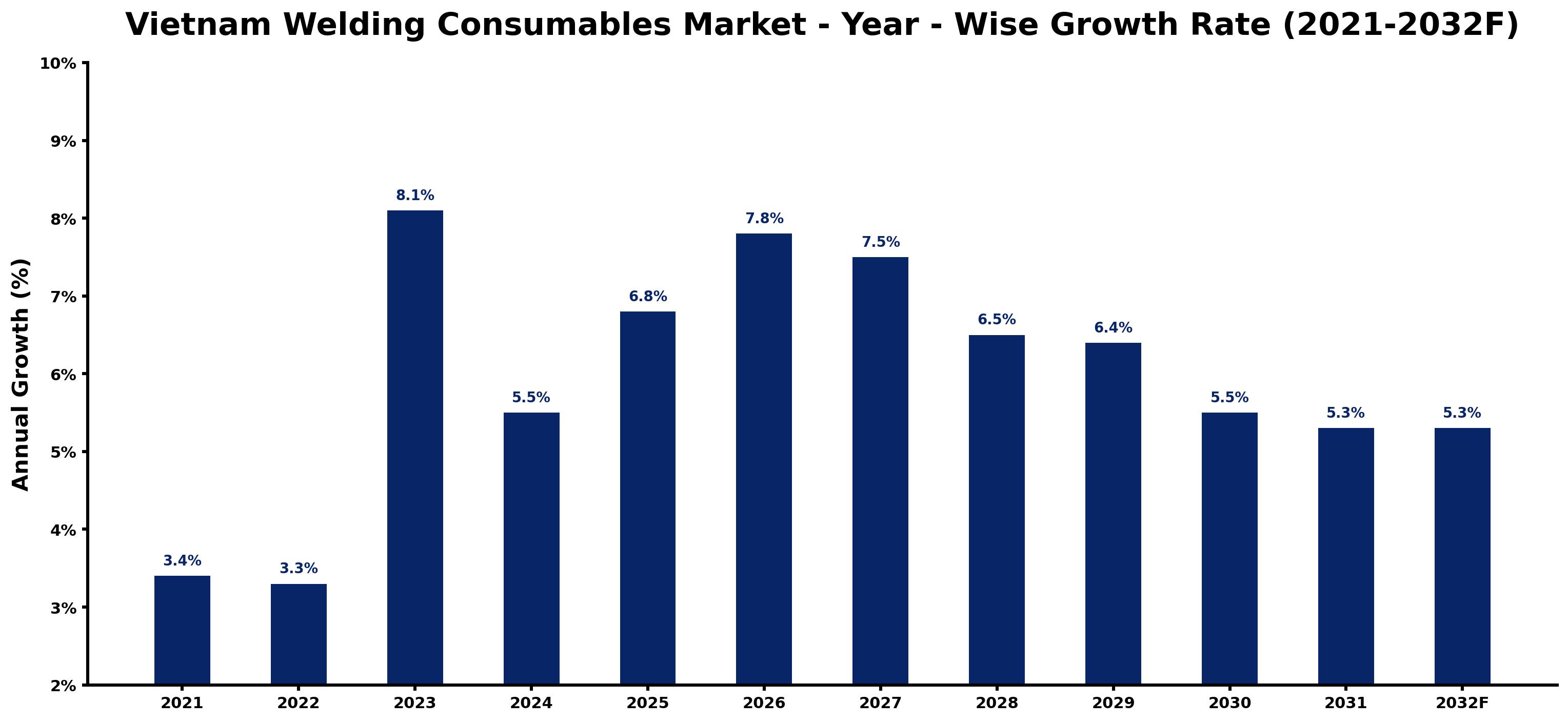
The table below presents the year‑wise growth rates along with the key drivers influencing the market
| Year | Growth Rate | Major Drivers |
| 2021 | 3.4% | Increasing smart city development projects |
| 2022 | 3.3% | Growing urbanization and commercial development |
| 2023 | 8.1% | Increasing industrial infrastructure investments |
| 2024 | 5.5% | Growing renewable energy integration projects |
| 2025 | 6.8% | Expansion of transportation and logistics networks |
| 2026 | 7.8% | Expansion of transportation and logistics networks |
| 2027 | 7.5% | Increasing smart city development projects |
| 2028 | 6.5% | Growing renewable energy integration projects |
| 2029 | 6.4% | Rising electricity demand across industries |
| 2030 | 5.5% | Expansion of commercial construction activities |
| 2031 | 5.3% | Rising electricity demand across industries |
| 2032 | 5.3% | Increasing smart city development projects |
Note - Market size estimations and growth projections presented in this report are based on 6Wresearch’s advanced forecasting approach, validated with industry datasets as of June 2026.
Vietnam Welding Consumables Market Synopsis
Following a period of steady growth, the Vietnam Welding Consumables Market is poised for significant expansion, driven by escalating infrastructure projects and an evolving industrial landscape. With an increasing emphasis on quality and efficiency in welding processes, manufacturers are focusing on innovations that cater specifically to the unique demands of the local market.
As the market transitions towards a more competitive environment, players are exploring advanced technologies to improve product offerings. This strategic pivot not only addresses current market needs but also positions Vietnam as a formidable hub for welding activities in Southeast Asia.
Vietnam Welding Consumables Market Key Takeaways
- Strong growth is projected due to rising investments in infrastructure and manufacturing.
- Innovative product development is enhancing welding efficiency and quality.
- The automotive and shipbuilding sectors are crucial for market expansion.
- A skilled workforce is essential for leveraging technological advancements in welding.
- Workplace safety compliance remains a top priority for industry stakeholders.
Evaluation of Restraints in Vietnam Welding Consumables Market
While the Vietnam Welding Consumables Market is experiencing promising growth, it grapples with several constraints that could impede its progress. A significant challenge is the ongoing shortage of skilled welders and technicians, which can adversely affect production quality and timelines across industries. Moreover, maintaining workplace safety standards is not just a regulatory requirement but a critical aspect that influences operational efficiency. Fluctuations in metal prices also pose a risk, impacting the pricing strategies of manufacturers. Competing technologies, such as adhesive bonding and mechanical fastening, further complicate the market landscape, necessitating a concerted effort to highlight welding's distinctive advantages.
Vietnam Welding Consumables Market Trends
The Vietnam Welding Consumables Market is witnessing several trends that are shaping its future. There is a noticeable shift towards eco-friendly and sustainable consumables, reflecting a global push for environmental responsibility. Automation in welding processes is on the rise, with manufacturers investing in robotic welding technologies to enhance precision and productivity. Additionally, the integration of digital solutions, such as real-time monitoring systems, is becoming prevalent, enabling better quality control and operational efficiency.
Vietnam Welding Consumables Market Opportunities
The market is ripe with opportunities for growth and investment. As infrastructure development continues to accelerate, the demand for high-quality welding consumables will surge. Investing in training programs for welders can address the skill gap, ensuring that the workforce is equipped to handle advanced welding technologies. Furthermore, exploring export markets within Southeast Asia presents a strategic avenue for manufacturers looking to expand their footprint and capture new revenue streams.
Government Initiatives in the Vietnam Welding Consumables Market
The Vietnamese government has recognized the importance of the manufacturing and construction sectors, leading to the implementation of various initiatives aimed at boosting economic growth. Public spending on infrastructure is set to increase, with substantial allocations for the development of transportation networks and industrial parks. Additionally, government programs aimed at enhancing vocational training for skilled labor are essential for ensuring a competent workforce in the welding industry.
Future Insights of the Vietnam Welding Consumables Market
Looking forward to 2026-2032, the Vietnam Welding Consumables Market is expected to thrive as technological advancements continue to shape the industry landscape. The emphasis on quality, safety, and efficiency will drive innovations in product development. Market participants who invest in training, safety protocols, and sustainable practices will be well-positioned to capitalize on the burgeoning opportunities that lie ahead, ensuring a robust market environment.
Vietnam Welding Consumables Market Latest Developments (May 2025 - June 2026)
In recent months, the industry has seen a flurry of activity as key stakeholders adapt to changing market dynamics. Many manufacturers are enhancing their product lines, focusing on sustainability and improved performance. The post-pandemic recovery phase has prompted several companies to adopt advanced technologies that ensure efficiency and safety in their operations. Collaborative initiatives between industry leaders and educational institutions have emerged, aiming to bridge the skills gap in the workforce.
Vietnam Welding Consumables Market - Key Attractiveness of the Report
- 10 Years of Market Numbers
- Historical Data Starting from 2022 to 2025
- Base Year: 2025
- Forecast Data until 2032
- Key Performance Indicators Impacting the Market
- Major Upcoming Developments and Projects
Key Highlights of the Report:
- Vietnam Welding Consumables Market Outlook
- Market Size of Vietnam Welding Consumables Market, 2025
- Forecast of Vietnam Welding Consumables Market, 2032
- Historical Data and Forecast of Vietnam Welding Consumables Revenues & Volume for the Period 2022-2032F
- Vietnam Welding Consumables Market Trend Evolution
- Vietnam Welding Consumables Market Drivers and Challenges
- Vietnam Welding Consumables Price Trends
- Vietnam Welding Consumables Porter's Five Forces
- Vietnam Welding Consumables Industry Life Cycle
- Historical Data and Forecast of Vietnam Welding Consumables Market Revenues & Volume By Type for the Period 2022-2032F
- Historical Data and Forecast of Vietnam Welding Consumables Market Revenues & Volume By Stick Electrodes for the Period 2022-2032F
- Historical Data and Forecast of Vietnam Welding Consumables Market Revenues & Volume By Solid Wires for the Period 2022-2032F
- Historical Data and Forecast of Vietnam Welding Consumables Market Revenues & Volume By Flux Cored Wires for the Period 2022-2032F
- Historical Data and Forecast of Vietnam Welding Consumables Market Revenues & Volume By SAW Wires & Fluxes for the Period 2022-2032F
- Historical Data and Forecast of Vietnam Welding Consumables Market Revenues & Volume By End-user Industry for the Period 2022-2032F
- Historical Data and Forecast of Vietnam Welding Consumables Market Revenues & Volume By Aerospace & Defense for the Period 2022-2032F
- Historical Data and Forecast of Vietnam Welding Consumables Market Revenues & Volume By Automotive & Transportation for the Period 2022-2032F
- Historical Data and Forecast of Vietnam Welding Consumables Market Revenues & Volume By Construction for the Period 2022-2032F
- Historical Data and Forecast of Vietnam Welding Consumables Market Revenues & Volume By Energy for the Period 2022-2032F
- Historical Data and Forecast of Vietnam Welding Consumables Market Revenues & Volume By Heavy Machinery for the Period 2022-2032F
- Historical Data and Forecast of Vietnam Welding Consumables Market Revenues & Volume By Shipbuilding for the Period 2022-2032F
- Historical Data and Forecast of Vietnam Welding Consumables Market Revenues & Volume By Process & Others for the Period 2022-2032F
- Historical Data and Forecast of Vietnam Welding Consumables Market Revenues & Volume By Welding Technique for the Period 2022-2032F
- Historical Data and Forecast of Vietnam Welding Consumables Market Revenues & Volume By Arc Welding for the Period 2022-2032F
- Historical Data and Forecast of Vietnam Welding Consumables Market Revenues & Volume By Resistance Welding for the Period 2022-2032F
- Historical Data and Forecast of Vietnam Welding Consumables Market Revenues & Volume By Oxy-fuel Welding for the Period 2022-2032F
- Historical Data and Forecast of Vietnam Welding Consumables Market Revenues & Volume By Laser-beam Welding for the Period 2022-2032F
- Historical Data and Forecast of Vietnam Welding Consumables Market Revenues & Volume By Others for the Period 2022-2032F
- Vietnam Welding Consumables Import Export Trade Statistics
- Market Opportunity Assessment By Type
- Market Opportunity Assessment By End-user Industry
- Market Opportunity Assessment By Welding Technique
- Vietnam Welding Consumables Top Companies Market Share
- Vietnam Welding Consumables Competitive Benchmarking By Technical and Operational Parameters
- Vietnam Welding Consumables Company Profiles
- Vietnam Welding Consumables Key Strategic Recommendations






































