Vietnam Welding Equipment Market Size, Share & Growth Rate
The Vietnam Welding Equipment Market was estimated at USD 463 Million in 2025 and is projected to reach USD 654 Million by 2032, growing at a CAGR of 5.1% from 2026 to 2032. This upward trajectory is primarily driven by the burgeoning demand from key sectors such as construction, automotive, and aerospace. As Vietnam continues to develop its industrial base, the need for advanced, efficient, and reliable welding solutions has never been more critical.
Vietnam Welding Equipment Market Year-wise Growth Rate and Key Drivers
This graph highlights how the Vietnam Welding Equipment Market has steadily grown over the years, supported by major growth factors.
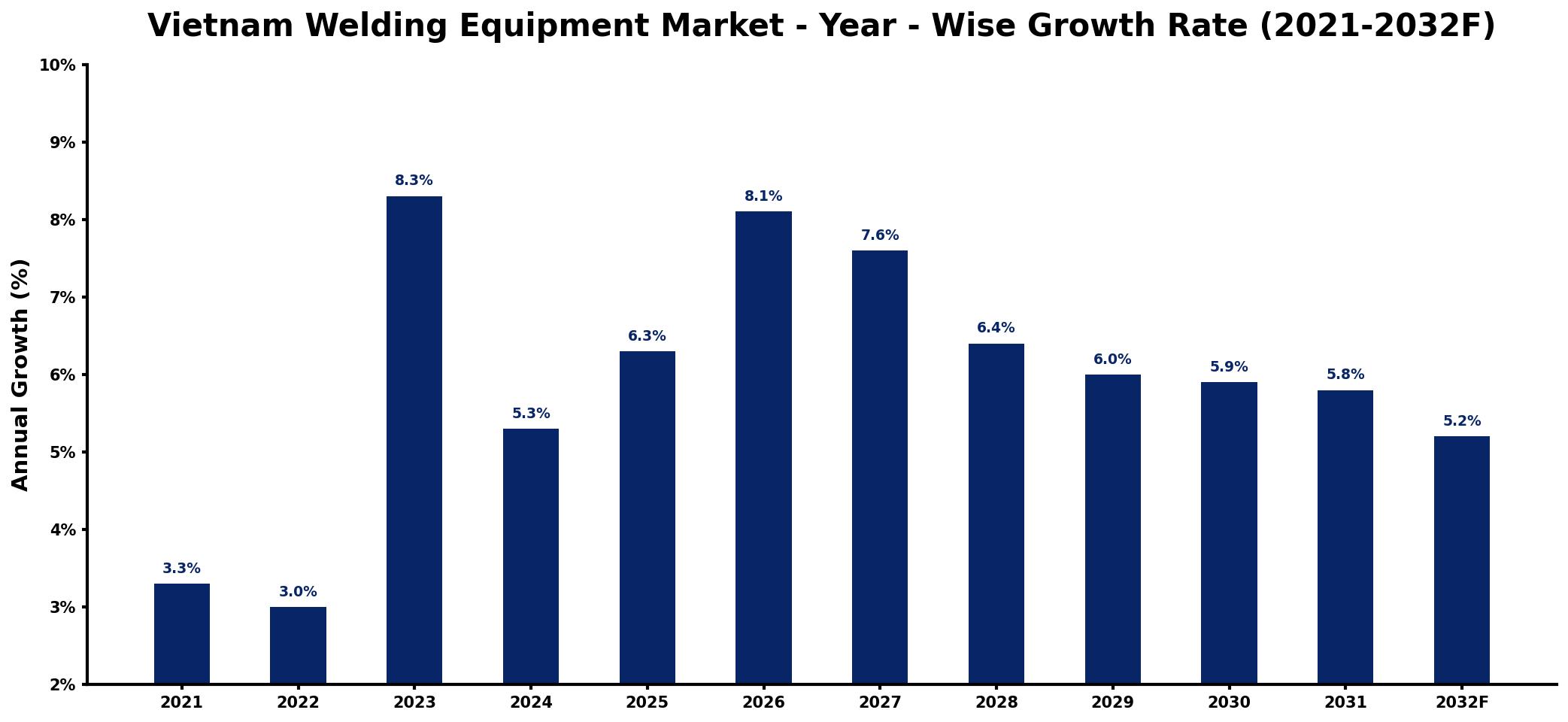
The table below presents the year‑wise growth rates along with the key drivers influencing the market
| Year | Growth Rate | Major Drivers |
| 2021 | 3.3% | Rising construction sector investments |
| 2022 | 3.0% | Growth in manufacturing activities |
| 2023 | 8.3% | Expansion in renewable energy projects |
| 2024 | 5.3% | Increased automotive production demand |
| 2025 | 6.3% | Surge in infrastructure development |
| 2026 | 8.1% | Technological advancements in processes |
| 2027 | 7.6% | Higher exports of finished goods |
| 2028 | 6.4% | Growing shipbuilding industry needs |
| 2029 | 6.0% | Increased automation in factories |
| 2030 | 5.9% | Rising demand for repair services |
| 2031 | 5.8% | Expansion of metalworking industries |
| 2032 | 5.2% | stronger distribution network expansion |
Note: Market size estimations and growth projections presented in this report are based on 6Wresearch's proprietary forecasting methodology, utilizing the latest available industry data, government publications, and primary research inputs.
Vietnam Welding Equipment Market Synopsis
The Vietnam welding equipment market is evolving rapidly, reflecting the increasing complexity of welding applications in various industries. With ongoing infrastructure projects and a rise in manufacturing activities, the demand for high-quality welding machinery is surging. As industries grow, so does the need for solutions that ensure precision and durability in metal joining.
Professionals in construction and manufacturing are investing in sophisticated welding technology to enhance productivity and meet stringent quality standards. This market not only supports traditional welding applications but also embraces innovations that address the specific needs of sectors such as renewable energy and automotive manufacturing.
Vietnam Welding Equipment Market Key Takeaways
- Significant market growth driven by demand in construction and manufacturing sectors.
- Technological advancements are enhancing the capabilities and efficiency of welding equipment.
- Increasing focus on automation and precision in welding processes is shaping purchasing decisions.
- Resilience demonstrated during the COVID-19 pandemic led to strategic shifts and new opportunities.
- Investment in infrastructure development is further propelling market expansion.
Evaluation of Restraints in Vietnam Welding Equipment Market
Despite the optimistic outlook, the Vietnam welding equipment market faces several constraints. Competition from alternative joining technologies poses a challenge, as industries look for innovative solutions that may not involve traditional welding. Additionally, the stringent quality and precision demands in manufacturing require continuous updates to equipment and processes. These factors necessitate that market players stay ahead of technological advancements while maintaining cost-effectiveness, which can strain resources and production capabilities.
Vietnam Welding Equipment Market Trends
Several trends are emerging in the Vietnam welding equipment market, notably the adoption of automation and robotics in welding processes. As industries seek to improve efficiency, automated welding solutions are becoming more prevalent. Additionally, the focus on environmental sustainability is driving demand for energy-efficient and low-emission welding technologies. Furthermore, there is a growing trend towards customization, with manufacturers seeking tailored solutions that meet specific project requirements.
Vietnam Welding Equipment Market Opportunities
Opportunities in the Vietnam welding equipment market abound, particularly in sectors poised for growth. The ongoing development of infrastructure, particularly in urban areas, offers significant potential for welding applications. Moreover, the push towards renewable energy projects presents a unique opportunity for suppliers to provide specialized equipment. Investing in the modernization of welding technology and exploring export markets could also yield substantial rewards for players in this space.
Government Initiatives in the Vietnam Welding Equipment Market
The Vietnamese government is actively promoting the growth of manufacturing and infrastructure sectors, which indirectly supports the welding equipment market. Policies aimed at enhancing industrial productivity and technological advancement are crucial. Public spending on infrastructure projects and incentives for green technology adoption also play vital roles in creating a favorable environment for welding equipment suppliers.
Future Insights of the Vietnam Welding Equipment Market
Looking ahead to 2026-2032, the Vietnam welding equipment market is set to experience robust growth fueled by ongoing industrialization. The demand for advanced welding solutions that cater to the increasing complexity of projects will shape the landscape. Additionally, innovations in welding technology and processes will likely enhance the overall performance and versatility of equipment available in the market, ensuring it meets the evolving needs of various industries.
Vietnam Welding Equipment Market Latest Developments (2025 - 2026)
Recent developments in the Vietnam welding equipment market indicate a shift towards more integrated and intelligent welding solutions. The focus has been on enhancing connectivity and compatibility with Industry 4.0 standards, allowing for real-time monitoring and adjustment of welding processes. Additionally, there is a rising interest in training programs aimed at upskilling welding professionals to ensure they can effectively utilize new technologies.
Vietnam Welding Equipment Market - Key Attractiveness of the Report
- 10 Years of Market Numbers
- Historical Data Starting from 2022 to 2025
- Base Year: 2025
- Forecast Data until 2032
- Key Performance Indicators Impacting the Market
- Major Upcoming Developments and Projects
Key Highlights of the Report:
- Vietnam Welding Equipment Market Outlook
- Market Size of Vietnam Welding Equipment Market, 2025
- Forecast of Vietnam Welding Equipment Market, 2032
- Historical Data and Forecast of Vietnam Welding Equipment Revenues & Volume for the Period 2022-2032F
- Vietnam Welding Equipment Market Trend Evolution
- Vietnam Welding Equipment Market Drivers and Challenges
- Vietnam Welding Equipment Price Trends
- Vietnam Welding Equipment Porter's Five Forces
- Vietnam Welding Equipment Industry Life Cycle
- Historical Data and Forecast of Vietnam Welding Equipment Market Revenues & Volume By Equipment for the Period 2022-2032F
- Historical Data and Forecast of Vietnam Welding Equipment Market Revenues & Volume By Electrodes & Filler Metal Equipment for the Period 2022-2032F
- Historical Data and Forecast of Vietnam Welding Equipment Market Revenues & Volume By Oxy-fuel Gas Equipment for the Period 2022-2032F
- Historical Data and Forecast of Vietnam Welding Equipment Market Revenues & Volume By Other Equipment for the Period 2022-2032F
- Historical Data and Forecast of Vietnam Welding Equipment Market Revenues & Volume By Accessory for the Period 2022-2032F
- Historical Data and Forecast of Vietnam Welding Equipment Market Revenues & Volume By Protective Gear for the Period 2022-2032F
- Historical Data and Forecast of Vietnam Welding Equipment Market Revenues & Volume By Gas Manifolds for the Period 2022-2032F
- Historical Data and Forecast of Vietnam Welding Equipment Market Revenues & Volume By Flow Controllers for the Period 2022-2032F
- Historical Data and Forecast of Vietnam Welding Equipment Market Revenues & Volume By Gas Panels for the Period 2022-2032F
- Historical Data and Forecast of Vietnam Welding Equipment Market Revenues & Volume By Gas Flow Meters for the Period 2022-2032F
- Historical Data and Forecast of Vietnam Welding Equipment Market Revenues & Volume By Gas Regulators for the Period 2022-2032F
- Historical Data and Forecast of Vietnam Welding Equipment Market Revenues & Volume By Gas Cabinets for the Period 2022-2032F
- Historical Data and Forecast of Vietnam Welding Equipment Market Revenues & Volume By Gas Filters for the Period 2022-2032F
- Historical Data and Forecast of Vietnam Welding Equipment Market Revenues & Volume By Consumable for the Period 2022-2032F
- Historical Data and Forecast of Vietnam Welding Equipment Market Revenues & Volume By Electrodes & Filler Materials for the Period 2022-2032F
- Historical Data and Forecast of Vietnam Welding Equipment Market Revenues & Volume By Gases for the Period 2022-2032F
- Historical Data and Forecast of Vietnam Welding Equipment Market Revenues & Volume By Fluxes & Wires for the Period 2022-2032F
- Historical Data and Forecast of Vietnam Welding Equipment Market Revenues & Volume By Technology for the Period 2022-2032F
- Historical Data and Forecast of Vietnam Welding Equipment Market Revenues & Volume By Arc Welding for the Period 2022-2032F
- Historical Data and Forecast of Vietnam Welding Equipment Market Revenues & Volume By Oxy-fuel Welding for the Period 2022-2032F
- Historical Data and Forecast of Vietnam Welding Equipment Market Revenues & Volume By Others for the Period 2022-2032F
- Historical Data and Forecast of Vietnam Welding Equipment Market Revenues & Volume By End-Use Industry for the Period 2022-2032F
- Historical Data and Forecast of Vietnam Welding Equipment Market Revenues & Volume By General Fabrication for the Period 2022-2032F
- Historical Data and Forecast of Vietnam Welding Equipment Market Revenues & Volume By Power Generation for the Period 2022-2032F
- Historical Data and Forecast of Vietnam Welding Equipment Market Revenues & Volume By Automotive for the Period 2022-2032F
- Historical Data and Forecast of Vietnam Welding Equipment Market Revenues & Volume By Construction & Infrastructure for the Period 2022-2032F
- Historical Data and Forecast of Vietnam Welding Equipment Market Revenues & Volume By Heavy Fabrication for the Period 2022-2032F
- Historical Data and Forecast of Vietnam Welding Equipment Market Revenues & Volume By Shipbuilding for the Period 2022-2032F
- Historical Data and Forecast of Vietnam Welding Equipment Market Revenues & Volume By Maintenance & Repair for the Period 2022-2032F
- Historical Data and Forecast of Vietnam Welding Equipment Market Revenues & Volume By Offshore for the Period 2022-2032F
- Vietnam Welding Equipment Import Export Trade Statistics
- Market Opportunity Assessment By Equipment
- Market Opportunity Assessment By Accessory
- Market Opportunity Assessment By Consumable
- Market Opportunity Assessment By Technology
- Market Opportunity Assessment By End-Use Industry
- Vietnam Welding Equipment Top Companies Market Share
- Vietnam Welding Equipment Competitive Benchmarking By Technical and Operational Parameters
- Vietnam Welding Equipment Company Profiles
- Vietnam Welding Equipment Key Strategic Recommendations






































