Vietnam Wheat Bran Market Size, Share & Growth Rate
The Vietnam Wheat Bran Market was estimated at USD 289 Million in 2025 and is projected to reach USD 409 Million by 2032, growing at a CAGR of 5.1% from 2026 to 2032. This growth is primarily fueled by an increasing consumer focus on health and nutrition, driving demand for high-fiber food options. Additionally, the expansion of the bakery and food processing sectors in Vietnam further supports the rising consumption of wheat bran, enhancing its appeal as a functional ingredient.
Vietnam Wheat Bran Market Growth Rate Analysis (2021-2032)
The Vietnam wheat bran market has exhibited a promising upward trend, with growth rates reflecting varying dynamics. Following a modest increase of 3.3% in 2021, growth accelerated to 8.2% in 2023, driven by rising consumer awareness of health benefits and an expanding food processing industry. While growth normalized to 5.5% in 2024, it remained robust, supported by increasing investments in agricultural technology and infrastructure. The anticipated growth of 7.9% in 2026 aligns with ongoing consumer demand for nutritious food products. By 2032, growth is projected to stabilize around 5.8%, indicating sustained interest amidst evolving market conditions and ongoing digitalization in supply chain management.
Vietnam Wheat Bran Market Year-wise Growth Rate and Key Drivers
This graph highlights how the Vietnam Wheat Bran Market has steadily grown over the past five years, supported by major growth factors.
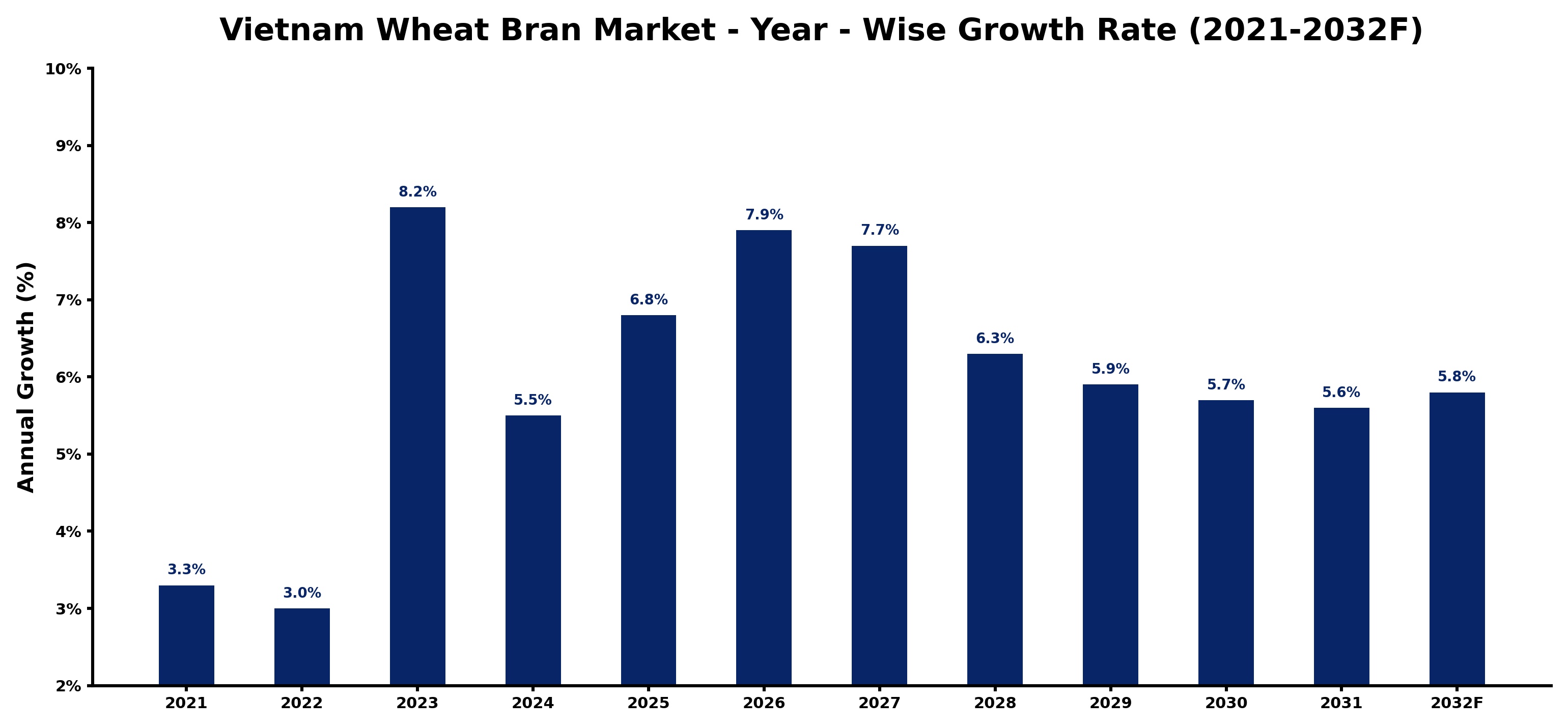
The table below presents the year‑wise growth rates along with the key drivers influencing the market
| Year | Growth Rate | Major Drivers |
| 2021 | 3.3% | Health awareness drove consumption growth |
| 2022 | 3.0% | Increased demand for healthy ingredients |
| 2023 | 8.2% | Rising popularity of functional foods |
| 2024 | 5.5% | Expansion of organic product lines |
| 2025 | 6.8% | Growing interest in plant-based diets |
| 2026 | 7.9% | Increased exports to neighboring countries |
| 2027 | 7.7% | Food processing innovations enhanced offerings |
| 2028 | 6.3% | Sustainable farming practices gained traction |
| 2029 | 5.9% | Nutritional benefits promoted by influencers |
| 2030 | 5.7% | E-commerce platforms expanded market reach |
| 2031 | 5.6% | Consumer education on health benefits |
| 2032 | 5.8% | Collaboration with health professionals increased |
Note - Market size estimations and growth projections presented in this report are based on 6Wresearch’s advanced forecasting approach, validated with industry datasets as of June 2026.
Vietnam Wheat Bran Market Synopsis
Consumer awareness of the health benefits of wheat bran is the dominant force currently shaping the market. As individuals seek to improve their dietary habits, the recognition of wheat bran as a source of dietary fiber and essential nutrients is becoming widespread.
Moreover, the growing trend towards health-conscious eating, particularly among urban populations, is increasing the demand for wheat bran in various applications. This surge is evident across both food and animal feed sectors, where wheat bran is being recognized for its nutritional advantages.
Vietnam Wheat Bran Market Key Takeaways
- The market is witnessing consistent growth driven by health-focused consumer preferences.
- Increased incorporation of wheat bran in food products highlights its nutritional benefits.
- Expanding food processing and bakery industries are vital growth contributors.
- Educational initiatives are needed to enhance consumer awareness about wheat bran.
- Future innovations in product development present exciting market opportunities.
Evaluation of Restraints in Vietnam Wheat Bran Market
Despite its potential, the Vietnam Wheat Bran market faces several constraints. One significant challenge is the prevailing perception of wheat bran as merely a byproduct, which undermines its value as a vital food ingredient. Limited consumer education regarding its health benefits and culinary versatility further hampers wider acceptance. To shift this narrative, stakeholders must invest in awareness campaigns to inform consumers about the advantages of including wheat bran in their diets, aiming to dispel misconceptions and stimulate demand.
Vietnam Wheat Bran Market Trends
Emerging trends in the Vietnam Wheat Bran market indicate a notable shift towards plant-based diets. As more consumers adopt vegetarian and flexitarian lifestyles, the demand for nutritious, plant-derived ingredients continues to rise. Additionally, innovative product formulations, such as gluten-free options and functional health foods incorporating wheat bran, are gaining traction. This trend reflects an evolving food landscape where health and nutrition are paramount.
Vietnam Wheat Bran Market Opportunities
The wheat bran market in Vietnam presents several growth opportunities for stakeholders. Expanding the range of products that utilize wheat bran, such as health snacks and fortified cereals, can attract health-conscious consumers. Additionally, investment in research and development to enhance the nutritional profile of wheat bran, as well as collaboration with culinary experts to create engaging recipes, could further drive market interest. The increasing demand for organic and natural food ingredients also opens up avenues for premium wheat bran products.
Government Initiatives in the Vietnam Wheat Bran Market
The Vietnamese government has taken steps to promote the agriculture sector, which indirectly supports the wheat bran market. Policies encouraging sustainable agricultural practices and investment in food processing infrastructure have been implemented. Additionally, initiatives aimed at enhancing food safety and quality standards are expected to positively impact the wheat bran supply chain, encouraging greater industry participation and consumer confidence.
Future Insights of the Vietnam Wheat Bran Market
Looking ahead to 2026-2032, the Vietnam Wheat Bran market is anticipated to undergo significant transformation. As health consciousness continues to rise among consumers, the market will likely evolve with a greater focus on product innovation. Furthermore, as manufacturers enhance their educational efforts regarding the benefits of wheat bran, consumer adoption is expected to increase, thereby fostering a robust growth trajectory. The ongoing expansion of the bakery and food processing sectors will also create new avenues for wheat bran utilization.
Vietnam Wheat Bran Market Latest Developments (May 2025 - June 2026)
Recent developments in the Vietnam Wheat Bran market reflect a growing inclination towards health-oriented product formulations. Companies are diversifying their offerings by launching wheat bran-infused snacks and bakery items. Concurrently, supply chain challenges faced during the COVID-19 pandemic have prompted stakeholders to explore more resilient sourcing strategies, ensuring consistent availability of quality wheat bran to meet escalating demand. Collaborative efforts with nutritional experts and health influencers are gaining momentum to amplify consumer education and acceptance.
Vietnam Wheat Bran Market - Key Attractiveness of the Report
- 10 Years of Market Numbers
- Historical Data Starting from 2022 to 2025
- Base Year: 2025
- Forecast Data until 2032
- Key Performance Indicators Impacting the Market
- Major Upcoming Developments and Projects
Key Highlights of the Report:
- Vietnam Wheat Bran Market Outlook
- Market Size of Vietnam Wheat Bran Market, 2025
- Forecast of Vietnam Wheat Bran Market, 2032F
- Historical Data and Forecast of Vietnam Wheat Bran Revenues & Volume for the Period 2022-2032F
- Vietnam Wheat Bran Market Trend Evolution
- Vietnam Wheat Bran Market Drivers and Challenges
- Vietnam Wheat Bran Price Trends
- Vietnam Wheat Bran Porter's Five Forces
- Vietnam Wheat Bran Industry Life Cycle
- Historical Data and Forecast of Vietnam Wheat Bran Market Revenues & Volume By Product Type for the Period 2022-2032F
- Historical Data and Forecast of Vietnam Wheat Bran Market Revenues & Volume By Animal Feed Grade for the Period 2022-2032F
- Historical Data and Forecast of Vietnam Wheat Bran Market Revenues & Volume By Medical Use Grade for the Period 2022-2032F
- Historical Data and Forecast of Vietnam Wheat Bran Market Revenues & Volume By Others for the Period 2022-2032F
- Historical Data and Forecast of Vietnam Wheat Bran Market Revenues & Volume By Application for the Period 2022-2032F
- Historical Data and Forecast of Vietnam Wheat Bran Market Revenues & Volume By Food Products for the Period 2022-2032F
- Historical Data and Forecast of Vietnam Wheat Bran Market Revenues & Volume By Animal Feed for the Period 2022-2032F
- Historical Data and Forecast of Vietnam Wheat Bran Market Revenues & Volume By Pharmacuticals for the Period 2022-2032F
- Historical Data and Forecast of Vietnam Wheat Bran Market Revenues & Volume By Cosmetics for the Period 2022-2032F
- Historical Data and Forecast of Vietnam Wheat Bran Market Revenues & Volume By Others for the Period 2022-2032F
- Vietnam Wheat Bran Import Export Trade Statistics
- Market Opportunity Assessment By Product Type
- Market Opportunity Assessment By Application
- Vietnam Wheat Bran Top Companies Market Share
- Vietnam Wheat Bran Competitive Benchmarking By Technical and Operational Parameters
- Vietnam Wheat Bran Company Profiles
- Vietnam Wheat Bran Key Strategic Recommendations






































